.png)
Embedded payment processing is the integration of payment acceptance and management directly within a SaaS platform, replacing third-party redirects with branded, on-platform transactions. This approach is the primary reason why SaaS platforms embed payment processing into their core product rather than bolting on an external gateway. The business case is direct: platforms that own their payment infrastructure generate 2–5x more revenue per user than those that do not. PCI-DSS compliance, KYC/AML standards, and interchange fee economics all factor into the decision. The result is a product that retains users longer, earns more per transaction, and competes on dimensions that pure software cannot.
Why SaaS platforms embed payment processing for revenue growth
Embedded payments turn every transaction into a monetized event. Without payment ownership, a SaaS platform earns only its subscription fee. With it, the platform earns on payment acceptance, disbursements, and payment operations simultaneously.

The revenue uplift is concrete: platforms that implement embedded payments can increase revenue per user by 2–5x compared to non-integrated models. That multiplier comes from stacking revenue layers, not from raising prices.
| Revenue layer | What it generates |
|---|---|
| Payment acceptance (pay-ins) | Interchange fees on every customer transaction |
| Disbursements (pay-outs) | Higher-margin interchange on vendor and contractor payments |
| Payment operations | Fees for reconciliation, reporting, and dispute management |
| Subscription uplift | Premium tiers unlocked by payment features |
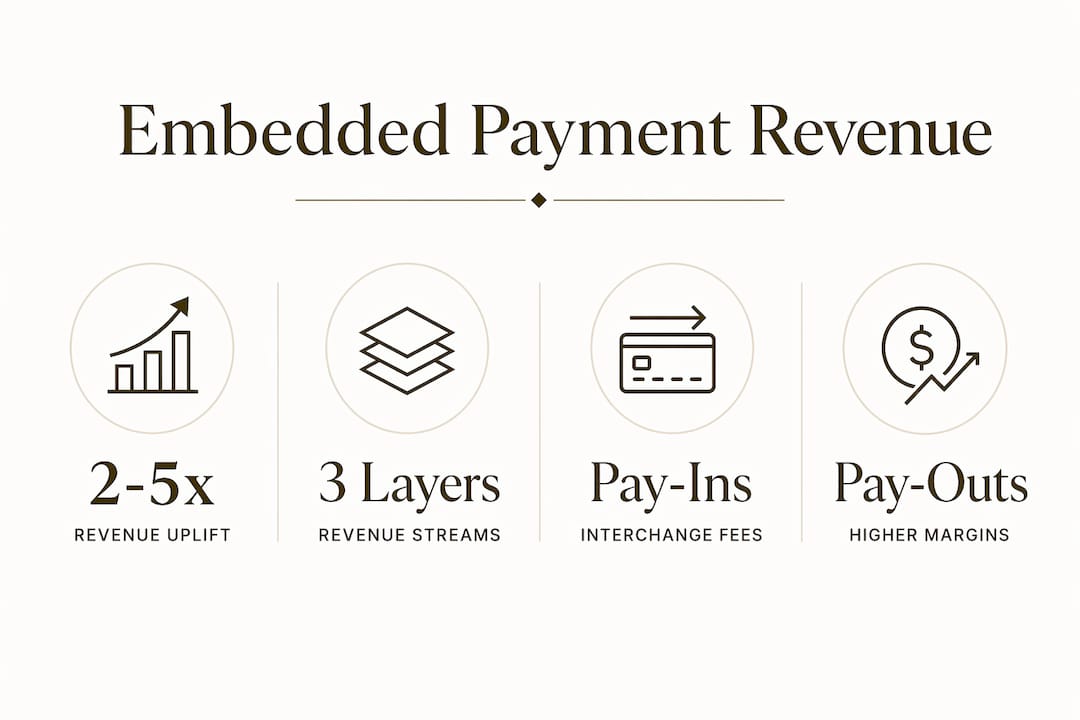
The pay-out layer is the most overlooked. Outbound payments to vendors and subcontractors generate higher-margin interchange revenue than customer pay-ins. Most SaaS platforms focus entirely on accepting customer payments and miss this entirely. A field service management platform, for example, pays dozens of subcontractors per job. Embedding that disbursement flow captures interchange on every outbound dollar.
Pro Tip: Build your revenue model around all three layers before you write a single line of integration code. Most teams design for pay-ins and discover pay-out revenue only after launch, which means months of missed margin.
What operational and user experience benefits does embedded payment processing provide?
The biggest misconception about embedded payments is that the primary benefit is a better merchant experience. The real value is platform stickiness that locks users in. Once payouts, reconciliation, and reporting live inside your product, switching to a competitor requires rebuilding an entire operational workflow.
Embedded payments deliver specific, measurable operational advantages:
- Reduced drop-off during onboarding. Keeping merchants inside your platform during payment setup eliminates the friction of external redirects. One documented case shows payment volume increased 1,000% after a platform embedded its payment flow.
- Unified workflows. Invoicing, booking, subscription billing, and payouts all run from one interface. Users do not toggle between your platform and a separate payment portal.
- Platform-controlled support. You own the merchant relationship. Refunds, disputes, and KYC exceptions are handled inside your product, not escalated to a third-party gateway’s support team.
- Higher switching costs. When reconciliation and reporting are embedded, your platform becomes operationally indispensable. Users do not leave because leaving is expensive.
- Data ownership. Every transaction generates behavioral and financial data that stays on your platform, not in a third-party system.
The retention effect compounds over time. A user who processes payroll, accepts customer payments, and runs financial reports inside your SaaS product has no practical reason to switch. That is the real importance of embedded payments: it makes your product the center of a user’s financial operations.
Pro Tip: Prioritize embedding reconciliation and reporting before you add advanced payment features. Those two functions create the stickiest workflows and the highest switching costs.
How should SaaS developers approach embedding payment processing technically?
Embedded payments and integrated payments are not the same thing. Integrated payments connect your platform to an external gateway via API. Embedded payments are fully white-labeled, branded experiences where your platform owns the merchant relationship, pricing, and data. The technical approach you choose determines how much revenue and control you actually capture.
A sound technical implementation follows this sequence:
- Select a unified API. Choose a payment infrastructure provider that covers pay-ins, pay-outs, and payment operations through a single API layer. Fragmented APIs create integration debt and reduce data visibility across transaction types.
- Embed merchant onboarding. Build KYC and KYB (Know Your Business) flows directly into your signup process. Do not redirect merchants to an external onboarding portal. Every redirect is a drop-off risk.
- Implement PCI-DSS scope management. Use tokenization and hosted payment fields to minimize your platform’s PCI-DSS scope. This reduces compliance cost and audit burden without sacrificing payment functionality.
- Build white-label UX. Every payment screen, receipt, and notification should carry your brand. Users should never see a third-party payment provider’s name during a transaction.
- Integrate payout management. Build disbursement flows for vendor payments, contractor payouts, and refunds. This is where the highest-margin interchange revenue lives, and it requires its own API endpoints and compliance checks.
- Connect reporting and reconciliation. Tie transaction data directly into your platform’s reporting layer. Real-time financial visibility is a core retention driver, not a nice-to-have feature.
KYC/AML compliance deserves specific attention. When you own the merchant relationship, you inherit responsibility for verifying merchant identity and monitoring for suspicious activity. Build these checks into onboarding, not as an afterthought after launch.
What challenges do SaaS platforms face when embedding payments?
Embedding payments increases operational complexity in ways that catch many product teams off guard. Compliance, disputes, and refund management all move inside your platform when you own the payment infrastructure. That is a significant operational shift.
The most common challenges are:
- PCI-DSS scope expansion. Owning payment data means owning compliance obligations. Tokenization and hosted fields reduce scope, but they do not eliminate it. Budget for annual PCI audits and ongoing security reviews.
- Dispute and chargeback management. You are now the first line of defense for merchant disputes. Build internal workflows for evidence collection and chargeback response before you go live.
- Tax and regulatory complexity. Embedded payments create new tax reporting obligations, particularly for platforms operating across multiple states or countries. Sales tax, 1099-K reporting, and cross-border regulations all require attention.
- Adoption risk. Merchants will not use payment features they do not trust or understand. Poor onboarding UX kills adoption regardless of how well the underlying API works.
- Overlooked pay-out revenue. Most platforms focus on pay-in volume and ignore disbursements. The pay-out functionality often generates higher-margin interchange than customer pay-ins, yet it is the last feature teams build.
The upfront integration effort is real. The long-term economics are stronger. A platform that processes $10 million in annual payment volume earns meaningfully more from that volume than it would from subscription fees alone. The key is treating embedded payments as a product capability from day one, not as a technical integration task assigned to a single engineer.
Key takeaways
SaaS platforms that embed payment processing generate 2–5x more revenue per user, retain customers longer, and build operational moats that make switching genuinely costly.
| Point | Details |
|---|---|
| Revenue multiplier | Embedding payments can increase revenue per user by 2–5x versus non-integrated models. |
| Pay-out opportunity | Outbound disbursements generate higher-margin interchange than pay-ins; build this layer early. |
| Retention driver | Embedded reconciliation and reporting make your platform operationally indispensable to users. |
| Compliance ownership | PCI-DSS, KYC/AML, and dispute management move inside your platform when you own payments. |
| White-label control | Full branding of payment flows keeps the merchant relationship and data on your platform. |
What I’ve learned about embedding payments before it’s too late
Most product teams treat embedded payments as a monetization feature they will add later, once the core product is stable. That is the wrong order. By the time a SaaS platform reaches meaningful transaction volume, the window to own that revenue has often closed. A competitor with embedded payments already built has a structural advantage that is very hard to overcome.
The pay-out layer is where I see the most consistent missed opportunity. Teams spend months building a polished pay-in experience and ship disbursements as an afterthought. The economics run in the opposite direction. Vendor payments, contractor disbursements, and marketplace payouts carry higher interchange margins than customer-facing transactions. If your platform touches any of those flows, you are leaving real money on the table every day you delay.
The other lesson is about product framing. Embedded payments transform payments from a cost center into a product capability and a data layer. The platforms that win treat payment data as a core product asset, not a byproduct of transactions. That data tells you which merchants are growing, which are at risk of churning, and where your platform creates the most value. That is a competitive advantage that has nothing to do with payment fees.
Start early. Build the pay-out layer. Treat payment data as a product. Everything else follows.
— Peter
Davincipay’s embedded payment solutions for SaaS platforms
SaaS developers and product managers building embedded payment infrastructure need a payment partner that understands compliance, high-risk verticals, and the operational demands of owning merchant relationships.

Davincipay works with ecommerce platforms, telehealth SaaS products, nutraceutical and supplement merchants, and subscription businesses that need reliable payment processing built for complex environments. The platform covers payment acceptance, fraud prevention, chargeback mitigation, and underwriting support through domestic and international acquiring relationships. If you are ready to embed payments and capture the revenue your platform is currently leaving behind, apply now and get your integration moving.
FAQ
What is embedded payment processing in SaaS?
Embedded payment processing is the integration of payment acceptance and management directly within a SaaS platform, keeping transactions on-platform rather than redirecting users to third-party portals. It gives the platform full control over the merchant relationship, pricing, and transaction data.
How much revenue can SaaS platforms gain from embedding payments?
SaaS platforms that implement embedded payments can increase revenue per user by 2–5x compared to platforms that rely on external payment providers. The gain comes from stacking pay-in fees, pay-out interchange, and payment operations revenue.
What is the difference between embedded and integrated payments?
Integrated payments connect a SaaS platform to an external gateway via API, leaving the merchant relationship with the gateway provider. Embedded payments are fully white-labeled experiences where the SaaS platform owns onboarding, pricing, and data.
What compliance obligations come with embedding payments?
Embedding payments brings PCI-DSS scope management, KYC/AML merchant verification, dispute handling, and tax reporting obligations inside the platform. Tokenization and hosted payment fields reduce PCI scope, but annual audits and ongoing security reviews remain required.
Why do SaaS platforms overlook pay-out revenue?
Most product teams focus on pay-in volume because customer-facing transactions are the most visible part of the payment flow. Pay-out disbursements to vendors and contractors generate higher-margin interchange and are frequently the last feature built, resulting in months of missed revenue.


.webp)
