.png)
Payment processors require reserves on high-risk merchant accounts to hold your funds as collateral against post-settlement liabilities. When a chargeback, refund, or fraud claim arrives after your transaction has already settled, someone has to cover it. If your account balance is empty, your acquiring bank absorbs that loss. Reserves prevent that from happening.
Three exposures drive this requirement:
- Chargebacks and disputes: Card scheme rules give cardholders up to 120 days to dispute a charge. Your acquirer remains liable throughout that window.
- Delayed fulfillment and subscriptions: Subscription billing and pre-order models create a gap between payment and delivery, extending the acquirer’s exposure well past settlement.
- Regulatory and AML risk: BSA/AML expectations and sponsor bank compliance requirements push acquirers to demand financial buffers from merchants in regulated or scrutinized verticals.
The merchant benefit is real: reserves are your own money, held temporarily, not a fee. Understand the mechanics, and you can plan around them, negotiate them, and reduce them.
Key Takeaways
Reserves are collateral held against post-settlement liabilities, and merchants who understand the mechanics, document their performance, and negotiate actively will carry lower reserve burdens over time.
| Point | Details |
|---|---|
| Reserves are collateral, not fees | Your withheld funds are released after the dispute window expires; treat them as locked working capital in your cash-flow model. |
| Rolling reserves range within a moderate percentage | Hold periods typically run 90–180 days; model monthly volume × hold % × hold days to calculate locked capital. |
| Chargeback control drives releases | A sustained ratio below 1% over 6–12 months is the primary metric underwriters use to approve reserve reductions. |
| Plan for the reserve tail | When you close or switch processors, withheld batches remain held for the full hold period, up to 180 days post-termination. |
| Davincipay offers tailored reserve terms | Davincipay matches high-risk merchants in supplements, telehealth, and subscriptions with acquiring relationships built around their actual risk profile. |
Table of Contents
- What is a merchant reserve account?
- Why processors and acquiring banks require reserves for high-risk accounts
- How reserve accounts work in practice
- Which merchants are commonly labeled “high risk”
- How reserves affect your cash flow and operations
- How to reduce your reserve requirements or accelerate releases
- Alternatives and supplements to reserve accounts
- What reserve percentages and hold durations actually look like
- A payment specialist’s perspective on reserves
- Davincipay supports high-risk merchants through the reserve process
- Sources
What is a merchant reserve account?
A merchant reserve account is a portion of your settlement funds held by your acquiring bank as collateral, not a processing fee. The funds remain yours. They are released according to a schedule tied to the expiration of dispute windows. According to Chargebacks911, reserves are a standard risk-management tool acquirers use to protect against chargebacks, refunds, and other unforeseen liabilities, and they are most common for merchants with elevated chargeback risk or unstable processing histories.
Three structures exist, and each creates a different cash-flow profile:
- Rolling reserve: A fixed percentage of each settlement batch is withheld and released after a hold period, typically 90–180 days. Example: 10% of every deposit held for 90 days, then released in staggered batches.
- Upfront (minimum) reserve: A lump sum is collected at onboarding or built up quickly from early settlements until a target balance is reached. Example: $15,000 held before full processing begins.
- Capped reserve: Similar to a rolling reserve, but withholding stops once the held balance reaches a defined ceiling. Example: 10% withheld until the reserve balance hits $25,000, then no further withholding.
The difference between a 10% rolling reserve held 90 days and a $15,000 upfront lump sum is not just structural. For a merchant processing $100,000 per month, the rolling reserve locks roughly $10,000 in perpetuity during normal operations, while the upfront reserve hits cash hard at launch but stabilizes quickly. Modeling both before signing a merchant agreement is worth the effort.
Why processors and acquiring banks require reserves for high-risk accounts
Acquirers settle funds to merchants before disputes are resolved. That timing gap is the core problem. If a chargeback arrives after settlement and your account has no funds, your acquiring bank pays the cardholder directly. Reserves close that gap.
The five exposures that drive reserve requirements:
- Chargeback liability: Visa and Mastercard dispute windows extend up to 120 days post-transaction. A merchant processing $200,000 per month with a 2% chargeback rate generates $4,000 in potential liability per month, every month, with a rolling tail.
- Post-sale refunds for subscriptions and delayed fulfillment: Subscription merchants bill before delivering ongoing value. Pre-order merchants collect payment months before shipping. Both models leave the acquirer exposed to refund claims long after settlement.
- Fraud losses: Card-not-present transactions carry higher fraud rates than in-person payments. When fraud-related chargebacks spike, the acquirer’s exposure spikes with them.
- Merchant insolvency: If your business closes, your acquirer still faces incoming disputes on transactions you processed. Without a reserve, there are no funds to draw from.
- Regulatory and AML exposure: Verafin’s guidance on high-risk customer management emphasizes that institutions must apply enhanced due diligence and ongoing monitoring to high-risk accounts. Sponsor banks that fail to do so face regulatory penalties, which they pass back to acquirers as compliance pressure.
A realistic scenario: a supplement merchant processing $150,000 per month experiences a chargeback spike to 3% after a product complaint goes viral. That generates $4,500 in chargebacks in a single month. If the merchant’s account holds only $2,000 in unsettled funds, the acquirer covers the $2,500 shortfall. A 10% rolling reserve held 90 days would have maintained roughly $45,000 in available collateral, more than enough to absorb that spike.
How reserve accounts work in practice
The mechanics vary by reserve type, but the logic is consistent: withhold a portion of settlement, hold it through the dispute window, then release it.
Rolling reserve mechanics: Your processor withholds a set percentage from each daily or weekly settlement batch. Those withheld amounts are held for a defined period (commonly 90–180 days per The Payments Edge) and then released in the same sequence they were withheld. The reserve balance stays relatively stable once the initial hold period passes.
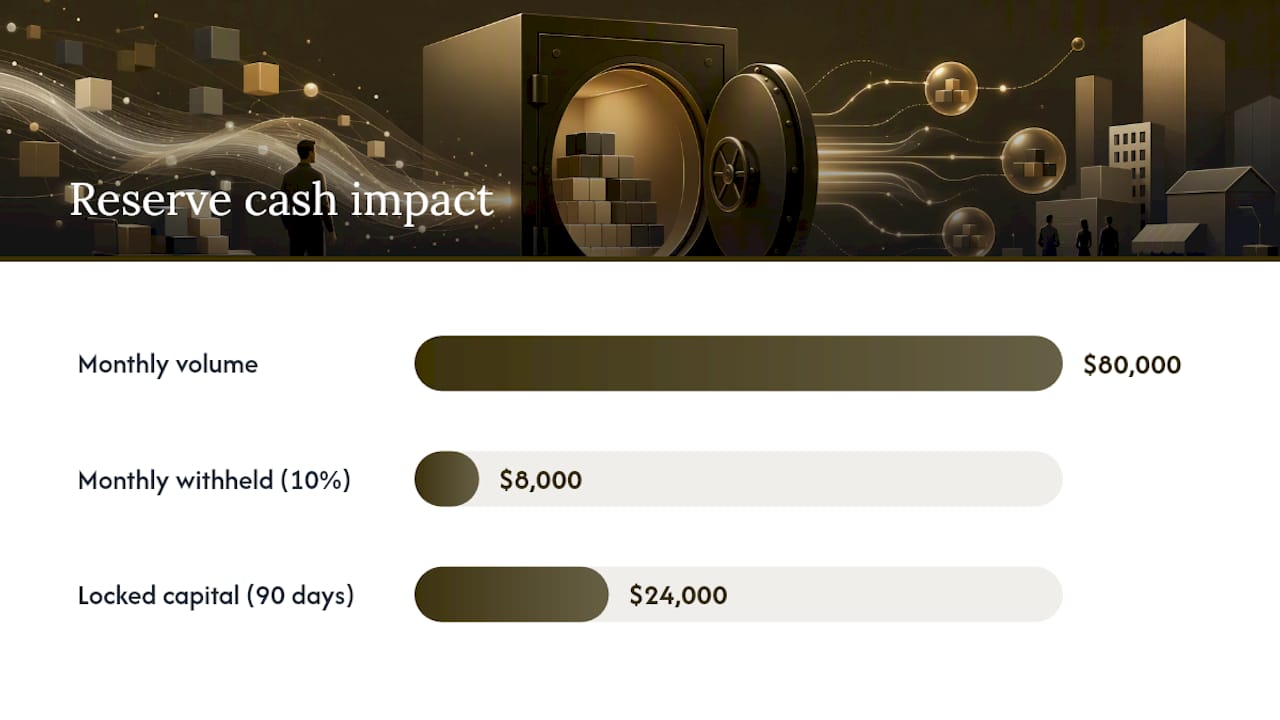
Calculation example: Monthly volume of $80,000 × 10% hold rate = $8,000 withheld per month. Over a 90-day hold, you carry roughly $24,000 in locked capital at any given time. That is working capital you cannot deploy.
Upfront reserve: Your processor collects a fixed dollar amount before or shortly after activation. Once that balance is funded, normal settlement resumes with no ongoing withholding.
Capped reserve: Withholding continues until the held balance reaches a ceiling, then stops. Releases begin after the hold period on the earliest-withheld batches expires.
| Event | Timing | Cash impact |
|---|---|---|
| Transaction processed | Day 1 | Full sale amount captured |
| Settlement to merchant | Day 2–3 | 90% deposited; 10% withheld |
| Reserve hold period | Days 3–90 | Withheld funds unavailable |
| First rolling release | Day 91–180 | Earliest withheld batch released |
| Account termination | Day of closure | Reserve tail held 90–180 days post-close |
Reconciliation matters here. Your processor should provide a reserve ledger showing withheld amounts, hold dates, and scheduled release dates. If you switch processors or close your account, plan for the reserve tail: your funds remain held for the full hold period on every batch already withheld, which can mean 90–180 days of locked capital after you stop processing.
Which merchants are commonly labeled “high risk”
High-risk classification is not a single-factor decision. Underwriters weigh a combination of signals, and no one trigger automatically forces a reserve. That said, certain verticals and account characteristics consistently raise flags.
Commonly flagged verticals:
- Nutraceuticals, supplements, and weight-loss products
- Telehealth and online pharmacy
- CBD and hemp products
- Subscription and continuity billing
- Online gaming and gambling
- Adult content and dating
- Travel and ticket resellers
- Financial services and lending
- Online tobacco and vaping
These verticals share common traits: higher-than-average chargeback rates, regulatory scrutiny, card-not-present transaction models, and in some cases, delivery timelines that extend the dispute window.
Underwriting risk factors processors evaluate:
- Chargeback ratio above 1% (Visa’s threshold for monitoring programs)
- High card-not-present (CNP) volume
- High average order value (AOV), which amplifies per-dispute dollar exposure
- Subscription or trial-to-paid billing models
- Long delivery or fulfillment windows
- New business with no processing history
- Owner’s personal credit history
- Significant international sales volume
- Prior terminated merchant accounts
NACM’s guidance on managing high-risk accounts confirms that standard financial statements are often absent or inconclusive for these merchants, which is why underwriters rely on alternative documentation and tailored credit arrangements.
Pro Tip: Before your underwriting review, pull your own chargeback ratio from your current processor. If it is above 0.9%, address it before applying. A ratio trending downward over three months is more persuasive than a single clean month.
How reserves affect your cash flow and operations
Reserves reduce your available working capital immediately and persistently. For small and mid-size merchants, that compression can be severe. JPMorgan Chase Institute research on small-business cash flows shows that unexpected holds on receipts can remove operating liquidity for months and increase reliance on outside financing.
Immediate cash-flow impacts:
- Reduced funds available for payroll, especially for businesses with bi-weekly cycles
- Constrained inventory purchasing during growth periods
- Compressed advertising budgets when scaling paid acquisition
- Slower vendor payment cycles, which can damage supplier relationships
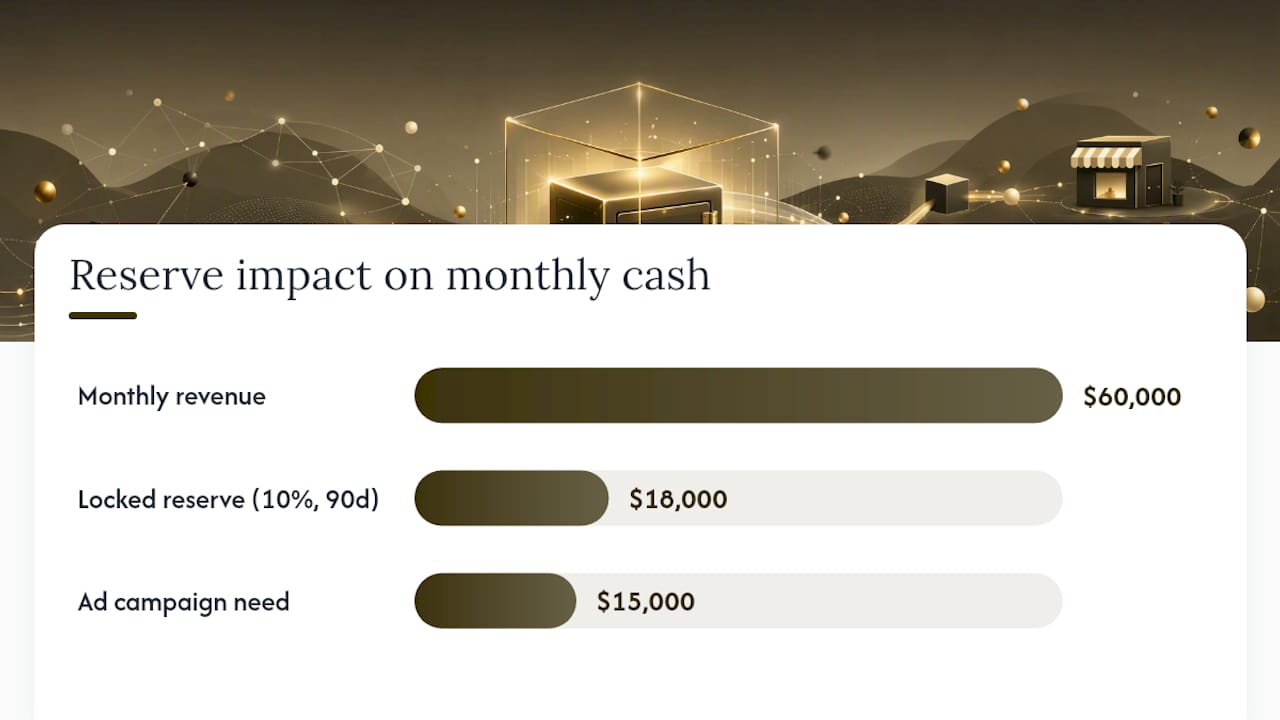
A concrete example: a subscription supplement brand processing $60,000 per month under a 10% rolling reserve with a 90-day hold carries $18,000 in locked capital at steady state. If that brand wants to run a $15,000 ad campaign, it must fund that spend from the remaining 90% of settlements, not from the full revenue figure. Growth compounds the problem: a 20% month-over-month volume increase raises the locked amount proportionally.
Operational knock-on effects:
- Longer vendor payment cycles as cash timing tightens
- Increased reliance on business credit lines or working-capital loans to bridge gaps
- Runway compression for early-stage merchants who modeled cash flow without accounting for reserves
- Difficulty funding seasonal inventory builds when reserve balances are at their highest
Treat the reserve balance as a line item in your cash-flow model, not an afterthought. It behaves like a mandatory, interest-free loan you make to your acquirer every month.
How to reduce your reserve requirements or accelerate releases
Reserve reduction is performance-driven. Acquirers do not lower reserves as a favor. They lower them because documented evidence shows the risk has decreased. Here is how to build that case.
Step-by-step documentation pack for underwriters:
- Chargeback mitigation log: Month-by-month chargeback ratio for the past 6–12 months, with notes on root causes and corrective actions taken.
- Fulfillment and shipping proof: Carrier tracking data, delivery confirmation rates, and average fulfillment timelines.
- Refund policy documentation: Clear, customer-facing refund terms and evidence they are honored promptly.
- Financial statements: Bank statements, P&L, and balance sheet showing stable or growing revenue.
- Fraud tool evidence: Documentation of fraud screening tools in use (e.g., 3D Secure, velocity checks, address verification).
Operational changes that reduce perceived risk:
- Shorten delivery windows and communicate them clearly at checkout
- Require additional verification on orders above a defined AOV threshold
- Tighten subscription cancellation flows to reduce “I forgot I was subscribed” chargebacks
- Implement clear billing descriptors so customers recognize your charge on their statement
- Use bank account verification practices to reduce ACH return rates and settlement disputes
Negotiation timing and metrics:
According to The Payments Edge, a sustained chargeback ratio well below 1% over 6–12 months is the primary lever underwriters use to justify a reserve review. Request a formal review at the 6-month mark if your ratio has been clean. Bring the documentation pack above. Ask specifically for a reduction in hold percentage or a transition from a rolling reserve to a capped reserve structure.
Pro Tip: Model your reserve as a cost of capital. If your rolling reserve locks $20,000 at a 10% annual opportunity cost, that is $2,000 per year in implicit cost. Negotiating down to a capped reserve at the same percentage eliminates the perpetual lock once the ceiling is reached, which is often worth more than a rate reduction.
Alternatives and supplements to reserve accounts
Reserves are not your only option for managing acquirer risk. Several instruments can reduce or replace reserve requirements, depending on your vertical and margins.
- Chargeback insurance: Third-party policies that reimburse chargeback losses above a defined threshold. Useful for merchants with predictable dispute patterns but can carry exclusions for fraud-related chargebacks.
- Surety bonds: A bond issued by a licensed surety company guarantees payment to your acquirer up to the bond amount. Some acquirers accept surety bonds in lieu of cash reserves, which preserves your liquidity.
- Working-capital loans: If a reserve is compressing your operating cash, a high-risk business loan can bridge the gap. The cost of borrowing must be weighed against the implicit cost of locked reserve funds.
- Third-party escrow for pre-orders: Placing pre-order funds in escrow with a neutral third party satisfies acquirer concerns about delayed-fulfillment risk without requiring a processor-held reserve.
- Dispute management services: Platforms that automate representment and pre-dispute resolution reduce chargeback ratios, which directly lowers the risk profile that drives reserve requirements in the first place.
The rule of thumb: if your chargeback ratio is above 1.5%, prioritize dispute reduction before pursuing alternatives. No insurance product or bond will substitute for a clean processing history when it comes to long-term reserve negotiation. If your ratio is already below 1% and the reserve is purely a liquidity constraint, surety bonds or working-capital financing are worth evaluating.
What reserve percentages and hold durations actually look like
CWA Merchant Services reports that rolling reserves commonly range from 5% to 15% of sales, with hold periods typically between 90 and 180 days. These ranges reflect the U.S. acquiring market broadly, but your actual terms will depend on your specific vertical, chargeback trend, AOV, and the sponsor bank behind your acquirer.
| Reserve type | Typical hold % | Hold duration | Release pattern |
|---|---|---|---|
| Rolling reserve | 5%–15% | 90–180 days | Staggered, batch-by-batch |
| Upfront/minimum reserve | Fixed dollar amount | Until account closes or terms change | Lump sum at release |
| Capped reserve | 5%–15% until ceiling | 90–180 days on each batch | Stops withholding at cap; releases continue |
A few caveats worth noting. Merchants in adult content, online gaming, or financial lending often see reserve percentages at the higher end of that range. New merchants with no processing history frequently face upfront reserves rather than rolling ones because there is no performance data to anchor the risk assessment. Merchants who have experienced a prior account termination may face reserve terms outside these ranges entirely.
When you receive a merchant agreement, calculate the steady-state locked capital using the formula from the mechanics section above: monthly volume × hold percentage × (hold days ÷ 30). That figure is what you are committing to before you sign.
A payment specialist’s perspective on reserves
Reserves get a bad reputation because merchants encounter them at the worst possible moment: during onboarding, when cash is already tight. But from an underwriter’s perspective, a reserve is often the reason a deal gets approved at all. Without it, the risk calculus for a new supplement merchant or a subscription telehealth platform simply does not work for the acquiring bank. The reserve is what makes the relationship possible.
What actually moves the needle in reserve reviews is not volume or revenue growth. It is documented, consistent dispute mitigation. Underwriters respond to a chargeback log that shows a ratio trending from 1.8% down to 0.6% over eight months, with notes explaining what changed. That kind of evidence signals operational maturity, and operational maturity is what acquirers price into reserve terms.
The merchants who struggle most are the ones who treat reserves as a fixed cost and never revisit them. A 10% rolling reserve negotiated at onboarding can often be reduced to 5% or converted to a capped structure after 12 months of clean performance. That conversation is worth having, and it starts with the documentation.
Davincipay supports high-risk merchants through the reserve process
High-risk merchants deserve a processor that understands their business before the underwriting conversation starts. Davincipay specializes in payment processing for high-risk businesses, including supplement brands, telehealth providers, subscription merchants, and nutraceutical companies. We bring domestic and international acquiring relationships, built-in chargeback mitigation tools, fraud prevention infrastructure, and underwriting support that is tailored to your vertical, not generic.

When you apply through Davincipay, your underwriting review accounts for your specific risk profile. We work to match you with acquiring relationships that offer reserve terms you can model and manage, not terms that blindside your cash flow. If you are ready to get approved with terms that fit your business, apply now and our team will walk you through the process.
Sources
- Managing High Risk Accounts — NACM
- Merchant Account Reserves: What You Need to Know in 2026 — Chargebacks911
- High-Risk Merchant Account Reserve Explained: Rolling, Upfront, Capped — The Payments Edge
- How to effectively manage high-risk customers — Verafin (ebook)
- Understanding Rolling Reserves: Why They Matter for High-Risk Merchants — CWA Merchant Services
This article is general information, not a substitute for advice from a qualified financial advisor. Consult a qualified financial professional about your own circumstances before acting on anything here.


.webp)
