.png)
Embedded payments are payment processing functions built directly into ecommerce platforms, letting customers complete purchases without leaving the platform’s interface. This architecture is why ecommerce platforms offer embedded payments as a core feature rather than an afterthought. Platforms that keep buyers inside their checkout flow see measurably better conversion, stronger customer retention, and new revenue streams that standalone payment connectors cannot produce. For ecommerce entrepreneurs, understanding how embedded payment systems work is the difference between a checkout that converts and one that leaks revenue at every step.
Why ecommerce platforms offer embedded payments: the conversion case
Embedded payments improve conversion rates by eliminating the single biggest cause of cart abandonment: redirecting customers away from the site to complete a purchase. When a buyer leaves your platform to pay, you lose control of the experience. Any friction at that moment, whether a slow redirect, an unfamiliar interface, or a security warning, gives the buyer a reason to quit.
The numbers behind this are concrete. A Shopify case study shows that embedded payment solutions produced a 20% reduction in software costs and 30 basis points of margin efficiency improvement. Those gains come directly from keeping the transaction inside the platform’s ecosystem.

Customer retention follows the same logic. When a platform holds a buyer’s payment credentials, transaction history, and preferences in one place, repeat purchases require less effort. That unified experience builds habit. Habit reduces churn.
Key conversion and retention benefits include:
- Fewer abandoned carts. Buyers who stay on-site are far less likely to drop off before completing a purchase.
- One-click repeat purchases. Stored credentials make returning customers faster to convert than new ones.
- Unified transaction history. Buyers can review past orders and payment records without switching apps or logging into a third-party portal.
- Faster onboarding. 70% of financial firms lost customers due to inefficient onboarding. Embedded payments enable one-click onboarding inside the platform flow, cutting that loss significantly.
That last point matters beyond fintech. Any ecommerce platform that forces buyers through a multi-step external payment setup loses a measurable share of them before the first transaction completes.
What does embedded payment integration actually require?
Embedded payment integration is a technical process that connects a payment provider’s infrastructure to your platform through APIs or SDKs. The scope of that work depends on your platform’s architecture and the provider you choose.
Integration timelines typically run 1–7 days when using established SDKs rather than building custom API connections from scratch. That range reflects real differences in platform complexity. A simple storefront with a single checkout flow integrates faster than a marketplace managing multi-party payouts.
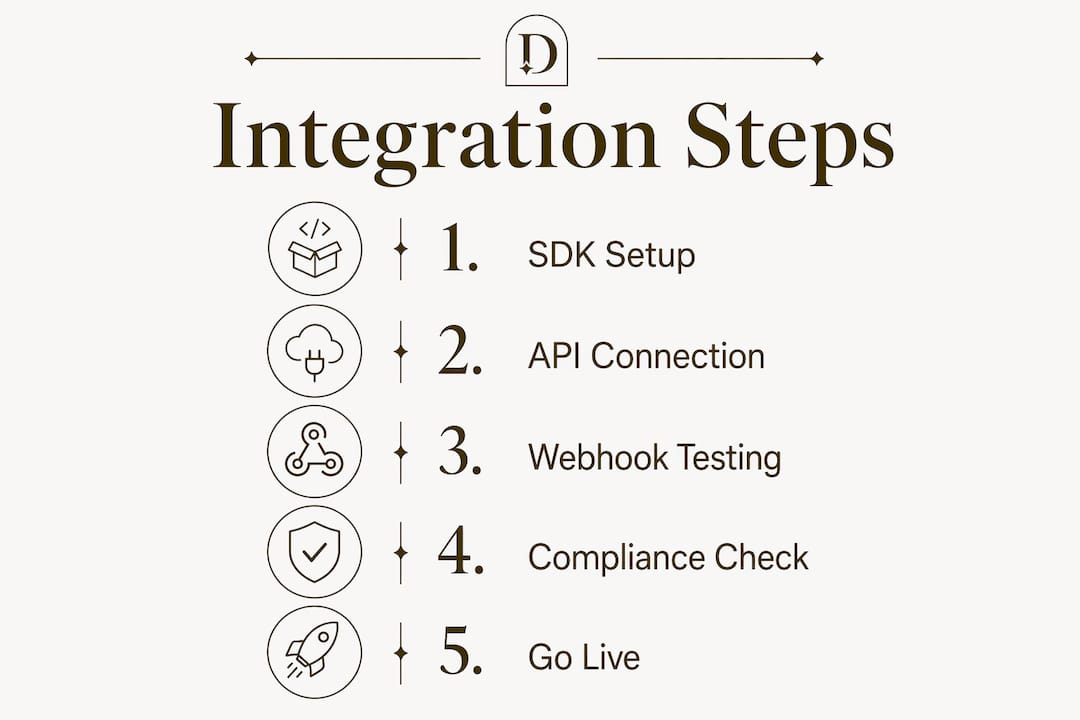
Security is non-negotiable at every stage. Tokenization keeps raw card data off your platform’s servers entirely. The payment provider’s SDK replaces sensitive card numbers with unique tokens, so your system never stores data that could expose you to a PCI DSS breach. This is not optional. It is the baseline for any compliant embedded payment setup.
Compliance responsibilities extend beyond PCI. Platforms that adopt embedded payments inherit obligations that include:
- KYC verification. You must verify the identity of sub-merchants or sellers operating through your platform.
- Transaction monitoring. Ongoing surveillance for fraud patterns and suspicious activity is your responsibility, not just the payment provider’s.
- Dispute management. Chargebacks and payment disputes require a defined internal process, not just a forwarded email to your processor.
- Webhook configuration. Incorrect webhook setup causes phantom orders and breaks payment status sync between your processor and order management system. Handling webhooks correctly is one of the most common technical failure points in embedded payment implementations.
Pro Tip: Test your webhook endpoints in a staging environment before going live. A missed webhook event can create an order that shows as paid in your processor but unpaid in your OMS, and reconciling that manually is expensive.
The compliance model you choose also shapes your risk profile. Registering directly as a payment facilitator gives you maximum control but full compliance ownership. A payfac-as-a-service (PFaaS) model shares that burden with your provider. Choosing between direct registration and PFaaS is one of the most consequential decisions in your embedded payment architecture.
How do embedded payments create new revenue streams?
Embedded payments shift your platform from a payment connector to a payment participant. That distinction is worth understanding clearly. A connector routes transactions to a third party and earns nothing. A participant captures a margin on every transaction that flows through its system.
Platforms that become payment participants earn transaction revenue, reduce churn by tightening the link between financial data and product usage, and gain access to proprietary data that external institutions cannot replicate.
That data advantage is where the real long-term value sits. Platforms with 12–18 months of transaction data can underwrite loans and early payout products that no external bank can match, because no external bank has the same granular view of a merchant’s daily revenue patterns. This is the foundation of embedded lending, one of the fastest-growing segments in AI payment trends for 2025 and beyond.
Revenue streams available through embedded payment models include:
- Transaction margin. Earn a basis-point spread on every payment processed through your platform.
- Subscription billing fees. Charge merchants or sellers for access to your payment infrastructure as a platform feature.
- Embedded lending. Use proprietary transaction data to offer cash advances or revenue-based loans to your merchants.
- Early payout products. Let sellers access funds before the standard settlement window, for a fee.
- Marketplace fee automation. Automatically deduct platform commissions before disbursing seller payouts, eliminating manual reconciliation.
Marketplaces benefit from this last point in particular. Embedded payments automate complex flows like fee deduction and multi-party payouts, which increases transaction volume without adding operational headcount.
Deep transaction data also enables platforms to build proprietary credit scoring models. That capability is a structural competitive advantage. Merchants who rely on your platform for financing are far less likely to migrate to a competitor.
What are the best practices for adopting embedded payments?
Successful embedded payment adoption starts with one principle: the checkout experience must feel like part of your product, not a third-party insert. Brand-consistent checkout design, matching fonts, colors, and error messaging, signals to buyers that they never left your platform. That perception directly supports conversion.
Pro Tip: Use your payment provider’s white-label UI components rather than building a custom checkout from scratch. White-label components are pre-certified for PCI compliance, which cuts your certification timeline significantly.
Unified settlement is the operational backbone of a well-run embedded payment setup. Fragmented payment setups create manual reconciliation and higher error rates. A single settlement engine that consolidates all payment flows into one report reduces accounting errors and gives you a clean audit trail.
Selecting the right payment partner matters as much as the technical implementation. Evaluate partners on three criteria: their compliance support model, their dispute management tools, and their data portability. A partner who locks your transaction data inside a proprietary system limits your ability to build the financing products described above.
Platforms also need to plan for scale from day one. The compliance and operational demands of processing $10,000 per month are manageable. The demands of processing $10 million per month require dedicated resources, automated monitoring, and a clear escalation path for disputes. Build that infrastructure before you need it, not after a compliance incident forces your hand.
Platforms that control their payment infrastructure also control support quality, uptime reliability, and pricing. That control reduces dependence on third parties and protects your margins as you scale.
Key Takeaways
Embedded payments are the most direct path from checkout friction to conversion growth, and the platforms that adopt them earliest gain compounding advantages in data, revenue, and merchant loyalty.
| Point | Details |
|---|---|
| Conversion improvement | Keeping buyers on-site during checkout directly reduces cart abandonment and increases completed purchases. |
| Integration speed | Embedded payment SDKs typically integrate within 1–7 days, making adoption faster than most merchants expect. |
| Compliance ownership | Platforms inherit KYC, transaction monitoring, and dispute management responsibilities when they embed payments. |
| Revenue diversification | Transaction margins, embedded lending, and early payout products create income streams beyond core product sales. |
| Data advantage | Twelve to eighteen months of transaction data enables proprietary credit scoring that external lenders cannot replicate. |
The part most ecommerce operators miss
Peter here. After working with ecommerce merchants across high-risk and high-growth categories, the pattern I see most often is this: operators adopt embedded payments for the conversion benefit, then are surprised by the compliance weight that comes with it.
The conversion case is real. Keeping buyers on-site works. But the merchants who get the most out of embedded payment systems are the ones who treat compliance as infrastructure, not overhead. They build KYC workflows, dispute processes, and transaction monitoring into their operations from the start. The ones who don’t spend enormous time and money fixing problems that were entirely predictable.
The data advantage is also underused. Most platforms collect transaction data and do nothing with it beyond reconciliation. The merchants who build financing products on top of that data, even simple cash advance programs, create a retention mechanism that no loyalty program can match. A merchant who relies on your platform for working capital does not leave.
My honest take: embedded payments are not just a checkout feature. They are the foundation of a financial relationship with your merchants and buyers. Treat them that way from day one, and the compounding returns are significant. Treat them as a technical checkbox, and you will spend years catching up on compliance and missed revenue.
— Peter
Davincipay’s approach to embedded payment processing
Ecommerce merchants in high-risk and complex categories face a specific problem: most payment providers are not built for their needs. Davincipay specializes in exactly this space, supporting ecommerce brands, subscription merchants, nutraceutical businesses, and other regulated operators with payment infrastructure that is built for their risk profile.

Davincipay provides domestic and international acquiring relationships, fraud prevention tools, chargeback mitigation, and underwriting support, all designed to support merchants who need more than a standard payment gateway. If you are ready to build a payment setup that fits your business, apply for an account and get a fast approval decision from a team that understands your industry. You can also review how it works to understand the onboarding process before you start.
FAQ
What are embedded payments in ecommerce?
Embedded payments are payment processing functions built directly into an ecommerce platform, allowing customers to complete purchases without being redirected to an external payment page. The transaction happens inside the platform’s own interface.
How long does embedded payment integration take?
Integration typically takes 1–7 days when using an established payment provider’s SDK. Custom API builds take longer depending on platform architecture complexity.
Do embedded payments improve conversion rates?
Yes. Embedded payments reduce checkout friction by keeping buyers on-site, which directly lowers cart abandonment. A Shopify case study documented 30 basis points of margin efficiency improvement from embedded payment adoption.
What compliance responsibilities come with embedded payments?
Platforms that embed payments take on KYC verification, transaction monitoring, dispute management, and PCI compliance obligations. The specific scope depends on whether you register as a payment facilitator directly or use a payfac-as-a-service model.
Can embedded payments generate revenue beyond transaction processing?
Yes. Platforms earn transaction margin on every payment processed and can use accumulated transaction data to offer embedded lending, early payout products, and revenue-based financing to their merchants.


.webp)
