.png)
Subscription billing is defined as a system that automatically charges customers at regular intervals while managing the full financial lifecycle of each subscriber, including plan changes, invoicing, proration, dunning, and revenue recognition. The industry term for this discipline is “recurring revenue management,” and it goes far beyond simply running a credit card on a schedule. The subscription billing management market is valued between $8 billion and $10 billion as of mid-2026. That figure reflects how much operational complexity sits underneath a model that looks simple from the outside. If you run a SaaS company, a supplement brand, or a telehealth service, understanding this infrastructure is not optional. It is the financial backbone of your business.
What is subscription billing and how does it work?
Subscription billing is a state machine, not a payment button. A subscription manages over eight distinct states including active, trialing, past due, paused, and canceled, and the system must handle every transition between them correctly. Getting a state wrong means charging a canceled customer, missing revenue from an upgrade, or failing to pause a subscriber who requested a hold. Each of those errors costs money and trust.

The core components of a billing engine
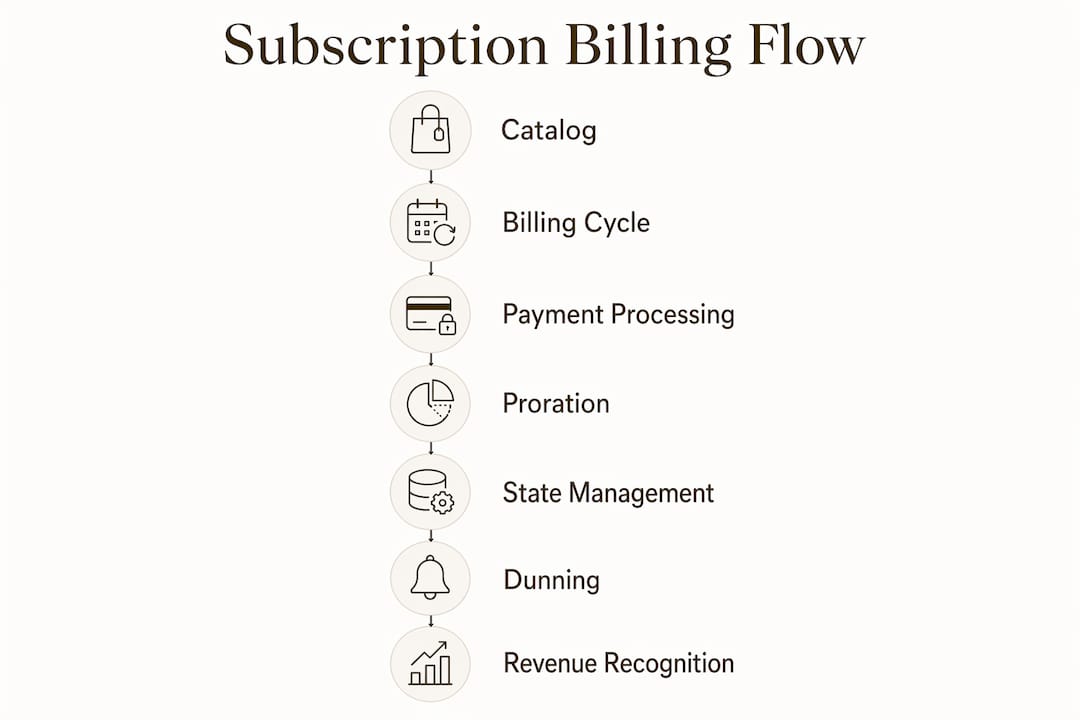
A production-grade billing engine handles several distinct functions simultaneously:
- Plan and pricing management: Stores every pricing tier, trial period, and discount rule in a product catalog.
- Proration: Calculates partial charges when a customer upgrades or downgrades mid-cycle.
- Invoicing: Generates itemized invoices automatically on each billing date.
- Usage metering: Ingests raw consumption data and applies the correct pricing tier. Modern systems handle usage ingestion above 10,000 events per second to support high-volume SaaS products.
- Dunning: Retries failed payments on a defined schedule and sends automated customer communications.
- Revenue recognition: Splits collected cash into earned revenue by period, following ASC 606 accounting standards.
How a single transaction flows
When a billing cycle triggers, the engine retrieves the customer’s stored payment token from a PCI DSS-compliant vault. It calculates the amount owed, applies any credits or prorations, generates an invoice, and submits an authorization request to the payment gateway. The gateway contacts the card network, which contacts the issuing bank. A full round trip completes in under 2 seconds. That speed matters because a billing run for 50,000 subscribers cannot stall for minutes at a time.
Pro Tip: Set up a separate test environment that mirrors your production billing states. Running upgrade and cancellation scenarios in staging catches proration bugs before they hit real customers.
| Function | What it does |
|---|---|
| Catalog management | Stores plans, pricing, and trial rules |
| Proration engine | Adjusts charges for mid-cycle changes |
| Dunning workflow | Retries failed payments automatically |
| Revenue recognition | Allocates cash to the correct accounting period |
| Usage metering | Converts consumption data into billable amounts |
Subscription billing vs. recurring billing: what is the real difference?
Recurring billing is the automated mechanism that charges a fixed amount on a fixed schedule. Subscription billing is the entire system that surrounds that charge. The distinction matters because most payment gateways handle recurring billing natively. They do not handle the rest.
Subscription billing software acts as a revenue subledger sitting between your CRM and your ERP. When a customer upgrades from a $49 plan to a $99 plan on day 15 of a 30-day cycle, the billing system calculates the prorated credit, issues a revised invoice, updates the revenue schedule, and pushes the correct journal entries to your accounting system. A payment gateway records a charge. It does not do any of that.
Why using a payment gateway as your billing system falls short
Treating a payment gateway as a billing system is one of the most common mistakes subscription businesses make. A gateway processes transactions. A billing system manages the subscriber relationship across its entire lifecycle. The modules a real billing system requires include catalog management, subscription state tracking, invoicing, proration, dunning, and ASC 606 revenue recognition. A gateway provides none of those natively.
Pro Tip: Before you build anything custom, map every billing event your business will need in year two: upgrades, downgrades, pauses, annual-to-monthly switches, refunds, and free trials. That list will tell you whether a managed platform or a custom build is the right call.
Consider a nutraceutical brand selling a monthly supplement subscription. A customer wants to pause for one month, then resume. A gateway stores a token and charges it. A billing system tracks the pause state, suppresses the charge, resumes the subscription on the correct date, and keeps the revenue schedule accurate. Those are fundamentally different capabilities.
What are the benefits of subscription billing for business growth?
The core benefit of a subscription billing model is predictable, automated revenue. But the operational advantages run deeper than that.
- Reduced manual errors: Automated lifecycle management removes human intervention from routine billing events. Upgrades, renewals, and cancellations process without a staff member touching them.
- Revenue compliance: ASC 606 requires recognizing revenue as service is delivered, not when cash is received. A $12,000 annual contract becomes $1,000 of recognized revenue each month. A proper billing system handles this automatically. Manual spreadsheets do not.
- Churn reduction through dunning: Automated retry logic and customer communications recover a meaningful share of failed payments that would otherwise result in involuntary churn. Email sequences, SMS alerts, and in-app notifications all trigger without manual oversight.
- Pricing flexibility: Usage-based, tiered, flat-rate, and hybrid pricing models all run on the same infrastructure. You can test a new pricing tier without rebuilding your payment stack.
- Cost efficiency: Managed billing platforms typically charge around 2.9% plus $0.30 per transaction. That fee structure is often more cost-effective than building and maintaining custom dunning, proration, and revenue recognition logic in-house.
The financial visibility benefit deserves special attention. When your billing system feeds accurate, period-correct revenue data into your accounting system, your P&L reflects reality. Investors, auditors, and your own finance team can trust the numbers. That trust has real value when you are raising capital or preparing for an acquisition.
How to implement subscription billing successfully
A successful implementation starts with identifying the modules your business actually needs before selecting a platform or writing a line of code.
- Define your product catalog. List every plan, price point, trial period, and discount rule. This catalog is the foundation every other module depends on.
- Map your subscription states. Document every state a subscription can enter and every event that triggers a transition. Active, trialing, past due, paused, and canceled are the minimum set.
- Configure proration rules. Decide how you handle mid-cycle upgrades and downgrades. Credit the unused portion, charge the difference immediately, or defer to the next cycle. Pick one rule and apply it consistently.
- Build or configure dunning workflows. Set retry intervals, define the maximum number of attempts, and write the customer communication sequence for each failure scenario.
- Connect your CRM and ERP. Subscription billing software must sync contract data from your CRM and push revenue journal entries to your ERP. Without those integrations, you will reconcile manually every month.
- Validate revenue recognition. Test that your system recognizes revenue by period, not by payment date. Run a scenario with an annual prepayment and confirm the monthly revenue schedule is correct.
- Monitor health metrics. Track monthly recurring revenue, churn rate, payment recovery rate, and average revenue per user on a weekly basis. These metrics tell you whether your billing infrastructure is performing.
For early-stage SaaS businesses under $10 million ARR, a managed billing platform handles the core functions without requiring a dedicated engineering team. Custom builds make sense when your pricing model is genuinely unusual or when you have outgrown the limits of available platforms.
Pro Tip: Audit your dunning sequence every quarter. The email subject lines, retry timing, and fallback payment methods that worked at launch may underperform as your subscriber base grows and diversifies.
Key takeaways
Subscription billing is a full revenue management system, not a payment feature, and businesses that treat it as one will face compounding errors in revenue, compliance, and customer retention.
| Point | Details |
|---|---|
| Subscription billing is a state machine | Systems must track and manage over eight subscriber states to prevent billing errors. |
| Revenue recognition requires ASC 606 compliance | Recognize a $12,000 annual payment as $1,000 per month, not as a lump sum. |
| Dunning automation reduces involuntary churn | Automated retries and communications recover failed payments without manual effort. |
| Managed platforms suit most early-stage businesses | SaaS companies under $10 million ARR gain more from managed platforms than custom builds. |
| Gateway tools do not replace billing systems | Payment gateways process charges; billing systems manage the full subscriber lifecycle. |
Why most businesses get subscription billing wrong from day one
I have worked with dozens of subscription merchants, and the pattern is almost always the same. A founder sets up a payment gateway, enables recurring charges, and calls it a billing system. It works fine for the first 200 customers. Then a customer upgrades mid-cycle, another pauses, a third disputes a charge, and the whole thing starts leaking revenue in ways that are genuinely hard to trace.
The uncomfortable truth is that subscription billing is an accounting problem as much as it is a payments problem. ASC 606 compliance, proration accuracy, and dunning logic are finance functions. They require the same rigor you would apply to your general ledger. Treating them as an afterthought creates technical debt that compounds every month.
My recommendation is to design your billing infrastructure as a revenue layer from the start, not as a feature you bolt on later. That means choosing a platform that handles proration, dunning, and revenue recognition natively, even if you do not need all of those features on day one. The cost of switching billing systems mid-growth is far higher than the cost of starting with the right foundation.
For businesses in regulated verticals like telehealth or nutraceuticals, the stakes are even higher. Payment processors in those industries apply additional scrutiny to subscription merchants. Your billing infrastructure needs to support clean transaction records, clear cancellation flows, and accurate refund handling. Those are not just good practices. They are requirements for maintaining your merchant account.
— Peter
Subscription payment processing built for complex billing needs
Running a subscription business in a high-risk vertical requires more than a standard payment gateway. You need a processor that understands recurring billing patterns, chargeback exposure, and the compliance requirements of your specific industry.

Davincipay works with subscription merchants in nutraceuticals, supplements, telehealth, and other regulated ecommerce verticals. We provide domestic and international acquiring relationships, fraud prevention tools, and chargeback mitigation support designed for businesses that bill on a recurring basis. Our underwriting team understands the transaction patterns of subscription models and works to keep your processing stable as you grow. If you are ready to secure reliable payment processing for your subscription business, apply with Davincipay today.
FAQ
What is subscription billing in simple terms?
Subscription billing is a system that automatically charges customers on a recurring schedule while managing plan changes, invoicing, and payment failures. It handles the full financial lifecycle of each subscriber, not just the payment itself.
How does subscription billing differ from recurring billing?
Recurring billing automates a fixed charge on a fixed schedule. Subscription billing includes that function plus proration, dunning, revenue recognition, and subscriber state management across the full customer lifecycle.
What is ASC 606 and why does it matter for subscription billing?
ASC 606 is the revenue recognition standard that requires businesses to recognize revenue as service is delivered, not when cash is received. A $12,000 annual subscription must be recorded as $1,000 of revenue per month, not as a single lump sum.
What modules does a subscription billing system need?
A complete subscription billing system requires catalog management, subscription state tracking, invoicing, proration, dunning workflows, and ASC 606-compliant revenue recognition. Payment gateways do not provide these modules natively.
When should a business build a custom subscription billing system?
Most SaaS businesses under $10 million ARR benefit from managed billing platforms rather than custom builds. Custom development makes sense only when your pricing model is too complex for available platforms or when you have outgrown their limits.


.webp)