.png)
Scalable payment infrastructure is a payments stack that handles rising transaction volume, new markets, additional payment methods, and multiple providers without a matching jump in engineering time or cost. It scales along four axes: volume, geography, methods, and providers, and it typically relies on cloud-native architecture, a provider-agnostic orchestration layer, and standards like ISO 20022 that keep messaging consistent as you add rails and regions. Get this right and you see higher authorization rates, lower marginal processing cost, and far more control when something breaks. Get it wrong and every growth spurt turns into a rebuild.
The stakes get real once national payment rails enter the picture. The Federal Reserve operates Fedwire, ACH, and the newer FedNow instant payments service, and any serious scalability plan has to account for how money actually settles across those rails.
A scalable setup generally shows these traits:
- Adding a new region or currency does not require rewriting checkout logic.
- A processor outage reroutes transactions automatically instead of failing them.
- Transaction cost per dollar processed stays flat, or improves, as volume climbs.
- Reconciliation and reporting keep pace with volume instead of lagging days behind.
Davincipay works with high-risk and regulated merchants who hit these walls constantly, and the patterns below reflect what actually holds up under real transaction load.
Key Takeaways
Scalable payment infrastructure depends on provider-agnostic orchestration, automated failover, and a unified data model far more than on any single processor’s raw capacity.
| Point | Details |
|---|---|
| Scale across four axes | Evaluate volume, geography, payment methods, and provider flexibility together, not one at a time. |
| Orchestration comes first | Add a provider-agnostic orchestration layer even with one processor, before adding more providers. |
| Idempotency prevents costly bugs | Idempotency keys and retry backoff stop duplicate charges during network retries at scale. |
| Test failure, not just success | Run chaos tests simulating provider outages and decline storms, not just load tests. |
| Davincipay fits high-risk merchants | Multi-acquirer relationships, fraud tools, and chargeback mitigation are built for regulated verticals from underwriting onward. |
Table of Contents
- What Are the Core Components of a Scalable Payments Stack?
- Which Architecture Patterns Actually Support Payment Growth?
- Why Do Payment Systems Break Under Load, and How Do You Fix It?
- How Do You Know If Your Payment Setup Is Actually Scalable?
- What Is the Rollout Plan for Scaling Payment Infrastructure?
- What Makes Davincipay’s Approach to Scalable Payments Different?
- Where Should You Start With Payment Scalability?
- Frequently Asked Questions
- Sources
What Are the Core Components of a Scalable Payments Stack?
A payments stack is a set of layers, and each layer has its own owner and its own way of failing. Miss one layer’s requirements and the whole system inherits that weakness, no matter how well the other layers perform.
Here is how the stack typically breaks down:
- Presentation and checkout. The customer-facing layer that collects payment details. Product and frontend engineering own it, and its common failure mode is a checkout that only supports one region’s payment methods.
- Orchestration and adapter layer. Sits between checkout and processors, deciding which provider handles a given transaction. Payments engineering owns it. Skip this layer and every new provider integration means touching core application code.
- Connectors to PSPs and acquirers. The actual integrations to processors and acquiring banks. A scalable payment infrastructure needs a connector library, not a one-off integration per provider, or every expansion becomes custom engineering work.
- Processing rails. The card networks, ACH, or instant-payment rails (like FedNow) that move the money. Finance and treasury need visibility here for liquidity planning.
- Settlement and reconciliation. Matching what was charged against what actually settled. This is where unified data models matter most, since mismatched formats across providers create reconciliation lag.
- Fraud and compliance. Risk scoring, KYC, age verification, and chargeback controls, usually owned jointly by risk and compliance teams.
- Reporting and analytics. Real-time visibility into approval rates, decline reasons, and cost per transaction. Finance and operations lean on this layer daily.
The most common scale failure happens between layers two and five: a company adds a second processor for redundancy, but without an orchestration layer or unified data model, reconciliation now means manually stitching together two different report formats every night. That is a staffing problem disguised as a technical one, and it gets worse every month volume grows.
Which Architecture Patterns Actually Support Payment Growth?
Cloud-native, horizontally scalable systems are the standard approach for handling growth across volume, geography, methods, and providers, and for most payments workloads, horizontal scaling beats vertical upgrades. Adding more instances handles traffic spikes better than provisioning a bigger single server, since payment traffic tends to arrive in bursts, not steady climbs.
A few patterns worth adopting deliberately:
- Modular services over a monolith. You do not need full microservices on day one, but checkout, orchestration, and reconciliation should be separable services, not tangled logic in one codebase. Modular, composable payment hubs also tend to improve straight-through processing rates and cut the total cost of running legacy systems.
- Event-driven design with CQRS. Separating the write path (processing a charge) from the read path (reporting, reconciliation) lets each scale independently. This is a documented pattern for preserving correctness while increasing throughput in payment systems.
- Idempotency keys on every transaction. Network retries happen constantly at scale. Without an idempotency key, a retried request can double-charge a customer. This single technique prevents more production incidents than almost any other pattern on this list.
- Circuit breakers and throttling. When a provider starts failing or slowing down, the system should stop hammering it and reroute, not queue up thousands of doomed retry attempts.
Pro Tip: Build your retry logic with exponential backoff from the start, even if you only have one payment provider today. Retrofitting backoff logic after an outage, while customers are watching failed transactions pile up, is a miserable way to learn the lesson.
Payment orchestration providing dynamic routing and intelligent retry logic is central to how 2026-scale payment systems are being designed, and it is worth treating as infrastructure, not a feature you bolt on later.

Why Do Payment Systems Break Under Load, and How Do You Fix It?
Four bottlenecks show up over and over as transaction volume climbs, and each one has a known fix.
- Database contention. A single database handling checkout writes, reconciliation reads, and reporting queries simultaneously slows everyone down at once. Partition or shard the database by transaction type or region, and separate your write path from your read path.
- Reconciliation lag. When settlement reports from multiple providers arrive in different formats and on different schedules, reconciliation backs up. Parallel reconciliation processes, feeding into a unified data model, keep this from becoming a multi-day backlog.
- Provider rate limits. Every processor caps how many requests you can send per second. Hit that ceiling during a traffic spike and legitimate transactions start failing. Provider-agnostic routing spreads load across multiple processors so no single rate limit becomes your bottleneck.
- Single-provider risk. If your only processor has an outage, your revenue stops. Automated failover that reroutes traffic to a secondary processor in real time is the difference between a minor blip and a lost sales day.
Testing catches what code review misses. Load test with realistic traffic patterns, not a smooth ramp. Run staging environments against production-like volume before a known peak period. And run chaos tests that simulate a provider going down entirely, not just slowing down, so your failover logic gets exercised before it matters.
Pro Tip: Simulate a declined-transaction storm, not just an outage. Processors sometimes fail by declining everything rather than going offline, and that failure mode needs its own runbook.
How Do You Know If Your Payment Setup Is Actually Scalable?
Ask the system to prove it, not describe itself. A handful of metrics tell you more than any vendor pitch deck:
- Authorization success rate, tracked against a defined SLA, not just watched informally.
- P99 latency for authorizations, the slowest 1% of requests, since that tail is where customers abandon checkout.
- Reconciliation lag, measured in hours, not days.
- Failover recovery time objective (RTO), how fast a secondary provider takes over after a primary outage.
- Cost per transaction, tracked as volume grows, to catch fee creep before it erodes margin.
Beyond metrics, evaluate operational capabilities directly:
- Does the platform support multi-acquirer, local acquiring in the regions you plan to enter?
- Is there a real sandbox environment for testing new integrations without touching production?
- Can routing rules be configured without an engineering deployment?
- Does reporting centralize across every provider, or do you need separate logins and separate exports?
If you are evaluating a vendor or partner, ask directly how they handle disputes and chargebacks, what their regional acquiring footprint actually covers, and what their historical uptime looks like, not just what their SLA promises. A payment infrastructure that starts with orchestration tends to deliver better analytics and easier provider onboarding almost immediately, even before volume grows.
What Is the Rollout Plan for Scaling Payment Infrastructure?
Scaling payments infrastructure works best as a staged rollout, not a single rebuild. Trying to fix everything at once usually means fixing nothing well.
Short-term, over a few weeks:
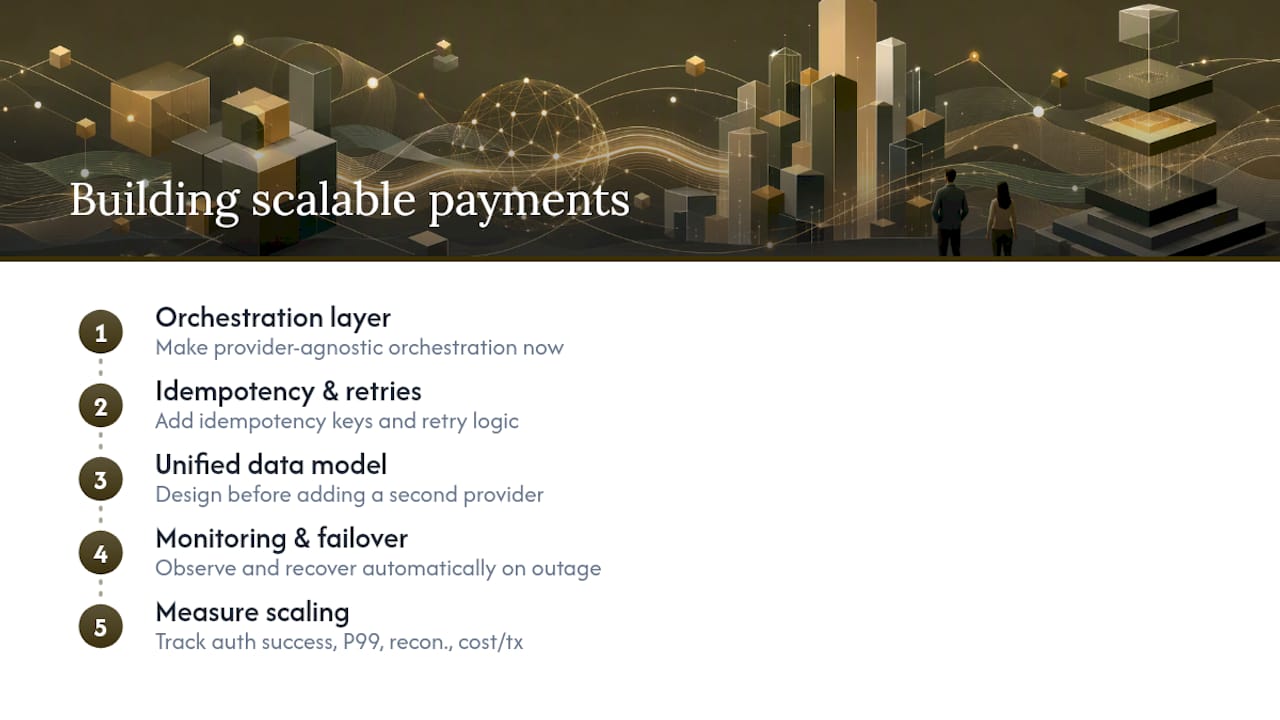
- Add an orchestration adapter layer, even with only one provider in place.
- Implement idempotency keys and retry logic with backoff on every transaction path.
- Stand up monitoring dashboards for authorization rates and latency.
Medium-term, over a few months:
- Integrate multi-acquirer routing so traffic can shift between providers automatically.
- Unify your data model across providers so reconciliation stops requiring manual translation.
- Automate reconciliation instead of running it as a manual monthly close task.
Long-term, over a few quarters:
- Decompose monolithic checkout and processing logic into modular, independently deployable services.
- Adopt ISO 20022 messaging where your provider relationships and geography call for it, particularly for cross-border or bank-rail integrations.
- Embed treasury and settlement automation so finance gets real-time visibility instead of end-of-day reports.
Budget accordingly: short-term work is mostly engineering time, medium-term work usually requires new provider contracts and integration costs, and long-term work touches architecture decisions that affect every team downstream. Sequencing matters more than speed here. A merchant that jumps straight to multi-acquirer routing without an orchestration layer in place just multiplies the number of places a bug can hide.
What Makes Davincipay’s Approach to Scalable Payments Different?
Peter has spent years working directly with high-risk and regulated merchants, the businesses where a single processor outage or an unexpected account freeze can shut down revenue overnight. That kind of pressure teaches you which architecture claims are real and which ones are marketing.
Here is what actually holds up:
- Provider-agnostic design is not optional for high-risk verticals. When one acquirer tightens its risk appetite, a merchant with only one processor loses the ability to take payments at all.
- Orchestration pays for itself before volume even grows. The monitoring and failover benefits show up on day one, not at some future scale threshold.
- Compliance and fraud controls belong in the architecture from the start, not layered on after a chargeback spike forces the issue.
High-risk merchants rarely fail because they picked the wrong processor. They fail because they built around a single one and never planned for it to fail.
Davincipay applies these same patterns for merchants in telehealth, nutraceuticals, and other regulated sectors, combining multi-acquirer relationships with fraud prevention and chargeback mitigation built into the underwriting process itself.
Where Should You Start With Payment Scalability?
Davincipay exists for merchants who cannot afford to treat payment processing as an afterthought. If you run a supplement brand, a telehealth platform, or a subscription business flagged as high-risk, you already know how fast a single-provider setup turns into a revenue emergency the moment one acquirer gets nervous.

What sets Davincipay apart is domestic and international acquiring built specifically for regulated and high-risk categories, paired with fraud prevention, chargeback mitigation, and underwriting support that most standard processors will not touch. You get real routing options instead of a single point of failure, plus recurring billing and ACH support built for subscription and telehealth models. For merchants in nutraceuticals or supplements specifically, that means underwriting that understands the category instead of flagging it on sight.
If the patterns in this piece describe the gap in your current setup, the next step is straightforward: apply now and get a real read on what a resilient, multi-acquirer setup looks like for your business.
Frequently Asked Questions
What is scalable payment infrastructure in simple terms? It is a payments setup that can handle more transactions, new countries, new payment methods, and multiple processors without requiring a proportional increase in engineering work or cost.
What is payment scalability actually measured by? Track authorization success rate, P99 latency on authorizations, reconciliation lag, and failover recovery time. Cost per transaction as volume grows is the clearest signal of whether the system is truly scaling or just barely holding on.
How do you create payment infrastructure that scales from the start? Start with a provider-agnostic orchestration layer, even with a single processor. Add idempotency keys and retry logic early, and build a unified data model before you add a second provider, not after.
What are the benefits of scalable payments for a growing business? Higher authorization rates, lower marginal processing cost, faster expansion into new markets, and the ability to recover automatically when a single provider has an outage.
Do small merchants need payment orchestration, or is it only for enterprise scale? Starting with orchestration early, even at a single-provider stage, avoids expensive rework later and delivers monitoring and failover benefits immediately rather than only at enterprise volume.
Sources
For deeper detail on the standards and patterns covered here:


.webp)
