.png)
Payment processing due diligence is the formal, risk-based evaluation a bank, sponsor, acquiring team, or merchant runs to verify that a payment processor has the operational controls, AML/BSA compliance program, and financial stability to handle transactions safely. It is not a one-time form. It is a structured review that determines whether to accept, decline, or place conditions on a processor relationship, and it repeats on a defined cadence for as long as the relationship exists.
Who performs it and when:
- Banks and sponsor banks conduct it before onboarding a third-party payment processor (TPPP) and periodically thereafter according to risk.
- Acquiring teams and underwriting units run it during merchant onboarding and whenever a material change occurs such as a new vertical or ownership change.
- Third-party risk and compliance teams own ongoing monitoring, SAR coordination, and periodic re-verification as per their program design.
- Legal and procurement validate contractual protections, audit rights, and termination mechanics as part of standard procedures.
The bottom-line outcome: you either approve the relationship with defined conditions, reject it outright, or escalate for senior review. Weak diligence leaves settlement funds, regulatory standing, and your institution’s reputation exposed.
Table of Contents
- Why does payment processing due diligence matter?
- What do U.S. regulators actually require?
- What are the primary risk factors in a processor relationship?
- What does onboarding due diligence actually look like?
- How do you verify operational resilience and contract terms?
- What AML controls should a processor be able to demonstrate?
- What red flags should trigger rejection or escalation?
- A practitioner checklist and vendor question set you can use now
- How long does due diligence take, and what does it cost?
- Key Takeaways
- The procurement mistakes that cost teams the most
- Davincipay handles the underwriting complexity for you
- Useful sources and further reading
Why does payment processing due diligence matter?
The payment ecosystem runs on layered trust. A merchant accepts a card, a processor routes the transaction, a sponsor bank settles it, and card networks enforce the rules. When any layer is opaque, liability concentrates at the bank. FDIC guidance is direct: banks must not rely solely on a processor’s representations and must independently verify merchant client lists, require audit rights, and establish reserve requirements to cover chargebacks.
Nested and aggregator structures make this harder. A processor may itself aggregate dozens of sub-merchants, none of whom the bank has vetted directly. That opacity is where fraud, money laundering, and chargeback exposure hide.
Operational consequences when diligence is weak are not theoretical. Regulators have issued enforcement actions, frozen settlement accounts, and required banks to exit processor relationships entirely. A processor that cannot produce a clean merchant list or a credible AML program is a structural risk, not just a compliance gap.
The stakeholders each carry distinct responsibilities. The processor must maintain its own merchant vetting and AML controls. The sponsor bank must independently verify and monitor. The merchant must disclose its business model accurately. Internal compliance and legal teams must translate findings into enforceable contract terms. When any party treats diligence as a checkbox, the whole chain weakens.
What do U.S. regulators actually require?
Five bodies set the expectations that shape every serious due-diligence program in the United States.
FDIC requires banks to authenticate a processor’s business operations, verify merchant client lists, require audit rights, and establish reserves for chargebacks. The revised guidance is explicit that independent verification is non-negotiable.
FFIEC BSA/AML Manual instructs banks to verify processors’ merchant vetting procedures, conduct background checks, perform operations visits, and monitor return and chargeback metrics as indicators of suspicious activity. The FFIEC manual also calls for periodic re-verification, not just onboarding checks.
OCC guidance recommends background checks on processor principals, merchant underwriting procedures, and hard limits on return rates. When suspicious activity surfaces, the OCC bulletin calls for immediate steps: SAR filing or relationship termination.
FinCEN and the BSA framework require covered financial institutions to maintain Customer Due Diligence (CDD) and Enhanced Due Diligence (EDD) standards. When a processor serves high-risk merchants or uses nested structures, EDD applies. SAR filing obligations extend to the bank and, in many cases, to the processor itself.
NACHA governs ACH originations. For processors that originate ACH debits, NACHA rules set return-rate thresholds that trigger monitoring and potential suspension. Unauthorized return rates above NACHA’s published thresholds are a direct regulatory exposure and a red flag in any diligence review.
Key regulatory callout: AML obligations for third-party payment processors increase in proportion to the complexity of their merchant base. A processor serving high-risk verticals or using aggregator models faces heightened supervisory scrutiny, and the sponsor bank inherits that scrutiny by association.
Compliance with payments compliance standards is not optional for any party in the chain. Regulators expect documented programs, not verbal assurances.
Key regulatory documentation your program must reference:
- FDIC Financial Institution Letter on Payment Processor Relationships (revised 2014 and 2026)
- FFIEC BSA/AML Examination Manual, Third-Party Payment Processors section
- OCC Bulletin 2008-12 and the OCC Comptroller’s Handbook, Merchant Processing booklet
- FinCEN CDD Rule (31 CFR Part 1010)
- NACHA Operating Rules, specifically return-rate monitoring thresholds
What are the primary risk factors in a processor relationship?
Risk-based diligence means triaging which risks are most likely and most damaging for a given processor. These are the four categories that consistently drive enforcement actions and relationship failures.
-
AML/BSA exposure from weak merchant vetting. Processors that serve gambling, cryptocurrency, subscription-based billing, or outbound telemarketing merchants carry elevated money-laundering risk. If the processor cannot demonstrate how it vets merchants in those verticals, the bank absorbs the AML exposure directly. AML/KYC weaknesses are the most critical risk category for deal survival in any PSP review.
-
Operational and continuity risk. Sponsor bank instability, settlement delays, and unilateral reserve increases can freeze a merchant’s working capital overnight. A processor whose sponsor bank is under a consent order or facing capital pressure is a continuity risk regardless of its own compliance posture.
-
Fraud and chargeback risk. Remotely created checks (RCCs), ACH return spikes, and repeated chargeback patterns signal either fraud or a merchant base that is fundamentally misrepresenting its products. High return rates are both a financial loss and a regulatory trigger.
-
Structural risks from nested processors and aggregators. When a processor aggregates sub-merchants, the bank has no direct visibility into who is actually originating transactions. Jurisdictional fragmentation across multiple acquiring banks or international entities compounds this opacity. These structures require EDD by default.
What does onboarding due diligence actually look like?
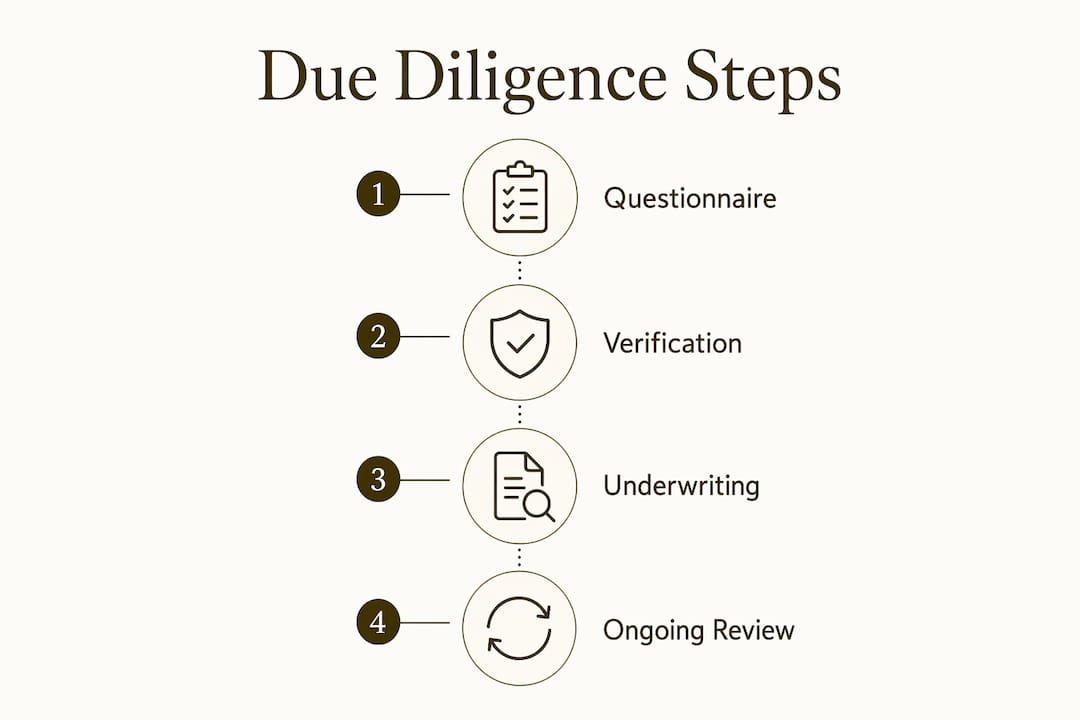
Structured onboarding diligence runs in three passes. The first pass is a written questionnaire. The second is independent verification against public records and references. The third is direct engagement with the sponsor bank or an external auditor for unresolved items.
| Document / Verification | Purpose | Who Verifies |
|---|---|---|
| Processor-merchant contracts | Confirm permitted merchant categories and liability terms | Legal / Compliance |
| Full merchant client list | Identify high-risk verticals and nested relationships | Underwriting |
| PCI DSS certification | Confirm cardholder data security posture | IT / Third-party risk |
| Settlement and chargeback history (12 months) | Assess return rates and financial exposure | Finance / Risk |
| Audited financial statements | Evaluate capital adequacy and reserve capacity | Finance |
| AML/BSA program documentation | Confirm CDD/EDD, monitoring, and SAR procedures | Compliance |
| Background checks on principals | Screen for adverse history, sanctions, PEP status | Compliance / Legal |
| Sponsor bank reference letter | Independently confirm the processor’s banking relationship | Compliance |
| MATCH list check | Screen for prior merchant terminations | Underwriting |
Independent verification is not optional. The FDIC is explicit that banks cannot rely solely on processor representations. Call the sponsor bank directly. Run background checks on principals. Contact two or three merchant references in the same vertical and volume tier.
Once documents and verifications are complete, convert findings into underwriting conditions: reserve requirements, transaction volume caps, audit rights, and a defined review cadence. A processor with a clean record and transparent merchant list may qualify for standard terms. One with gaps in its AML program or an opaque sub-merchant stack should face EDD conditions or a conditional approval with a 90-day review trigger.
Pro Tip: Request a live merchant list, not a summary. Ask the processor to certify it is complete and current. Discrepancies between the certified list and what you find in public records or card network data are one of the fastest ways to identify a structural risk.
Review cadence matters as much as the initial check. Quarterly reviews catch sponsor de-risking patterns and reserve changes months before a relationship can be formally terminated, giving you time to act rather than react.
How do you verify operational resilience and contract terms?
Operational diligence goes beyond documents. You need to confirm that the processor can actually deliver what it promises and that your contract protects you when it cannot.

Sponsor bank verification is the first priority. Contact the sponsor bank directly, not through the processor, to confirm the relationship is active, in good standing, and has no pending supervisory restrictions. Ask about the sponsor’s appetite for the processor’s merchant verticals. A sponsor that is quietly de-risking from a category will not volunteer that information.
Settlement and reserve mechanics deserve close scrutiny:
- Settlement cadence: Confirm the standard payout schedule and the conditions under which it can be delayed.
- Reserve mechanics: Understand how reserves are calculated, when they can be increased unilaterally, and what triggers a holdback.
- Termination clauses: Know the notice period required and whether funds in reserve are released immediately or held for a defined period after termination.
- SLA and technical continuity: Confirm uptime commitments, failover procedures, and what happens to in-flight transactions during an outage.
For chargeback management, ask for the processor’s dispute workflow in writing. Validate historical chargeback rates against the figures in their settlement history. A processor that quotes a 0.5% chargeback rate but whose settlement data shows recurring spikes is misrepresenting its performance.
Contract clauses that practitioners consistently wish they had insisted on: explicit audit rights with a defined notice period, data portability on termination, a reserve ceiling stated as a fixed percentage of monthly volume, a minimum termination notice of 30 days, and funds segregation for merchant settlements. These clauses often determine whether a business recovers quickly if the processor relationship fails.
For teams managing cross-border and multi-jurisdiction payment relationships, contractual protections become even more critical because enforcement across jurisdictions is slower and more expensive.
What AML controls should a processor be able to demonstrate?
A processor’s AML program is not a document you accept at face value. You verify it against observable metrics and ask specific questions about how it functions in practice.

| AML Control | What to Verify | Acceptable Evidence |
|---|---|---|
| CDD/EDD procedures | Written policy and sample merchant onboarding files | Policy document + redacted case file |
| Sanctions and PEP screening | Screening tool, frequency, and escalation path | Vendor contract + alert log sample |
| Automated transaction monitoring | System name, rule sets, and alert volumes | System documentation + alert disposition report |
| SAR filing process | Who files, under what threshold, and how fast | SAR log (redacted) + filing timeline |
| Return/chargeback rate monitoring | Thresholds, breach response, and merchant notification | Monitoring report + breach response procedure |
| Merchant concentration limits | Maximum exposure per merchant or vertical | Written policy |
Key metrics to track on an ongoing basis: unauthorized ACH return rates (NACHA thresholds apply), chargeback rates by merchant category, transaction velocity changes, and unusual funding patterns such as round-dollar transactions or rapid cycling. Merchant concentration, where a single merchant accounts for a disproportionate share of volume, is a risk multiplier.
SAR coordination between the bank and the processor requires clarity upfront. When the underlying merchant is opaque or nested, the bank may have an independent SAR obligation even if the processor files its own report. Define in the contract who files, under what circumstances, and how each party notifies the other.
What red flags should trigger rejection or escalation?
Some findings require an immediate decision. Others require escalation before proceeding. Know the difference before you start a review.
Hard reject triggers:
- Processor cannot or will not produce a complete merchant client list
- Principals appear on OFAC sanctions lists or have prior fraud convictions
- Sponsor bank relationship cannot be independently confirmed
- AML program is absent or consists only of a policy document with no operational evidence
- Prior regulatory enforcement action directly related to AML or fraud controls
Escalate to senior management and legal:
- Mismatch between the processor’s stated permitted activities and what merchant references describe
- Unusually high return or chargeback rates with no credible explanation
- Sponsor bank has received a supervisory letter or is operating under a consent order
- Nested sub-merchant structures with no pass-through KYC documentation
- Ownership structure that obscures beneficial ownership across multiple jurisdictions
Conditional approval with heightened controls:
- AML program exists but has gaps in EDD or monitoring documentation
- Chargeback history shows isolated spikes rather than a persistent pattern
- Financial statements show adequate capital but thin reserves
The practical escalation flow: pause onboarding, notify the compliance officer and legal counsel, document findings in writing, and determine whether a SAR is warranted based on the specific facts. Do not continue processing transactions while an escalation is open.
A practitioner checklist and vendor question set you can use now
Run this checklist in three passes: written questionnaire first, independent verification second, direct sponsor or audit engagement for anything unresolved.
Onboarding checklist:
- Collect full merchant client list, certified as complete and current
- Obtain 12 months of settlement and chargeback history
- Request AML/BSA program documentation including CDD/EDD policy, monitoring procedures, and SAR log
- Run OFAC and PEP screening on all principals
- Check MATCH list for prior merchant terminations
- Obtain PCI DSS certification or current assessment report
- Request audited financial statements for the past two years
- Collect all contracts between the processor and its sponsor bank
- Independently contact the sponsor bank to confirm the relationship
- Contact two merchant references in the same vertical and volume tier
- Review public records and adverse media for principals and the entity
- Confirm NACHA return-rate compliance for ACH originators
Sample vendor questions by theme:
Sponsor bank and structure:
- Who is your current sponsor bank, and how long has that relationship been in place?
- Have you received any supervisory communications from your sponsor bank in the past 24 months?
- Do you use sub-processors or nested acquiring relationships? If so, provide a full list.
Merchant vetting and AML:
- Describe your merchant onboarding process, including KYC and EDD triggers.
- What automated monitoring system do you use, and what rule sets are active?
- How many SARs did you file in the past 12 months, and what were the primary triggers?
Technical SLA and continuity:
- What is your contractual uptime commitment, and what is your failover procedure?
- How are in-flight transactions handled during a system outage?
- What is your data portability process if the relationship terminates?
Pro Tip: When calling merchant references, ask specifically whether the processor has ever imposed an unilateral reserve increase, delayed a settlement, or frozen an account without advance notice. Those three questions surface more useful diligence data than any written questionnaire.
How long does due diligence take, and what does it cost?
Timeline depends on the depth of review and how quickly the processor responds.
- Light diligence for standard processors with low-risk merchant bases may take several weeks, assuming prompt document delivery and routine verifications.
- Standard diligence involving moderate risk or some high-risk verticals generally requires a longer review period, including sponsor bank confirmation and merchant reference checks.
- Deep diligence for complex cases with nested structures or prior regulatory issues involves extended timelines due to added audit and legal reviews.
Multi-pass response cycles add time. If the processor takes two weeks to respond to the initial questionnaire, the timeline extends accordingly. Build that buffer into your project plan.
Internal owners by task:
- Compliance: AML program review, SAR coordination, CDD/EDD assessment, sanctions screening
- Underwriting/Risk: Merchant list review, chargeback history analysis, MATCH check, reserve structuring
- Legal: Contract review, audit rights negotiation, termination clause analysis
- Finance: Financial statement review, reserve adequacy assessment, settlement mechanics
- Operations/IT: Technical SLA review, PCI DSS confirmation, continuity planning
Primary cost drivers include external background check services, third-party audit fees for processors with complex structures, sponsor bank confirmation calls (which may require legal coordination), and remediation work when gaps are found. Ongoing monitoring adds a recurring cost for transaction monitoring tools and periodic review labor. Teams that understaff compliance and legal at the outset typically spend more on remediation later.
Key Takeaways
Payment processing due diligence requires independent verification, documented AML controls, and enforceable contract terms at onboarding and on a recurring basis to protect settlement, regulatory standing, and revenue.
| Point | Details |
|---|---|
| Independent verification is mandatory | FDIC guidance prohibits relying solely on processor representations; confirm sponsor bank relationships directly. |
| AML/KYC gaps are the highest-risk finding | Absent or undocumented AML programs are hard reject triggers, not conditions to negotiate around. |
| Contracts must include specific protections | Audit rights, reserve ceilings, data portability, and termination notice periods determine recovery speed if a relationship fails. |
| Diligence is a continuous cycle | Quarterly reviews catch sponsor de-risking and reserve changes months before formal termination becomes possible. |
| Davincipay supports high-risk underwriting | Davincipay operationalizes sponsor confirmations, AML assessments, and underwriting workflows for merchants in complex or regulated verticals. |
The procurement mistakes that cost teams the most
The most common error in processor due diligence is treating it as a rate negotiation with a compliance checklist attached. Teams spend weeks comparing processing fees and almost no time confirming whether the sponsor bank relationship is stable or whether the processor’s AML program has ever been tested. That inversion is exactly what regulators find when they examine failed relationships.
Finance teams often enter the process too late. By the time they review settlement mechanics and reserve terms, legal has already drafted a contract without the reserve ceiling or data portability clause that would have protected the business. The sequence matters: legal and compliance should set the contractual floor before finance negotiates commercial terms, not after.
Continuity risk is consistently underestimated. A processor with competitive rates and a clean compliance record can still destroy a merchant’s cash flow if its sponsor bank exits the relationship with 30 days’ notice and no data portability. The most revealing diligence question is not “what are your rates?” It is “what happens to my settlement funds and transaction data if this relationship ends tomorrow?”
When a processor fails a diligence check, the right first move is to pause onboarding and confirm the sponsor bank relationship independently. That single step resolves more uncertainty faster than any additional document request. From there, negotiate audit rights before you negotiate price. A processor that resists audit rights is telling you something important about what an audit would find.
Davincipay handles the underwriting complexity for you
High-risk merchants in nutraceuticals, telehealth, subscription billing, and regulated ecommerce face a harder version of this process. Their merchant category codes trigger automatic EDD, their chargeback profiles require active management, and their sponsor bank options are narrower. Running a full due-diligence program in-house while also managing operations is a real resource constraint.

Davincipay specializes in exactly this situation. The team manages documentation collection, sponsor bank confirmation, AML program assessments, and underwriting workflows for merchants that standard processors decline or over-reserve. The focus is on domestic and international acquiring relationships that hold up under scrutiny, not just at onboarding but through ongoing monitoring and periodic review. If you need a processor relationship that is built to survive a compliance review, start your application and get a direct assessment of your options.
Useful sources and further reading
These are the primary guidance documents your program should reference for policy language, audit defense, and examiner expectations.
- FDIC Payment Processor Relationships Revised Guidance: The foundational bank-facing document on processor due diligence. Use it for onboarding policy language and to justify independent verification requirements.
- FFIEC BSA/AML Manual, Third-Party Payment Processors: The examiner’s reference for AML controls, monitoring expectations, and re-verification cadence. Use it when building or auditing your AML program for processor relationships.
- OCC Bulletin 2008-12, Payment Processors: Risk Management Guidance: Covers background checks, merchant underwriting, return-rate limits, and escalation steps. Use it for escalation policy and SAR trigger definitions.
- OCC Comptroller’s Handbook, Merchant Processing: Detailed examiner guidance on charge-back monitoring, MATCH list use, fraud detection, and third-party oversight. Use it for audit defense and to benchmark your monitoring controls.
- FinCEN CDD Rule (31 CFR Part 1010): The regulatory basis for CDD and EDD standards. Use it when defining merchant identity verification requirements and beneficial ownership documentation.
- NACHA Operating Rules: Sets return-rate thresholds for ACH originators. Use it for monitoring thresholds and to define breach-response procedures for processors that originate ACH debits.
- Finconduit BaaS Due Diligence Checklist: A structured 30-question checklist across six review areas. Use it as a starting template for your written questionnaire and to benchmark your review cadence.
This article provides general information about payment processing due diligence practices and regulatory expectations. It is not legal, compliance, or financial advice. Confirm current regulatory requirements with the relevant primary sources or a qualified professional for your specific situation.


.webp)
