.png)
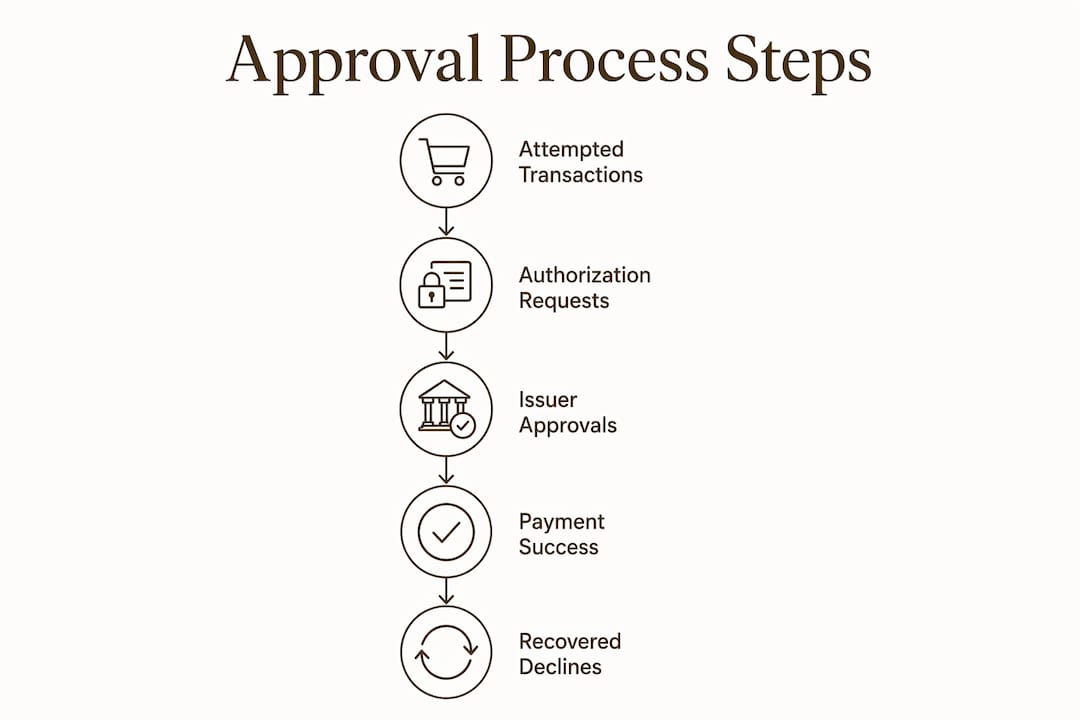
Payment processing approval odds measure the share of attempted payments that become settled, successful transactions — not just the first authorization response from an issuer. The industry term you’ll see most often is approval rate or payment acceptance rate, and it captures everything: issuer decisions, merchant fraud checks, and any recovered transactions from retries or failover routing.
If you’re losing revenue and aren’t sure where, start here:
- Check your current approval rate. Divide approved transactions by total attempted transactions. An approval rate where approximately nine out of ten attempts are approved represents a high success rate.
- Pull your top five decline codes. Separate issuer declines from merchant-side blocks. The fix is different for each.
- Enable basic retry logic. If you’re not retrying soft declines within a defined window, you’re leaving recoverable revenue on the table.
Even a single percentage point of approval rate improvement can mean hundreds of thousands of dollars annually for a mid-volume merchant. That’s not a rounding error.
Pro Tip: Don’t wait for a revenue dip to investigate your approval rate. Set a weekly alert in your payment dashboard for any drop greater than 2 percentage points from your baseline.
Table of Contents
- What do payment processing approval odds actually measure?
- What counts as a good approval rate for ecommerce merchants?
- Why do transactions get declined?
- How approval odds translate directly into revenue
- How to improve your approval odds: a prioritized checklist
- Special considerations for subscription and recurring billing
- What to measure and how to track approval rate improvements
- Advanced recovery tactics and what specialized providers offer
- Key Takeaways
- Where most merchants should actually focus their time
- Davincipay helps high-risk merchants recover more revenue
- Useful sources and references
What do payment processing approval odds actually measure?
The phrase “approval odds” is a practical shorthand for your end-to-end payment success rate, and it’s broader than most merchants realize. Understanding the difference between related metrics is what separates merchants who react to problems from those who prevent them.
- Authorization rate: The percentage of transactions approved on the first attempt by the issuing bank. This is the raw issuer response, before any recovery logic runs.
- Approval rate (acceptance rate): The percentage of all attempted payments that ultimately succeed, including transactions recovered through retries, failover routing, or account updater services. Approval rate is broader than authorization rate because recovered transactions count toward it even when the first attempt failed.
- Recovery rate: The gap between your approval rate and your authorization rate. A 3-point or larger gap typically signals that your retry and failover logic is doing meaningful work.
- Capture rate: The final step. A payment can be authorized but not captured if your system fails to complete the settlement request. Capture rate tracks how many authorized transactions actually result in funds moving.
Here’s a quick numeric scenario to make this concrete. Suppose you attempt 10,000 transactions. Your issuer authorization rate is 84% (8,400 approvals). After retries and failover, 500 more transactions succeed. Your final approval rate is 89%. The 5-point recovery gap is your retry engine’s contribution.
Platforms like Stripe separate “authorization” and “payment success” metrics and exclude certain pre-network failures (like 3DS failures or fraud blocks) from the authorization denominator entirely. That means your authorization rate on one platform may look different from another, even with identical transaction volume. Always confirm what each platform includes in its denominator before benchmarking.
What counts as a good approval rate for ecommerce merchants?
Benchmarks vary by vertical, payment method, and geography, but the ranges below give you a practical starting point.

| Segment | Typical Approval Rate Range | Notes |
|---|---|---|
| Card-present (in-store) transactions typically have very high approval rates due to enhanced fraud reduction measures like Chip/PIN. | ||
| Standard ecommerce (card-not-present) transactions tend to have healthy approval rates, typically in the 85–95% range when optimized. | ||
| High-risk verticals such as nutraceuticals, supplements, or telehealth often experience moderately lower approval rates due to increased issuer risk assessments. | ||
| Subscription and recurring billing transactions typically see approval rates that can vary due to factors like stale card data and retry logic. | ||
| Cross-border card-not-present transactions generally face lower approval odds caused by currency mismatches and international risk considerations. |
Card-not-present (CNP) transactions always underperform card-present because the issuer can’t verify the physical card or cardholder. That gap is structural, not a sign something is broken on your end.
For high-risk verticals like nutraceuticals, supplements, or telehealth a rate in the low-to-mid 80s is often realistic without advanced routing. With multi-acquirer infrastructure and tuned fraud rules, many merchants in these categories push into the upper 80s or low 90s.
- New customers typically see lower approval rates than returning customers. Issuers have no transaction history with the card at your merchant, so risk scores run higher.
- Digital wallets (Apple Pay, Google Pay) generally outperform raw card entry because tokenized credentials reduce fraud signals and issuers treat them more favorably.
- Debit cards can underperform credit cards for CNP transactions, particularly when available balance is close to the transaction amount.
Why do transactions get declined?
Declines fall into three buckets: issuer-side, network/technical, and merchant-side. Knowing which bucket owns the problem tells you who needs to act.
Issuer declines are the most common. The issuer’s system evaluated the transaction and said no. Common reasons include:
- Insufficient funds or credit limit exceeded
do_not_honor(a generic issuer decline with no specific reason given)- Suspected fraud based on the issuer’s own risk model
- Card reported lost or stolen
- Geographic restrictions on the account
For issuer declines, your customer may need to call their bank, use a different card, or try a digital wallet. You can’t override an issuer decision, but you can route to a different acquirer and re-present the transaction.
Network and technical failures are less frequent but harder to diagnose. Symptoms include timeout errors, gateway connectivity failures, or acquirer outages. These are usually temporary and respond well to automated retry logic.
Merchant-side declines are where many merchants lose revenue they shouldn’t. Overly aggressive fraud rules, AVS mismatches, CVC failures, and velocity limits can block legitimate transactions before the issuer ever sees them. False positives are expensive. A customer who gets blocked at checkout rarely comes back.

Stripe’s acceptance analytics documents that some failures occur entirely before the authorization attempt, including 3DS authentication failures and Radar fraud blocks. These never reach the issuer, so they won’t appear in your authorization rate but will drag down your approval rate.
Pro Tip: Log every decline with its code, the originating system (issuer, gateway, or your fraud tool), and the transaction amount. After two weeks, sort by frequency and revenue impact. The top three codes by revenue lost are your first fix targets.
How approval odds translate directly into revenue
The math is straightforward, and it’s worth running against your own numbers.
Formula: Approval rate × attempted transaction volume × average order value = approved revenue
- Baseline example. A merchant processing many transactions per month with a healthy average order value generates substantial approved revenue proportional to their approval rate.
- At 95% approval. The same volume and AOV produces 9,500 approved transactions and $807,500 in monthly revenue.
- The delta. Improving the approval rate by several percentage points can result in significant additional revenue without extra marketing costs.
Even a small increase in approval rate on large transaction volumes can lead to meaningful revenue growth annually. Industry examples show the revenue delta between 85% and 95% approval can reach hundreds of thousands to millions of dollars depending on scale.
For subscription merchants, the stakes are compounded. A failed payment that isn’t recovered becomes involuntary churn. That customer’s lifetime value is gone, not just one transaction. A subscriber paying $49/month who churns because of a stale card represents $588 in annual revenue lost from a problem that account updater services can often prevent.
For ecommerce checkouts, a declined payment at the final step is a conversion loss. Many customers won’t retry. They’ll abandon the cart and, in competitive categories, buy from someone else within the hour.
How to improve your approval odds: a prioritized checklist
Start with the fixes that require the least engineering and deliver the fastest results. Then layer in infrastructure.
-
Fix card data hygiene first. Expired cards and stale stored credentials are the easiest wins. Enable an automatic card updater service through your processor or network (Visa Account Updater, Mastercard Automatic Billing Updater). This alone can recover a meaningful share of recurring billing failures.
-
Collect richer authentication data. Pass AVS (Address Verification Service) and CVC data on every transaction. Issuers use these signals to assess risk. Missing data increases decline probability. Start with data hygiene and merchant controls before investing in complex routing.
-
Implement smart retry logic for soft declines. Not all declines are final. Soft declines (insufficient funds, temporary hold) can often be retried successfully. Follow card network retry rules: Visa and Mastercard both limit the number of retries on a declined transaction within a defined window. Exceeding those limits can result in fines.
-
Add cascading / acquirer failover. Route failed transactions to a secondary acquirer automatically. If your primary acquirer or the issuer relationship produces a decline, a different acquiring bank may approve the same transaction. This is especially valuable for high-risk merchants where issuer relationships vary by acquirer.
-
Use 3DS selectively, not universally. 3DS (3D Secure) adds an authentication step that can reduce fraud-related declines and shift liability. But applying it to every transaction increases friction and can hurt conversion. Use step-up authentication on transactions that trigger risk signals, not as a blanket policy.
-
Tokenize stored credentials. Network tokens (Visa Token Service, Mastercard Digital Enablement Service) replace raw card numbers with issuer-managed tokens. Issuers treat tokenized credentials more favorably, and tokens update automatically when cards are reissued.
-
Tune fraud rules to reduce false positives. Review your fraud tool’s block rate against your chargeback rate. If your block rate is 5% and your chargeback rate is 0.3%, your rules are likely too aggressive. Whitelist repeat customers with clean transaction histories. Adjust velocity rules for high-AOV categories where large single purchases are normal.
Pro Tip: Segment your approval rate by new vs. returning customers. Returning customers with stored credentials typically show materially higher approval odds because issuers recognize the card-merchant relationship. If your new-customer rate is dragging down your overall number, focus fraud tuning and authentication improvements there first.
Special considerations for subscription and recurring billing
Subscription merchants face a distinct set of approval challenges because every billing cycle is a new authorization attempt on a stored card. The card that worked last month may be expired, reissued, or over-limit today.
-
Run account updater before each billing cycle. Visa Account Updater and Mastercard Automatic Billing Updater push new card numbers and expiration dates to your stored credentials before you attempt the charge. This prevents a large share of stale-card declines before they happen.
-
Build a staged dunning sequence. When a payment fails, don’t immediately cancel the subscription. A well-structured dunning plan typically looks like this:
- Day 0: First retry (same day, different time of day)
- Day 3: Second retry
- Day 7: Third retry with customer email notification
- Day 14: Final retry with cancellation warning
- Day 21: Subscription pause or cancellation
-
Respect network retry rules. Card networks limit how many times you can retry a declined transaction. Exceeding those limits can trigger fines and damage your relationship with the acquiring bank.
-
Use MIT (Merchant-Initiated Transaction) flags correctly. When you initiate a recurring charge without the customer present, flag it as an MIT with the correct transaction type. Issuers treat properly flagged recurring transactions differently from unrecognized charges, which can reduce declines.
Combining account updater services with a staged retry plan typically recovers the largest share of otherwise lost subscription revenue.
What to measure and how to track approval rate improvements
You can’t improve what you don’t measure consistently. These are the formulas and reporting dimensions that matter.
Core formulas:
- Approval rate: Approved transactions ÷ total attempted transactions
- Authorization rate: First-attempt issuer approvals ÷ total transactions sent to the network
- Recovery rate: Approval rate minus authorization rate (the contribution of retries and failover)
- Capture rate: Captured/settled transactions ÷ authorized transactions
- Failed-payment churn rate: Subscriptions lost to payment failure ÷ total active subscriptions in the period
Reporting dashboard: suggested weekly/monthly metrics
| Metric | Segment By | Frequency | Alert Threshold |
|---|---|---|---|
| Approval rate | Payment method, geography, new vs. returning | Weekly | Drop >2 pts from baseline |
| Authorization rate | Acquirer, card type | Weekly | Drop >2 pts |
| Recovery rate | Retry attempt number, decline code | Monthly | Below 3 pts gap |
| Decline code mix | Issuer vs. merchant vs. network | Weekly | Any code >5% of volume |
| Capture rate | Product line, subscription vs. one-time | Monthly | Below 95% |
- Segment by payment method (credit, debit, digital wallet) because each has a different baseline and responds to different fixes.
- Segment by geography because cross-border transactions carry different issuer risk rules. For merchants handling payouts or settlements across borders, payee verification tools can reduce downstream failures and manual remediation in cross-border flows.
- Segment by new vs. returning customers. Returning customers with stored credentials consistently show higher approval odds due to issuer familiarity and tokenization.
- Run A/B tests on fraud rule changes before rolling them out to full volume. A rule that reduces chargebacks by 0.1% but drops approval rate by 2% is a net revenue loss.
Advanced recovery tactics and what specialized providers offer
When basic fixes are in place, the next layer of improvement comes from infrastructure: multi-acquirer routing, smart retry engines, and automated credential refresh.
Cascading and multi-acquirer routing re-present a declined transaction to a different acquiring bank automatically. Issuers have different risk relationships with different acquirers. A transaction that a specific issuer declines through one acquirer may be approved through another. This is particularly valuable for high-risk merchants where issuer-acquirer relationships vary significantly by vertical.
Smart retry engines go beyond simple time-based retries. They use decline-code heuristics to determine whether a retry is likely to succeed, when to retry, and which acquirer to route to. A do_not_honor decline from an issuer may warrant a different retry strategy than an insufficient funds decline.
- Retry
insufficient fundsdeclines at the end of the month or beginning of the next, when cardholders are more likely to have funds available. - Don’t retry
do_not_honorcodes immediately. These often indicate a risk flag at the issuer that won’t clear within hours. - Route retries through a different acquirer when the original decline appears acquirer-specific rather than issuer-specific.
Account updater and token refresh automate credential maintenance. Rather than waiting for a card to fail, these services push updated card numbers and expiration dates to your stored tokens before the next billing attempt. Recovery mechanisms that lift approval rate include acquirer failover, smart retry logic, 3DS step-up, and account updater services working together.
For merchants operating across multiple currencies or with international payout needs, bulk payee verification reduces returned payments and manual remediation in cross-border settlement scenarios.
What a specialized provider brings to high-risk merchants: Standard processors often apply generic routing and conservative underwriting to high-risk verticals. A specialist like Davincipay offers tailored underwriting, multi-acquirer routing built for regulated categories, chargeback mitigation, and recovery infrastructure designed specifically for merchants in nutraceuticals, telehealth, supplements, subscriptions, and similar verticals.
Pro Tip: Measure your recovery rate (approval rate minus authorization rate) every month. A gap of 3 or more percentage points usually means your retry and failover infrastructure is working. A gap under 1 point on a high-volume account is a signal that recovery tooling needs attention.
Key Takeaways
Your payment processing approval rate is the single most direct measure of how much attempted revenue actually reaches your account, and improving it starts with knowing your baseline, diagnosing your top decline codes, and enabling recovery logic before investing in complex routing.
| Point | Details |
|---|---|
| Approval rate vs. authorization rate | Approval rate includes recovered transactions; authorization rate is first-attempt issuer response only. |
| Healthy ecommerce benchmark | 85–95% is the typical healthy approval rate range for card-not-present ecommerce; most providers recommend aiming for 90% or higher. |
| Revenue impact is immediate | A 10-point improvement on 10,000 monthly transactions at $85 AOV adds significant additional revenue |
| Measure three rates separately | Track approval rate, authorization rate, and recovery rate to pinpoint where losses occur. |
| Davincipay for high-risk merchants | Davincipay provides multi-acquirer routing, underwriting, and chargeback mitigation for high-risk and subscription ecommerce. |
Where most merchants should actually focus their time
The conventional wisdom on approval rate optimization tends to skip straight to infrastructure: multi-acquirer routing, smart retry engines, 3DS orchestration. That advice is right for high-volume merchants with dedicated payments engineering teams. For most ecommerce operators, it’s the wrong starting point.
The merchants who see the fastest improvement are the ones who fix the basics first. Card updater services, complete AVS and CVC data collection, and a simple two-to-three attempt dunning sequence for subscriptions will outperform a complex routing build for most businesses under a few million dollars in annual processing volume. The engineering cost is lower, the timeline is shorter, and the gains are often larger than expected.
The case for hiring a specialist payments partner is clearest when two conditions are true: your vertical carries elevated issuer risk (nutraceuticals, telehealth, supplements, adult, gaming, financial services), and your decline rate is high enough that the cost of a specialist is smaller than the revenue you’re recovering. For most high-risk merchants processing more than $500,000 monthly, that math usually favors a specialist. Building multi-acquirer routing in-house at that scale is expensive, slow, and requires ongoing maintenance that pulls engineering resources away from your core product.
The merchants who struggle longest are the ones who treat approval rate as a payments team problem rather than a revenue operations problem. Every percentage point is a business decision, not a technical one.
Davincipay helps high-risk merchants recover more revenue
High-risk and regulated ecommerce merchants face approval challenges that standard processors aren’t built to solve. Nutraceutical brands, telehealth providers, supplement merchants, and subscription businesses deal with elevated issuer scrutiny, conservative acquirer underwriting, and decline rates that standard routing can’t fix.
Davincipay is built specifically for this. With multi-acquirer routing and recovery infrastructure, Davincipay connects high-risk merchants to domestic and international acquiring relationships that match their vertical, transaction profile, and risk category. The platform includes chargeback mitigation, subscription billing management, fraud prevention tools, and underwriting support for merchants who can’t get reliable processing elsewhere.

Merchants who benefit most are those in high-risk verticals with meaningful monthly volume, recurring billing models, or a history of elevated declines. If your approval rate is below where it should be and standard processors haven’t solved it, apply with Davincipay and have your current processing volume, average order value, and top decline codes ready. The review process is direct, and the focus is on finding a processing structure that actually works for your business.
Useful sources and references
These are the primary references and documentation sources cited in this article. Each one provides additional depth on the metrics, standards, and implementation details covered above.
- Payment Approval Percentage: Definition and Examples — NHIMG glossary covering how merchant-side fraud controls affect approval percentage.
- Approval Rate: Definition, How It Works — PXP payments glossary explaining the difference between authorization rate and end-to-end approval rate, including recovery contributions.
- What Is Payment Approval Percentage and How to Improve Your Rate — Signifyd’s practical guide covering benchmarks, the 85–95% healthy range, and worked revenue examples.
- Acceptance Analytics — Stripe documentation on how the platform separates authorization rate from payment success rate, and how pre-network failures are categorized.
- Optimize for Higher Authorization Rates — PayPal’s business resource center guidance on authorization rate optimization and the payment authorization flow.
- Payment Gateway — Wikipedia overview of payment gateway architecture and the authorization process.
- How It Works — Davincipay’s explanation of cascading, routing, and recovery features for high-risk ecommerce merchants.


.webp)
