.png)
Payment middleware is defined as a software layer that sits between your application and multiple payment service providers (PSPs), routing transactions, screening for fraud, and managing tokenization through a single unified interface. Rather than building separate integrations for each PSP, businesses connect once to the middleware layer, which handles all downstream communication. This architecture is the standard approach for any business that processes payments across multiple gateways, currencies, or acquiring banks. For high-risk merchants, subscription businesses, and e-commerce developers, understanding payment middleware is the first step toward building a payment stack that actually holds up under pressure.
What is payment middleware and how does it function?
Payment middleware is the software layer that connects applications to PSPs through a single API, centralizing transaction routing, tokenization, and fraud screening without requiring multiple individual integrations. The industry term most commonly used for this architecture is payment orchestration, though “payment middleware” describes the same core concept from a developer infrastructure perspective. Both terms refer to the same function: abstracting the complexity of multiple PSP APIs behind one unified interface.
The middleware layer handles three core jobs. First, it routes each transaction to the most appropriate PSP based on rules you define. Second, it maintains a consistent record of every transaction state, even when PSP responses arrive asynchronously. Third, it applies fraud screening and tokenization before data ever reaches the PSP.

Orchestration platforms expose routing APIs without hosted checkout or white-label merchant tools, which places them firmly in the infrastructure layer rather than the merchant-facing product layer. This distinction matters when you are deciding which components to build versus buy.
How does payment middleware work to optimize processing?
The routing engine is the core of any payment processing middleware. Every transaction passes through a decision layer that evaluates variables like currency, card network, issuer location, and processing cost in milliseconds. The result is a routing decision that sends the transaction to the PSP most likely to approve it at the lowest cost.
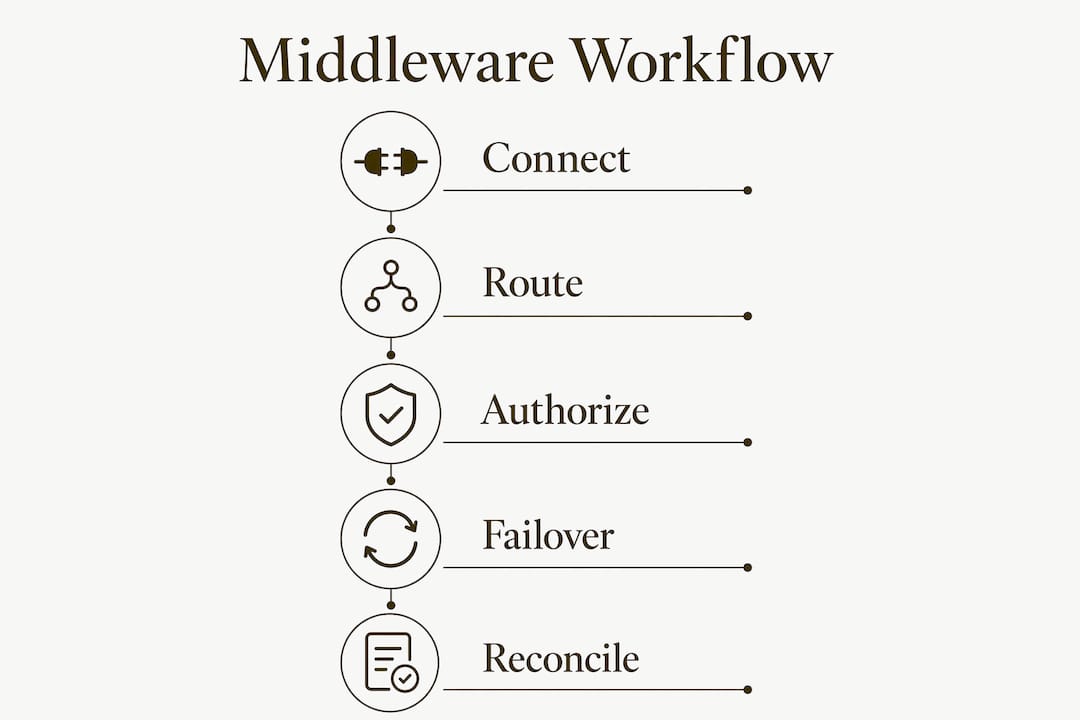
Here is how a typical transaction flows through middleware:
- Transaction initiation. Your application sends a payment request to the middleware API.
- Tokenization. The middleware replaces sensitive card data with a token stored in a secure vault, so raw card numbers never touch your servers.
- Fraud screening. The risk engine scores the transaction against defined rules before routing begins.
- Dynamic routing. The middleware selects the optimal PSP based on geography, currency, cost, and approval rate history.
- PSP communication. The middleware sends the transaction to the selected PSP and waits for a response.
- Failover logic. If the primary PSP declines or times out, cascading failover routes the transaction to a secondary gateway automatically.
- State management. The middleware acts as the source of truth, reconciling async webhook responses with synchronous API replies to maintain an accurate transaction record.
The state machine function is one of the most underappreciated parts of payment middleware. PSPs return responses in different formats and at different speeds. Without a middleware layer maintaining transaction state consistently, a timeout followed by a successful retry can create duplicate authorization attempts, which violates card network rules and risks penalties.
Pro Tip: Configure your cascading failover rules to detect previous authorization attempts on the same card number and amount before retrying. Duplicate authorization requests violate network rules and can result in your account being flagged or blocked.
What are the key benefits of using payment middleware solutions?
The benefits of payment middleware go well beyond convenience. For businesses processing significant transaction volume, the financial and operational impact is direct and measurable.
- Higher approval rates. Multi-PSP failover means a declined transaction at one gateway automatically retries at another. Businesses with access to multiple acquiring relationships see materially better authorization rates than those locked into a single PSP.
- Lower processing costs. Dynamic routing optimizes for cost by selecting the PSP with the best interchange rate for each specific card type and currency. Over high volume, this produces significant savings.
- Reduced integration overhead. One API connection replaces dozens of individual PSP integrations. Your development team maintains one codebase instead of managing separate connectors for each provider.
- Fraud screening across all channels. A centralized risk engine applies consistent fraud rules regardless of which PSP processes the transaction. This closes the gaps that appear when fraud logic is split across multiple integrations.
- Automated reconciliation. Middleware eliminates financial leakage by reconciling multiple PSP settlement records into a unified double-entry ledger. Manual reconciliation across multiple PSPs is where most financial errors occur.
- Configuration over code. Dashboard-driven routing management replaces code changes for routing updates, so your operations team can adjust rules without a deployment cycle.
- Faster time to market. Adding a new PSP or payment method through middleware takes days, not months. This directly supports business agility when entering new markets or responding to acquiring relationship changes.
What features define modern payment processing middleware?
Modern payment middleware is not a single tool. It is a collection of components that work together to manage the full transaction lifecycle.
Tokenization vault
The vault stores card data as tokens, replacing sensitive numbers with references that are useless outside the vault. This reduces your PCI DSS scope significantly. When a customer returns for a repeat purchase, the middleware retrieves the token and processes the payment without re-entering card details.
Risk engine
The risk engine scores every transaction before routing. It applies rules based on velocity, geography, device fingerprint, and behavioral signals. High-risk merchants, including those in nutraceuticals, telehealth, and subscription billing, rely on this layer to reduce chargebacks before they reach the PSP.
Settlement reconciliation ledger
Settlement reconciliation is the most technically complex part of middleware. PSPs deliver settlement reports in different formats, including CSV, JSON, and SFTP files. The middleware normalizes these formats into a consistent internal ledger. Middleware that integrates with ERP systems like Microsoft Dynamics 365 or SAP automates this reconciliation between the digital ledger and bank settlement records.
API gateway and routing dashboard
The API gateway abstracts all PSP connections behind a single endpoint. The routing dashboard lets your team configure rules visually, without writing code. This is where you set failover sequences, cost thresholds, and geographic routing preferences.
| Component | Primary function |
|---|---|
| Tokenization vault | Stores card data as tokens, reduces PCI scope |
| Risk engine | Scores transactions and applies fraud rules pre-routing |
| Reconciliation ledger | Normalizes PSP settlement formats into one record |
| API gateway | Abstracts multiple PSP connections behind one endpoint |
| Routing dashboard | Configures routing and failover rules without code changes |
Pro Tip: When evaluating payment middleware solutions, check whether the reconciliation ledger supports your existing ERP. Native connectors to systems like SAP or Microsoft Dynamics 365 cut implementation time significantly and reduce manual data mapping errors.
How to integrate payment middleware into your existing infrastructure
Integration timelines depend heavily on how much of the middleware stack you build versus buy. For KYC and AML compliance components, pre-validated modular tools reduce both development time and regulatory risk. Core financial middleware like digital wallets typically reaches MVP in 3 to 5 months using modular, pre-validated components. Building from scratch takes considerably longer and introduces more compliance exposure.
A practical integration follows these steps:
- Audit your current PSP connections. Map every existing integration, its failure rate, and its cost per transaction. This baseline determines where middleware delivers the most immediate value.
- Select modular components. Choose pre-built tokenization vaults, KYC/AML modules, and reconciliation tools rather than building each layer from scratch. Modular components carry existing compliance certifications.
- Connect your ERP or core banking system. Automated reconciliation only works when the middleware ledger feeds directly into your financial reporting system. Manual data exports defeat the purpose.
- Configure routing rules before go-live. Define your primary PSP, failover sequence, and cost thresholds in the dashboard before processing live transactions. Avoid hardcoding these rules in application code.
- Test cascading logic thoroughly. Simulate PSP failures and timeouts in a staging environment. Confirm that your failover sequence does not generate duplicate authorization attempts on the same card and amount.
- Monitor and iterate. Review approval rates, routing costs, and reconciliation exceptions weekly for the first 90 days. Adjust routing rules based on real performance data.
The most common integration mistake is treating middleware as a feature to bolt onto an existing stack. Viewing payment middleware as core infrastructure from the start prevents the technical debt that accumulates when routing logic is scattered across multiple codebases.
Key Takeaways
Payment middleware is the single most effective way to increase approval rates, reduce processing costs, and maintain transactional integrity across multiple PSPs through one unified integration.
| Point | Details |
|---|---|
| Core definition | Middleware connects your app to multiple PSPs via one API, handling routing, tokenization, and fraud screening. |
| Routing drives savings | Dynamic routing selects the lowest-cost, highest-approval PSP for each transaction in milliseconds. |
| State management prevents errors | Middleware tracks transaction state across async PSP responses to prevent duplicate authorizations and financial leakage. |
| Reconciliation is the hardest part | Normalizing PSP settlement formats into one ledger is complex and requires ERP integration for accuracy. |
| Build modular, not monolithic | Using pre-validated KYC, AML, and ledger components cuts MVP timelines to 3–5 months and reduces compliance risk. |
Why I treat middleware as the foundation, not an add-on
Working with high-risk merchants across e-commerce, telehealth, and subscription billing has shown me one pattern repeatedly: businesses that treat payment middleware as an afterthought spend far more time and money fixing problems than those that build it in from the start.
The most painful situations I have seen involve merchants managing three or four separate PSP integrations with no central state management. When one PSP goes down, the team scrambles to reroute transactions manually. When settlement reports arrive in different formats, someone spends days reconciling spreadsheets. These are not edge cases. They are the predictable result of skipping the middleware layer.
The shift from hardcoded routing logic to dashboard-driven configuration is where I have seen the biggest operational gains. When your team can update a routing rule in minutes without a code deployment, you can respond to PSP performance changes the same day they appear. That speed matters enormously when you are in a high-risk category where acquiring relationships can change quickly.
The other insight I would push back on conventional wisdom about: middleware is not primarily a cost-saving tool. The approval rate improvement from multi-PSP failover is the real value. A transaction that would have failed at your primary PSP and been lost forever instead succeeds at a secondary gateway. That recovered revenue compounds across every billing cycle.
— Peter
Davincipay’s payment processing approach for complex businesses
Davincipay builds payment infrastructure specifically for high-risk and complex e-commerce businesses, including telehealth companies, nutraceutical brands, and subscription merchants. The middleware layer sits at the center of how Davincipay routes transactions across domestic and international acquiring relationships, applies fraud screening, and manages chargeback mitigation.

If your business needs reliable payment processing with multi-PSP routing, tokenization, and automated reconciliation built in, Davincipay’s payment solutions for high-risk businesses are built for exactly that environment. You can review how the infrastructure works on the how it works page, or go straight to the application to get started with fast approvals and a payment stack designed for your industry.
FAQ
What is the difference between payment middleware and a payment gateway?
A payment gateway is a single connection to one acquiring bank or PSP. Payment middleware sits above the gateway layer, routing transactions across multiple gateways and managing tokenization, fraud screening, and reconciliation through one API.
How does payment middleware improve authorization rates?
Middleware routes failed transactions to secondary PSPs through cascading failover logic, recovering approvals that would otherwise be lost. Dynamic routing also selects the PSP with the highest historical approval rate for each specific card type and currency.
What is transaction middleware in financial systems?
Transaction middleware is the software layer that manages the state of financial transactions across multiple systems, ensuring that each transaction has a single, accurate record regardless of how many PSPs or banking systems are involved.
How long does it take to integrate payment middleware?
Using modular, pre-validated components for KYC, AML, and ledger reconciliation, most businesses reach a working MVP in 3 to 5 months. Building a custom middleware stack from scratch takes significantly longer.
Is payment middleware necessary for e-commerce businesses?
Payment middleware for e-commerce becomes necessary once a business processes across multiple PSPs, currencies, or acquiring relationships. Single-PSP businesses can operate without it, but any business with failover, multi-currency, or reconciliation requirements needs a middleware layer to maintain accuracy and control costs.


.webp)
