.png)
What is a merchant account hold, and how does it differ from a freeze?
A merchant account hold is a temporary withholding of specific transaction funds by your payment processor. Instead of depositing those funds into your bank account on the normal settlement schedule, the processor pauses the release while its risk team reviews the transaction or account activity. Critically, holds are risk management tools, not accusations of wrongdoing. Processors hold funds to maintain enough liquidity to cover potential chargebacks, refunds, or disputes that could arrive weeks after the original sale.
A merchant account freeze is a different and more serious situation. Where a hold targets specific funds or transactions, a freeze restricts the entire account, blocking both new card payments and pending settlements. Freezes typically signal that a processor has identified a significant risk concern and may be considering account termination.
Here is how the two compare at a glance:
- Scope: A hold affects specific funds or transactions. A freeze locks the entire account.
- Duration: Holds typically last 1–14 days for event-driven situations, though account-level holds can extend further. Freezes can last several months during an active investigation.
- Processing ability: During a hold, you can usually continue accepting card payments. During a freeze, all processing stops.
- Severity: A hold is a routine risk control measure. A freeze often precedes account termination and can trigger placement on the MATCH list (Member Alert to Control High-Risk Merchants).
- Resolution path: Holds resolve through documentation. Freezes require a more formal investigation and may involve legal review.
One more term worth separating out: a rolling reserve. Unlike a hold, a rolling reserve is an ongoing, structured deduction applied to every transaction over a defined period, typically 90–180 days or more. Reserves are negotiated; holds are resolved through documentation and communication with your processor’s risk team.
Table of Contents
- Common reasons your merchant account ends up on hold
- What actually happens during a merchant account hold
- How to lift a merchant account hold efficiently
- How to prevent merchant account holds before they happen
- Davincipay: built for merchants who can’t afford payment disruptions
- Key Takeaways
Common reasons your merchant account ends up on hold
Processors don’t place holds randomly. Automated risk algorithms pre-screen transactions and merchant behavior against median profiles for their industry, flagging deviations before a human ever reviews the account. When your activity looks different from what the processor expected when it approved you, the system triggers a hold automatically.
The most common causes include:
- Chargeback spikes: When dispute rates climb toward card network thresholds, processors step in to limit their own exposure by holding funds.
- Sudden volume increases: A fast-growing business that doubles its monthly processing volume can look like fraud to an automated system, even when the growth is completely legitimate.
- Unusual transaction patterns: Large individual transactions, a shift in average ticket size, or a change in the geographic origin of payments can all trigger a flag.
- New account activity: Merchants with limited processing history have no established pattern. Processors tend to hold funds more aggressively during the first few months until a track record develops.
- Suspected fraud or mismatched customer data: Address Verification System (AVS) mismatches, card-not-present anomalies, and mismatched billing details can pause individual transactions.
- High refund rates: A spike in refunds, especially before funds settle, signals potential product or fulfillment problems that processors treat as financial risk.
- High-risk industry classification: Nutraceuticals, telehealth, subscription billing, and other regulated categories face more frequent holds because their chargeback rates are historically higher.
Poor initial underwriting is an underappreciated root cause. When processors approve fast-growing businesses without thorough risk profiling, their automated fraud systems are calibrated to a profile that doesn’t match the merchant’s real activity. The mismatch almost guarantees holds as the business scales.
There are also two structural types of holds worth distinguishing. A transaction-level hold targets one or more specific transactions while leaving the rest of your account functional. An account-level hold suspends all disbursements while the processor investigates a broader concern, such as a volume surge or a compliance question.

What actually happens during a merchant account hold
When a hold is placed, your settlements stop depositing into your bank account on the normal schedule. The funds exist and are held in a reserve account controlled by the processor. You processed the transactions. The customers were charged. You just cannot access the money yet.
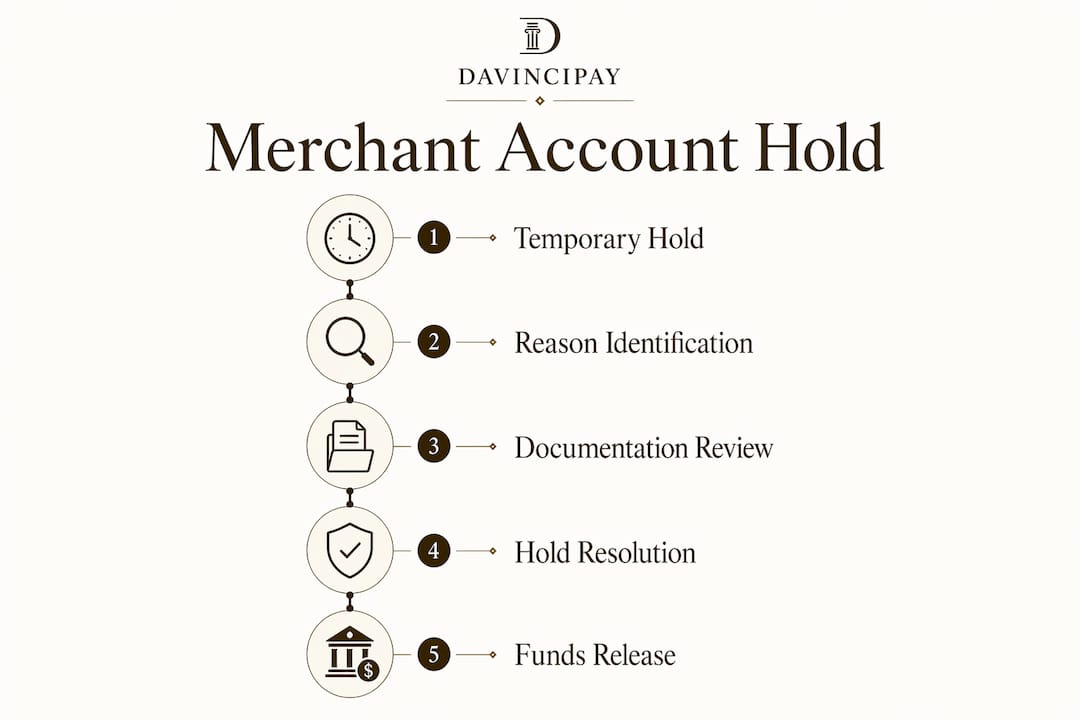
Here is how the process typically unfolds:
- Hold initiation: An automated risk flag or a manual review triggers the hold. The processor’s risk department takes over.
- Classification: The risk team determines whether the hold is transaction-level or account-level. This classification affects both the duration and the documentation required.
- Merchant notification: You receive a notification through your processing dashboard or by email. The notice should explain what triggered the hold and what documentation the processor needs.
- Documentation review: You submit the requested materials. The risk team reviews them and either releases the funds, limits the account further, or escalates the investigation.
- Resolution or escalation: If documentation is complete and satisfactory, funds are released. If the processor finds deeper concerns, the hold can escalate to a freeze or termination.
The cash flow impact is real and immediate. Payroll, supplier payments, and operating expenses don’t pause because your processor is running a review. Transaction-level holds often clear within 1–14 days. Account-level holds can take weeks, and edge cases can remain on hold for several months.
Customer refunds are also affected. If a customer requests a refund during a hold, processing that refund may be delayed or complicated by the restricted account status. Clear communication with customers during this period protects your reputation even when funds are temporarily inaccessible.
Your legal position matters here. Your merchant services agreement gives processors broad authority to hold funds under risk-related conditions. Most agreements also include mandatory arbitration clauses, meaning disputes must go through private arbitration rather than court. Before you can challenge a hold, you need to read your contract, specifically the sections covering reserves, holds, termination, and fund release. If your processor holds funds beyond what your contract specifies, you have grounds to file a formal complaint or seek legal counsel.
How to lift a merchant account hold efficiently
Speed is your biggest asset when responding to a hold. Resolving a hold requires promptly contacting the processor’s risk department and providing complete documentation. Failure to respond, or submitting partial information, unnecessarily extends the hold.
Follow these steps as soon as you receive a hold notification:
- Contact the risk department in writing. Email creates a documented record. Request the specific reason for the hold and the exact documentation required.
- Gather your documentation immediately. The most commonly requested materials include:
- Supplier invoices and purchase orders
- Fulfillment records and shipping confirmations with tracking numbers
- Customer transaction evidence and order histories
- Return and refund policy documentation
- Business license or registration if requested
- Submit everything at once. Piecemeal submissions slow the review. Send a complete, organized package.
- Provide clear explanations for anomalies. If a volume spike was caused by a seasonal promotion or a new product launch, say so in writing with supporting evidence.
- Track every communication. Log dates, times, names, and the content of every exchange with the processor’s risk team.
- Continue fulfilling orders. Keep your operations running normally. Customers should receive their orders on schedule, and your support team should communicate proactively about any payment-related delays.
Pro Tip: Maintaining clear, professional dialogue with the risk team consistently accelerates hold resolution. Merchants who respond defensively or go silent extend their own holds. Treat the risk team as a partner in the review, not an adversary.
Holds that involve a straightforward documentation review often resolve within a few weeks when the merchant responds promptly. Holds tied to chargeback investigations or suspected fraud patterns can extend to longer contractual periods. If you need to manage cash flow during the hold period, exploring cash flow strategies for slow-revenue periods can help bridge the gap.

One important caution: sudden operational changes during a hold can raise suspicion and potentially escalate a temporary hold into account closure. Hold off on restructuring your product catalog, changing your business model, or switching fulfillment providers until the review is complete.
How to prevent merchant account holds before they happen
Prevention is far less disruptive than resolution. The merchants who rarely deal with holds share a few consistent habits.
Choose the right processor from the start. The quality of your initial underwriting directly influences your hold risk. A processor that approves you quickly without a thorough risk assessment is calibrating its automated systems to a profile that may not match your real business. Work with a processor that understands your industry, your volume trajectory, and your chargeback exposure before you sign.
Build fraud prevention into your operations. Use Address Verification System checks, card verification value (CVV) requirements, and 3D Secure authentication on transactions where it applies. Fraud prevention tools reduce the transaction anomalies that trigger automated holds.
Keep your chargeback rate low. Clear product descriptions, accurate shipping timelines, and a straightforward refund policy reduce disputes before they become chargebacks. Respond to every dispute promptly with documentation.
Avoid sudden volume spikes without notice. If you’re running a major promotion or launching a new product that will significantly increase your processing volume, notify your processor in advance. A heads-up prevents the automated system from treating legitimate growth as a fraud signal.
Pro Tip: Review your merchant services agreement every 90 to 180 days, specifically the sections on reserves, holds, and termination. Processors update their risk policies, and knowing your current contractual exposure lets you negotiate reserve terms proactively rather than reactively.
Additional practices that reduce hold frequency:
- Maintain consistent, documented fulfillment standards with tracking on every order
- Settle your transaction batches daily rather than letting them accumulate
- Avoid manual card entry whenever possible, as it carries higher fraud risk
- Keep your business information current with your processor, including your website, product descriptions, and contact details
- Work with processors experienced in high-risk merchant categories, who build their underwriting and monitoring systems around the realities of your industry
Merchants in nutraceuticals, supplements, telehealth, and subscription billing face structurally higher hold risk because of their industry’s chargeback history. For those businesses, working with a processor that specializes in supplement payment processing or similar high-risk verticals is not optional. It’s the difference between a processor whose risk model fits your business and one that treats your normal operations as a red flag.
Davincipay: built for merchants who can’t afford payment disruptions
High-risk merchants don’t get the luxury of learning payment processing the hard way. A single hold at the wrong moment can delay payroll, stall supplier orders, and damage customer relationships you spent years building.

Davincipay works specifically with ecommerce brands, telehealth companies, nutraceutical and supplement merchants, and subscription businesses that need payment infrastructure built around their actual risk profile, not a generic one. That means thorough underwriting from day one, domestic and international acquiring relationships, fraud prevention tools, and chargeback mitigation support, all designed to reduce the conditions that trigger holds in the first place. When a hold does occur, you’re working with a team that understands the documentation process and can help you respond quickly and correctly.
If your current processor’s risk model doesn’t fit your business, the holds will keep coming. Apply now to see how Davincipay structures processing for merchants in your category.
Key Takeaways
A merchant account hold is a temporary, event-triggered withholding of specific funds by your processor, resolved through documentation, while a freeze is a full account restriction requiring formal investigation.
| Point | Details |
|---|---|
| Hold vs. freeze | A hold targets specific funds and typically lasts 1–14 days for event-driven holds, while an account-level freeze locks the entire account and can last up to 120 days. |
| Automated triggers | Risk algorithms flag deviations from your expected merchant profile, often before any human reviews the account. |
| Resolution speed | Responding promptly with complete documentation is the single most effective way to shorten a hold. |
| Post-termination exposure | Processors can hold funds for 90–180 days after account closure to cover late-arriving chargebacks. |
| Davincipay fit | Davincipay specializes in high-risk merchant underwriting and chargeback mitigation, reducing the conditions that trigger holds. |


.webp)
