.png)
Embedded payments let your customers complete a transaction inside your app or website, with no redirect to an external processor. The payment experience stays on your branded checkout, while the provider handles authorization, settlement, and compliance behind the scenes. For high-risk and regulated ecommerce merchants in the US, that distinction carries real weight: it reduces checkout abandonment, centralizes PCI DSS and NACHA compliance handling, and gives you tighter control over the customer experience. Watch for these signals when evaluating providers:
- APIs and SDKs that let you embed payment forms natively in your UI
- Tokenization so raw card data never touches your servers
- White-label checkout that keeps your branding intact
- Specialist underwriting from providers like Davincipay who understand high-risk verticals
Table of Contents
- What are embedded payments, and how do they differ from hosted checkout?
- How embedded payment systems actually work
- Why embedded payments benefit high-risk merchants specifically
- How to implement embedded payments as a high-risk merchant
- US compliance and risk considerations you need to plan for
- What embedded payments typically cost for high-risk merchants
- Where embedded payments add the most value by vertical
- How Davincipay supports high-risk merchants with embedded payments
- Key Takeaways
- Why specialist underwriting changes everything for regulated merchants
- Useful sources and further reading
What are embedded payments, and how do they differ from hosted checkout?
The definition of embedded payments is straightforward: the payment UI lives inside your merchant environment. The customer never leaves your site. That is the core difference from a hosted or redirect checkout, where the customer clicks “Pay” and lands on a processor-branded page before returning to your site.
Embedded payments are also distinct from “integrated payments,” a term that emphasizes back-office connectivity, such as syncing transaction data to your ERP or accounting platform. Integrated payments are operationally focused. Embedded payments are UX-first.
Embedded payments are also a subset of embedded finance. Embedded finance is the broader category that includes in-app lending, insurance, and accounts. Embedded payments focus specifically on transaction completion.
The actors in a typical embedded payment flow:
- Merchant front end: your app or website, where the customer enters payment details
- Payment provider/gateway: receives the encrypted data via API and routes it
- Acquiring bank: processes the authorization request with the card network
- Card networks/rails: Visa, Mastercard, or ACH/NACHA for bank debits
- Fraud and KYC suppliers: third-party services layered in by the provider
How embedded payment systems actually work
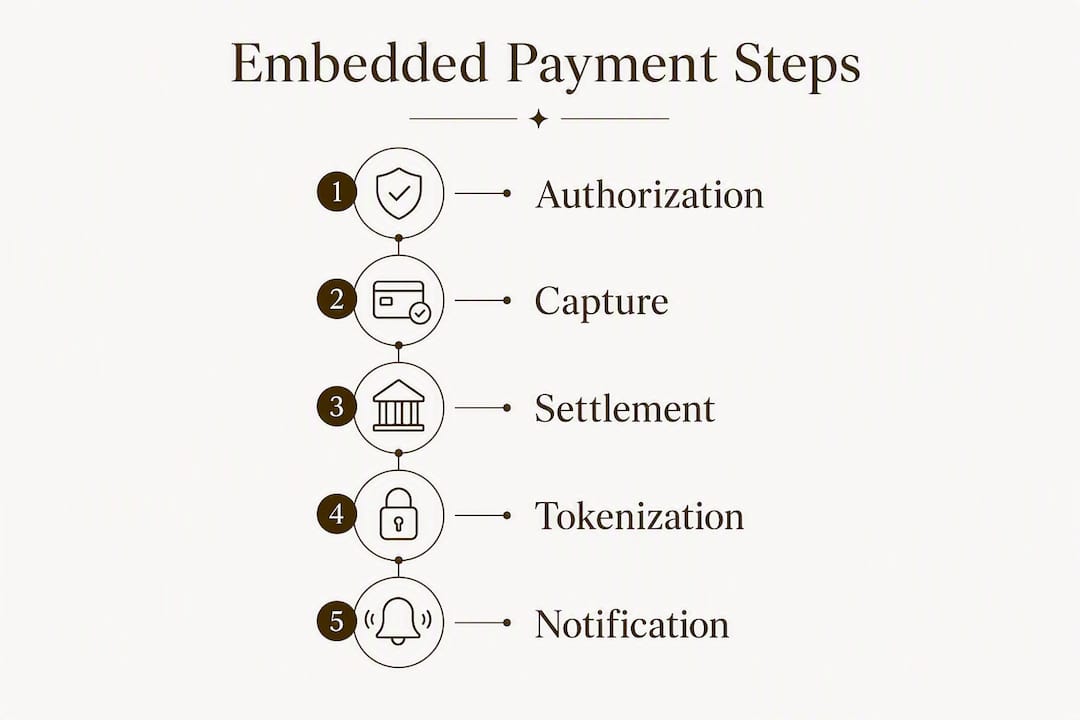
A typical embedded payment transaction moves through three stages: authorization, capture, and settlement. When a customer submits payment, your front end sends encrypted card data to the provider’s API. The provider routes it to the acquiring bank, which requests authorization from the card network. On approval, the transaction is captured and queued for settlement, usually within one to two business days depending on your agreement.

Integration patterns and PCI scope
There are three common ways to build this:
- Full API integration: your UI collects card data and sends it directly to the provider’s API. Highest flexibility, highest PCI DSS scope (SAQ D).
- SDK-based UI components: the provider’s SDK renders the payment fields inside your page. Card data goes directly to the provider, reducing your PCI scope to SAQ A-EP.
- Hosted iFrame: a provider-rendered form embedded in your page. Card data never touches your servers, reducing scope to SAQ A.
Tokenization is the security primitive that makes this work. The provider replaces raw card data with a non-sensitive token your system stores for recurring charges. Encryption in transit (TLS) protects data between the browser and the provider’s endpoint. Understanding financial data security threats is essential context for choosing the right integration pattern.
Developer tooling typically includes sandbox environments, test card numbers, webhooks for real-time event notifications, and reconciliation APIs for automated settlement matching.
Pro Tip: If your team lacks deep PCI expertise, start with a hosted iFrame. You trade some UI customization for a dramatically smaller compliance footprint, and you can migrate to an SDK pattern later as your team scales.
Why embedded payments benefit high-risk merchants specifically
Keeping checkout inside your brand experience is the primary conversion lever. When a customer sees a redirect to an unfamiliar processor page, trust drops, especially in high-risk verticals like supplements, telehealth, or subscription commerce where customers are already cautious about recurring charges.
Beyond conversion, the operational benefits compound quickly:
- Brand control: your logo, colors, and copy stay visible through the entire payment flow
- One-click repeat payments: stored tokens power subscription billing and upsell flows without re-entry friction
- Consolidated reporting: a single data feed covers authorizations, settlements, refunds, and chargebacks
- Provider-managed compliance: white-labeled providers handle authorization, settlement, and compliance infrastructure, reducing your internal burden
- Integrated fraud tools: scoring, device fingerprinting, and 3D Secure run at the provider layer, not as a bolt-on
Industry context: Visa frames embedded payments as a direct response to consumer expectations for frictionless transactions, including one-click checkout, pay-by-link, and in-app wallets.
For high-risk merchants, the compliance benefit is particularly concrete. When your provider manages tokenization and hosted components, they absorb a significant portion of your PCI DSS obligations. Your SAQ type shrinks, and your annual compliance effort follows.
How to implement embedded payments as a high-risk merchant
-
Select a provider with the right underwriting fit. Confirm they approve your vertical (supplements, telehealth, CBD, etc.), understand your chargeback profile, and offer the settlement timing and reserve structure your cash flow can support. Ask about supported rails: card networks, ACH, and digital wallets.
-
Choose your integration pattern. Map API/SDK vs. hosted iFrame to your PCI tolerance and UX requirements. A hosted iFrame gets you live faster with less compliance overhead. A full SDK integration gives you more control over the checkout experience.
-
Complete technical setup. Build in the sandbox first. Validate your tokenization flow, configure webhooks for authorization and chargeback events, set up error handling for declines, and connect your reconciliation feed.
-
Address compliance and operations. Confirm KYC/AML checks are active at account creation. Configure age verification and region restrictions for regulated products. Document your chargeback dispute workflow before you go live.
-
Test thoroughly before launch. Run test card and ACH flows for approvals, declines, and refunds. QA the customer UX on mobile and desktop. Conduct load testing if you expect traffic spikes. Plan a staged rollout to a subset of traffic first.
-
Monitor post-launch. Watch your chargeback ratio, authorization rate, and settlement timing in the first 30 days. Adjust fraud rules based on real transaction patterns.
Pro Tip: Before go-live, run a tabletop exercise with your team: simulate a chargeback spike and a fraud event. Walk through every step of your mitigation playbook. Gaps are much cheaper to fix in staging than after your first dispute wave.
US compliance and risk considerations you need to plan for
High-risk merchants face a tighter compliance environment than standard ecommerce. Plan for these specifically:
- PCI DSS scope: your integration pattern determines your SAQ type. A hosted iFrame limits scope to SAQ A. Full API integration requires SAQ D and a much broader set of controls. IT compliance standards for financial services provide useful context for scoping your obligations.
- ACH and NACHA rules: recurring debit transactions require written authorization from the customer, stored and producible on demand. Micro-deposit verification is standard for ACH onboarding. Excessive return rates trigger NACHA scrutiny and can result in account termination.
- Underwriting triggers: chargeback rates above 1% (Visa’s threshold) or product verticals with regulatory risk (nutraceuticals, telehealth, adult content) typically require rolling reserves. Expect a percentage of monthly volume held as a rolling reserve for several months, though your specific terms depend on your provider and risk profile.
- Chargeback mitigation: deploy 3D Secure for card-not-present transactions where appropriate, use fraud scoring and device fingerprinting at checkout, and enroll in dispute management programs your provider offers.
- KYC/AML and age verification: regulated products require identity checks at account creation and age gates at checkout. Sanctions screening should run at onboarding and on an ongoing basis.
Compliance note: this article is general information, not legal or compliance advice. Confirm current requirements with your legal counsel or a qualified compliance professional for your specific situation.
What embedded payments typically cost for high-risk merchants
High-risk pricing differs meaningfully from standard merchant rates. Here is what to expect across each cost component:
| Cost component | What to expect for high-risk merchants |
|---|---|
| Setup / integration fee | One-time fee; varies by provider and integration complexity |
| Monthly gateway fee | Fixed monthly charge for gateway access and support |
| Per-transaction rate | Base interchange plus a markup; higher than standard risk |
| ACH per-item fee | Per-transaction fee for ACH debits; lower than card rates |
| Chargeback fee | Per-dispute fee; can add up quickly at elevated chargeback rates |
| Rolling reserve | Percentage of monthly volume held; typically released on a several months cycle |
| Fraud/compliance tools | May be bundled or charged separately depending on provider |
Negotiation levers worth using: volume tiers (higher volume earns lower per-transaction rates), settlement cadence (faster settlement may carry a fee), blended pricing for mixed card types, and bundling fraud tools or chargeback management into your base agreement rather than paying add-on rates.
Where embedded payments add the most value by vertical
- Subscriptions and recurring billing: stored tokens power retry logic and dunning sequences without asking customers to re-enter card details. The entire lifecycle, from trial to renewal to cancellation, stays inside your branded experience.
- Telehealth and regulated services: telehealth payment flows benefit from consent capture, age verification, and integrated invoicing built directly into the clinical workflow. Patients never leave the platform to pay.
- Supplement and nutraceutical commerce: nutraceutical merchants need compliance gating, sales-quantity controls, and age or region restrictions enforced at checkout, not as an afterthought.
- Marketplaces and platforms: embedded payments handle seller onboarding, split settlements, and payout flows while keeping KYC controls active across all parties. Both merchant-embedded and platform-embedded patterns apply here.
How Davincipay supports high-risk merchants with embedded payments
Davincipay specializes in payment processing for high-risk and regulated ecommerce, with domestic and international acquiring relationships, gateway integration, fraud prevention, chargeback mitigation, recurring billing management, and real-time reporting. The how it works process covers API and SDK integration options alongside operational support for verticals including supplements, nutraceuticals, telehealth, subscription commerce, CBD, digital services, and more.
Typical onboarding stages:
- Application and underwriting: submit your business details, product vertical, and processing history. Davincipay reviews risk profile and determines reserve requirements.
- Integration planning: select your integration pattern (API, SDK, or hosted component) and map compliance requirements to your checkout flow.
- Sandbox testing: validate tokenization, webhooks, and reconciliation feeds in a test environment before touching live transactions.
- Go-live and monitoring: staged rollout with active monitoring of authorization rates, chargeback ratios, and settlement timing.
Operational support includes reserve handling, chargeback dispute management, tailored fraud rules by vertical, and dedicated underwriting review for merchants whose risk profile changes over time. Merchants ready to engage a specialist can apply for a merchant account directly.
Key Takeaways
Embedded payments give high-risk merchants a direct path to higher conversion, tighter compliance control, and a branded checkout experience, but the integration pattern you choose determines your PCI scope, cost, and go-live timeline.
| Point | Details |
|---|---|
| Definition | Embedded payments keep customers on your site; no redirect to an external processor page. |
| PCI scope matters | Your integration pattern (iFrame vs. API) determines your SAQ type and compliance burden. |
| High-risk pricing | Expect rolling reserves, higher per-transaction markups, and chargeback fees; negotiate volume tiers. |
| Specialist underwriting | High-risk verticals need a provider who understands your product risks, not a generic gateway. |
| Go-live safely | Sandbox testing, tabletop fraud exercises, and staged rollouts prevent costly post-launch surprises. |
Why specialist underwriting changes everything for regulated merchants
Most merchants underestimate how much their provider choice shapes their compliance exposure. A generic gateway approves your account and leaves you to figure out PCI scope, chargeback thresholds, and NACHA return rates on your own. A specialist provider builds those controls into the onboarding process.
The merchants I see struggle most are the ones who chose a standard processor to save a few basis points, then spent months fighting chargebacks and reserve holds they never anticipated. Embedded payments are the right architecture for regulated ecommerce. But the architecture only works as well as the provider behind it. Careful provider selection, thorough sandbox testing, and a clear chargeback playbook before go-live are not optional steps. They are the difference between a payment stack that scales and one that creates operational drag from day one. Davincipay’s focus on high-risk underwriting and compliance support is exactly the kind of specialist backing that makes embedded payments a durable advantage rather than a liability.
Useful sources and further reading
- What are embedded payments? | Plaid — embedded payments vs. embedded finance, merchant and platform patterns
- Embedded payments | Visa Acceptance Solutions — industry framing for frictionless UX and one-click checkout
- IT Compliance Standards for Financial Services | 247Techify — IT and compliance standards relevant to payment systems
- Davincipay | High-Risk Payment Processing — specialist provider for high-risk and regulated ecommerce merchants in the US


.webp)
