.png)
Cross-border payment processing is the end-to-end system that moves funds between a payer in one country and a payee in another, and it operates across two distinct legs: a messaging leg (instructions routed via networks like SWIFT or ISO 20022) and a settlement leg (actual funds movement through correspondent banks or alternative rails). For high-risk ecommerce merchants, the FX spread between the mid-market rate and your merchant-facing rate is typically the largest hidden cost in the entire transaction chain.
Three things to check before you sign with any international payment processor:
- FX transparency: Demand corridor-level pricing and mid-market rate comparisons in your reconciliation reports.
- Orchestration plus funds movement: Confirm the provider handles both the messaging layer and the actual settlement, not just one.
- Underwriting for your vertical: Verify the processor has approved merchants in your specific category, whether that’s supplements, telehealth, or subscription commerce. Davincipay specializes in exactly these verticals.
Table of Contents
- How does cross-border payment processing actually work?
- Why is cross-border processing harder for high-risk merchants?
- What payment rails move cross-border funds today?
- How do FX spreads and fees actually drive your cross-border costs?
- How do you choose the right cross-border payment partner?
- How Davincipay supports US high-risk merchants for cross-border processing
- Key Takeaways
- Why cross-border processing for high-risk merchants is where we focus
- Davincipay is built for merchants who can’t afford payment disruptions
- Authoritative references and further reading
How does cross-border payment processing actually work?
A cross-border transaction moves through six distinct stages, and knowing each one helps you pinpoint where delays and fees accumulate.
- Authorization/acceptance. Your customer initiates payment via card or ACH. The acquiring bank checks card validity, available funds, and basic fraud signals before approving the transaction.
- Messaging. Payment instructions travel across a messaging network. SWIFT is the dominant standard for bank-to-bank flows; ISO 20022 is the structured-data format now replacing older formats across most major corridors.
- Routing and orchestration. An orchestration layer (your processor or gateway) decides which rail and which correspondent path to use, based on corridor, cost, and compliance requirements.
- Intermediary/correspondent legs. Funds typically pass through multiple intermediaries before reaching the recipient bank. Each hop can add fees and a processing delay.
- FX conversion. Currency conversion happens at one or more points in the chain. The spread applied at each conversion point is where value quietly disappears.
- Settlement and reconciliation. The recipient bank credits the payee. Your finance team then reconciles the settled amount against the original transaction, checking for spread leakage and intermediary deductions.
A simple way to visualize the flow: Merchant → Messaging/Orchestration Layer → Rails and Intermediaries → Recipient Bank. Each node is a potential failure point and a cost event.
Domestic payment rails are not directly connected internationally. Mismatched operating hours and settlement cut-offs across time zones create liquidity gaps that hit high-volume subscription businesses hardest — a batch that misses a cut-off in one corridor can delay settlement by a full business day or more.
Pro Tip: Ask your processor for a corridor-by-corridor settlement schedule before you go live. Knowing the cut-off times for your top five markets lets your treasury team plan cash flow instead of reacting to surprises.
Why is cross-border processing harder for high-risk merchants?
High-risk and regulated ecommerce merchants face extra underwriting scrutiny, mandatory sanctions screening, higher chargeback exposure, and restricted acquiring corridors that standard merchants never encounter. That combination makes every leg of the transaction more complicated.
Specific friction points include:
- Extended underwriting: Processors require more documentation for regulated verticals (supplements, telehealth, CBD, adult, gaming), and approval timelines are longer.
- AML/KYC and OFAC screening: Every leg of a cross-border transaction can trigger a compliance check. OFAC sanctions lists and FinCEN requirements apply at the US end; foreign regulators add their own layers.
- Higher chargeback rates and longer reversal windows: International card transactions carry extended dispute windows, and high-risk categories already operate near network chargeback thresholds.
- Restricted acquiring corridors: Some card networks and correspondent banks simply won’t process certain verticals in certain countries, forcing rerouting that adds cost and latency.
- Reserve requirements: Processors routinely hold rolling reserves (often 5–10% of volume) for high-risk merchants, tying up working capital. If you need additional liquidity during onboarding, non-bank lenders can bridge that gap faster than traditional credit lines.
Pro Tip: Choose a processor that runs integrated compliance screening (KYC, KYT, OFAC) at the orchestration layer, not just at onboarding. Catching a flagged transaction before it enters the correspondent chain prevents freezes that can take days to resolve.
Longer onboarding, reserve holds, and increased reconciliation work are common operational realities for high-risk merchants. Build them into your launch timeline.

What payment rails move cross-border funds today?
No single rail fits every corridor, every transaction size, or every compliance profile. Orchestration across multiple rails is a genuine competitive advantage, not a marketing claim.
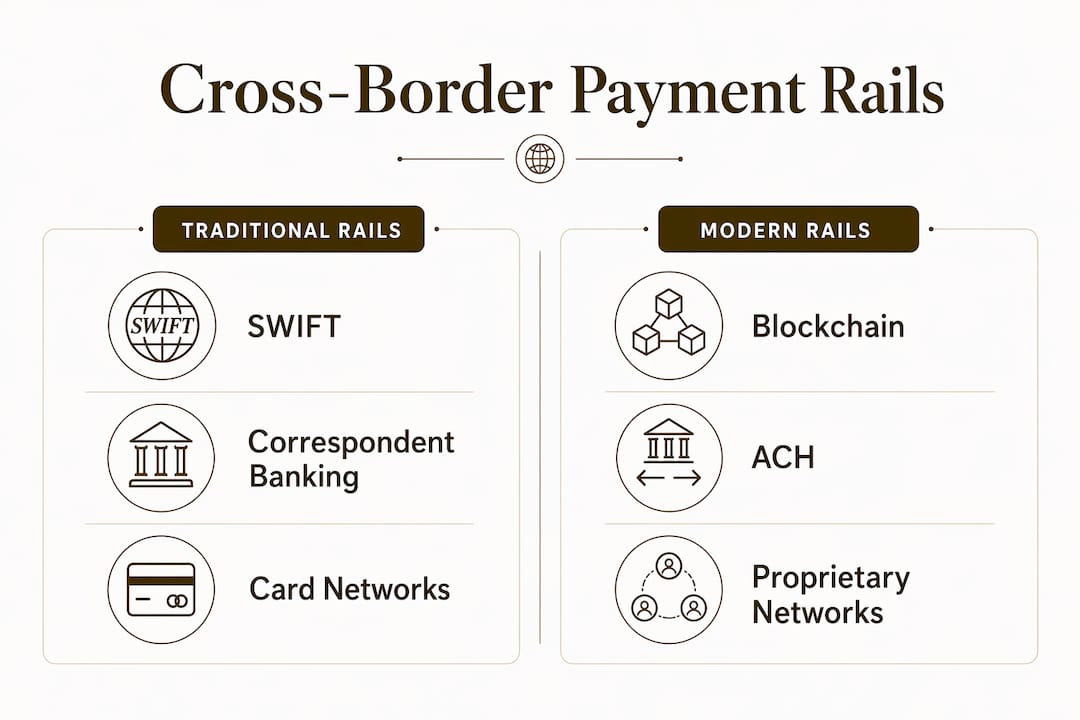
Correspondent banking and SWIFT remain the backbone for large-value B2B flows. SWIFT handles messaging only; actual settlement still relies on correspondent relationships between banks. The ISO 20022 migration, completed through 2025, delivers richer structured remittance data that reduces manual reconciliation and supports automated compliance checks.
Card networks let you accept payments globally and handle currency conversion automatically, but fees can be steep and chargeback rules vary by corridor. For high-risk ecommerce, card-on-foreign-rail transactions carry additional scrutiny.
ACH is cost-effective for recurring B2B payments but settles over several business days and doesn’t support real-time authorization, which limits its use for retail checkout flows.
Proprietary networks that combine messaging and funds movement behind a single connection can offer greater transparency and lower intermediary fees for specific corridors. They reduce integration overhead and give you a single point of accountability.
Blockchain and stablecoin rails settle on-chain in seconds to minutes and operate 24/7, but fiat on/off-ramps introduce additional fees and compliance checkpoints that partially offset the speed advantage.
The ISO 20022 migration is the most consequential near-term shift for US merchants. Providers that preserve structured data end-to-end reduce your reconciliation load and support automated compliance, which matters especially when you’re processing across multiple regulated corridors.
How do FX spreads and fees actually drive your cross-border costs?
The FX spread — the gap between the wholesale mid-market rate and the rate applied to your transaction — typically eclipses per-transaction fees for B2B cross-border flows. Most merchants focus on the wire fee and miss the spread entirely.
The full cost stack includes:
- Interchange: Card network fee, paid by the acquiring bank and passed to you.
- Acquirer/processor fee: Your processor’s per-transaction or percentage charge.
- Correspondent/intermediary fees: Each bank in the chain may deduct a fee before passing funds along.
- Fixed wire fees: Flat charges per outbound wire, often $15–$45 per transaction (ranges vary by bank and corridor).
- FX spread/markup: The difference between mid-market and merchant-facing rate, often 0.5%–3% or more depending on the corridor and provider.
Illustrative example: On a $10,000 USD outbound payment, a 1.5% FX spread costs $150 before you add wire fees and intermediary deductions. On a subscription business processing $500,000 per month internationally, a 1.5% spread represents $7,500 monthly in spread leakage alone.
| Cost Component | Typical Range | Visibility |
|---|---|---|
| Interchange | 1.5%–3% | Usually disclosed |
| Acquirer/processor fee | 0.5%–1.5% | Usually disclosed |
| Correspondent/intermediary fees | $15–$45 per transaction | Often opaque |
| Fixed wire fee | $15–$45 per wire | Usually disclosed |
| FX spread/markup | 0.5%–3%+ | Frequently opaque |
Ask every provider for mid-market rate references in their reconciliation reports. If they can’t show you the spread per corridor, that’s a red flag.
How do you choose the right cross-border payment partner?
The decision rule is straightforward: choose a partner that handles both messaging and funds movement, discloses FX pricing at the corridor level, and has approved merchants in your specific vertical.
| Dimension | What to Evaluate |
|---|---|
| Messaging vs. funds movement | Does the provider own both legs, or rely on opaque correspondent chains? |
| FX transparency | Do reconciliation reports show mid-market rate vs. merchant rate per corridor? |
| Underwriting and high-risk support | Has the provider approved merchants in your vertical (supplements, telehealth, subscriptions)? |
| Fraud and chargeback mitigation | What tools and SLAs cover disputes and reversals for international transactions? |
| API/gateway integration and reporting | Single API for orchestration, real-time reporting, and reconciliation? |
| Settlement frequency | Daily, weekly, or rolling? What are the cut-off times per corridor? |
| Pricing components | Are interchange, spread, intermediary fees, and wire fees all itemized? |
Questions to ask in your first sales call:
- Do you perform FX conversions directly, or route to local banks?
- How do you calculate FX spreads, and will you show me corridor-level examples?
- What documents do you require for underwriting in my industry?
- Do you provide reconciled reports that compare mid-market rates to the rates applied to my settlements?
- What is your typical time-to-approval for a merchant in my vertical?
- How do you handle chargeback disputes on international card transactions?
Red flags: No FX transparency, opaque correspondent chains with no visibility, refusal to share settlement timelines, vague chargeback handling, and no track record with your vertical.
For busy ops teams, prioritize FX transparency and underwriting fit first. Integration quality and reporting depth are important but can be validated during onboarding.
How Davincipay supports US high-risk merchants for cross-border processing
Davincipay’s core promise is specialized underwriting combined with integrated orchestration and transparent FX reporting, built specifically for regulated and high-risk ecommerce merchants.
Key capabilities include:
- Domestic and international acquiring relationships across multiple corridors, reducing dependence on a single correspondent chain.
- Unified gateway and API for orchestration, fraud prevention, and real-time reporting in one integration.
- Fraud prevention and chargeback mitigation tools designed for high-risk transaction profiles, including subscription and recurring billing flows.
- Reconciliation and reporting that surfaces mid-market rate comparisons so your finance team can quantify spread leakage by corridor.
- Underwriting support for regulated verticals: nutraceuticals, supplements, telehealth, CBD, wellness, digital services, financial lending, gaming, adult, dating, and online tobacco.
Supplement brands typically benefit from faster onboarding because Davincipay’s underwriting team already knows the documentation requirements for that category. Telehealth operators get compliance controls built into the payment flow. Subscription merchants get recurring billing management with ACH support and age/compliance controls that reduce chargebacks before they start.
Pro Tip: Before you apply, prepare your processing history (three to six months of statements), chargeback ratio data, and a clear description of your product or service. Complete documentation shortens underwriting time significantly.
To start, apply for a merchant account or request a consultation directly through Davincipay’s site.
Key Takeaways
Cross-border payment processing requires managing two separate legs — messaging and settlement — and the FX spread between those legs is consistently the largest hidden cost for high-risk ecommerce merchants.
| Point | Details |
|---|---|
| Messaging vs. settlement are separate | Treat them as distinct legs; a provider that owns both reduces failure points and gives you accountability. |
| FX spread is the major hidden cost | Recurring spread on subscription revenue compounds fast; demand corridor-level reporting from every provider. |
| Orchestration is a competitive advantage | A provider that routes across rails based on cost, speed, and compliance reduces freezes and delays. |
| High-risk merchants need vertical-specific underwriting | Generic processors won’t approve regulated verticals; confirm track record in your category before signing. |
| Davincipay serves US high-risk merchants | Davincipay provides international acquiring, fraud prevention, chargeback mitigation, and FX-transparent reporting for regulated ecommerce. |
Why cross-border processing for high-risk merchants is where we focus
Most payment processors treat high-risk merchants as an afterthought, offering standard rails and generic underwriting that wasn’t built for regulated ecommerce. We built Davincipay around the opposite premise: that supplement brands, telehealth operators, and subscription merchants deserve the same quality of cross-border infrastructure that enterprise retailers take for granted.
The pain points we hear most often are unexpected freezes from opaque correspondent chains, FX costs that only surface in month-end reconciliation, and processors who approved the account but can’t support the volume or the vertical at scale. Those are solvable problems. Transparent FX reporting, integrated compliance screening, and underwriting teams that know your category are the difference between reliable settlement and a frozen account at the worst possible moment.
Davincipay is built for merchants who can’t afford payment disruptions
High-risk ecommerce merchants need a processor that understands their vertical before the first transaction, not one that learns on the job. Davincipay brings domestic and international acquiring, transparent FX reporting, and chargeback mitigation to regulated merchants who need reliable cross-border settlement from day one.

Getting started is straightforward. Apply now and submit your processing history, chargeback data, and business documentation. Davincipay’s underwriting team reviews applications for regulated verticals including supplements, telehealth, subscriptions, and CBD. Typical onboarding includes a rolling reserve discussion, corridor-level FX pricing disclosure, and a clear settlement schedule before you go live. Need working capital while reserves are being established? A fast-funding partner can help bridge that gap. Visit Davincipay.ai for a full overview of services, or go straight to the application and get your account in review today.
This article is general information, not legal or financial advice. Confirm current regulatory requirements with a qualified professional or the relevant primary authority for your specific situation.
Authoritative references and further reading
These sources support the claims in this article and provide additional depth for operations and compliance teams evaluating cross-border payment infrastructure.
- BIS Paper: Cross-Border Payment Technologies — Bank for International Settlements analysis of interoperability challenges, ISO 20022 adoption, and governance gaps in cross-border payment systems. Essential reading for understanding why back-end complexity persists despite front-end innovation.
- Axon: Cross-Border Payments Business Guide — Detailed taxonomy of cross-border flows, FX spread mechanics, correspondent banking model, and stablecoin rail trade-offs. Covers messaging vs. settlement distinction in depth.
- NetSuite: Cross-Border Payments Types and Challenges — Practical breakdown of ACH vs. wire transfer trade-offs, required beneficiary data fields, and operational controls for reconciliation.
- Thunes: What Are Cross-Border Payments? — Explains proprietary network advantages for combining messaging and funds movement, with corridor-level transparency benefits.
- Davincipay.ai — Publisher overview of high-risk merchant services, international acquiring, and compliance infrastructure for regulated ecommerce verticals.


.webp)
