.png)
A payment processor is defined as a company or service that manages the transfer of funds between a customer’s bank and a merchant’s bank account during an electronic transaction. Every time a customer pays by credit card, debit card, or digital wallet, a payment processor handles the authorization, security checks, and settlement behind the scenes. Understanding how this system works gives you direct control over your costs, your cash flow, and your ability to accept payments reliably. The key players in every transaction are the customer, the merchant, the issuing bank, the acquiring bank, and the card network.
What is a payment processor and how does it fit into your business?
A payment processor is the technical and financial intermediary that connects your business to the global card payment infrastructure. Without one, you cannot accept credit cards, debit cards, or digital wallets. The processor communicates between your payment gateway, the card networks (Visa, Mastercard, American Express, Discover), the customer’s issuing bank, and your acquiring bank.

Card networks set the rules and fee structures that all processors must follow. Card-issuing banks charge interchange fees set by those networks, and U.S. Regulation II places a cap on debit interchange fees specifically. This regulatory layer directly affects the pricing you see on your merchant statement.
The payment processor definition extends beyond just moving money. Processors also enforce fraud screening, manage compliance with PCI DSS (Payment Card Industry Data Security Standard), and handle dispute resolution when chargebacks occur. For small business owners, this means your processor is not just a vendor. It is a compliance partner.
Pro Tip: Ask any processor you evaluate whether they are a direct acquirer or a third-party reseller. Direct acquirers typically offer faster funding and more direct dispute resolution.
How does a payment processor work to complete a transaction?
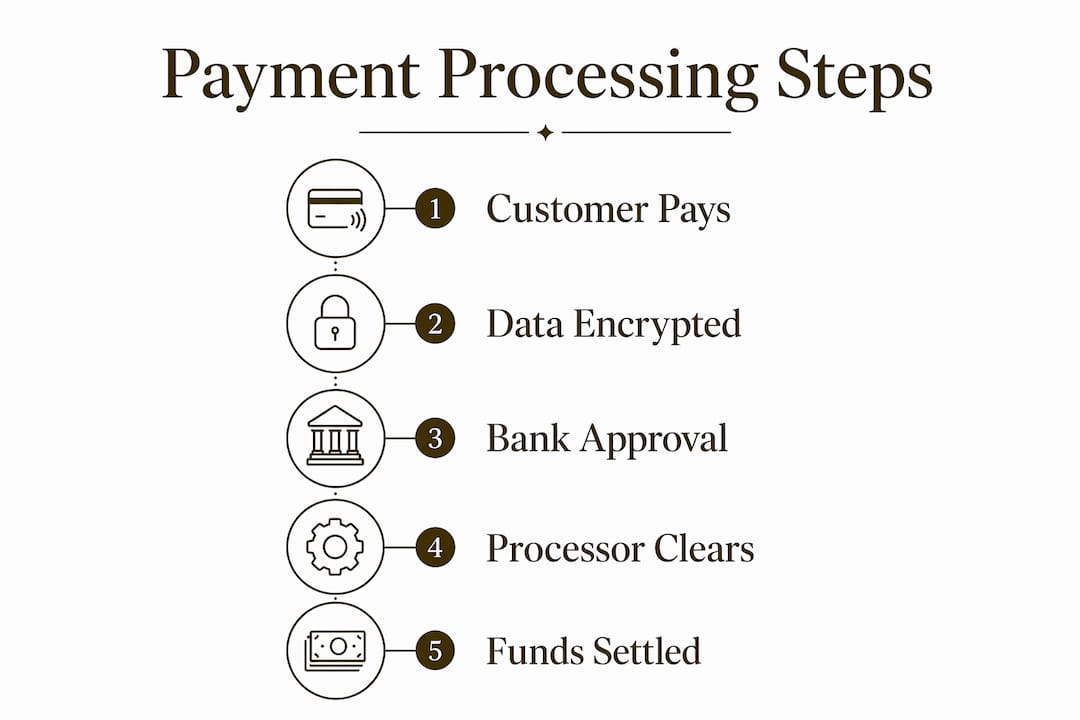
The transaction flow follows four distinct stages: authorization, authentication, clearing, and settlement. Each stage involves a different set of institutions and checks.
- Authorization. The customer presents a card or digital wallet. Your payment gateway encrypts the data and sends it to your acquiring bank. The acquiring bank forwards the request through the card network to the customer’s issuing bank. The issuing bank checks for available funds, fraud signals, and account status, then returns an approval or decline code within seconds.
- Authentication. For card-not-present transactions (online purchases), additional verification steps apply. These include CVV checks, AVS (Address Verification System) matching, and 3D Secure protocols like Visa Secure or Mastercard Identity Check. These steps reduce fraud before a transaction is approved.
- Clearing. After authorization, the transaction details move through the card network for reconciliation. The issuing bank confirms the final amount, and the acquiring bank records the obligation.
- Settlement. The actual funds transfer from the issuing bank through the card network to your acquiring bank, and then into your merchant account. Traditional systems delay funds 2 to 5 business days, while modern processors offer next-day or same-day funding. Faster funding directly improves your operating cash flow.
Throughout this process, the processor runs real-time fraud checks and logs transaction data for reporting. The authorization step happens in under three seconds. Settlement takes longer because it involves actual bank-to-bank fund movement across multiple institutions.
Pro Tip: If cash flow is tight, prioritize processors that offer next-day or same-day funding. The difference between a 2-day and 5-day funding window can affect whether you cover payroll or restock inventory on time.
What payment processor types exist and how do pricing models work?
Payment processors fall into two broad categories based on how they price their services: flat-rate processors and interchange-plus processors. Your monthly processing volume determines which model costs you less.
Flat-rate pricing
Flat-rate processors charge a single percentage plus a fixed fee per transaction, regardless of card type. Businesses processing under $10,000 monthly benefit most from flat-rate pricing, with typical fees running 2.6%–2.9% plus $0.15–$0.49 per transaction. The advantage is simplicity. You know exactly what each sale costs without decoding a complex statement.
Interchange-plus pricing
Interchange-plus pricing separates the interchange fee (set by the card network and paid to the issuing bank) from the processor’s markup. Interchange fees range from 1.3% to 3.3% plus a fixed fee, depending on card type and transaction method. The processor adds a fixed margin on top. This model is more transparent and typically cheaper for businesses processing $10,000 to $100,000+ monthly.
| Pricing model | Best for | Transparency | Typical cost driver |
|---|---|---|---|
| Flat-rate | Low-volume merchants | Low | Predictable per-transaction fee |
| Interchange-plus | Mid to high-volume merchants | High | Interchange rate plus fixed margin |
Hidden fees are a real cost factor. Hidden fees can add 15–30% to your annual processing costs. These include monthly minimums, PCI compliance fees, batch fees, and chargeback fees. Always request a full fee schedule before signing.
Key questions to ask before choosing a pricing model:
- What is your average monthly processing volume?
- Do you accept premium rewards cards, which carry higher interchange rates?
- Do you need international card acceptance, which adds cross-border fees?
- How often do you experience chargebacks?
Pro Tip: Request a sample merchant statement from any processor before signing. If they refuse, treat that as a red flag. Transparent processors show you exactly what you will pay.
What payment methods do processors support?
Modern payment processors support a wide set of payment methods beyond traditional credit and debit cards. The range now includes:
- Credit and debit cards. Visa, Mastercard, American Express, and Discover remain the dominant card networks.
- ACH transfers. Automated Clearing House payments move funds directly between bank accounts, typically at lower cost than card transactions.
- Digital wallets. Apple Pay, Google Pay, and PayPal process payments using tokenized card credentials stored on a device.
- Buy Now, Pay Later (BNPL). Services like Affirm and Klarna split purchases into installments, funded upfront to the merchant.
Consumer demand for multi-channel payment acceptance drives this expansion. Businesses that accept only cards leave revenue on the table from customers who prefer digital wallets or bank transfers.
Businesses scaling internationally must prioritize multi-currency support. A processor with local acquiring capabilities in your target markets reduces cross-border fees and improves authorization rates. A U.S.-based supplement brand selling into Canada, the UK, or Australia, for example, will see meaningfully higher approval rates when their processor has local acquiring relationships in those regions. Davincipay specializes in exactly this type of international acquiring infrastructure for nutraceutical and supplement businesses.
Fraud management and real-time analytics are now standard features in modern processors, not premium add-ons. Real-time dashboards let you monitor transaction patterns, flag suspicious activity, and respond to chargebacks before they escalate.
What advanced features help businesses scale?
The best payment processors for growing businesses go beyond basic transaction handling. Advanced capabilities separate processors built for scale from entry-level options.
Multi-PSP orchestration
Multi-PSP (payment service provider) orchestration routes each transaction through the processor most likely to approve it. Multi-PSP orchestration and smart routing increase approval rates by 6–10% and reduce failed charges. For a business processing $50,000 monthly, a 6% improvement in approval rates translates directly into recovered revenue. This technology is an emerging competitive advantage, particularly for subscription merchants who face recurring billing declines.
Developer APIs and customization
Fast-growing businesses benefit from processors offering APIs for customization, subscription management, and marketplace payouts. A telehealth platform, for example, needs subscription billing logic, patient payment plans, and HIPAA-adjacent data handling. A generic processor cannot support that. Developer-friendly platforms let you build payment flows that match your exact business model. Davincipay supports telehealth providers with exactly this kind of specialized infrastructure.
Embedded finance and value-added services
Advanced processors now offer working capital advances, business intelligence dashboards, and chargeback mitigation tools as part of their service stack. These features reduce the number of third-party vendors you need to manage. Chargeback management is especially critical for high-risk merchants, where dispute rates can trigger account termination if left unmanaged.
The best payment processor for your business depends on your volume, your global reach, and whether you need multi-currency support. There is no single right answer. A local retail business and a subscription ecommerce brand have fundamentally different needs.
Key takeaways
A payment processor is the core infrastructure connecting your business to every electronic payment method your customers use, and choosing the wrong one costs you money, approvals, and time.
| Point | Details |
|---|---|
| Payment processor definition | A processor manages authorization, clearing, and settlement between customer banks and merchant accounts. |
| Pricing model choice | Flat-rate suits low-volume merchants; interchange-plus saves money above $10,000 monthly. |
| Hidden fees matter | Hidden fees can add 15–30% to annual costs, so always request a full fee schedule. |
| Advanced routing improves revenue | Smart routing and multi-PSP orchestration increase approval rates by 6–10%. |
| Match processor to business needs | Volume, payment methods, and global reach should drive your processor selection. |
What I have learned about choosing a payment processor
The conversation around payment processors almost always focuses on rates. That is the wrong starting point.
I have seen small business owners sign up for the lowest advertised rate, only to discover that monthly minimums, PCI fees, and chargeback penalties pushed their effective rate well above what a slightly higher flat-rate processor would have charged. The advertised rate is a marketing number. The effective rate is what you actually pay.
The second mistake I see constantly is choosing a processor based on current volume rather than projected volume. If you are processing $8,000 a month now but expect to hit $25,000 within a year, you should be evaluating interchange-plus processors today. Switching processors mid-growth is disruptive and sometimes costly if you are locked into a contract.
The third issue is underestimating the importance of approval rates. A processor with a slightly higher fee but a 6% better approval rate on recurring billing will almost always generate more net revenue. Declined transactions are invisible losses. They do not show up on your statement, but they absolutely show up in your revenue.
My honest recommendation: prioritize transparent pricing, fast funding, and a processor that has direct experience in your industry vertical. A generic processor that serves every type of business equally well usually serves no type of business especially well. If you operate in a regulated or high-growth sector, find a processor that has underwritten merchants like you before.
— Peter
Davincipay’s approach to payment processing for growing businesses
Davincipay works with ecommerce brands, telehealth companies, supplement merchants, and other businesses that need more than a generic payment account. We offer interchange-plus pricing with full fee transparency, support for multiple payment methods, and fast funding designed to keep your cash flow predictable.

Whether you are launching your first online store or scaling a subscription business internationally, Davincipay provides the acquiring relationships, fraud prevention tools, and chargeback mitigation support your business needs. We understand the compliance demands and processing challenges that come with high-growth and regulated industries. Apply for an account and get a payment solution built around your actual business model, not a one-size-fits-all setup.
FAQ
What is the payment processor definition in simple terms?
A payment processor is a company that handles the transfer of funds between a customer’s bank and a merchant’s bank during an electronic transaction. It manages authorization, fraud checks, and settlement on behalf of the merchant.
How does a payment processor work for online payments?
The processor encrypts the customer’s payment data, sends it through the card network to the issuing bank for approval, then facilitates the transfer of funds to the merchant’s account. Authorization happens in seconds; settlement typically takes 1–5 business days depending on the processor.
What are the main payment processor types by pricing model?
The two primary models are flat-rate pricing and interchange-plus pricing. Flat-rate works best for merchants processing under $10,000 monthly; interchange-plus offers better value at higher volumes.
What are the advantages of payment processors for small businesses?
Payment processors give small businesses access to card networks, fraud protection, chargeback management, and multi-method payment acceptance without building that infrastructure themselves. They also provide real-time reporting and compliance support.
How do I avoid hidden fees when choosing a processor?
Request a complete fee schedule before signing any agreement. Hidden fees including PCI compliance fees, batch fees, and monthly minimums can add 15–30% to your annual processing costs if left unexamined.


.webp)
