.png)
A payment gateway is the software layer that securely captures, encrypts, and transmits payment data to authorize online transactions between a buyer, a merchant, and their respective banks. Think of it as the digital equivalent of a card terminal at a physical store, except it operates entirely in the background of your website or app. Gateways like Stripe and Braintree handle the critical handoff between a customer entering card details and a merchant receiving confirmation that funds are available. Without a payment gateway, no online transaction can be authorized, verified, or completed securely.
What is a payment gateway and how does it fit into online payments?
A payment gateway is defined as the technology that connects a merchant’s checkout environment to the payment networks and acquiring banks that move money. It sits between the customer’s browser or app and the financial infrastructure behind every card transaction. The gateway performs three core functions: encryption of sensitive card data, real-time authorization requests sent to the issuing bank, and secure transmission of approval or decline responses back to the merchant.
The payment gateway definition is often confused with the payment processor. These are distinct roles. The processor handles the actual movement of funds between banks after authorization. The gateway is the front-end technology that captures and secures the data before it ever reaches the processor. JPMorgan describes the gateway as the digital point of sale that initiates the transaction flow, while the processor executes the financial settlement downstream.

Named entities matter here. Stripe, Braintree (a PayPal service), and Authorize.Net are among the most recognized payment gateway services in the market. Each connects to acquiring banks and card networks like Visa and Mastercard through standardized APIs and hosted payment pages.
How payment gateways work step by step
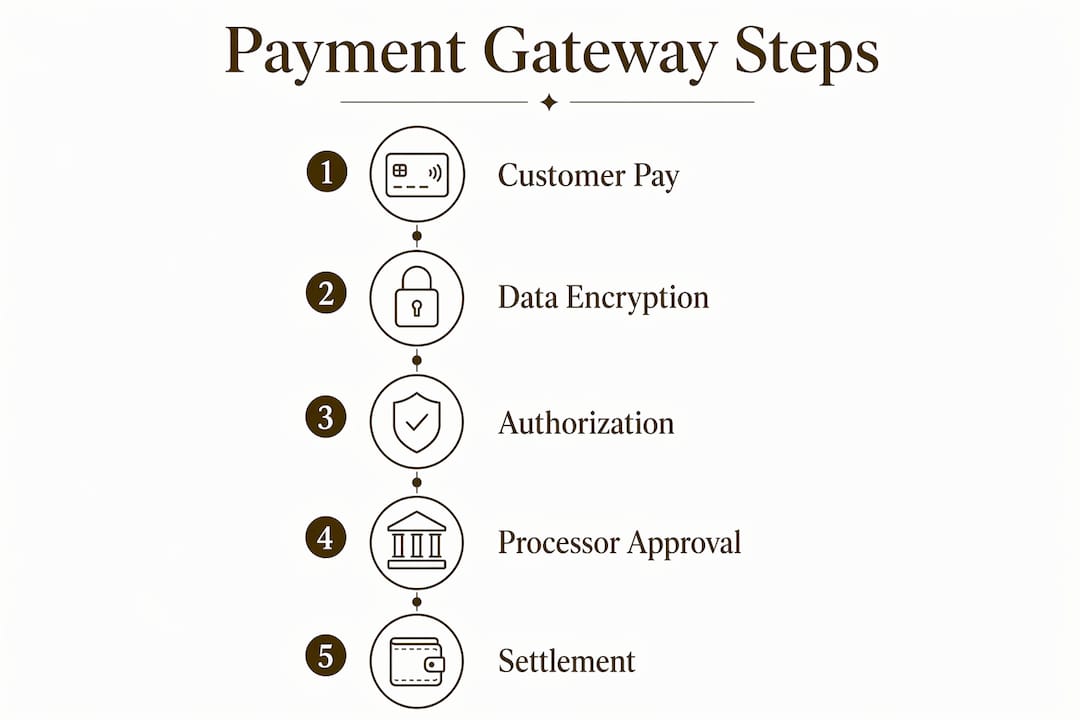
Understanding how payment gateways work requires following a transaction from the moment a customer clicks “Pay Now” to the moment funds land in a merchant’s account. The process is faster than most people realize, yet it involves multiple systems communicating in sequence.
Pro Tip: Never assume an authorization means money is in your account. Build your cash flow planning around the one-to-three-day settlement window, not the instant approval notification.
Security and compliance standards payment gateways must meet
Payment gateways carry a legal and technical obligation to protect cardholder data. The primary standard governing this obligation is PCI DSS (Payment Card Industry Data Security Standard). Every gateway that handles card data must comply with PCI DSS requirements or risk losing the ability to process payments entirely.
Key security requirements include:
“The most dangerous security pitfall is assuming your gateway handles everything. Merchants still own responsibility for how card data is stored, displayed, and accessed within their own systems.”
Common mistakes include storing card numbers in plain text within order databases, skipping 3D Secure for high-risk transaction categories, and failing to update TLS configurations when older protocol versions are deprecated.
Hosted vs. integrated payment gateways: which is right for you?
The two primary gateway implementation types represent fundamentally different trade-offs between security responsibility and user experience control. Choosing between them is one of the most consequential technical decisions a merchant makes.
A hosted payment gateway redirects the customer from the merchant’s website to a secure payment page managed by the gateway provider. PayPal’s standard checkout and Stripe Checkout operate this way. The gateway provider owns the payment form, the encryption, and the PCI compliance for that page. The merchant never touches raw card data.
An integrated payment gateway embeds the payment form directly into the merchant’s website or app via API. APIs empower merchants to fully customize form design, branding, and payment options. The checkout experience feels native and uninterrupted. However, the merchant takes on greater security responsibility because card data passes through or originates within their environment.
FeatureHosted gatewayIntegrated gatewayPCI compliance burdenLower (provider manages)Higher (merchant manages)Checkout experienceRedirect to external pageNative, on-site experienceCustomizationLimitedFull control via APIDevelopment complexityLowMedium to highBest forSmall businesses, low dev resourcesEstablished merchants, custom UX needs
The security control responsibility shifts significantly depending on which model you choose. Hosted gateways handle encryption and form hosting entirely outside merchant systems. Integrated gateways require merchants to manage these aspects directly, which demands stronger internal security practices and more rigorous PCI compliance programs.
Pro Tip: If your development team is small or your business is early-stage, start with a hosted gateway. You can always migrate to an integrated model as your technical capacity and transaction volume grow. Migrating in the other direction is far more disruptive.
For a broader view of how gateways fit within your full ecommerce payment stack, understanding each component’s role prevents costly integration mistakes.
How to choose the right payment gateway for your business
Selecting among the best payment gateways requires evaluating more than just transaction fees. The right gateway depends on your industry, transaction volume, technical resources, and compliance obligations. Key selection factors include transaction fees, PCI compliance support, multi-currency handling, API flexibility, and 24/7 customer support availability.
Here are the criteria that matter most:
The most common mistake businesses make is choosing a gateway based solely on the lowest transaction fee. A gateway that lacks fraud tools, has poor uptime, or creates integration headaches will cost far more in chargebacks and lost sales than the fee savings ever justify.
Key takeaways
A payment gateway is the foundational technology that encrypts, authorizes, and transmits payment data, and choosing the wrong one directly impacts your security exposure, compliance obligations, and customer conversion rates.
PointDetailsGateway vs. processorThe gateway captures and secures data; the processor moves the funds. These are separate functions.Authorization vs. settlementAuthorization confirms funds in seconds; settlement transfers money within one to three business days.Hosted vs. integratedHosted gateways reduce PCI burden; integrated gateways offer full UX control but require stronger merchant security.Security is non-negotiablePCI DSS compliance, TLS 1.2+ encryption, and tokenization are required, not optional, for any legitimate gateway.Selection criteriaEvaluate cost, compliance support, scalability, payment method coverage, and integration fit before committing to a gateway.
Why most businesses underestimate gateway complexity
I have worked with enough merchants to say this plainly: the payment gateway is the most underestimated piece of infrastructure in e-commerce. Most businesses treat it as a commodity, pick whatever their platform recommends, and move on. That approach works fine until it doesn’t.
The authorization-versus-settlement confusion alone causes real operational problems. I have seen subscription businesses build their entire fulfillment workflow around authorization timestamps, then run into cash flow problems because settlement was delayed by three days during a bank holiday. That is a fixable problem, but only if you understand it exists before it hits your reconciliation reports.
The hosted-versus-integrated decision deserves far more deliberation than most businesses give it. The security responsibility shift is real and significant. An integrated gateway that is poorly configured creates PCI scope that a hosted gateway would have eliminated entirely. I have watched companies spend more on compliance remediation than they saved by building a custom checkout experience.
For high-risk merchants in sectors like telehealth, nutraceuticals, and supplements, the stakes are even higher. Standard gateways often decline these merchants outright or terminate accounts without warning. The gateway choice in these industries is not just a technical decision. It is a business continuity decision. Working with a provider that understands your industry’s compliance requirements and acquiring relationships from day one prevents the kind of mid-operation disruptions that are genuinely hard to recover from.
Get reliable payment gateway support from Davincipay
Davincipay specializes in payment processing for merchants who need more than a standard gateway setup. Whether you operate in telehealth, nutraceuticals, or supplements, Davincipay provides gateway access, fraud prevention tools, chargeback mitigation, and full PCI compliance support through domestic and international acquiring relationships.
High-risk merchants face unique challenges that off-the-shelf gateways are not built to handle. Davincipay’s underwriting support and specialized infrastructure give you a payment setup that holds up under scrutiny and scales with your business. Apply now to get started, or visit Davincipay to learn more about what the right payment infrastructure looks like for your industry.
FAQ
What is a payment gateway in simple terms?
A payment gateway is the technology that securely captures a customer’s payment details at checkout, encrypts them, and sends an authorization request to the bank. It acts as the digital connection between a merchant’s website and the financial networks that approve or decline transactions.
How is a payment gateway different from a payment processor?
The gateway captures and encrypts payment data at the point of sale; the processor handles the actual transfer of funds between the customer’s bank and the merchant’s account. Both are required for a complete transaction, but they perform separate functions.
What are the two main types of payment gateways?
The two main types are hosted gateways, which redirect customers to a secure external payment page, and integrated gateways, which embed the payment form directly on the merchant’s site via API. Hosted gateways reduce PCI compliance burden; integrated gateways offer greater customization and a native checkout experience.
How long does a payment gateway transaction take?
Authorization typically completes within 800 milliseconds to 1.5 seconds. Settlement, which is the actual transfer of funds to the merchant, occurs through batch processing and generally takes one to three business days after authorization.
Do payment gateways handle PCI compliance for merchants?
Gateways reduce PCI scope by encrypting and tokenizing card data before it reaches merchant systems, but merchants retain responsibility for how data is stored and accessed within their own environments. Full PCI compliance requires both a compliant gateway and sound merchant-side security practices.


.webp)