To stop revenue leakage, enable Account Updater (Visa’s VAU and Mastercard’s ABU), run decline-code-aware retries, and send pre-bill reminders with clear consent on file. Those three moves protect the most subscription revenue. Keep your billing aligned with the FTC Negative Option Rule, and work with a payments partner that supports recurring billing, as we do at Davincipay.
TL;DR:
- Account Updater generally lifts recurring billing by 2–4%, but processors may charge $0.25 to $0.50 per update, and network coverage is incomplete.
- Retry soft declines after 3–5 days, retry issuer outages within 4–24 hours, and stop immediately on hard declines while requesting new card details.
- Keep verifiable consent records for at least three years, disclose price and renewal terms before payment details, and make online cancellation as easy as signup.
- Keep digital access available briefly during payment recovery, but pause supplements or meal kit shipments until the outstanding payment clears.
Table of Contents
- What should you look for in a payments platform for wellness subscriptions?
- How do you recover failed payments without burning issuer goodwill?
- How does Account Updater work, and what does it cost?
- Which retention moves are tied to billing and member experience?
- What does the FTC Negative Option Rule require?
- How should you budget for subscription payment costs?
- What can we offer wellness merchants with complex billing?
- How long does it take to go live?
- How does payment processing integrate with wellness and ecommerce platforms?
- What do underwriters look for in wellness subscription merchants?
- Which payment gateway options support high-risk wellness subscriptions?
- Perspective: ops changes I’d make this week
- Ready to fix subscription billing for your wellness business?
- FAQ
- Sources
What should you look for in a payments platform for wellness subscriptions?
Your platform decides how much revenue you keep after the signup. Before you switch providers or tune your current setup, check it against this list:
- Flexible monetization models: memberships, replenishment plans, coaching packages, bundles, and proration when members upgrade or downgrade mid-cycle.
- Entitlements and access control: automated provisioning, plus pause or hold states, so a member’s access follows their billing status without manual work. Webhook and event support lets your booking or app system react when a payment succeeds or fails.
- Tokenization and SetupIntent-style flows: save the payment method once, securely, so future charges run without asking the member to re-enter details.
- Wide payment method support: cards, ACH, and wallets, plus control over the billing descriptor so the charge on a statement looks like your studio or brand.
- Fraud and chargeback tools: built-in screening, reporting, and dispute evidence retention, so you can answer a chargeback with the signup record, consent timestamp, and usage history.
- Clear reporting: failed-payment reasons, retry outcomes, and churn tied to billing, not just total revenue.
A gap in any one of these usually shows up later as a pile of manual work or a spike in disputes. If you also sell supplements or telehealth services alongside memberships, ask whether the same account handles those lines. We cover that scenario on our supplements payment processing page.
How do you recover failed payments without burning issuer goodwill?
Not every decline deserves the same response. Soft declines, like insufficient funds, often clear on a later attempt. Hard declines, like a lost or stolen card, never will, and repeated attempts only hurt your standing with issuers. Payments & Risk guidance recommends retrying soft declines in 3–5 days, stopping on hard declines to request new payment details, and avoiding blind retries that damage issuer relationships. When the issuer is simply unavailable, a retry within 4–24 hours is reasonable.
Here is a timeline you can build into your platform rules or run by hand:
- Day 0, payment fails: send an immediate, friendly alert with a one-click link to update the card. Do not accuse; most failures are accidents.
- Day 3, first retry: retry soft declines only. If it succeeds, send a short receipt. If not, send a second update reminder.
- Day 7, second retry: retry again, ideally close to a likely payday. Tell the member what happens next and when.
- Day 14, warning: state plainly that access or shipment will pause unless the payment method is updated.
- Day 14–21, final notice: confirm the pause or cancellation date and make reactivation simple.
Product type changes how patient you can be. For a digital library or app with near-zero delivery cost, you can keep access open a bit longer. For physical shipments like supplements or meal kits, hold the next box until payment clears.
Pro Tip: Match your retries to payday cycles, such as the 1st and 15th, and never retry a hard decline. Smart timing beats more attempts.
How does Account Updater work, and what does it cost?
Account Updater is the background service that refreshes card-on-file details when a card expires or gets reissued. Visa runs VAU and Mastercard runs ABU. According to Recurly’s documentation, you should enable these services before building custom retry logic, because they prevent many declines from ever happening.
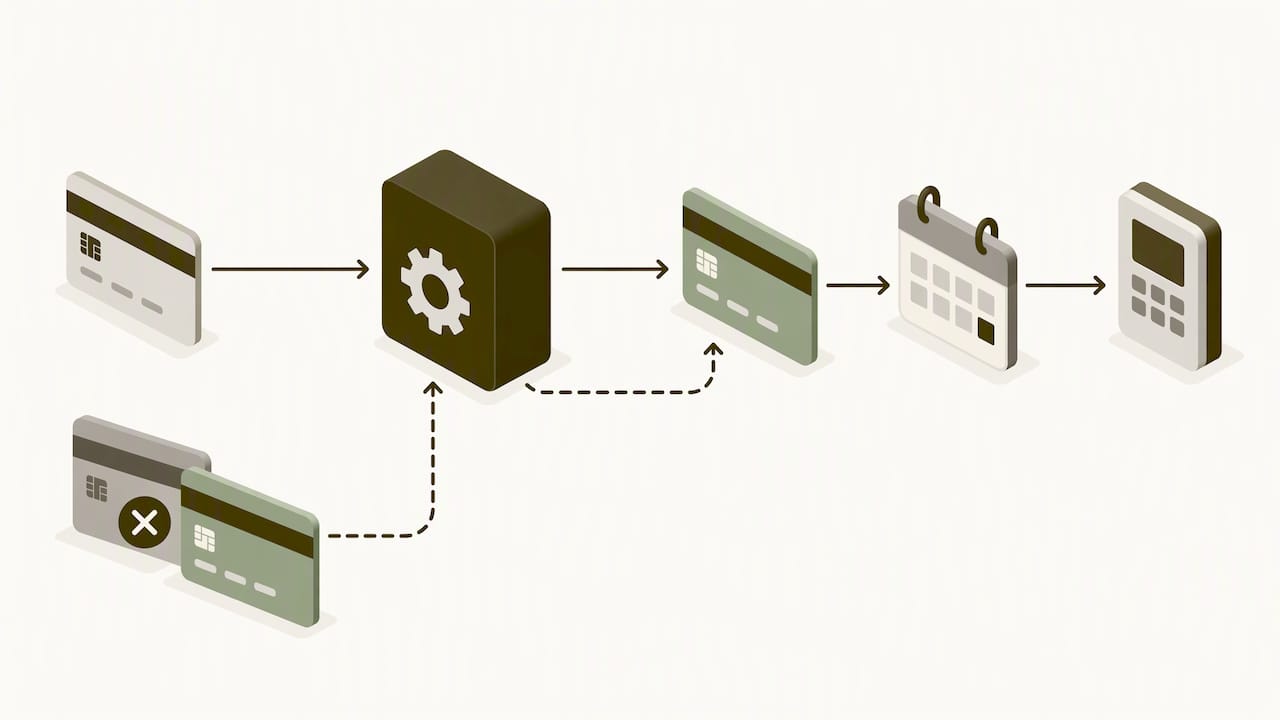
Account Updater generally provides a 2–4% recurring-billing lift, though processors may charge per-update fees, typically $0.25 to $0.50. For a business with thousands of members, that gap is real money without any new marketing spend.
It is not universal or automatic, so confirm these points with your processor:
- Enablement: you usually have to turn it on; it is not always the default.
- Pricing: some processors charge per update, while others include it in a plan.
- Coverage: not every card network or issuer participates, so some members will still need a manual update request.
Track three numbers once it is live:
- CAU coverage: the share of subscribers whose cards can be updated.
- Update rate: how many cards were actually refreshed each month.
- Prevented churn: members who would have lapsed from a stale card.
Which retention moves are tied to billing and member experience?
Billing is the most common reason a happy member leaves. These changes protect revenue without pressuring anyone:
- Pre-bill reminders: send notice 3–5 days before monthly charges and 7–14 days before annual renewals. Members who expect the charge rarely dispute it.
- Pause and downgrade options: let a member freeze a plan during an injury, a move, or a busy season, with transparent proration. A paused member can come back; a canceled one rarely does.
- Clear billing descriptors: use a name members recognize, ideally the studio or brand name plus a support contact. Unknown charges are a leading source of avoidable disputes.
- LTV segmentation: a high-value, long-tenure member may warrant a personal save offer, such as a discount or coach check-in. A low-value trial user probably just needs a clean exit.
Whatever you do, keep cancellation easy. A save offer is fine as an option, but it cannot become a maze the member has to escape.
What does the FTC Negative Option Rule require?
The rule covers recurring subscriptions and other negative option programs, and wellness memberships clearly fall within that world. The eCFR text of 16 CFR Part 425 requires sellers to disclose material terms before collecting billing information, obtain express informed consent, and provide a simple cancellation mechanism that is at least as easy as signup. The FTC’s final rule notice in the Federal Register also expanded coverage across all negative option programs and prohibits misrepresentation.
Put it into practice with this checklist:
- Disclose first: price, billing frequency, renewal terms, and how to cancel appear before the payment form.
- Record consent: keep timestamped proof of the member’s agreement. The FTC’s business guidance says to keep verifiable proof of consent for at least three years.
- Mirror signup in cancellation: if members can join online easily, they should be able to leave online just as easily.
- Avoid hidden steps: buried cancel links and forced phone calls invite enforcement attention.
Health and wellness companies draw particular scrutiny. Loeb & Loeb advises reviewing signup flows, renewal disclosures, and cancellation processes, and watching state automatic renewal laws too. This is general information, not legal advice, so have counsel review your flows.
How should you budget for subscription payment costs?
Four cost drivers matter most:
- Processing fees and reserves: higher-risk wellness niches may see reserve requirements or higher rates. Ask for these terms in writing before you sign.
- Account Updater math: at $0.25 to $0.50 per update against a 2–4% billing lift, the feature pays for itself once a recovered renewal is worth more than the update fee. Run it with your own average plan price.
- Advanced services: fraud prevention, chargeback mitigation, and ACH support add cost, and they pay back when disputes or fraud losses start to eat margin.
- Reconciliation: monthly payouts rarely match your sales report to the cent, so plan accounting time. This guide to reconciling bank payouts walks through the process.
A specialized payments partner is worth the extra cost when a standard provider keeps freezing funds, declining your category, or leaving you to handle disputes alone.
What can we offer wellness merchants with complex billing?
We specialize in high-risk and regulated merchants, and many wellness businesses land in that category because of supplements, telehealth, or recurring plans. Our team supports underwriting, chargeback mitigation, fraud prevention tools, and recurring billing management. We also run PCI Level 1 certified infrastructure and offer age verification and real-time monitoring for merchants who need them.
If you sell telehealth services, our telehealth payment processing page explains how we handle those accounts. When you are ready, you can apply directly, and we will review your business model, billing flow, and refund policy during underwriting. Author credentials and customer case studies are not published here, so we point you to the facts we can stand behind: the specialization, the services, and the application path.
How long does it take to go live?
For most merchants, the timeline involves application, underwriting, integration, and test transactions. Application is fast if you gather documents first. Underwriting is where the wait varies, because higher-risk categories get a deeper look. Integration and testing depend on your platform and developer availability. We position our onboarding as fast, but your own timeline depends on document readiness and integration work.
Speed up your launch with these steps:
- Prepare documents early: business formation papers, bank details, processing history if you have it, and your website with clear terms.
- Publish your policies: refund, cancellation, and billing terms should be live before you apply.
- Plan integration in parallel: do not wait for approval to scope your checkout and billing setup.
- Test the failure paths: run declined cards, expired cards, and cancellations in a sandbox before real members touch them.
A clean file with transparent policies moves faster than one that raises questions.
How does payment processing integrate with wellness and ecommerce platforms?
Most wellness businesses already run a booking tool, a member app, or a storefront, and payments must connect to them without manual copying. Integration usually happens through a payment gateway, hosted checkout, or API that talks to your existing system. Webhooks matter most: when a payment succeeds or fails, your platform should instantly grant, pause, or restrict access.
Ask these questions before you commit:
- Does it connect to your stack? Confirm support for the scheduling, membership, or ecommerce platform you use now, not just what is on a sales page.
- Can you store tokens securely? Tokenization lets you charge future renewals without holding raw card data.
- Will failed-payment events reach your system? Without them, your dunning emails and access rules will drift out of sync.
- Can you export clean reports? Your finance team needs reconciled data, not screenshots.
If you sell both memberships and products, such as supplements bundled with coaching, make sure one setup handles both revenue streams, so reporting stays in one place.
What do underwriters look for in wellness subscription merchants?
Underwriting is risk assessment, and for wellness subscriptions it centers on whether your business is transparent and your disputes stay low. Underwriters typically review your business model, product claims, billing terms, refund and cancellation process, marketing practices, and any processing history. Supplements and telehealth models draw extra attention because of regulatory exposure and dispute patterns.
Strengthen your file with these items:
- Clear terms at checkout: visible price, renewal date, and cancellation steps, in line with the FTC rule.
- Low dispute indicators: recognizable descriptors, pre-bill reminders, and easy refunds reduce chargebacks before they start.
- Credible claims: product and service claims that you can back up.
- Operational readiness: customer support contact details, fulfillment details, and a documented process for handling complaints.
- Honest history: disclose prior terminations or high chargeback periods rather than hiding them.
Specialists like us place high-risk merchants with banking partners suited to complex models. Our high-risk payment processing service is built for exactly that situation, and transparency about reserves and pricing is part of how we work.
Which payment gateway options support high-risk wellness subscriptions?
Not every gateway welcomes wellness subscriptions, and some will accept you, then freeze your funds later. Look for a gateway that is explicit about your category and supports recurring billing, tokenization, and failure handling natively. Beyond the basics, check these capabilities:
- Recurring billing and card-on-file: scheduled charges, proration, and retry rules you can control.
- Account Updater support: confirm VAU and ABU are available and how they are priced.
- Multiple acquiring relationships: merchants in higher-risk categories benefit from backup routing when one bank relationship tightens.
- Fraud and chargeback tooling: screening, alerts, and dispute workflows inside the platform. For broader fraud awareness, this overview of push payment fraud prevention steps is a useful operational read.
- Support for ACH: useful for members who prefer bank debits and for lowering card fees on larger plans.
Ask each provider for written terms on reserves, rolling holds, and termination. A gateway that hides these details until after approval is a risk to your cash flow.
Perspective: ops changes I’d make this week
Most operators chase new signups while a leaking billing system quietly cancels members for them. I’d start here: enable Account Updater, set up a basic dunning sequence tied to decline codes, and walk your own cancellation flow as a customer. Recovering existing revenue costs less than acquiring new members, and these fixes can help address billing problems.
— Peter
Ready to fix subscription billing for your wellness business?
Losing members to failed payments is avoidable, and you do not have to rebuild your stack to fix it. We pair high-risk payment processing with chargeback mitigation and recurring billing support, and our team supports underwriting for complex merchants.

See how our high-risk payment processing works, then apply now. We will walk you through next steps.
FAQ
What are the best wellness subscriptions to run as a business?
The strongest wellness subscriptions combine recurring value with low friction, such as memberships, replenishment plans, and coaching. What matters most is billing reliability and an easy exit. Pair your model with Account Updater and clear renewal reminders to keep members longer.
How do I stop a subscription from charging me?
Start by canceling directly with the merchant, using the account page or the contact details on your receipt. Under the FTC Negative Option Rule, sellers must provide a simple cancellation mechanism at least as easy as signup. If the merchant does not respond, contact your card issuer.
How do I find all the subscriptions I’m paying for?
Review your bank and card statements for repeating charges, then check app store and email receipts for renewal notices. Merchants can help by using recognizable billing descriptors, which reduces confusion. Cancel anything you do not recognize or use.
Why do wellness subscription payments fail?
Most failures come from expired or reissued cards, insufficient funds, or issuer-side blocks. Account Updater addresses the first problem automatically, and well-timed retries handle many of the second. Hard declines, like lost cards, require a new payment method from the member.
How many failed payments can Account Updater prevent?
Account Updater generally provides a 2–4% recurring-billing lift. Results depend on your member base, card mix, and processor setup. Per-update fees may apply.
Sources
- Account updater
- eCFR :: 16 CFR Part 425 (Jan. 14, 2025) – Rule Concerning Recurring Subscriptions and Other Negative Option Programs
- [Federal Register :: Negative Option Rule](https://www.federalregister.gov/documents/2024/11/15/2024-25534/negative-option-rule)
- Subscriptions and Recurring Billing | Payments & Risk