.png)
Under Visa’s 2026 subscription rules, merchants must collect explicit acceptance of payment terms at enrollment, pass the required stored-credential data (including the network transaction identifier generated through 3DS2), apply enhanced descriptors to the first post-trial charge, and offer frictionless online cancellation. Issuers now have network-level tools, including Visa’s Enhanced Subscription Manager, that can stop recurring payments directly. Merchants that skip these steps risk hard declines, not just disputes.
TL;DR:
- Merchants must store proof of separate acceptance, include NTID and credential metadata on each authorization, and use enhanced descriptors for the first post-trial charge.
- Visa’s Subscription Manager enables issuers to pause or cancel subscriptions directly within banking apps, with declines automatically triggered by network-level stop instructions.
- Failing to pass complete stored-credential data or inadequate cancellation options are primary causes of declines and disputes, which can escalate enforcement actions.
- Operational compliance requires rigorous logging, regular testing of stop instruction flows, and updating billing language and terms before issues lead to chargebacks.
- Both Visa and Mastercard now require clear, frictionless cancellation options and transparent trial disclosures, with enforcement handled through network decline codes and monitoring.
Table of Contents
- What changed in 2026: timeline and headline updates you must know
- Key Visa requirements for free trials, disclosures, and stored credentials
- How Visa Subscription Manager changes merchant workflows
- Practical compliance checklist: step-by-step tasks
- Common enforcement triggers and how to prioritize fixes
- Operational lessons from working with subscription merchants
- Recurring billing support built for high-risk merchants
- FAQ
- Sources
What changed in 2026: timeline and headline updates you must know
Visa’s rules on free trials and discounted introductory offers have been in place since 2020, when the network first required separate disclosure of trial terms and a distinct acceptance step before charging a card. The 2026 recurring-offer guidance refreshes and reinforces those requirements, spelling out exactly how trial terms must be presented and how post-trial charges must be labeled.
The bigger shift this year is enforcement. Visa launched Enhanced Subscription Manager in spring 2026, working with Pinwheel to give North American issuers in-app tools for subscription switching, cancellation, and alerts starting summer 2026. At the same time, network rules around stored-credential data have tightened considerably.
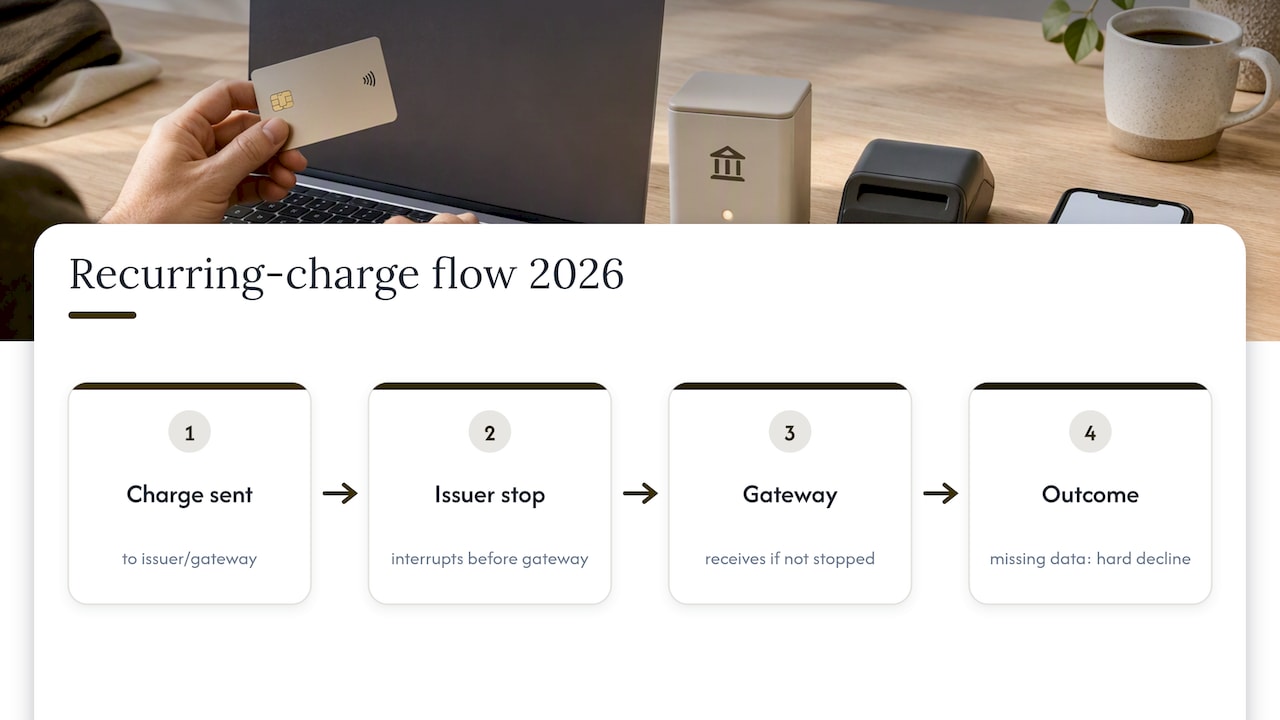
Operationally, this means issuers can now embed stop instructions that interrupt a recurring charge before it ever reaches your gateway. A missing data field that used to generate a soft warning can now generate a hard decline.
Key Visa requirements for free trials, disclosures, and stored credentials
Visa’s recurring-offer guidance sets specific requirements for how you structure enrollment, trial timing, and the data attached to every recurring authorization.
- Separate acceptance: Capture a distinct, affirmative acceptance of payment terms at enrollment, apart from general terms of service, and send a confirmation email or receipt immediately after.
- Record-keeping: Store the terms link, the acceptance timestamp, and the specific offer disclosed to the cardholder, since Visa’s recurring-offer guidance ties enforcement to what you can prove was disclosed.
- Short trials: Trials of seven days or fewer carry specific reminder and expiration-notice requirements before the first charge.
- Enhanced descriptors: The first post-trial charge must carry an enhanced descriptor, such as language identifying it as an “end trial” transaction, in both clearing records and the cardholder’s statement.
- Stored-credential data: Run an initial 3DS2 authentication to generate a network transaction identifier (NTID), then pass that NTID and stored-credential metadata, including a card-on-file flag, on every subsequent recurring authorization.
Each recurring authorization message should also include your merchant identifier, the NTID, the stored-credential indicator, and the correct merchant category code. Missing any one of these fields is now a common cause of avoidable declines.
Pro Tip: Treat the initial 3DS2 authentication as a contract-bound event, not a one-time formality: the NTID it generates becomes the key that keeps every future charge authorized.
How Visa Subscription Manager changes merchant workflows
Visa Subscription Manager gives issuers a direct view into a cardholder’s recurring charges and the ability to pause or stop them from inside a banking app, without routing the request through you first. The developer documentation describes endpoints for adding and canceling stop instructions, along with matching rules that pair a stop instruction to a specific merchant’s authorizations.
- Issuer view: Cardholders see their subscriptions listed in-app and can pause or cancel with a few taps.
- Stop-instruction matching: VisaNet matches the stop instruction to your authorizations using merchant identifiers and stored-credential data.
- Decline signals: When a match occurs, acquirers and merchants see specific return and decline codes rather than a generic failure.
The practical effect is that you may see a subscription decline with no prior cancellation request reaching your systems. Reconciling these events with your acquirer, and updating customer records accordingly, becomes a routine part of running recurring billing in 2026.
Practical compliance checklist: step-by-step tasks
A subscription compliance program comes down to five operational areas. Work through them in order, since each one depends on the data captured in the step before it.
- Enrollment: Require separate acceptance of payment terms, store proof of that acceptance, and run the initial 3DS2 authentication to capture the NTID and related metadata.
- Billing: Send the enhanced descriptor on the first post-trial charge, pass the NTID and stored-credential flags on every recurring authorization, and keep merchant category codes and billed amounts consistent.
- Cancellation: Offer an immediate online cancellation method, confirm the cancellation by email with an effective date, and log every request for audit purposes, consistent with Visa’s dispute management guidelines.
- Monitoring: Track decline and return codes alongside dispute ratios, and test your authorization flow in a sandbox environment that simulates a stop instruction before it happens in production.
- Operations: Update your terms and conditions, customer-facing billing language, and engineering checklists, then re-test the full flow on a regular schedule.
A step-by-step guide to canceling unused subscriptions is a useful reference for understanding what a smooth cancellation experience looks like from the cardholder’s side, which is the same experience your own cancel flow needs to deliver.
Pro Tip: Run a quarterly sandbox test with your acquirer that simulates a stop instruction and confirms your system doesn’t automatically retry a transaction the network has already blocked.
Common enforcement triggers and how to prioritize fixes
Two failure types drive most of the pain. Technical gaps, like a missing NTID or incomplete stored-credential metadata, produce hard declines before a customer ever complains. Customer-facing gaps, like a buried cancellation link or unclear trial pricing, drive disputes instead.
Fix the technical gaps first since they block revenue outright. Then address the customer-facing issues, since Visa’s dispute management guidelines note that elevated dispute ratios invite closer monitoring and remediation demands from your acquirer. A review of 2026 settlement trends for subscription services shows how quickly unresolved billing complaints escalate into bigger enforcement problems.

Operational lessons from working with subscription merchants
The merchants who avoid decline spikes treat compliance as an engineering problem, not a legal footnote. Authoritative logging of every acceptance event, proactive descriptor handling before a trial ends, and scheduled reconciliation with acquirers catch issues before they become chargebacks. An identity verification checklist for compliance teams offers a useful companion for teams tightening their 3DS2 and NTID controls alongside their billing fixes. If you’re reworking your integration, it’s worth testing it against these patterns before launch.
— Peter
Recurring billing support built for high-risk merchants
We built our payment processing to support subscription merchants with necessary features like 3DS2 onboarding, stored-credential compliance, and enhanced descriptors from day one.

Our services include:
- Recurring-billing integration support for subscription-based transaction models
- 3DS2 onboarding and NTID compliance built into merchant setup
- Chargeback mitigation tools paired with dispute reason-code monitoring
- Specialized acquiring for nutraceuticals, supplements, and telehealth subscription merchants
If your current processor can’t explain how it handles stored-credential data or stop instructions, apply now and we’ll walk through what a compliant setup looks like for your business.
This article is general information, not a substitute for advice from a qualified financial advisor. Consult a qualified financial professional about your own circumstances before acting on anything here.
FAQ
How do I stop a subscription in my credit card?
You generally cancel through the merchant’s online cancellation method or, increasingly, directly through your card issuer’s app using tools like Visa’s Enhanced Subscription Manager. Issuer-side cancellation can stop future charges at the network level even if the merchant hasn’t processed the request yet.
What is the new rule for visa subscriptions in 2026?
Visa’s 2026 recurring-offer guidance requires separate acceptance of payment terms, enhanced descriptors on the first post-trial charge, and specific reminder rules for trials of seven days or fewer. Merchants must also pass the network transaction identifier generated through 3DS2 on every recurring authorization.
Can I use a gift card for online subscriptions?
Gift cards often fail recurring billing because they lack the stored-credential data, like a persistent NTID, that networks now require for subscription authorizations. Check with the gift card issuer directly, since support for recurring charges varies by card and program.
What’s going on with Visa and Mastercard subscription rules?
Both networks have tightened subscription billing rules in 2026: Visa through enhanced stored-credential enforcement and its Subscription Manager tools, and Mastercard through its negative-option billing guidance calling for transparent enrollment, confirmation emails, and easy online cancellation. Both networks are pushing toward frictionless, click-to-cancel experiences for cardholders.
Who enforces these subscription billing requirements?
Visa and Mastercard enforce their rules through their respective networks, with acquirers and issuers applying decline codes, dispute escalations, and monitoring programs when merchants fall out of compliance. Payment processors like us help merchants build the technical and operational controls that keep accounts in good standing under these rules.


.webp)
