Telehealth chargebacks rarely come from stolen cards. Most come from patients who forgot a renewal, did not recognize a statement line, or could not find the cancel button. You can prevent most of them with clear billing, fast cancellation and evidence you collect at the point of sale. You can fight the rest with structured proof. This guide shows you how, and why your processor matters as much as your process.
TL;DR
- Most telehealth disputes are a communication problem: unclear descriptors, surprise renewals and hard-to-find cancellation. Fix those first.
- Winning a dispute does not erase it from your chargeback ratio, so prevention beats representment.
- Collect consent, IP, device and usage data at checkout, not after a dispute lands.
- Regulators treat slow-walked cancellation as an enforcement issue, and it can threaten your payment access.
- A processor that understands telehealth, with chargeback tools and clear reserve terms, keeps one bad month from becoming a frozen account.
Table of Contents
- Why telehealth merchants see more disputes
- The main causes of telehealth chargebacks
- Why your chargeback ratio matters more than any single dispute
- Building an evidence file before you need one
- A prevention checklist for telehealth merchants
- How to respond to a dispute
- Our perspective: the processor is part of your chargeback strategy
- Payment processing built for telehealth
- What to do this week
- FAQ
- Sources
Why telehealth merchants see more disputes
Telehealth sells a service, not a box. There is nothing to track and nothing to return. A patient who is unhappy with a visit, a prescription decision or a renewal has one obvious option: call the card issuer.
Several features of the model add risk:
- Recurring billing. Memberships, monthly medication programs and ongoing care plans all renew automatically. Renewals are where memory fails.
- Card-not-present sales. Every online transaction is card-not-present, and the merchant is generally liable for those disputes, as Mastercard’s merchant guidance explains.
- Sensitive purchases. Some patients do not want a telehealth charge to be recognizable on a statement shared with a spouse or parent. They may dispute rather than ask.
- Regulatory attention. Telehealth is a regulated, scrutinized category. Card networks and banks treat it as higher risk, which is why many telehealth businesses need an acquiring partner built for it.
None of this means you should expect high dispute rates. It means the margin for error is smaller than it is in a typical online store.
The main causes of telehealth chargebacks
Friendly fraud
Friendly fraud, also called first-party misuse, happens when a cardholder disputes a legitimate purchase, often to get a refund while keeping the service. Visa’s explanation of friendly fraud describes it as a long-standing challenge in digital commerce.
In telehealth, much of what looks like friendly fraud is closer to confusion. The patient did receive care. They just do not connect the line on their statement with the visit, or they forgot they signed up for a plan.
The subscription trap
Recurring plans are the largest single source of avoidable disputes. A patient signs up for a month of care, feels better, stops logging in and is billed again. By the time they notice, they dispute instead of canceling.
The fix is operational:
- Send an automated renewal notice 3 to 5 days before each charge.
- Put a one-click cancellation link in every billing email and text.
- Confirm every cancellation immediately, in writing.
- Make the cancellation path as short as the signup path.
Unrecognizable billing descriptors
If the statement says something your patient has never seen, they will assume fraud. The descriptor should identify the merchant name the patient knows and include a phone number or URL for support. Descriptor clarity is one of the cheapest dispute reducers you can deploy.
Hard cancellation and refund paths
The FTC enforces the Restore Online Shoppers’ Confidence Act (ROSCA), which covers online subscriptions. In April 2024 the agency announced a proposed order against telehealth firm Cerebral that would require it to pay $7 million and also restrict how it uses sensitive data for advertising. The agency’s amended complaint is public if you want to see how it frames the practices at issue.
The lesson for merchants goes beyond that one case. A complicated cancellation process produces disputes, draws regulators and can put your payment access at risk. A patient who cannot cancel will find another way to stop the charge.
Billing errors that look like chargebacks
If you bill insurance or Medicare as well as cards, coding mistakes can produce denials and reversals that feel like disputes. Telehealth-specific modifiers and code changes are a common trap. For example, CMS instructs billing staff at Rural Health Clinics and Federally Qualified Health Centers to bill the individual CPT or HCPCS code for distant site telehealth services instead of HCPCS code G2025, effective October 1, 2026. The annual Physician Fee Schedule summary also lists telehealth services added for 2026.
This is a reimbursement matter, not a card dispute, but the operational lesson is shared: keep billing staff current, and bad billing will not turn into customer disputes.
Real fraud
True fraud still happens: stolen cards used to start a consultation, or accounts opened with someone else’s identity. Identity checks, device and IP monitoring and velocity rules help here. Real-time monitoring is worth having because the patterns show up within hours, not weeks.
Why your chargeback ratio matters more than any single dispute
A chargeback costs more than the sale. You lose the revenue, you typically pay a fee, and the dispute counts toward your ratio, the share of transactions that end in disputes. Card networks run monitoring programs that flag merchants above their thresholds, and those programs can bring fines, higher reserves or termination.
Thresholds and program rules change, so ask your acquirer for the current numbers that apply to your merchant ID rather than relying on a blog post, including this one.
The point most merchants miss: winning does not undo the dispute. As the research behind this guide puts it, the dispute event itself remains a factor for the networks regardless of outcome. Repeated disputes, even winning ones, can mark you as high risk.
That shifts your priorities:
- Prevention first. A dispute you avoid costs nothing.
- Representment second. Fight the ones you can win, with real evidence.
- Concede the rest. Mastercard’s guidance notes that when evidence is weak, it can be more cost-effective to accept the chargeback than to spend resources on a lost cause.
Building an evidence file before you need one
The best time to prepare for a dispute is at checkout. Treat every transaction as one that could be contested. Visa’s merchant dispute guide says successful responses focus on clearly linking the transaction to the cardholder and showing their participation in or benefit from it.
For telehealth, that means capturing:
| Evidence | What it proves | When to capture it |
|---|---|---|
| Signed or clicked consent to terms and recurring billing | The patient agreed to the charge and its schedule | At signup |
| IP address and device ID | The same person used the service | At signup and each login |
| Login history and session timestamps | The patient used the service | Continuously |
| Visit or consultation records (with privacy controls) | Service was delivered | At each visit |
| Renewal notices and delivery logs | You warned the patient before billing | Before each renewal |
| Cancellation requests and confirmations | When the patient asked to stop, and what you did | At each request |
| Support tickets and refund offers | You tried to resolve it | As they happen |
Handle health information carefully. Share the minimum needed to prove the transaction, and talk to your compliance counsel about what you can include in a dispute response.
Compelling Evidence 3.0
Visa’s Compelling Evidence 3.0 (CE3.0) lets merchants submit structured data showing the cardholder took part in the transaction. The program was built to address first-party misuse and to balance liability between issuers and merchants. Visa’s merchant FAQ on compelling evidence lays out the framework.
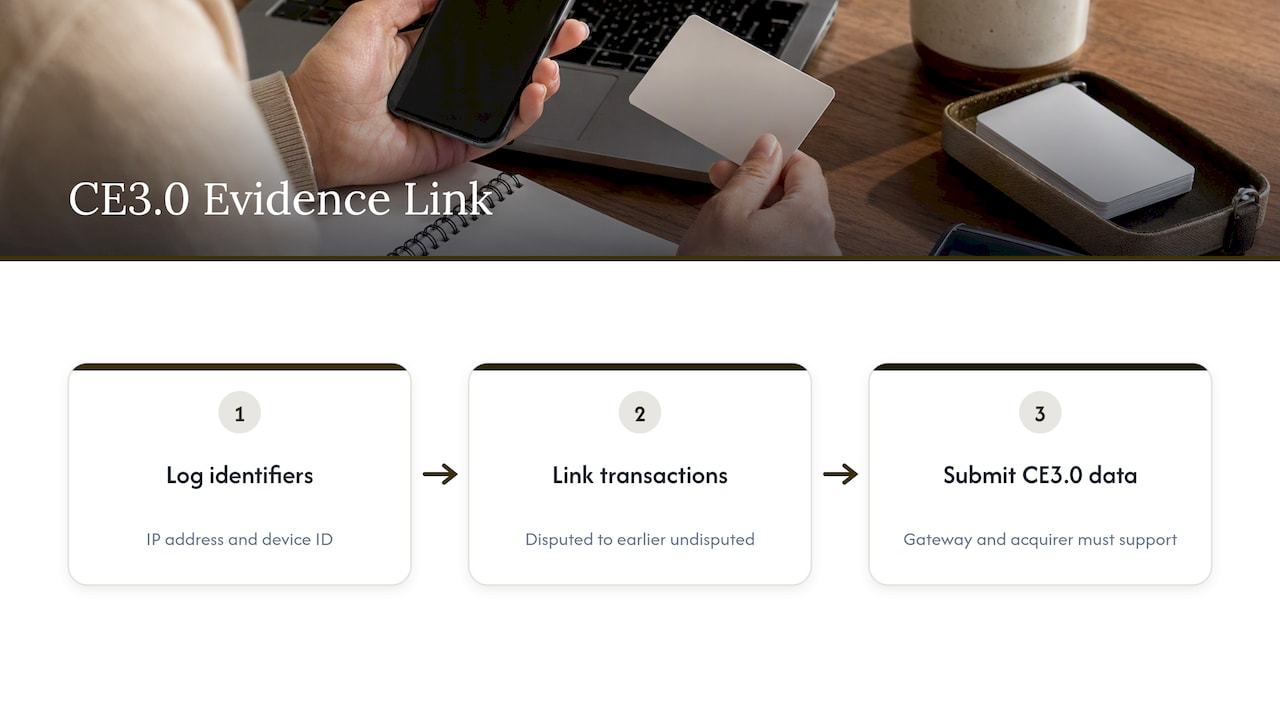
In practice, CE3.0 relies on linking the disputed transaction to earlier undisputed ones through shared identifiers such as IP address and device ID. That is why logging digital identifiers on every transaction pays off. Your gateway and acquirer must support the data submission, so confirm this before you rely on it.
A prevention checklist for telehealth merchants
Use this as a quarterly review.
- Descriptor. Does it match your public brand and include support contact details?
- Checkout disclosure. Does the patient see price, renewal frequency and cancellation terms before paying, with an affirmative step to agree?
- Renewal notices. Are they automated and sent 3 to 5 days ahead?
- Cancellation. Can a patient cancel online in the same number of steps it took to join?
- Support response time. Do you answer billing questions within one business day?
- Refund policy. Is it plain, visible and honored? A voluntary refund is cheaper than a dispute.
- Identity and fraud screening. Are you using device, IP and velocity checks?
- Data retention. Can you pull a full evidence file for any transaction in minutes?
- Alerts. Do you get notified of disputes quickly enough to refund before they become chargebacks, where your setup allows it?
- Billing accuracy. If you also bill payers other than patients’ cards, are codes and modifiers current?
Regulators have signaled little tolerance for multi-step cancellation. The FTC and CFPB have both pursued firms for deceptive enrollment and cancellation practices. The CFPB’s action involving CareCredit, a healthcare card program, ordered refunds of up to $34.1 million over deceptive enrollment at doctors’ and dentists’ offices. A cancellation process built to retain patients through friction is a liability on every front.
How to respond to a dispute
When a chargeback arrives, move quickly. Reason codes and deadlines vary by network, so check your acquirer’s portal for the clock.
- Read the reason code. A cancelled-recurring claim needs different evidence than a fraud claim.
- Pull your evidence file. Match each piece to the claim.
- Decide whether to fight. If you cannot show participation or delivery, accept it and fix the cause.
- Submit a focused response. Lead with the strongest proof: consent, usage logs, and the notice you sent. Skip long narratives.
- Track outcomes by reason. If one reason code keeps repeating, the problem is upstream in your flow.
- Refund obvious errors. If a patient was double-billed or billed after canceling, refund and move on.
Our perspective: the processor is part of your chargeback strategy
We work with telehealth, nutraceutical, supplement and subscription merchants every day. The same pattern shows up again and again. A merchant with a decent product and a manageable dispute rate gets into trouble not because of one spike, but because the processing relationship was never built for the category.
Three things matter most in our experience.
Underwriting that understands the model. Telehealth is regulated and often subscription-based. If your processor does not understand that from day one, you face surprise reserves, sudden holds or termination notices. We underwrite with the category in mind and place merchants with banking partners suited to complex businesses.
Tools inside the stack. Fraud screening, real-time monitoring, age verification where relevant and chargeback mitigation should sit alongside your gateway, not in a patchwork of vendors that never share data. Our PCI Level 1 certification and built-in mitigation tools exist for this reason.

Clear terms. Reserves, fees and rules should be on the table before you sign. Merchants can plan around terms they know. They cannot plan around surprises.
We do not pretend a processor can fix a broken cancellation flow. You still own the patient experience. But the right partner gives you early warning, evidence tooling and stable processing while you fix it.
— Peter
Payment processing built for telehealth
If you run a telehealth business and need a stable merchant account, see our telehealth payment processing page. We offer domestic and international acquiring, gateway integration, fraud prevention, chargeback mitigation, recurring billing management and underwriting support, with approvals in as little as 24 hours. Ready to start? Apply now.
What to do this week
You do not need a new platform to cut disputes. Start with what you control.
- Pull your last 90 days of disputes and sort them by reason code.
- Check your descriptor against what patients see on their statements.
- Test your own cancellation flow on a phone and count the steps.
- Confirm your gateway logs IP, device ID and login history for every transaction.
- Ask your acquirer for your current monitoring thresholds and your reserve terms in writing.
If the answers expose gaps, or if your current processor has already put you on a hold, talk to a team that works with high-risk and regulated merchants. You can see our wider high-risk payment processing services on our home page.
FAQ
What is a telehealth chargeback?
It is a reversal of a card payment that a patient disputes with their card issuer. The issuer pulls the funds back from your account while the dispute is reviewed. Because telehealth is card-not-present, the merchant is generally liable unless it can show compelling evidence.
Does winning a chargeback dispute lower my chargeback ratio?
No, not in the way most merchants expect. The dispute event still counts for card network monitoring even if you win. That is why prevention, such as clear descriptors, renewal notices and easy cancellation, matters more than representment. Confirm the exact counting rules with your acquirer.
How can I prove a patient used my telehealth service?
Keep signed or clicked consent, IP addresses, device IDs, login timestamps and visit records. Visa’s Compelling Evidence 3.0 uses linked identifiers from earlier undisputed transactions to show participation. Handle health data carefully, and consult compliance counsel about what you share in a dispute response.
Should I fight every chargeback?
No. If your evidence is weak, accepting the chargeback is often cheaper than spending time on a dispute you will lose. Fight the cases where you can clearly show consent, use and the notices you sent. Fix the process behind the rest.
Can a telehealth business get a merchant account if it has had high chargebacks?
Often yes, but you need a processor that works with high-risk merchants and can review your history, controls and business model. Expect underwriting questions about your billing flow, cancellation process and dispute data. Our application starts that review.
Sources
- Visa: Friendly fraud explained
- Visa: Evolution of Compelling Evidence merchant FAQs
- Visa: Dispute Management Guide for Merchants
- Mastercard: Disputing chargebacks, practical guidance for merchants
- FTC: Proposed order against Cerebral
- FTC: Cerebral first amended complaint
- CFPB: Remarks on the CareCredit enforcement action
- CMS: MM14468, billing distant site telehealth services
- CMS: MM14315, Physician Fee Schedule final rule summary CY 2026