.png)
Subscription billing fraud costs businesses far more than the initial stolen transaction. Because recurring payments repeat automatically, a single successful exploit compounds on every future rebill until you catch it. Mastercard reports that 25% of its chargebacks are now driven by recurring transactions, and many organizations experienced payment fraud with significant median losses per case. The most effective defense is not a single tool at checkout. It is a connected, lifecycle-aware prevention program that screens every signup, rebill, reactivation, and account change with the same rigor.
Key fraud categories subscription businesses face:
- Trial and promo abuse: Multiple fake identities claiming introductory offers repeatedly
- Account takeover (ATO): Credential stuffing to hijack subscriber accounts
- Friendly fraud chargebacks: Legitimate charges disputed at the bank instead of with you
- Stolen card signups: Synthetic or stolen payment credentials used to open subscriptions
- Reactivation abuse: Fraudsters quietly restarting canceled accounts after a takeover
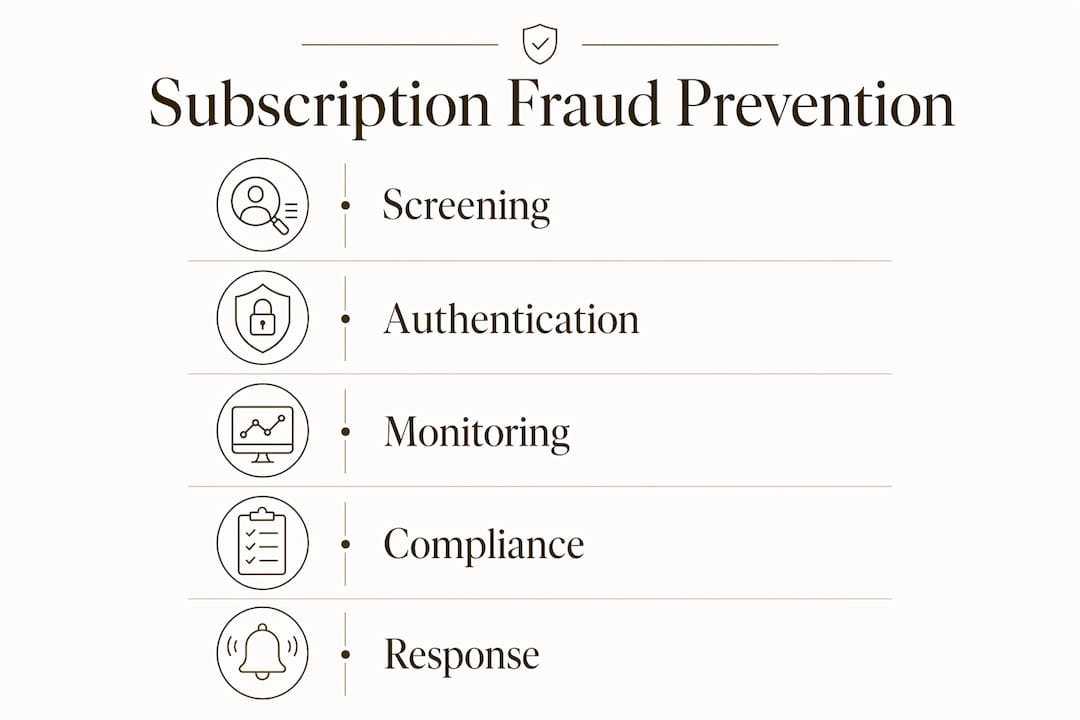
Prevention works best as a lifecycle discipline, not a one-time gate. Screening only the initial checkout leaves rebills, reactivations, and one-click reorders completely exposed.
What types of subscription billing fraud should you watch for?
Subscription fraud rarely arrives as a single attack. It layers across the customer journey, and each layer exploits a different gap in your defenses.

Trial and promo abuse is the most common entry point. Fraudsters create disposable email addresses, use prepaid cards with no transaction history, and cycle through free trials before the first charge hits. VPNs mask their location, defeating the geographic anomaly checks most platforms rely on. The pattern is hard to catch because each account looks like a new, legitimate signup in isolation.
Account takeover has become one of the fastest-rising fraud categories. Attackers use credential lists from data breaches to run automated stuffing attacks against subscriber login pages. Once inside, they change shipping addresses before a rebill, drain stored payment methods, or quietly reactivate a previously canceled subscription hoping the real account holder does not notice.
Friendly fraud chargebacks hit every billing cycle. A subscriber forgets they signed up, cannot find the cancel button, or simply disputes the charge with their bank rather than contacting you. Mastercard classifies this as first-party fraud, and it represents a large and growing share of all chargebacks across the network.
Additional fraud patterns to monitor:
- Reactivation abuse: A takeover victim’s account gets a canceled subscription quietly restarted
- One-click rebill abuse: Subscription merchants offering “buy again” buttons often skip risk scoring on those clicks, giving fraudsters a low-friction drain path
- Policy and refund abuse: Repeatedly working courtesy refund and cancellation terms as a personal subsidy
- Stolen card rebills: Fraud that does not surface at signup but appears on the second or third recurring charge
How subscription fraud damages your business and your customers
The financial hit from subscription fraud extends well beyond the disputed transaction itself. Payment fraud in 2024 carried median losses of $145,000 per case across organizations, and subscription businesses face compounding exposure because each successful exploit recurs on every future billing cycle.
“When a consumer disputes a subscription with their bank, merchants lose the ability to influence the relationship with their customer.” — Navpreet Randhawa, SVP, Ethoca, a Mastercard company
Chargebacks trigger fees, consume customer support hours, and, if your ratio climbs too high, put you into card network monitoring programs that restrict your ability to process payments. That is a direct threat to revenue continuity for any subscription merchant.
The operational damage runs deeper than the numbers. Fraud incidents erode customer trust and accelerate churn. When subscribers experience unauthorized charges, they cancel and rarely return. Potential new customers who hear about fraud incidents reconsider signing up entirely. Customer support teams absorb the volume of fraud-related complaints, slowing response times for everyone else.
False positives compound the problem from the other direction. Blocking legitimate subscribers to stop fraud creates its own revenue leak and damages the customer relationship just as effectively as the fraud itself.
What regulations govern subscription billing fraud prevention?
Compliance is not optional for subscription businesses in the United States, and the regulatory environment tightened considerably heading into 2026.
The FTC’s Negative Option Rule requires businesses to clearly disclose all subscription terms before charging, obtain explicit consent, and provide a simple cancellation mechanism. “Click-to-cancel” enforcement means canceling a subscription must be as easy as signing up for one. Violations carry significant civil penalties.
Key compliance requirements for U.S. subscription merchants:
- PCI DSS: Tokenize stored payment instruments and maintain secure cardholder data environments. Proper tokenization limits the blast radius if an account is compromised.
- FTC Negative Option Rule: Clear pre-charge disclosure, explicit consent, and easy cancellation for all recurring billing arrangements.
- Card network rules: Mastercard and Visa both impose chargeback thresholds. Exceeding them triggers monitoring programs with escalating fees and potential account termination.
- State-level auto-renewal laws: California, New York, and several other states impose additional disclosure and consent requirements on top of federal rules.
- Segregation of duties: For internal billing controls, the accounts payable function requires separation between vendor setup, invoice approval, and payment release to prevent internal fraud exploits.
Staying compliant with these frameworks also directly reduces fraud exposure. Transparent billing and easy cancellation, for example, divert friendly fraud disputes away from the card networks and back to your support team, where you can resolve them without a chargeback.
Effective strategies to prevent subscription billing fraud
The most common failure in subscription fraud programs is only inspecting the initial checkout. Fraudsters exploit recurring rebills and reactivations precisely because most merchants stop screening after the first order. Effective prevention covers the entire lifecycle.
Core prevention capabilities every subscription business needs:
- Lifecycle payment screening: Score signups, rebills, reactivations, and one-click reorders with the same rigor. Do not treat the first order as the only risk moment.
- Promo and free trial abuse detection: Catch multi-account patterns, disposable email addresses, and prepaid card clusters that signal discount farming.
- Account takeover protection: Apply behavioral and device signals to recurring accounts over time, not only at the checkout moment. Watch for sudden address changes before a rebill, unusual login patterns, and rapid account-detail updates.
- Chargeback management: Build structured dispute workflows to recover first-party friendly fraud. Every billing cycle is a fresh dispute trigger.
- Connected decisioning: Link signals across checkout, returns, support, and disputes so the same actor is recognized everywhere, not just at the transaction level.
Two-factor authentication blocks a very high percentage of automated attacks and nearly all bulk credential-stuffing attempts. Make it the default for subscription accounts, not an opt-in feature.
Transparent billing and easy cancellation are among the most cost-effective fraud controls available. Proactive renewal notifications and one-click cancellation pathways divert honest disputes away from the card networks, cutting friendly fraud chargebacks without any friction for legitimate subscribers.

Pro Tip: Right-size friction to actual risk. Trusted subscribers with clean behavioral histories should experience fast checkout and easy account management. Reserve tighter verification for the patterns that genuinely warrant it. Blanket friction alienates good customers and does not stop determined fraudsters.
Real-world examples of subscription fraud and how businesses stopped it
Understanding how these attacks play out in practice makes the prevention strategies above concrete.
Trial farming at scale. A direct-to-consumer supplement brand noticed its free trial conversion rate dropping while trial volume climbed. Investigation revealed a coordinated ring using disposable email addresses, prepaid Visa gift cards, and rotating IP addresses to claim trials repeatedly. No single account triggered a rule because each looked like a new signup. The pattern only became visible when signals were connected across accounts: shared device fingerprints, clustered signup timestamps, and prepaid card BINs with no prior transaction history. Implementing multi-account detection and prepaid card flagging at signup cut the abuse within two billing cycles.
Account takeover before a rebill. A telehealth subscription platform saw a spike in shipping address changes in the 48 hours before monthly billing. Attackers had used a credential-stuffing tool against a list of breached email/password pairs, successfully accessing accounts with reused passwords. They changed delivery addresses to intercept physical products included with the subscription. The fix combined 2FA set as default, velocity checks on address changes, and behavioral scoring that flagged logins from new devices immediately before a billing event.
Friendly fraud from poor cancellation UX. A software-as-a-service company with a buried cancellation flow saw chargeback rates climb quarter over quarter. Most disputes came from subscribers who had tried to cancel and could not find the path. Moving to a one-click cancellation option and adding pre-rebill email notifications reduced chargebacks materially, with no corresponding drop in retention among subscribers who actually wanted the product.
Key lessons from these cases:
- Connect signals across accounts, not just within them
- Screen reactivations and rebills with the same tools as new signups
- Transparent billing and easy cancellation resolve the friendly fraud problem at the source
- Velocity checks on account changes catch ATO before the damage compounds
Expert insights on payment processing and fraud prevention for subscription businesses
The most effective fraud programs in 2026 share one structural characteristic: they read intent across the whole customer lifecycle, not just identity at the checkout moment. A connected risk intelligence layer that monitors signup, rebills, returns, support, and disputes gives you a complete picture of whether a pattern represents a loyal subscriber or an exploit being worked.
Static rule engines go stale fast. Fraud tactics shift continuously, and a ruleset calibrated for last year’s attack patterns will miss this year’s variants. The strongest defenses come from platforms that learn continuously across many merchants, surfacing cross-merchant patterns that no single business could detect on its own. Sift’s Global Data Network, for example, analyzes more than 1 trillion annual events to identify behavioral patterns linked to fraud across industries.
Behavior-based scoring over the subscription lifecycle is becoming the baseline standard, not a premium feature. Scoring only the initial signup while leaving rebills unscreened is the single most common and costly gap in subscription fraud programs. The same decisioning rigor that applies to a new order should apply to every reactivation, every one-click rebill, and every account change.
Segregation of duties matters internally as well. As AI tools make it easier to generate convincing fake documentation, the accounts payable function needs clear separation between the people who set up vendors, approve invoices, and release payments. A single employee controlling all three steps creates an exploitable gap regardless of how good your external fraud tools are.
“Fraud has always been a cat-and-mouse game. The fraudsters are always a step ahead, and we’re chasing.” — Kniepmann, fraud expert, Journal of Accountancy
Pro Tip: The security-versus-experience tradeoff mostly disappears with accurate, connected decisioning. When your system can distinguish a trusted subscriber from a pattern being worked, you can keep fast checkout and easy management for the many while reserving verification for the few who warrant it.
Subscription businesses in high-risk verticals, including nutraceuticals, telehealth, and supplements, face elevated scrutiny from acquirers and card networks. Understanding how lifecycle risk monitoring integrates with your payment infrastructure is a practical starting point for building a program that protects revenue without creating friction for your best customers. Staying current on machine learning fraud detection approaches helps you evaluate whether your current tooling matches the threat environment.
How to respond to and recover from a subscription billing fraud incident
Speed matters when fraud hits. The faster you contain the breach and notify affected parties, the less the damage compounds across future billing cycles.
Immediate response steps:
- Isolate affected accounts. Suspend billing on accounts showing signs of compromise. Do not wait for confirmation before pausing charges on high-confidence fraud signals.
- Notify your payment processor and acquirer. Early communication keeps you out of chargeback monitoring thresholds and opens the door for representment support.
- Preserve evidence. Log IP addresses, device fingerprints, login timestamps, and account change histories before any cleanup. This documentation supports chargeback representment and, if needed, law enforcement referrals.
- Notify affected subscribers. Clear, direct communication about what happened and what you are doing about it preserves trust. Offer password resets and 2FA enrollment proactively.
- File reports. Report confirmed fraud to the FTC and, for card fraud, to the relevant card networks. Document everything.
Recovery and hardening:
- Audit your fraud rules immediately. The attack pattern that just succeeded is likely still active elsewhere in your subscriber base.
- Run a full review of reactivations and rebills from the prior 90 days. Compounding losses often predate detection by months.
- Implement or tighten velocity checks on signups, address changes, and payment retries.
- Review your cancellation and billing communication flows. Many post-incident chargeback spikes come from frustrated subscribers who could not reach you, not from the original fraud event.
Zuora’s research on subscription payment fraud highlights that resolving fraud incidents requires significant time from customer support teams, and delayed response directly increases operational costs. Building a clear internal escalation path before an incident occurs is the difference between a contained event and a prolonged revenue drain.
Key Takeaways
Subscription billing fraud prevention requires lifecycle-wide screening, not just checkout controls, because every unscreened rebill and reactivation is a compounding loss waiting to happen.
| Point | Details |
|---|---|
| Chargebacks from recurring billing | 25% of Mastercard chargebacks are driven by recurring transactions, making subscription billing a primary fraud target. |
| Screen beyond the first order | Rebills, reactivations, and one-click reorders need the same risk scoring as initial signups to close the most common fraud gap. |
| 2FA as a default control | Two-factor authentication blocks roughly 99.9% of automated attacks; make it default, not opt-in, for all subscription accounts. |
| Transparent billing cuts friendly fraud | Proactive renewal notifications and one-click cancellation divert honest disputes away from card networks before they become chargebacks. |
| Connected decisioning beats point tools | Linking signals across checkout, support, and disputes surfaces coordinated fraud that isolated tools miss entirely. |
Protect your subscription revenue with Davincipay

Subscription merchants in high-risk verticals face a harder fraud environment than most, and generic payment processors are not built for it. Davincipay specializes in payment processing for high-risk businesses, including subscription merchants in nutraceuticals, telehealth, supplements, and ecommerce, with fraud prevention tools, chargeback mitigation, and acquiring relationships designed for recurring billing models.
If your current setup leaves rebills unscreened or your chargeback ratio is climbing, the time to act is before your acquirer puts you on notice. Apply now and get a payment infrastructure built for the subscription economy.


.webp)
