.png)
A soft decline is a temporary, often-recoverable payment rejection; a hard decline is a permanent issuer refusal that needs a new payment method. Soft declines call for smart retries, sometimes automated within minutes. Hard declines call for an immediate stop: ask the customer for a different card, because response codes determine which action you’re actually allowed to take.
TL;DR:
- Retry soft declines such as insufficient funds and AVS mismatches after appropriate waiting periods and corrections, but never reattempt hard decline codes like stolen or invalid cards.
- Use response code mappings to guide retry logic, respecting the specific instructions on whether a decline is retryable or requires customer action, rather than relying on generic timers.
- Avoid repeated retries on hard declines and fraud-flagged accounts to prevent increased chargeback risk and potential account scrutiny from payment processors.
- Implement intelligent retry strategies that include staggered attempts and automated card data updates, rather than immediate, blind retries, to maximize recovery.
- High-risk and subscription merchants should consider specialized payment processing services that provide tailored recovery, better compliance, and infrastructure designed to handle their unique decline patterns.
Table of Contents
- Soft vs Hard Declines: A Quick Triage Checklist
- What Decline Codes Actually Tell You to Do
- Recovering Soft Declines Without Annoying Customers
- When You Should Never Retry a Decline
- API Errors Are Not the Same Problem as Declines
- When to Bring in a Payment Specialist
- The One Change That Fixes Most Decline Losses
- Get Payment Infrastructure Built for High-Risk Recovery
- Sources
- FAQ
Soft vs Hard Declines: A Quick Triage Checklist
When a payment fails, you have seconds to decide whether to retry or redirect the customer. Here’s the fast version, organized by what you’re seeing and what to do about it.
Signals that point to a soft decline:
- Insufficient funds: retry later, ideally after a payday cycle or with exponential backoff.
- AVS or CVN mismatch: prompt the customer to re-enter billing details rather than retrying blind.
- Processor or gateway timeout: reconcile first, then retry with a fresh idempotency key.
- “Authentication required” responses: route back through 3D Secure instead of resubmitting the same request.
Signals that point to a hard decline:
- Card reported stolen or lost: never retry; request an alternate payment method immediately.
- Invalid or closed account: same rule, no retry, customer needs new payment details.
- Fraud flag from the issuer: stop automated retries and route to manual review.
Getting this triage right the first time is what separates a merchant with a healthy recovery rate from one quietly leaking revenue to declines nobody investigated.
What Decline Codes Actually Tell You to Do
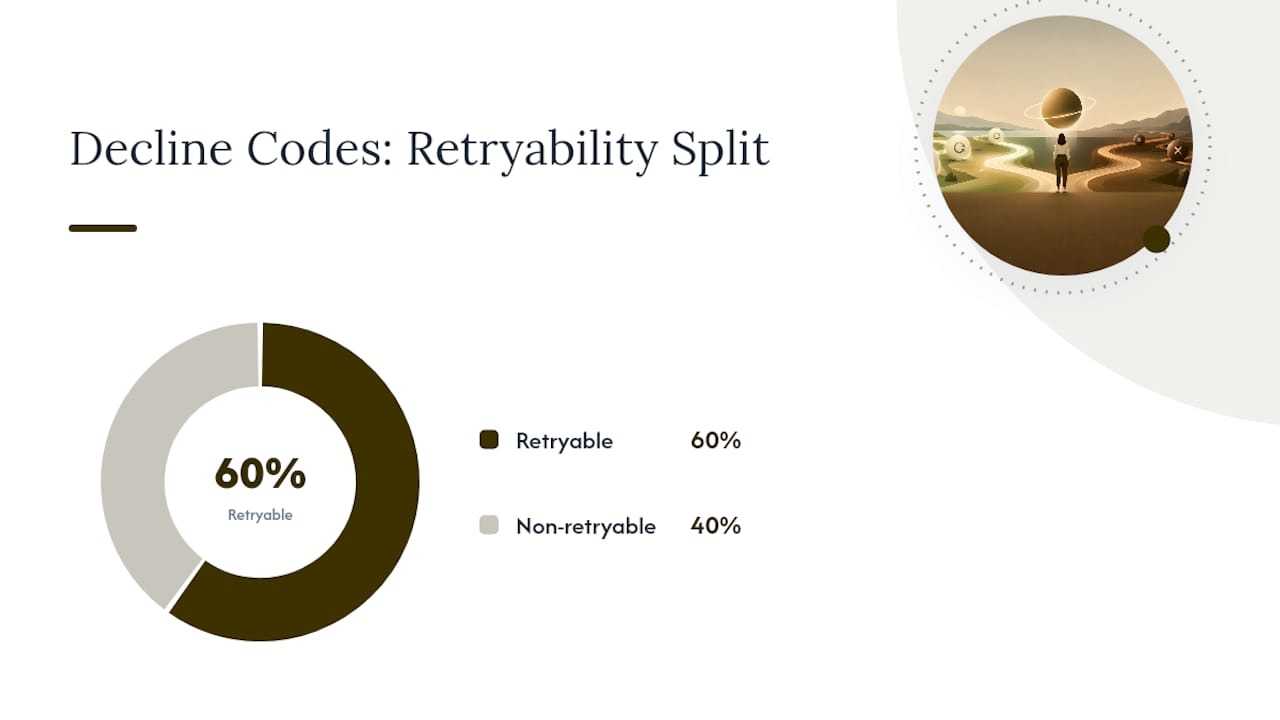
Response codes aren’t just error labels. They’re instructions. Visa and other card networks categorize codes into retryable and non-retryable buckets, and your retry logic should follow that split exactly rather than treating every decline the same way. Visa’s rule updates on declined transaction resubmission changed which codes merchants are permitted to reattempt, so a mapping table built two or three years ago may already be out of date.
Here’s how the most common codes typically break down:
| Response Code | What It Means | Recommended Merchant Action |
|---|---|---|
| INSUFFICIENT_FUND | Cardholder lacks available balance | Retry later, often after a payday cycle |
| AVS_FAILED / CV_FAILED | Billing address or security code mismatch | Prompt customer to correct and resubmit |
| PROCESSOR_DECLINED | Generic issuer refusal, cause unclear | Retry once, then request alternate payment |
| STOLEN_LOST_CARD | Card reported lost or stolen | Never retry; require new payment method |
| INVALID_ACCOUNT | Account closed or number invalid | Never retry; require new payment method |
Build your retry engine around this table, not around a single “try again in an hour” default. A code that maps to “never approve” and gets retried anyway isn’t a technical glitch. It’s a policy failure that can rack up unnecessary authorization attempts against your merchant account.
Recovering Soft Declines Without Annoying Customers
Recovery isn’t about hammering the card network with retries and hoping one sticks. It’s a sequence, and skipping steps costs you money.
- Map the code before you touch the retry logic. Insufficient funds and processor timeouts deserve automated retry. AVS or CVN failures need corrected data, not blind resubmission.
- Stagger subscription retries intelligently. Space attempts across a few days instead of retrying immediately, and layer in account updater services that refresh expired or reissued card numbers automatically.
- Reconcile timeouts before resubmitting. A timeout doesn’t always mean the charge failed. Check for an existing authorization using your idempotency key before firing a second request.
- Give customers a low-friction update path. A short email or in-app prompt to update card details converts better than silence, especially when it hits within a day of the failed charge.
- Track the right metrics. Watch retry success rate, recovered monthly recurring revenue, and the distribution of decline reasons so you know where the leaks actually are.
Pro Tip: Don’t let your dunning emails all sound identical. A payment that failed for insufficient funds needs a gentle “your card didn’t go through” message, while an expired card needs a direct “update your payment details” call to action. Mismatched messaging kills recovery rates.
When You Should Never Retry a Decline
Retrying a hard decline doesn’t just fail. It can actively hurt you. Repeated attempts against a stolen card or a closed account increase your exposure to fraud flags and can push your account toward higher scrutiny from your acquirer.
- Stolen or lost card reports: stop immediately, no exceptions.
- Response codes explicitly categorized as non-retryable by the card network: honor the mapping, don’t override it.
- Fraud-flagged transactions: route to manual review instead of automated resubmission.
The right move in these cases is simple: request an alternate payment method, open a support ticket if the customer disputes the flag, or escalate to manual review. Blind retries here don’t recover revenue. They create chargeback risk and can damage your standing with your processor.
API Errors Are Not the Same Problem as Declines
A 500 error and a hard decline look similar to a stressed engineer at 2 a.m., but they need completely different handling. Transport and server failures are plumbing problems. Issuer declines are business decisions. Mixing the two into one retry policy is how merchants end up either resubmitting broken requests forever or giving up on transactions that would have gone through fine.
- Retry 500, 502, 503, and 504 errors with exponential backoff, and respect the Retry-After header on 429 responses.
- Do not retry 400, 403, 404, 409, or 422 errors without fixing the underlying request. These mean something is wrong with what you sent, not with the network.
- Use idempotency keys on every retry after a timeout. VisaNet Connect documents correlation IDs specifically so you can reconcile an ambiguous timeout instead of accidentally creating a second authorization hold on the same card.
Treat these as two separate decision trees in your codebase, not one retry function trying to handle everything.
When to Bring in a Payment Specialist
Some decline patterns are bigger than a retry logic fix. If you’re seeing persistent declines across a wide swath of customers, a sudden spike right after a platform or gateway change, or underwriting friction specific to a regulated vertical like telehealth or supplements, that’s your signal to escalate rather than keep tuning code.
A specialist in high-risk processing can help with acquiring placement suited to your vertical, retry logic tuned to your actual decline mix, chargeback mitigation, and underwriting support that keeps your account stable instead of frozen. For subscription merchants specifically, a dedicated recovery program often catches revenue that generic retry logic misses entirely, particularly across telehealth and nutraceutical billing cycles where compliance rules add another layer of complexity on top of standard payment friction.

The One Change That Fixes Most Decline Losses
If you fix only one thing, map your response codes to permitted actions before you touch retry timing or messaging. Most merchants build recovery around guesswork instead of the code itself, and that’s where recoverable revenue quietly disappears. High-risk or regulated merchants dealing with recurring declines at scale are usually better off getting a specialist involved early rather than debugging retry logic alone.
— Peter
Get Payment Infrastructure Built for High-Risk Recovery
Generic payment processors treat every decline the same way, which is exactly why high-risk and subscription merchants lose recoverable revenue to blunt retry logic. Specialized payment processors focusing on high-risk and regulated merchant verticals offer fast approvals, transparent pricing, and PCI Level 1 certified infrastructure that includes built-in chargeback mitigation and real-time monitoring designed for merchants who can’t afford sudden account freezes.

Whether you run a subscription supplement brand fighting soft-decline churn or a telehealth platform navigating compliance-heavy recurring billing, Davincipay’s high-risk payment processing is built around your vertical, not a one-size-fits-all template. Merchants in nutraceuticals and supplements get tailored payment processing with underwriting support that understands their specific decline patterns and reserve requirements. If persistent declines or a shaky acquiring relationship are costing you revenue, apply now and get a placement built for how your business actually processes payments.
Sources
- Knowledge Article Detail Page - CYBS | Visa Acceptance Support
- Error Codes and Troubleshooting | Visa Click to Pay API | Visa Developer Center
FAQ
What Is the Difference Between a Hard Decline and a Soft Decline?
A soft decline is a temporary payment failure, often caused by insufficient funds or a processor timeout, that can typically be resolved with a retry. A hard decline is a permanent issuer refusal, such as a stolen card or invalid account, that requires a new payment method entirely.
What Does a Soft Decline Mean for My Business?
It means the transaction was rejected but the underlying issue is often fixable, whether that’s a temporary funds shortage, a mismatched billing address, or a processor timeout. Retrying with the right timing and corrected data usually recovers the sale rather than losing the customer.
Is It Embarrassing if a Customer’s Card Declines?
Most declines happen for mundane reasons like insufficient funds or an expired card, not fraud or financial trouble, so treat the moment as routine rather than awkward. A smooth, low-friction prompt to update payment details keeps the experience professional and often recovers the sale within a day.
What Does Decline Code 4 Mean?
Decline code 4 typically corresponds to a “pickup card” or stolen card scenario, which falls squarely into hard-decline territory. Merchants should never retry this code and should request an alternate payment method immediately rather than resubmitting the transaction.
How Should Subscription Merchants Handle Repeated Soft Declines?
Stagger retries over several days instead of resubmitting immediately, and layer in account updater services to catch expired or reissued cards automatically. High-risk subscription merchants dealing with elevated decline volume often benefit from a specialist recovery program, like the support available through Davincipay’s high-risk processing, rather than relying on generic retry defaults.


.webp)
