.png)
ROSCA requires three things before you bill a U.S. customer: clear, conspicuous disclosures of material terms, express informed consent, and a simple online cancellation method. Get any one of those wrong and you’re a target for FTC scrutiny, not just a complaint email. The immediate move is a prioritized audit of your checkout flow and cancellation path, which the checklist below walks through step by step.
TL;DR:
- Ensuring clear disclosure of price, billing cycle, and trial end date before payment is essential to avoid FTC violations, especially in auto-renewal cases.
- Implementing an unambiguous consent mechanism, like an unchecked box or clearly labeled button, and logging the exact consent details are key compliance steps.
- Cancellations must be handled through the same channel as enrollment, with confirmation emails providing a direct link for proof and recordkeeping.
- Regulatory enforcement is increasing, with settlements like Chegg indicating that complicated cancellation flows or undisclosed future charges significantly raise compliance risks.
- Using payment platforms that support consent logging, compliant renewal notices, and audit-ready records reduces exposure to ROSCA and state law violations.
Table of Contents
- What ROSCA Compliance Requires for Subscriptions
- What Recent FTC Cases Reveal About Enforcement Risk
- Your ROSCA Compliance Checklist for Checkout and Cancellation
- Why State Automatic Renewal Laws Add Another Layer
- Recordkeeping That Survives an FTC Investigation
- How Payment Infrastructure Reduces Your ROSCA Exposure
- Get Compliant Billing Infrastructure Built for High-Risk Subscriptions
- Primary Sources for ROSCA Compliance
- Sources
- FAQ
What ROSCA Compliance Requires for Subscriptions
The Restore Online Shoppers’ Confidence Act, codified at 15 U.S.C. §§ 8401 through 8405, governs any “negative option feature,” meaning any offer where silence or inaction gets treated as acceptance of a charge. If you run free trials, auto-renewing memberships, or recurring shipments, you’re covered.
The FTC’s own reading of the statute breaks compliance into three obligations, and each one maps to specific product decisions:
- Clear and conspicuous disclosure means the price, billing cadence, and trial end date appear in a font and placement a customer can’t miss, before you ever ask for a card number, not buried in a footer link or a terms-of-service modal.
- Express informed consent requires an affirmative action, like a distinct checkbox or a checkout button that names the charge, not a pre-checked box or consent implied by proceeding through checkout.
- Simple cancellation means the customer can stop billing through the same channel they used to sign up. If they enrolled online, they cancel online, without a phone call or a retention agent standing between them and the exit.
The statute also bars “data pass,” the practice of handing a customer’s billing details to a third-party seller after checkout without that third party collecting its own consent directly. That matters most for marketplaces, subscription bundles, and affiliate upsell offers where a post-purchase page tries to enroll customers in an unrelated product using the payment method already on file.
What Recent FTC Cases Reveal About Enforcement Risk
The Chegg settlement shows how costly a broken cancellation flow gets, even for a company with no history of consumer fraud complaints. The FTC alleged Chegg made subscribers jump through more steps to cancel than to enroll, a pattern regulators now treat as a standalone violation regardless of intent.
Enforcement scale is no longer theoretical. The FTC’s settlement with Amazon reached into the billions, and civil penalties under ROSCA can run into the tens of thousands of dollars per violation, where each affected customer often counts separately.
Across cases involving Amazon, Uber, and Grubhub, a few recurring triggers show up:
- Enrollment flows that use color, size, or placement to make “subscribe” look like the default and “no thanks” look like a mistake.
- Cancellation paths that route customers through retention scripts, hold queues, or multi-step confirmation screens.
- Free-to-paid conversions where the trial-end date and future charge amount aren’t disclosed until after signup can benefit from strategies like value based retargeting to improve consent capture and customer communication.
Remedies typically combine consumer redress, injunctive terms dictating how you must design future disclosures, and multi-year compliance monitoring. That last piece often costs more than the settlement itself, since it usually means recurring third-party audits of your checkout code.
Your ROSCA Compliance Checklist for Checkout and Cancellation
Fixing your subscription flow doesn’t require a legal team on retainer. It requires working through these steps in order, starting with what a customer sees before they ever hit “pay.”
- Display every material term at checkout. Price, billing frequency, next charge date, and trial end date belong on the same screen where the customer enters payment information, not one click away.
- Capture consent with an unambiguous affirmative act. Use an unchecked box or a button labeled with the actual charge (“Start my $49.99/month plan”), and log the timestamp, IP address, and exact terms version shown at the moment of consent.
- Build cancellation into the same channel as enrollment. If customers sign up through your app, they cancel through your app, without a forced call, a chat gate, or a retention offer they must decline first.
- Send a cancellation confirmation email with a direct link back to account settings. This creates a paper trail and closes the loop for the customer.
- Vet every post-purchase or third-party offer before it touches stored billing details. If a partner wants to charge the same card, they need their own consent and their own disclosure screen; a data-pass violation attaches liability to the original merchant too.
- Freeze A/B testing on material terms. Price, cancellation copy, and disclosure placement should never be a testing variable, since inconsistent versions make it harder to prove any version was compliant.
- Review complaint volume monthly. A spike in chargebacks or cancellation-related support tickets is often the earliest signal that regulators would also notice.
Pro Tip: Screenshot your checkout and cancellation flow every time you push a design change, and store the file with a date stamp. When a Civil Investigative Demand shows up two years later, you want proof of what customers actually saw, not a reconstruction from memory.
Why State Automatic Renewal Laws Add Another Layer
ROSCA sets the federal floor, but state automatic renewal laws often go further, and merchants selling nationally have to satisfy the strictest one that applies to any customer on their list. Several states require a separate renewal reminder email sent a set number of days before an annual plan renews, something ROSCA itself doesn’t mandate.
Other state rules that commonly exceed the federal standard:
- Specific font-size or bold-text requirements for renewal disclosures, not just “conspicuous” placement.
- Mandatory renewal reminder notices for offers running longer than 12 months, sent independently of the receipt or invoice.
- Language requirements for cancellation confirmations, including a required statement that the subscription has actually ended.
The practical fix is building to the strictest applicable state standard as your default, rather than maintaining separate flows per state. One compliant national experience is cheaper to maintain and audit than fifty near-misses.
Recordkeeping That Survives an FTC Investigation
If a regulator ever sends a Civil Investigative Demand, the merchants who fare best are the ones who can produce a clean evidence trail without scrambling. That means retaining specific artifacts, not just a general sense that your checkout “looks fine.”
- A timestamped snapshot of the exact terms and price shown to each customer at signup.
- Server logs capturing IP address, consent action, and the checkbox or button state at the moment of purchase.
- Copies of confirmation emails, cancellation confirmations, and any renewal reminder notices sent.
- A version history of your checkout and cancellation UI, tied to the dates each version was live.
Most legal teams recommend retaining these records for at least the length of your state’s applicable statute of limitations, often several years, since ROSCA claims can surface long after the original transaction.
Pro Tip: Run a quarterly internal audit where someone outside your product team actually walks through signup and cancellation as a customer would. Fresh eyes catch friction your own team stopped noticing months ago.
How Payment Infrastructure Reduces Your ROSCA Exposure
Your checkout copy matters, but so does the plumbing behind it. Hosted checkout pages with built-in consent logging remove the guesswork of proving what a customer saw and clicked, since the payment processor’s own system timestamps the transaction and retains the disclosure version shown.
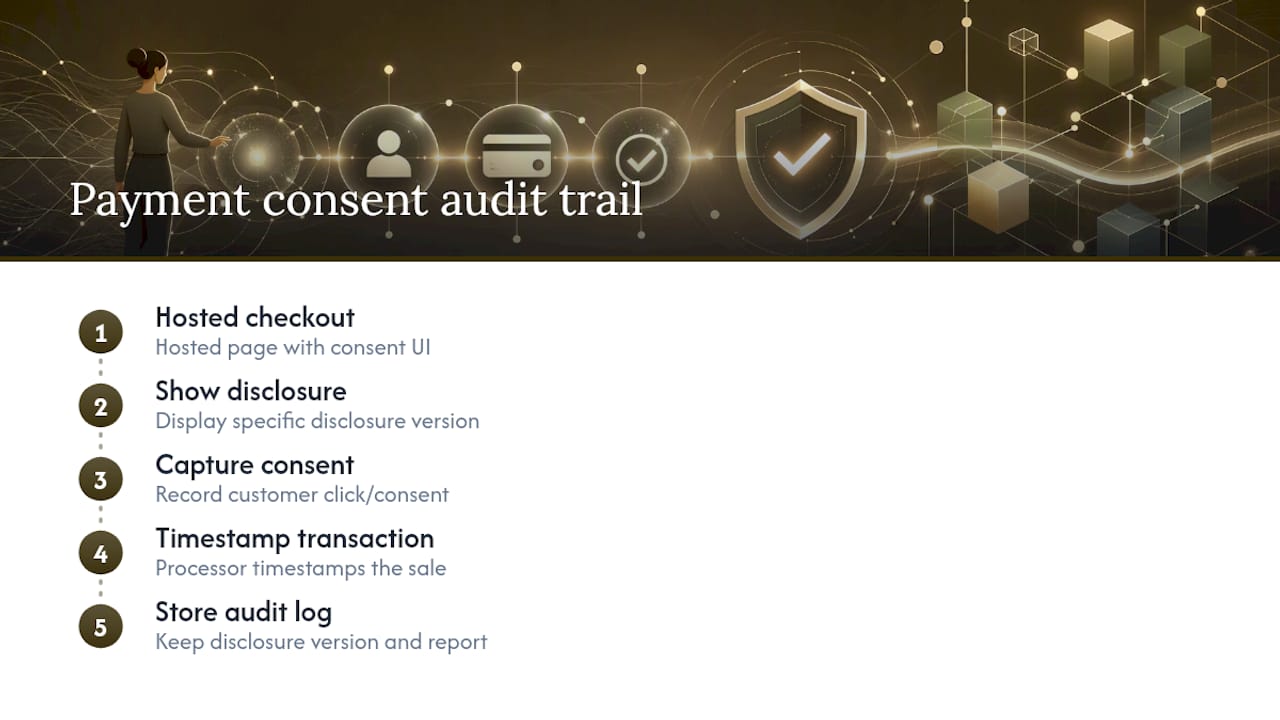
Flexible billing cadence support matters too. If your processor forces rigid renewal cycles, you end up hacking your own compliance logic around a system that wasn’t built for it. Davincipay builds recurring billing tools with consent capture and audit-ready reporting baked into the underwriting relationship, which is the kind of infrastructure regulated subscription verticals actually need.
The decision point is simple: if your UX is the problem, fix your UX. If your processor can’t produce consent logs or supports only rigid billing terms, that’s a signal to change infrastructure, not just copy.
— Peter
Get Compliant Billing Infrastructure Built for High-Risk Subscriptions
Most generic payment processors treat recurring billing as an afterthought, bolted onto systems built for one-time purchases. Some payment processors build subscription billing, consent capture, and chargeback mitigation into the underwriting relationship from day one, enabling compliance controls to work smoothly with the payment stack.

That matters most in regulated verticals. Davincipay’s telehealth payment processing, nutraceuticals payment processing, and supplements payment processing programs pair recurring billing with age and compliance controls, fraud prevention, and real-time reporting, so your cancellation logs and consent records exist without engineering them from scratch. Merchants in these sectors face outsized ROSCA scrutiny precisely because negative option offers are common there, and a processor that already understands the compliance landscape shortens your path to a defensible checkout flow.
If your current processing setup can’t produce audit-ready consent logs or keeps freezing accounts over recurring-billing disputes, apply now and talk with Davincipay’s underwriting team about building infrastructure that fits how your subscription business actually runs.
Primary Sources for ROSCA Compliance
- Restore Online Shoppers’ Confidence Act (FTC)
- Public Law 111–345, ROSCA statute text
- FTC negative option policy statement
- Cooley: FTC enhances scrutiny of subscriptions under ROSCA
Sources
- Restore Online Shoppers’ Confidence Act | Federal Trade Commission
- Public Law 111–345 — Restore Online Shoppers’ Confidence Act (text)
FAQ
What Is the New Law About Canceling Subscriptions?
ROSCA isn’t new, but the FTC has ramped up enforcement of its existing requirement that cancellation be as simple as sign-up. The rule requires the same channel used to enroll be available to cancel, with no extra steps like forced phone calls or retention screens.
What Is ROSCA Regulation, Exactly?
ROSCA governs any subscription or recurring charge classified as a “negative option feature,” requiring clear disclosure of material terms, express informed consent, and simple cancellation, as spelled out in 15 U.S.C. §§ 8401 through 8405. It applies to nearly every U.S. ecommerce subscription business, from telehealth to supplements to digital services.
Can a Company Automatically Renew a Subscription?
Yes, but only if the merchant disclosed the renewal terms clearly before billing and got the customer’s express informed consent to the recurring charge. Silent renewal without that upfront disclosure and consent violates ROSCA and often state automatic renewal laws too.
Can a Company Refuse to Let You Cancel a Subscription?
No. Refusing or complicating cancellation, through hidden menus, mandatory calls, or retention gauntlets, is one of the most common triggers behind FTC enforcement actions, including the Chegg settlement referenced above. A merchant using a payments partner like Davincipay that builds consent and cancellation logging into its billing infrastructure has an easier time proving the cancellation path met the “simple mechanism” standard.


.webp)
