.png)
Payment infrastructure is the operational backbone of every SaaS subscription business. It converts recurring intent into collected, predictable revenue, prevents involuntary churn, and enforces compliance at every transaction. Without it working correctly, you lose money quietly, one failed charge at a time.
The stakes are concrete. Subscription billing research shows that without dunning automation, a large portion of failed payments can become permanent losses. Optimized dunning can recover a significant percentage of those failures depending on whether your customer base is B2B or B2C. That range represents real MRR sitting on the table. Payment infrastructure touches four value areas directly:
- Revenue collection: recurring billing, retry logic, and settlement timing
- Fraud prevention and compliance: PCI DSS certification, 3D Secure (3DS), tokenization, and chargeback mitigation
- Customer experience: checkout security, payment method variety, and frictionless renewals
- Analytics and recovery: authorization rates, decline codes, and dunning performance data
Davincipay is one specialist built specifically for SaaS and high-risk subscription merchants navigating all four areas.
Key Takeaways
Payment infrastructure is product infrastructure for SaaS: authorization rates, dunning recovery, and gateway selection directly determine how much of your subscription revenue you actually collect.
| Dunning automation is non-negotiable | Without it, 60–69% of failed payments become permanent losses; optimized dunning recovers 25–85% depending on whether your customer base is B2B or B2C and the approach. | Authorization rate is your leading indicator | Target above 90%; a drop signals a routing or fraud rule problem before churn appears. | | Gateway type sets your PCI burden | Hosted gateways use SAQ A; integrated/API gateways require SAQ D and full security ownership. | | MoR decision is structural | Make the MoR vs. processor call early; MoR economics often become compelling between $500K–$3M ARR for global B2C. | | Davincipay for high-risk SaaS | Davincipay provides underwriting, chargeback mitigation, recurring billing, and compliance controls for regulated subscription merchants. |
Table of Contents
- What does payment infrastructure actually mean for a SaaS product?
- Why payment infrastructure matters more for subscription businesses
- What technical and business components does your SaaS stack need?
- Hosted vs. integrated gateways: which fits your SaaS product?
- Implementation timeline and cost: what to budget
- KPIs that tell you whether your payments stack is healthy
- How to choose a payment provider: questions and red flags
- When should a SaaS business use a specialized payments partner?
- How Davincipay handles high-risk and complex SaaS payment needs
- What most SaaS teams get wrong about payments
- Davincipay: payment processing built for your subscription business
- Sources
What does payment infrastructure actually mean for a SaaS product?
Payment infrastructure is the full stack of systems that moves money from your subscriber to your bank account. Each layer has a distinct job.
- Billing engine: manages subscription plans, proration, usage-based charges, and invoice generation
- Payment gateway: authenticates and encrypts payment data, then routes it to the processor; many e-commerce platforms bundle one by default
- Payment processor/acquirer: moves funds between the cardholder’s issuing bank and your merchant account
- Payment rails: the networks carrying the transaction, including ACH, RTP/FedNow, card networks (Visa, Mastercard), SWIFT, and SEPA; rail choice affects cost, settlement speed, and geographic reach
- Token vault: stores encrypted payment credentials so you can charge subscribers again without re-entering card data
- Merchant of record (MoR) vs. processor: a processor moves funds but leaves tax and chargeback obligations with you; an MoR becomes the legal seller and absorbs those responsibilities
The transaction flow runs: customer → gateway → acquirer/processor → issuing bank → settlement back to your account. Subscription logic, dunning, and tokenization live between the gateway and the billing engine, not at the card network level.
Why payment infrastructure matters more for subscription businesses
Every SaaS business runs on predictable recurring revenue. A single infrastructure failure compounds across every renewal cycle.
Payment gateways are frequently cited as the most critical component of an e-commerce tech stack, and perceived checkout insecurity directly drives cart abandonment and long-term loyalty loss. For subscription products, the damage extends further: a subscriber who experiences a failed renewal or a confusing charge dispute often cancels rather than re-enters payment details.
The subscription-specific risks are distinct:
- Involuntary churn: cards expire, banks reissue numbers, and spending limits change. None of these are the customer’s decision to leave, but they produce the same revenue loss.
- Dunning complexity: retry timing, messaging cadence, and card-updater services determine whether a failed charge recovers or churns permanently.
- Proration and mid-cycle changes: plan upgrades, downgrades, and seat additions require billing logic that standard processors do not handle natively.
- Global tax and currency handling: sales tax, VAT, and currency conversion rules vary by jurisdiction and must be calculated at the point of charge.
Pro Tip: Instrument every decline with a reason code. Soft declines (insufficient funds, temporary holds) are recoverable with smart retry logic. Hard declines (stolen card, closed account) are not. Treating them identically wastes retry attempts and accelerates churn.
What technical and business components does your SaaS stack need?
Think of this as your payments audit checklist before briefing an engineer or evaluating a vendor.
Technical essentials:
- Billing engine with plan management, proration, and usage-based metering
- Token vault with PCI DSS-compliant storage and portability on migration
- Smart retry logic with configurable dunning schedules and decline-code routing
- Card updater service (Visa Account Updater, Mastercard Automatic Billing Updater)
- Payment orchestration for multi-rail routing and fallback logic
- Webhook and API coverage for real-time event handling and reconciliation
- Reporting and settlement reconciliation tied to your general ledger
Business and operational essentials:
- PCI DSS scope definition (SAQ A vs. SAQ D depending on gateway type)
- Sales tax and VAT calculation and remittance
- Chargeback response workflows and evidence management
- Underwriting documentation and reserve requirements
- SLA commitments on uptime, settlement timing, and support response
Pro Tip: Own your token vault and billing engine if you plan to switch processors or expand internationally. Outsource tax remittance and chargeback management to a specialist. The first two give you control; the last two require jurisdiction-specific expertise that takes years to build in-house.
Hosted vs. integrated gateways: which fits your SaaS product?
The gateway type you choose shapes your PCI burden, your checkout UX, and your engineering timeline. Hosted gateways reduce merchant PCI scope while integrated/API gateways improve UX but increase security responsibilities.
| Dimension | Hosted gateway | Integrated/API gateway |
|---|---|---|
| PCI scope | SAQ A (minimal) | SAQ D (full assessment) |
| Checkout branding | Limited; redirects to provider page | Fully branded, on-domain |
| Engineering effort | Low (days to weeks) | High (weeks to months) |
| Subscription feature support | Basic; depends on provider | Full control over retry, proration, metering |
| Authorization rate optimization | Provider-controlled | You control routing and retry logic |
| Speed to market | Fast | Slower |
For early-stage SaaS products or teams without dedicated payments engineers, a hosted gateway gets you live quickly with minimal compliance overhead. Once you reach the point where checkout conversion and dunning recovery materially affect MRR, the integrated/API approach gives you the control to optimize both. Many teams start hosted and migrate to an integrated model as ARR grows.
Implementation timeline and cost: what to budget
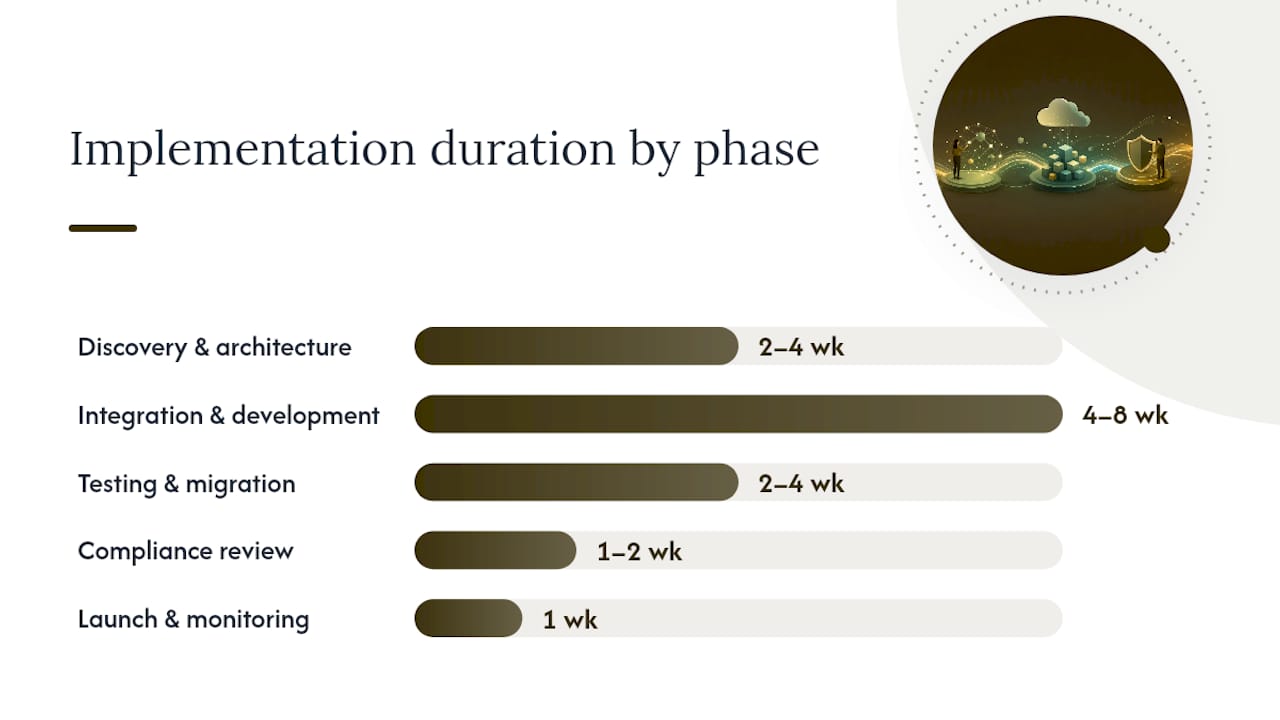
A realistic payment infrastructure build or overhaul moves through six phases.
- Discovery and architecture (2–4 weeks): define payment rails, gateway type, MoR vs. processor decision, and PCI scope
- Integration and development (4–8 weeks): gateway API, billing engine, webhook handlers, and token vault setup
- Testing and migration (2–4 weeks): sandbox testing, subscription migration scripts, and re-collection flows for existing subscribers
- Compliance review (1–2 weeks): PCI SAQ completion, fraud rule configuration, and 3DS setup
- Launch and monitoring (1 week): go-live with real transactions, decline-code monitoring, and dunning activation
- Optimization (ongoing): authorization rate tuning, dunning schedule refinement, and reporting calibration
Cost line-items to budget:
- One-time engineering: varies by team size and integration complexity
- Gateway/platform monthly fees: fixed platform charges from your processor or PSP
- Per-transaction fees: percentage plus fixed amount per successful charge
- Tax remittance services: monthly or per-transaction fees for VAT/sales tax automation
- Chargeback mitigation: per-dispute fees or monthly retainer for managed services
- MoR premium: typically 1–3% above standard processing rates in exchange for tax and chargeback coverage
Migration carries real churn risk. Subscribers whose tokens do not transfer cleanly must re-enter payment details, and a meaningful share will not. Mitigate this by negotiating token portability before signing with any processor, and run parallel processing during cutover rather than a hard switch.
KPIs that tell you whether your payments stack is healthy
Track these metrics monthly. They tell you where revenue is leaking and whether your infrastructure is performing.
| Metric | Definition | Target range |
|---|---|---|
| Authorization rate | Successful charges ÷ total attempts | Above typical authorization rates |
| Soft decline rate | Recoverable declines ÷ total attempts | Below 5% |
| Hard decline rate | Unrecoverable declines ÷ total attempts | Below 2% |
| Dunning recovery rate | Recovered failed payments ÷ total failed | 25–85% depending on B2B/B2C and recovery approach |
| Involuntary churn rate | Churned subscribers from payment failure ÷ total subscribers | Below 1% monthly |
| Chargeback rate | Disputes ÷ total transactions | Below typical chargeback exposure threshold |
| Dispute win rate | Won disputes ÷ total disputes | Above typical recovery rates |
| Settlement lag | Days from transaction to funds in account | 1–3 business days |

Authorization rate and involuntary churn are your two leading indicators. A drop in authorization rate signals a routing, fraud rule, or issuer relationship problem. A rise in involuntary churn signals dunning failure. Both are fixable, but only if you measure them.
How to choose a payment provider: questions and red flags
Use this checklist when evaluating any gateway, PSP, or MoR.
Must-ask vendor questions:
- What is your average authorization rate for subscription merchants in my vertical?
- How does your dunning logic work, and can I configure retry timing and messaging?
- What token portability guarantees do you offer if I migrate?
- What are your SLA commitments for uptime and settlement timing?
- How do you handle chargeback evidence submission and dispute management?
- What payment rails do you support, and which markets can you settle in?
- Can you provide developer documentation and a sandbox environment before contract signing?
Red flags to walk away from:
- Opaque or bundled fee schedules with no per-transaction breakdown
- No token portability clause in the contract
- No dunning automation or manual-only retry processes
- Missing or outdated developer documentation
- No dedicated support contact for high-volume or high-risk accounts
Assess cost structure, security certifications, scalability, and payment method support and developer APIs before signing anything. A low processing rate with poor authorization performance costs more than a slightly higher rate with strong routing.
When should a SaaS business use a specialized payments partner?
Standard processors work well for low-risk, domestic, B2B SaaS with simple billing. Move to a specialist when the complexity outgrows what a general processor handles.
Use cases that favor a specialist:
- High-risk verticals: nutraceuticals, telehealth, supplements, CBD, digital subscriptions, gaming, or adult content
- Complex compliance requirements: age verification, health product regulations, or state-level licensing
- Rapid international consumer expansion with multi-currency billing and local payment methods
- Chargeback exposure above 0.5% requiring active dispute management
- Regulated products where the processor’s standard terms exclude your category
The MoR decision is structural: it changes who is the legal seller and who carries tax and chargeback risk. Make it early, with a clear read on your customer geography. MoR economics tend to become compelling for global B2C SaaS once the cost of managing international tax compliance and chargeback disputes internally is believed to exceed the MoR premium.
The trade-off is real: you offload tax remittance, chargeback liability, and compliance overhead, but you pay a higher percentage per transaction and accept some constraints on billing customization.
How Davincipay handles high-risk and complex SaaS payment needs
Davincipay is built for the merchants that standard processors decline or underserve. For SaaS businesses in regulated or high-risk verticals, the feature set maps directly to the risks described above.
Core capabilities:
- Underwriting support for high-risk merchant categories including nutraceuticals, telehealth, supplements, and subscription commerce
- Chargeback mitigation with active dispute management and evidence workflows
- Fraud prevention tools integrated at the gateway level
- Recurring billing management with configurable dunning and retry logic
- ACH and real-time payment rail support alongside card processing
- Age and compliance controls for regulated product categories
- Real-time reporting and reconciliation dashboards
Onboarding flow:
- Application and underwriting review
- Gateway and billing engine integration with developer documentation
- Test transactions and compliance configuration
- Go-live with active monitoring and support
For telehealth companies specifically, Davincipay’s compliance-focused payment processing addresses the intersection of health regulations and subscription billing that general processors are not equipped to handle. If your SaaS product sits in a regulated vertical and you are losing merchant accounts or fighting chargebacks manually, that is the signal to evaluate a specialist.
What most SaaS teams get wrong about payments
The most common mistake is treating payment infrastructure as a one-time integration rather than a living product component. Teams spend weeks on the initial setup, then ignore authorization rates and dunning performance until a churn spike forces a post-mortem.
The single highest-impact behavior change is simple: instrument every payment event with structured logging, set up weekly authorization rate and dunning recovery dashboards, and assign a named owner in product or finance to review them. Most SaaS businesses have the data. Almost none have the review cadence.
The second mistake is delaying the MoR vs. processor decision until international expansion is already underway. By then, you are re-platforming under pressure, migrating subscriber tokens, and managing tax exposure retroactively. Make that architecture decision before you need it.
Davincipay: payment processing built for your subscription business
High-risk and regulated SaaS merchants face a specific problem: standard processors either decline the account outright or approve it without the compliance controls, chargeback management, or dunning infrastructure the business actually needs. Davincipay solves that directly.

Davincipay provides domestic and international acquiring, gateway integration, fraud prevention, chargeback mitigation, and recurring billing management for subscription merchants in nutraceuticals, telehealth, supplements, digital services, and other regulated verticals. You get underwriting support, real-time reporting, ACH and card rail access, and a team that understands the compliance requirements of your category. For teams evaluating Magento 2 API integration alongside payment infrastructure, Davincipay’s gateway connects cleanly with existing e-commerce stacks.
If your SaaS business is in a high-risk vertical, expanding internationally, or fighting chargebacks without a managed process, apply for a Davincipay merchant account and get your payment infrastructure matched to the actual risk profile of your business.
Sources
- Payment gateways | Salesforce Commerce
- Payment gateways: What they are and how to choose one | J.P. Morgan
- What is a payment gateway? | TechRepublic
- How to set up payment processing for SaaS: Full guide | Freemius
- Merchant of Record vs Payment Processor: What SaaS Founders Actually Need to Know | FintechSpecs
- Subscription billing infrastructure: Recurring payments, dunning, and revenue recovery | Spark


.webp)
