.png)
The acquiring bank is the merchant-facing engine that authorizes, settles, and carries settlement risk for every card transaction flowing through your platform. It owns the BIN/ICA used for clearing, contracts directly with card schemes like Visa and Mastercard, and remains liable for the activity of every merchant or submerchant it sponsors. That liability is not abstract. When a merchant on your platform generates chargebacks, the acquirer answers to the scheme first, then recovers from you.
Three operational levers determine how much an acquirer affects your platform’s business model. Authorization rates control conversion: a poorly routed authorization request can fail at the scheme or issuer level before a buyer ever sees a decline message. Settlement timing controls cash flow: whether your merchants receive funds in T+1, T+2, or on a rolling reserve schedule shapes their working capital and your churn risk. Chargeback exposure controls margin: the acquirer sets reserve requirements and dispute timelines that directly affect how much capital you tie up and how fast you can resolve disputes.
J.P. Morgan’s analysis of payment volume growth identifies embedded payments and platform-driven transaction flows as central to the next phase of payments infrastructure, making acquirer selection a strategic product decision, not a procurement checkbox.
TL;DR for platform operators:
- Choose a local acquirer for each key market to protect authorization rates on cross-border transactions.
- Clarify your merchant-of-record (MoR) model before signing an acquirer contract — it determines who owns compliance liability.
- Require real-time decline codes to be surfaced to your merchants and product teams.
- Build reserve requirements into your seller pricing model from day one.
- Confirm the acquirer owns the BIN directly — rent-a-BIN arrangements carry oversight risks you need to manage contractually.
Table of Contents
- What does an acquiring bank actually contract to do?
- How does an acquirer differ from a processor, gateway, and issuer?
- How does the transaction flow work from authorization to settlement?
- What platform features should you require from an acquirer?
- How do acquirer fees work, and what does a real transaction cost?
- Who bears the risk, and what does compliance require?
- How do acquiring choices shape your platform’s business model?
- How do you choose the right acquirer for your platform?
- How Davincipay supports platforms and high-risk merchants
- Key Takeaways
- What most platforms get wrong about acquirer selection
- Davincipay: acquiring built for platforms that need more than standard processing
- Primary sources and further reading
What does an acquiring bank actually contract to do?
An acquiring bank (also called a merchant acquirer) is the financial institution that enters a merchant services agreement with a business, provisions a merchant account, and takes on settlement and scheme liability for that business’s card transactions. It is the entity that contracts with card schemes — Visa, Mastercard, Discover, and American Express — to process transactions on behalf of merchants, and it remains responsible to those schemes for any third party it sponsors.
Core acquirer responsibilities:
- Merchant account provisioning: Opens and maintains the merchant account that receives settled funds.
- BIN/ICA ownership: Holds the Bank Identification Number and Interbank Card Association number used to route and clear transactions through card networks.
- Settlement and clearing: Receives interchange from the issuing bank, nets fees, and deposits net proceeds into the merchant’s account.
- Card-scheme sponsorship: Maintains direct membership in card networks, which allows it to sponsor processors, ISOs, and submerchants.
- Underwriting and reserves: Evaluates merchant risk, sets reserve requirements, and monitors ongoing activity for compliance with scheme rules.
- Third-party oversight: Remains liable for the activity of any ISO, payment facilitator, or submerchant it sponsors, per OCC guidance on merchant processing.
Merchant-of-record vs. agent models
How the acquirer appears in your platform depends on which model you operate. In a platform-as-MoR model, the platform is the merchant of record, holds the master merchant account, and the acquirer settles all funds to the platform, which then disburses to sellers. In a seller-as-MoR model, each seller has a direct merchant account with the acquirer, and the platform acts as an agent or payment facilitator. A third structure, the collect-and-disburse model, uses For Benefit Of (FBO) accounts to hold funds on behalf of sellers before disbursement, as Spark’s marketplace research outlines.
The acquirer’s operational footprint differs significantly across these models. In the MoR model, the acquirer underwrites the platform, not individual sellers. In the agent/payment facilitator model, the acquirer may require submerchant-level KYB and set per-submerchant transaction limits. Your legal team and compliance officer need to know which model applies before you finalize any acquirer contract.
Operational models: bank acquirer, processor-owned acquirer, and rent-a-BIN
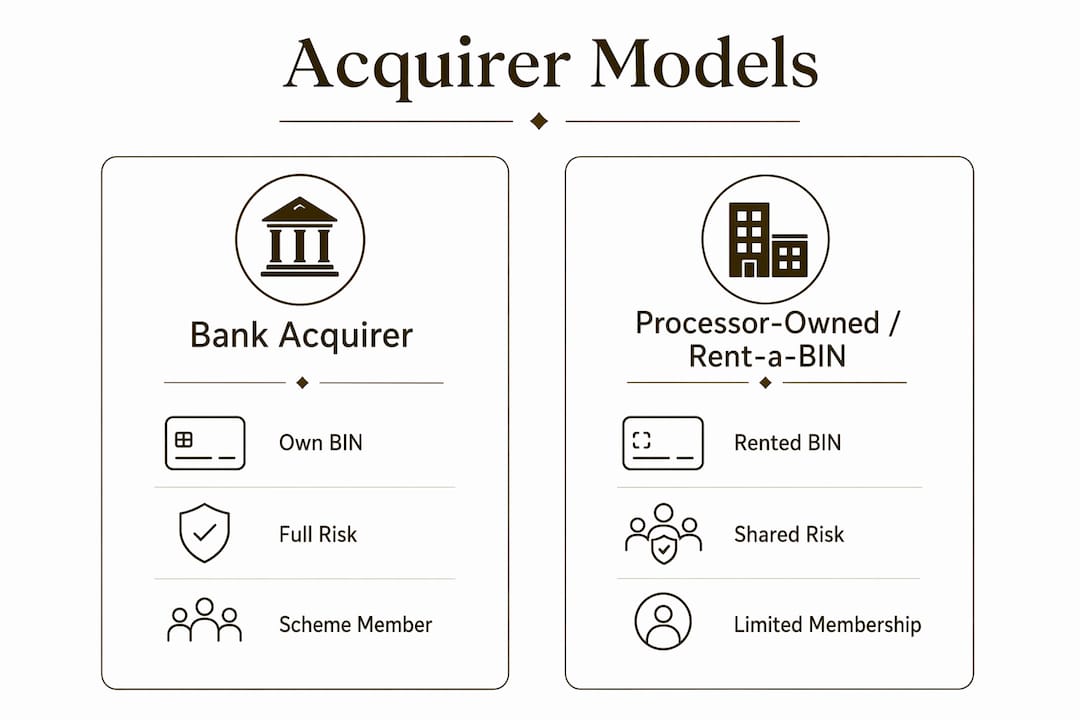
A bank-owned acquirer (Wells Fargo, JPMorgan Chase) holds its own BIN, carries its own scheme membership, and bears full settlement liability. A processor-owned acquirer combines processing infrastructure with BIN ownership under one entity, often offering tighter API integration. A rent-a-BIN arrangement lets an ISO or payment facilitator use a sponsoring bank’s BIN, but the OCC’s Comptroller’s Handbook is explicit: the sponsoring bank retains legal settlement and scheme liability regardless of how operational control is delegated. That exposure requires rigorous contractual controls and ongoing oversight.
How does an acquirer differ from a processor, gateway, and issuer?
The confusion between these roles costs platform teams real money when they assign the wrong responsibility to the wrong vendor. The acquirer, processor, gateway, and issuer each perform distinct functions — and in some arrangements, one vendor plays multiple roles simultaneously.
| Dimension | Acquiring Bank | Payment Processor | Payment Gateway | Issuing Bank |
|---|---|---|---|---|
| Merchant account ownership | Yes — holds the account | No | No | No |
| BIN/ICA ownership | Yes | Sometimes (processor-as-acquirer) | No | Yes (for card issuance) |
| Settlement timing control | Yes | Partial (executes settlement) | No | No |
| Chargeback liability | Yes — primary | Shared contractually | No | Initiates disputes |
| KYC/underwriting | Yes | Partial (for sponsored merchants) | No | For cardholders |
| API/payment orchestration | Limited | Yes | Yes — primary | No |
| Scheme membership | Direct | Indirect (via acquirer) | No | Direct |
Where roles combine or split
A bank-owned acquirer that also runs its own processing infrastructure controls settlement, BIN routing, and clearing under one roof. That simplifies your integration but can limit flexibility on pricing and API customization. A processor-only arrangement means the processor routes transactions through a separate acquiring bank, which introduces a second contractual relationship and potentially longer settlement chains.
What platform teams must track when roles are combined or split:
- Who receives raw decline codes from the scheme, and will they pass them through to you?
- Who issues reserve draws, and what triggers them?
- Who holds funds during the settlement window, and what happens if that entity fails?
- Which entity is your primary contact for chargeback notifications and dispute evidence submission?
Pro Tip: When a single vendor plays both processor and acquirer, ask explicitly whether they own the BIN or rent it from a sponsor bank. The answer changes your risk exposure and your contract negotiation leverage.
How does the transaction flow work from authorization to settlement?
The acquirer is active at every stage of the card lifecycle. Understanding where it plugs in lets you diagnose authorization failures, settlement delays, and reconciliation gaps without waiting for a vendor to explain it.
- Card capture: The buyer enters card details at checkout. The gateway tokenizes and encrypts the data, then passes the authorization request to the processor.
- Authorization request (acquirer → scheme → issuer): The processor routes the request through the acquirer’s BIN/ICA to the card network (Visa, Mastercard). The network forwards it to the issuing bank.
- Authorization response: The issuer approves or declines and returns a response code. The scheme passes it back through the acquirer to the processor and gateway. The acquirer logs the response and the authorization hold.
- Capture: After the transaction is confirmed (or after seller fulfillment in marketplace models), the platform or processor sends a capture request. In marketplace settings, separating authorization from capture reduces dispute exposure by authorizing at checkout but capturing only after seller confirmation.
- Clearing: The acquirer submits the captured transaction to the card network in a clearing file, typically in batch at end of day. Interchange fees are calculated at this stage based on card type, transaction category, and merchant category code (MCC).
- Settlement/ACH to merchant account: The card network settles net funds to the acquirer, who then deposits net proceeds (after interchange, scheme fees, and acquirer markup) into the merchant account, typically via ACH.
- Reconciliation: The acquirer generates settlement reports. Platforms reconcile these against their own transaction records using ACH files, ISO 20022 formats, or CSV exports depending on the acquirer’s reporting stack.
How BIN/ICA routing affects authorization rates
When a transaction originates in the U.S. but the buyer’s card was issued by a European bank, the issuer evaluates the acquirer’s BIN country as part of its fraud scoring. A U.S.-based BIN processing a German card may trigger additional friction or an outright decline. A local acquirer with a BIN registered in the buyer’s region reduces that friction. As GlobalBlue’s acquiring explainer notes, acquirers that can route through local BINs consistently achieve higher authorization rates for cross-border transactions.

Settlement timing and platform cash flow
Acquirers offer different settlement cadences. T+2 is the U.S. standard for most card transactions. T+1 is available from some acquirers for qualifying merchants. Same-day and instant payout options exist but typically carry additional fees and require the acquirer to extend credit against unsettled funds. Rolling reserves, typically a portion of gross volume held for an extended period, are common for high-risk merchants and directly affect seller working capital. Build your platform’s seller payout schedule around the acquirer’s settlement cadence, not the other way around.
What platform features should you require from an acquirer?
The acquirer’s feature set determines what your platform can build. A thin acquiring relationship limits your product roadmap. A full-featured acquirer with strong API coverage lets you build split payouts, real-time dashboards, and automated reserve management directly into your platform.
Essential acquirer capabilities for platform operators:
- Submerchant onboarding and KYB support: Automated or API-driven KYB workflows that let you onboard sellers without manual underwriting queues. Look for configurable risk tiers and document collection APIs.
- Split payouts: The ability to split a single transaction across multiple sellers or accounts at settlement. Critical for multi-seller carts, service marketplaces, and any platform where revenue is shared.
- Payout scheduling: Configurable settlement windows (daily, weekly, on-demand) that match your seller agreements and your own cash flow model.
- FBO account management: Segregated accounts that hold seller funds before disbursement, required for regulatory compliance in many states.
- Reserves and rolling reserves: Transparent reserve policies with API-accessible reserve balance data so your finance team can reconcile without manual requests.
- Real-time reporting and webhooks: Event-driven notifications for authorizations, captures, settlements, disputes, and reserve changes. Real-time transaction telemetry materially reduces time-to-resolution on disputes and lowers operational load for payment ops teams.
- Dispute management: Automated chargeback notification routing, evidence submission APIs, and SLA commitments on response windows.
- BIN sponsorship/rent-a-BIN: If the acquirer offers rent-a-BIN arrangements, confirm the oversight and contractual controls in place.
- Multi-currency settlement: Settlement in local currencies for cross-border platforms, with transparent FX rates and conversion timing.
Integration surface: what to expect technically
Your engineering team should expect REST APIs with OAuth 2.0 authentication, webhook endpoints for event notifications, and batch settlement file delivery in ACH or ISO 20022 format. Uptime SLAs of 99.9% or higher are standard for production acquiring environments. Ask for a sandbox environment with realistic test data before committing to integration.
Why decline-code pass-through matters
Most acquirers receive granular decline codes from card schemes: insufficient funds, card not present fraud flags, velocity limits, geographic restrictions. Many acquirers collapse these into generic “do not honor” responses before passing them to the platform. That obscures the real cause of declines and makes it impossible for your product team to fix routing logic or for merchants to troubleshoot their own issues. Require full scheme decline code pass-through in your contract.
Pro Tip: Map every decline code your acquirer surfaces to a merchant-facing message and an internal routing action. Platforms that do this typically see meaningful reductions in repeat declines within 60 days of implementation.
How do acquirer fees work, and what does a real transaction cost?
Acquiring economics have three layers: interchange (set by card networks), scheme fees (set by networks), and the acquirer’s own markup. Platforms that understand all three can model margins accurately and identify where optimization is possible.
Fee components in a typical U.S. card transaction:
- Interchange: Paid to the issuing bank. Rates vary by card type (debit, credit, rewards, corporate), MCC, and transaction method (card-present vs. card-not-present). For a standard U.S. consumer credit card in a card-not-present environment, interchange typically runs in the range of 1.5%–2.0% plus a per-transaction cent amount, though exact rates are published by Visa and Mastercard and vary by category.
- Scheme/network fees: Paid to Visa, Mastercard, or other networks. These include assessment fees, network access fees, and cross-border fees. They are generally a small fraction of the transaction but add up at volume.
- Acquirer markup (MDR): The acquirer’s margin, expressed as a percentage of the transaction plus a per-item fee. This is the negotiable component.
- Processor fees: If the processor is separate from the acquirer, an additional per-transaction fee applies.
- Gateway fees: Monthly access fees plus per-transaction fees for the payment gateway layer.
- Add-ons: 3D Secure authentication fees, chargeback handling fees, currency conversion fees, and reserve-related costs.
Sample calculation: a $100 card-not-present transaction
Rates are illustrative. Actual interchange is determined by card network published schedules and varies by card type, MCC, and transaction conditions.
Pricing models for platforms
Blended pricing bundles all fees into a single percentage, which is simple to communicate to sellers but hides the actual interchange cost and limits your optimization options. Interchange-plus pricing passes interchange at cost and adds a fixed acquirer markup, giving you full visibility into the fee stack. This is the preferred model for platforms that want to optimize routing and negotiate volume tiers. Volume-negotiated tiers are available from most acquirers above a certain monthly processing volume and can significantly reduce the acquirer markup component.
Where platforms can optimize costs:
- Route debit transactions separately to capture lower interchange rates.
- Use local acquiring in key markets to avoid cross-border fees.
- Negotiate multi-currency settlement to reduce FX conversion costs.
- Implement 3DS selectively (high-risk transactions only) to avoid adding authentication fees to every transaction.
Who bears the risk, and what does compliance require?
The acquirer underwrites your platform and carries scheme liability for your merchants’ activity. That means your risk profile directly affects your acquirer’s willingness to work with you, the reserves they require, and the controls they impose.
Acquirer responsibilities in risk and compliance:
- Underwriting and KYB/KYC: The acquirer evaluates your business model, your merchants’ business models, and your fraud and chargeback history before approving a merchant account.
- AML monitoring: Acquirers are required to monitor transaction flows for suspicious activity and file Suspicious Activity Reports (SARs) where required under the Bank Secrecy Act.
- PCI DSS compliance: The acquirer is responsible for ensuring merchants meet PCI DSS requirements. Platforms that store, process, or transmit cardholder data must maintain their own PCI scope and provide evidence of compliance.
- Chargeback handling and liability: When a cardholder disputes a transaction, the issuer initiates a chargeback. It flows from the issuer → card scheme → acquirer → merchant. The acquirer debits the merchant account and manages the dispute process. If the merchant cannot fund the chargeback, the acquirer absorbs the loss.
- Reserves and holdbacks: Acquirers hold a percentage of gross volume in reserve to cover potential chargebacks and fraud losses. For high-risk merchants, rolling reserves of 5%–10% held for 90–180 days are common.
The chargeback lifecycle on a platform
When a buyer disputes a charge, the clock starts immediately. The issuer has up to 120 days to initiate a chargeback under Visa and Mastercard rules. The acquirer notifies the platform or merchant, typically within 5–10 business days of receiving the chargeback. The merchant has a defined window (usually 20–30 days) to submit representment evidence. If the acquirer loses the dispute, the funds are debited from the merchant account or reserve. Platforms operating as MoR bear this exposure directly.
Fraud controls available through acquirers
Most acquirers offer rule-based fraud filters, velocity checks, and BIN-level blocking. More sophisticated acquirers provide 3DS orchestration, device fingerprinting, and real-time risk scoring. Platforms add value by layering their own merchant risk scoring and order review engines on top of acquirer-level controls. Transaction monitoring tools that integrate with acquirer data feeds can flag anomalies before they become chargebacks, which is particularly important for high-risk verticals like nutraceuticals, telehealth, and subscription commerce.

Pro Tip: Require your acquirer to surface both the scheme reason code and the issuer response code for every chargeback. Generic reason codes make it impossible to identify whether disputes are driven by fraud, merchant error, or fulfillment issues — and each requires a different operational response.
How do acquiring choices shape your platform’s business model?
Acquiring is not just a back-end function. The acquirer you choose, and the model you operate under, determines your liability exposure, your data access, and your ability to monetize payment flows.
MoR, agent, and collect-and-disburse: what changes with each model
In the platform-as-MoR model, the platform controls the full payment experience, owns the transaction data, and bears chargeback and compliance liability. This model gives you the most control and the richest data set, but it requires the most regulatory infrastructure. In the seller-as-MoR model, liability shifts to individual sellers, which reduces your compliance burden but limits your data access and your ability to offer a consistent buyer experience. The collect-and-disburse model with FBO accounts sits between the two: the platform collects funds on behalf of sellers, holds them in segregated accounts, and disburses on a schedule. Acquirer selection affects all three models differently in terms of settlement timing, reserve requirements, and reporting granularity.
How local acquiring improves cross-border conversion
A platform expanding into new markets faces a predictable problem: authorization rates drop when transactions cross borders because issuers apply additional fraud scoring to unfamiliar acquirer BINs. Adding a local acquirer with a BIN registered in the target market typically lifts authorization rates, reduces FX conversion costs, and speeds settlement. The trade-off is managing an additional acquiring relationship, with its own contract, integration, and compliance requirements.
Data strategy and payment monetization
Platforms that control the payment flow capture transaction-level data: purchase frequency, average order value, product category, buyer geography, and payment method mix. That data feeds product decisions, merchant pricing, and targeted marketing. Academic research on platform payment services confirms that platforms frequently accept lower direct payment revenue in exchange for richer transaction data that can be monetized across the platform’s other business lines.
Your acquirer contract determines how much of that data you can access, in what format, and with what latency. Insist on transaction-level reporting with full metadata, not just settlement summaries. Transaction management systems that integrate with acquirer reporting feeds are central to extracting business value from payment flows at scale.
Pro Tip: If your platform subsidizes payment fees to capture transaction data, document the trade-off explicitly in your financial model and set controls on how that data is used. Regulators and acquirers both scrutinize platforms that monetize payment data without clear disclosure.
How do you choose the right acquirer for your platform?
Acquirer selection is a product infrastructure decision. Authorization performance and settlement cadence directly affect conversion, merchant churn, and working capital needs. Treat the evaluation with the same rigor you apply to core infrastructure vendors.
Prioritized evaluation checklist
- Authorization performance: Ask for authorization rate benchmarks by card type, geography, and MCC. Require data, not estimates.
- BIN ownership: Confirm the acquirer owns its BIN directly. If it uses a rent-a-BIN arrangement, understand the sponsoring bank’s oversight requirements and your contractual protections.
- Local presence: For each key market, confirm whether the acquirer has a local BIN or relies on cross-border routing.
- Settlement cadence: Confirm T+1 or T+2 availability, same-day payout options, and rolling reserve terms in writing.
- API and webhook reliability: Require 99.9% uptime SLA, sandbox access, and documentation for all endpoints before signing.
- Reporting granularity: Confirm transaction-level reporting with full metadata, real-time webhooks, and settlement file formats compatible with your reconciliation stack.
- Chargeback SLA: Ask for the acquirer’s average time from chargeback notification to merchant notification, and their representment support capabilities.
- Reserve policy: Get the reserve percentage, hold period, and release triggers in writing. Understand what events can increase the reserve requirement.
- PCI support: Confirm the acquirer’s PCI DSS compliance level and what support they provide for your own PCI scope management.
- Onboarding timelines: Get a written timeline with milestones for underwriting, technical integration, and go-live. Vague timelines are a red flag.
Questions to ask in vendor interviews
- Do you own the BIN, or are you using a sponsor bank’s BIN?
- Where will funds settle, and in what currency?
- What triggers a reserve draw, and how quickly can we access reserve funds after the hold period?
- Will you surface full scheme decline codes and issuer response codes to our platform in real time?
- What is your chargeback ratio threshold, and what happens if we exceed it?
- How do you handle submerchant onboarding for a platform with high seller volume?
Red flags to watch for
- Opaque or bundled fee structures that make it impossible to identify interchange passthrough.
- Refusal to surface granular decline codes to the platform.
- Onboarding timelines with no written milestones or underwriting criteria.
- Rent-a-BIN arrangements with no documented oversight controls on the sponsoring bank relationship.
- Reserve policies that give the acquirer unilateral discretion to increase holds without notice.
Integration roadmap and go-live readiness
A typical platform integration with a new acquirer runs 6–12 weeks for a synchronous API integration, longer if batch settlement file reconciliation requires custom development. Webhook-based reconciliation can reduce ongoing operational load significantly once implemented. Before go-live, run a pilot with a controlled merchant cohort: test authorization flows, capture, settlement, chargeback notification routing, and reserve reporting. Confirm that decline codes are surfacing correctly and that your reconciliation stack is matching acquirer settlement files to your internal transaction records without gaps.
How Davincipay supports platforms and high-risk merchants
Davincipay is built for the merchants and platforms that standard acquirers decline or underserve. Specialized acquiring for high-risk verticals, tailored underwriting, and API-driven reporting are the core of what Davincipay provides to platform operators and ecommerce merchants in regulated or complex categories.
Platform-relevant capabilities Davincipay offers:
- KYB onboarding support: Structured onboarding workflows for high-risk merchants, including nutraceuticals, telehealth, supplements, CBD, subscription commerce, and digital services.
- Domestic and international acquiring relationships: Access to acquiring infrastructure across multiple markets, supporting cross-border transaction flows for platforms expanding globally.
- Chargeback mitigation: Proactive dispute management, chargeback monitoring, and representment support designed for verticals with elevated dispute rates.
- Real-time reporting and reconciliation APIs: Transaction-level data with the granularity platform finance and ops teams need for accurate reconciliation and merchant-level reporting.
- Reserve management tailored for high-risk verticals: Reserve structures that reflect actual risk profiles rather than blanket policies, helping merchants manage working capital more effectively.
- Vertical-specific controls: Age verification, compliance controls, and subscription billing management for regulated product categories including telehealth payment processing and supplement merchants.
- Fraud prevention tools: Rule-based filters, 3DS support, and chargeback mitigation tools integrated into the acquiring relationship.
- Recurring billing management: Subscription billing infrastructure with retry logic and decline recovery for subscription-first platforms.
For platforms evaluating a specialist acquiring partner, the Davincipay how it works page outlines the integration model and onboarding process. Teams ready to move forward can start at the Apply Now page.
Key Takeaways
The acquiring bank controls authorization rates, settlement timing, and chargeback liability — making acquirer selection one of the highest-leverage infrastructure decisions a platform operator makes.
| Point | Details |
|---|---|
| Acquirer controls three levers | Authorization rates, settlement cadence, and chargeback liability each directly affect platform conversion, cash flow, and margin. |
| MoR model determines liability | Your merchant-of-record structure determines who owns compliance and chargeback exposure — clarify this before signing any acquirer contract. |
| Local acquiring lifts authorization | A local BIN in the buyer’s market reduces cross-border decline rates and FX costs for platforms expanding internationally. |
| Decline code transparency is required | Require full scheme and issuer decline codes in your contract — generic responses make troubleshooting impossible. |
| Davincipay for high-risk platforms | Davincipay provides specialized acquiring, tailored underwriting, and chargeback mitigation for regulated and high-risk ecommerce platforms. |
What most platforms get wrong about acquirer selection
The conventional wisdom in platform payments is that acquirer selection is a finance decision — negotiate the lowest MDR, sign the contract, and move on. That framing is wrong, and it costs platforms real money.
Authorization rates are a product metric, not a finance metric. A 2% drop in authorization rate on a platform processing $10 million per month is $200,000 in lost revenue per month, before you account for the merchant churn that follows repeated declines. Settlement timing is a seller retention metric: merchants who wait five days for funds while their costs are due in two will find another platform. Chargeback exposure is a capital planning metric: a reserve draw at the wrong moment can create a cash flow crisis that no amount of MDR optimization can fix.
The other mistake is treating the acquirer as a commodity once the integration is live. Acquirer relationships require active management: monitoring authorization rates by card type and geography, reviewing decline code distributions monthly, and renegotiating terms as volume grows. Platforms that treat acquiring as set-and-forget leave significant optimization on the table.
For high-risk and regulated verticals, the stakes are higher still. Standard acquirers often apply blanket restrictions to categories like nutraceuticals, telehealth, and subscription commerce, regardless of the individual merchant’s actual risk profile. Specialist acquirers with underwriting expertise in these verticals can structure merchant accounts that reflect real risk, not category assumptions. That is the difference between a merchant account that survives a chargeback spike and one that gets terminated at the worst possible moment.
Davincipay: acquiring built for platforms that need more than standard processing
High-risk and regulated ecommerce platforms need an acquiring partner that understands their business model before the first transaction is processed. Davincipay provides reliable acquiring relationships, tailored underwriting for complex verticals, and split payout infrastructure for platforms managing multiple sellers.

Whether you operate a supplement brand, a telehealth platform, a subscription commerce business, or a multi-seller marketplace, Davincipay’s acquiring and merchant services are structured around your actual risk profile, not a generic category restriction. Fast approvals, transparent reserve policies, and real-time reporting give your team the visibility and control to manage payment operations confidently. Apply now to start the onboarding process, or visit Davincipay to review the full range of capabilities before you reach out.
Primary sources and further reading
- OCC Merchant Processing, Comptroller’s Handbook: The primary U.S. regulatory reference for acquirer responsibilities, BIN/ICA ownership, rent-a-BIN risk, and third-party oversight requirements. Essential reading for compliance and legal teams.
- Academic paper on platform payment services and data monetization: Analyzes how platforms trade lower payment revenue for transaction data access and monetization opportunities. Useful for platform finance and product strategy teams.
- Marketplace Payments: How Platforms Handle Money Between Buyers and Sellers, Spark: Covers MoR models, authorization/capture separation, and FBO account structures for marketplace operators.
- Payments Are Eating the World, J.P. Morgan: J.P. Morgan’s analysis of embedded payments and platform-driven transaction volume growth. Useful for strategic context and executive briefings.
- GlobalBlue: What Is an Acquirer and Why They Are Important: A concise practitioner explainer of acquirer responsibilities, authorization routing, and cross-border acquiring considerations.
- How Transaction Management Systems Work in Finance, Currexchanger: Explains how transaction management systems support reconciliation, fraud monitoring, and operational scaling for payment platforms.
- Why Transaction Monitoring Matters in Finance, Currexchanger: Covers AML controls and compliance tooling and how they affect platform licensing and acquirer relationships.


.webp)
