Your refund policy is the first line of defense against chargebacks, but it does not make you immune to them. A clear, easy refund path gives unhappy customers a faster option than calling their bank. A “no refunds” line does not stop a cardholder from filing a dispute, and it will not decide the outcome by itself. The issuing bank reviews the claim and the records, not just your policy page.
We work with high-risk and regulated online merchants every day, so we see where policies help and where they fail. This guide covers how refunds and chargebacks interact, what to put in your policy, how to prove a refund when a customer disputes anyway, and where the legal lines sit.
TL;DR
- A refund is voluntary and starts with you. A chargeback is a reversal that starts with the cardholder, through the issuing bank.
- A fast, visible refund path is your cheapest chargeback prevention. Make it easier than calling the bank.
- A “no refund” policy does not block disputes. Banks review each claim on its reason and the evidence.
- If a customer disputes a charge you already refunded, send dated proof with transaction IDs. Keep it short and relevant.
- Chargeback tools must support honest dispute handling. Regulators have acted against firms that used deceptive tactics.
Table of Contents
- Refund vs. chargeback: who acts and who pays
- Why a refund policy reduces chargebacks
- What to put in your refund policy
- Do “no refund” policies stop chargebacks?
- How long customers have to dispute
- When a customer disputes a charge you already refunded
- Can you go to jail over a chargeback?
- Chargeback mitigation without crossing the line
- Our perspective: policy, process and honest underwriting
- Policy details for high-risk and subscription merchants
- Build a refund-to-dispute workflow
- Work with a processor that understands your model
- FAQ
- Sources
Refund vs. chargeback: who acts and who pays
The difference is who starts the reversal and who decides.
A refund is a reversal you initiate. A chargeback is a compulsory reversal initiated by the cardholder through their issuing bank. You control one. You only respond to the other.
| Refund | Chargeback | |
|---|---|---|
| Who starts it | You, the merchant | The cardholder, via the issuing bank |
| Who decides | You | The issuer and card network, after your response |
| Typical cost to you | The sale amount | The sale amount, plus dispute fees and a mark on your account |
| Effect on account standing | None | Counts toward your dispute ratio |
| Speed | Often within days, depending on the card issuer | Often weeks or months |
Two rules follow from this. Once you have processed a valid refund, the cardholder has no grounds to dispute that same amount. And if a chargeback goes through, you cannot also refund that transaction. Issuing a refund after a chargeback is how merchants end up paying twice.
That last point answers a common question: what happens if you refund after a chargeback? The customer can end up with two credits and you with two debits. If a dispute is open, ask your processor how to handle it before you send money back.
Why a refund policy reduces chargebacks
Most disputes start as a customer problem you could have solved. The card networks say as much. Visa encourages merchants to try to resolve problems directly with the cardholder through a refund before any chargeback is filed. Mastercard guidance treats the refund process as a primary dispute-prevention tool, along with proactive communication and organized records of customer interactions.
The CFPB tells consumers to call the card company right away when there is a problem with a charge. Many shoppers do not read that far. They go to the number on the back of the card because it is the first one they find. Your job is to make your own contact path easier to find than that number.
What a good policy does for you
- Answers the question before it becomes a dispute. A customer who knows the return window, the condition rules and the timeline has less reason to escalate.
- Sets expectations at checkout. Disputes often come from surprise: an unexpected renewal, a delayed shipment, a charge nobody recognized.
- Creates a paper trail. A policy the customer saw and accepted is evidence of what you promised.
- Gives your support team a script. Agents who know exactly what they can approve resolve cases faster and more consistently.
What to put in your refund policy
Write for the customer first and the issuing bank second. Plain language beats legal language. Cover these points.
- What is refundable. Name the products, services and conditions. Say what is not refundable and why, for example opened consumables or custom items.
- The time window. State the number of days and what starts the clock: purchase date, delivery date or the start of a subscription period.
- How to ask. Give an email address, a form or a phone number. One channel is fine. A hidden channel is not.
- How fast you respond and pay. Commit to a reply time you can actually keep. Say how long the refund takes to appear on the card.
- Return steps and costs. State who pays return shipping and what the customer must send back.
- Subscription rules. Explain renewal dates, how to cancel and what happens to the current billing period. Unclear cancellation is a common dispute trigger for subscription merchants.
- Recognizable billing descriptor. List the name that appears on card statements. Customers who do not recognize a charge often dispute it instead of searching their inbox.
Where to show it
A policy buried in the footer does little. Link it on the product page, at checkout next to the pay button, in the order confirmation email and on every receipt. For subscriptions, repeat the cancellation steps in the renewal reminder. Have the customer tick a box or click a clearly labeled button to accept terms at checkout, and keep the timestamp.
Do “no refund” policies stop chargebacks?
No. A policy that says sales are final does not remove the cardholder’s right to dispute. The issuer still looks at the reason for the claim and the records behind it. Whether the product arrived, whether it matched your description, whether the customer authorized the charge and whether you delivered what you promised all matter more than a policy line.
A strict policy can also backfire. A customer who cannot get a refund from you has only one option left: the bank. For a merchant in a regulated or higher-risk category, a flat refusal often turns a $60 problem into a $60 loss, a dispute fee and a higher ratio.
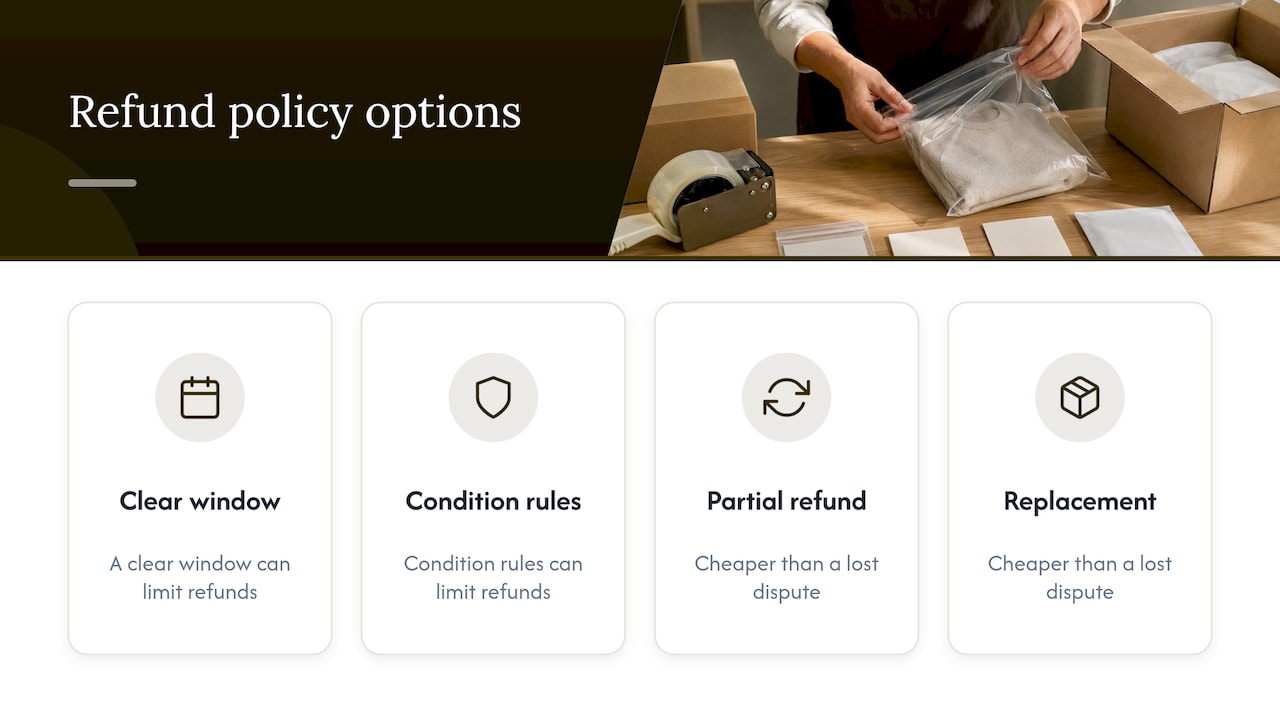
A balanced policy works better. You can still limit refunds, for example with a clear window, condition rules or partial refunds, while giving customers a real way to be heard. Consider offering a replacement, store credit or a partial refund where it makes sense. Each is cheaper than a lost dispute.
How long customers have to dispute
Your policy window and the dispute window are not the same. A 30-day return policy does not stop a customer from filing a dispute on day 90.
Many chargebacks must be filed within 120 days of the transaction date. That is the common rule, not the only one. Visa also has a long-stop deadline often called the 540-day rule: a dispute can be filed up to 540 calendar days from the transaction date, provided it is initiated within 120 days of when the cardholder reasonably expected the goods or services. It matters most for delayed deliveries, long-lead services and merchant insolvency.
What this means for you:
- Keep delivery confirmations, service logs and customer communications for well beyond your return window.
- Do not promise delivery dates you cannot meet. A delay can extend the dispute window.
- For prepaid or long-term services, keep proof that the service was delivered across the full period.
When a customer disputes a charge you already refunded
This happens more than merchants expect. The refund is still pending on the customer’s statement, or the customer forgets, or the dispute was filed before you acted. The fix is evidence.
Visa’s dispute guidance says the burden is on the merchant to show the claim is unwarranted. Clear, dated proof of the refund, with the transaction identifiers and dates, is the most effective way to answer a duplicate dispute.
When you respond:
- Pull the refund record. Include the refund date, amount, original transaction ID and refund ID.
- Show the timeline. Make clear the refund was issued before or in response to the dispute, and say so in one or two sentences.
- Add the customer’s request. If the customer asked for the refund, include that message.
- Submit it inside the deadline. Your acquirer sets internal cutoffs ahead of the network deadline. Ask for yours.
- Keep it short. Visa’s guidance notes that piling on unrelated evidence can obscure the key facts. Responses should be concise, tied to the dispute reason and written in English or translated.
If you are unsure whether a refund can still be sent while a dispute is open, ask your processor first. The right move depends on the dispute stage.
Can you go to jail over a chargeback?
For a normal dispute, no. Disputing a charge is a consumer protection tool, not a crime. The CFPB describes the process as a right cardholders use by contacting their card company.
The risk comes from abuse. Deliberately filing a dispute on a purchase the customer made and received, so they can keep both the product and the money, is often called friendly fraud. Consequences can include account closure and difficulty with financial institutions, and in organized or extreme cases it can draw fraud investigations. Those are consequences for the abuser. For you as a merchant, the practical point is to document every sale well enough that you can show the purchase was legitimate.
Chargeback mitigation without crossing the line
Merchants in high-risk categories often need help with disputes. That help has to be honest. In November 2023, the FTC and the State of Florida reached a settlement with Chargebacks911 and its owners that restricts working with certain high-risk clients and prohibits deceptive efforts to stop consumers from reversing disputed charges. The lesson applies to every merchant and provider: mitigation is about investigating disputes properly, not about silencing complaints or inflating win rates.
The FTC has also warned that processors need to keep watching for signs of fraud, such as unusually high chargeback rates or a questionable business model. A processor that chases a win rate instead of the root cause puts itself and its merchants at risk.
In practice, that means:
- Fight disputes where the evidence supports you. Refund the ones where the customer is right.
- Never give the issuer inaccurate information.
- Track dispute reasons. A cluster of “not as described” or “not received” claims points to a product, shipping or marketing problem a better policy will not fix.
- Choose a payment partner that reviews your business model honestly during underwriting.
Our perspective: policy, process and honest underwriting
We see the same pattern across supplement brands, telehealth companies and subscription merchants. Merchants rarely get into trouble because one customer disputed one order. They get into trouble because a preventable cause repeated: an unclear renewal, a slow support reply, a refund process nobody could find.
Our view is simple. Treat refunds as part of your risk controls, not as a cost to minimize. A refund costs you the sale. A chargeback costs you the sale, a fee and standing with your acquirer. When ratios climb, the usual outcome is higher reserves or a terminated account, which is far more expensive than a generous return window.

We also believe in telling merchants the truth about their model before they apply. If your return policy, cancellation flow or billing descriptor will cause disputes, we want to flag that during underwriting support, not after a freeze. We pair that with gateway tools, fraud prevention, age and compliance controls, recurring billing management and real-time reporting, so you can see dispute patterns early. Our approach to chargeback mitigation is built on accurate evidence and root-cause fixes.
If you remember one thing: make it easy for a customer to get a fair answer from you. That is the cheapest chargeback prevention available.
— Peter
Policy details for high-risk and subscription merchants
Some categories need extra care because disputes concentrate around specific moments.
- Supplements and nutraceuticals. Customers often buy a trial, then dispute the first renewal. Spell out trial length, renewal price and cancellation steps next to the buy button. Our supplements and nutraceuticals processing pages cover what we support in those verticals.
- Telehealth. Disputes can involve consultation outcomes, prescriptions that were not issued or recurring plan fees. State clearly what the customer pays for, including a consultation that happens even if no prescription is written. See our telehealth payment processing page.
- Subscriptions and digital services. Send renewal reminders, make cancellation as easy as sign-up and confirm every cancellation in writing.
- Delayed fulfillment. If shipping takes longer than usual, say so at checkout and email updates. Silence turns a delay into a “not received” dispute.
Build a refund-to-dispute workflow
A policy only works if your team follows it. Set up a simple workflow.
- One inbox, one clock. Route all refund requests to a single queue with a response target.
- Pre-approved refund rules. Give agents clear authority up to a set amount so they do not escalate every request.
- Log everything. Record the request, the reply, the refund ID and the date in the order record.
- Watch alerts. Ask your processor how you are notified of new disputes, and act the same day.
- Review monthly. Compare refunds, disputes and reasons by product. Fix the top cause first.
Work with a processor that understands your model
If you sell in a high-risk or regulated category, your payment partner matters as much as your policy. We built our high-risk payment processing service for merchants who need stable acquiring, a gateway, fraud tools, chargeback mitigation and underwriting support in one place. Approvals can take as little as 24 hours, and we are PCI Level 1 certified. Pricing and reserves are discussed upfront so you can plan. Talk to us before you launch or when disputes start to climb, and we will review your policy, flow and risk with you.
FAQ
Does a refund count as a chargeback?
No. A refund is a voluntary reversal you issue. A chargeback is a reversal the cardholder starts through their issuing bank. Both return money to the customer, but only a chargeback adds a dispute to your record and typically a fee.
Can a customer still file a chargeback if I have a no-refund policy?
Yes. The issuer reviews the claim and the evidence, not only your policy. A policy helps most when it was clearly disclosed and the customer accepted it, but it will not win a dispute about a product that never arrived or a charge the customer did not authorize.
What is the 540-day rule for chargebacks?
It is a long-stop deadline in the Visa rules. A dispute can be filed up to 540 calendar days after the transaction, as long as it starts within 120 days of when the customer expected the goods or services. It applies mostly to delayed or undelivered items.
What should I do if a customer disputes a charge I already refunded?
Send your processor dated proof of the refund, including the original transaction ID and refund ID, before the response deadline. Keep the response short and tied to the dispute reason. Do not issue a second refund.
Can I go to jail for filing a chargeback?
Filing a legitimate dispute is not a crime. Repeatedly disputing purchases you made and received, to get a free product, is friendly fraud and can lead to closed accounts and, in serious or organized cases, investigations. If you face a specific accusation, talk to a licensed attorney.
Sources
- Visa: chargebacks and purchase disputes
- Visa: dispute FAQ for clients
- Visa: Dispute Management Guide for Merchants
- Mastercard: how merchants can dispute credit card chargebacks
- CFPB: how do I dispute a charge on my credit card bill?
- FTC: Chargebacks911 settlement press release
- FTC: message of the Qualpay case