.png)
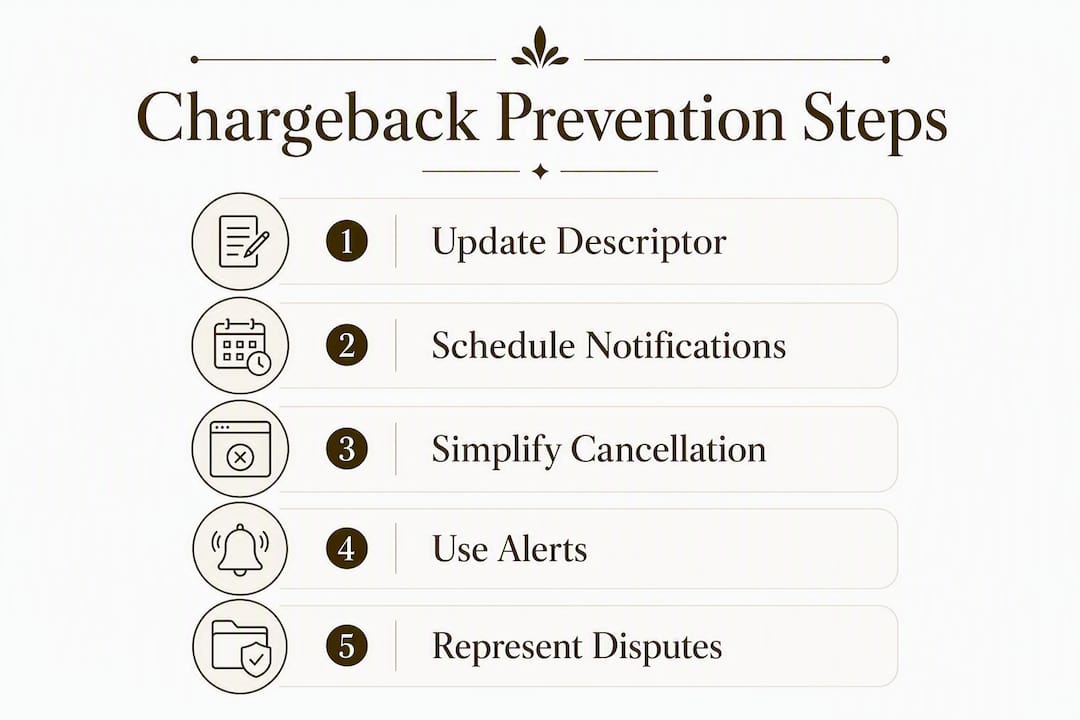
Six high-impact actions stop the majority of subscription chargebacks before they ever reach your processor’s dispute queue. Fix your billing descriptor, send pre-billing reminders with a cancel link, provide one-click cancellation and a pause option, process same-day refunds on complaints, integrate pre-dispute alert networks like Mastercard Fraud Deflect, and monitor your chargeback ratio weekly by cohort.
Here is your shortlist:
- Fix billing descriptors. Your statement entry should show your brand name, a recognizable domain or short phone number, and never your payment processor’s name.
- Send pre-billing reminders. Email subscribers several days before any renewal or trial conversion, and include a direct cancel link in every message.
- Enable one-click cancellation and a pause option. A self-serve cancel button and a 30–60 day pause option remove the two biggest reasons customers call their bank instead of you.
- Process same-day refunds. When a customer complains, refund before the dispute escalates. A proactive refund almost always costs less than a chargeback after fees and ratio impact.
- Integrate pre-dispute alert networks. Mastercard Fraud Deflect, Ethoca-style issuer alerts, and Visa RDR give you a short window to resolve disputes before they hit your ratio. Auto-refund rules inside that window are the fastest path to prevention.
- Monitor and segment chargeback data weekly. Track your chargeback-to-transaction ratio against Visa VAMP thresholds and break disputes down by cohort, SKU, and signup flow to find root causes.
Your single testable task for today: log into your payment gateway, update the descriptor on one live SKU to show your brand name plus your support URL, and schedule a pre-bill reminder for your next renewal cohort. That one change addresses the top cause of “unrecognized transaction” disputes. Davincipay can help you configure both if your current processor makes it difficult.
Pro Tip: If you are unsure what your descriptor looks like on a real statement, charge $1 to a personal card and check. Most merchants are surprised by what they see.
Table of Contents
- Why do subscription businesses get so many chargebacks?
- Proven tactics to prevent subscription chargebacks before they start
- How chargeback alerts stop disputes before they hit your ratio
- How to fight chargebacks when you need to represent a dispute
- Technical setup that prevents renewal-triggered disputes
- When should you bring in a specialist payment processor?
- Key Takeaways
- What subscription merchants usually get wrong about chargebacks
- Davincipay helps subscription businesses manage and prevent chargebacks
- Useful sources and platform documentation
Why do subscription businesses get so many chargebacks?
Subscription merchants typically run higher chargeback rates relative to standard e-commerce, roughly double the rate for standard e-commerce, and a significant share of those disputes trace back to recurring billing confusion rather than actual fraud. That single statistic reframes the entire problem: most of your disputes are preventable with operational fixes, not fraud tools.
Recurring billing creates predictable high-risk moments that standard e-commerce does not face:
- Trial-to-paid conversion. Customers forget they signed up for a free trial. When the first paid charge appears, they do not recognize it and dispute it.
- Annual renewals. A subscriber who paid monthly all year may not remember the annual plan they agreed to 12 months ago.
- Failed-payment retries. A card decline followed by a successful retry two days later can look like a double charge on a statement.
- Unrecognizable billing descriptors. The charge shows your parent company’s name or your processor’s name, not your brand. The customer has no idea who billed them.
- Difficult cancellation flows. When customers cannot find a cancel button, they call their bank. The FTC’s Click-to-Cancel rule now requires that cancellation be as easy as sign-up, so friction here carries legal risk on top of chargeback risk.
- Unexpected upsells or price changes. A price increase or add-on charge that was not clearly communicated is a near-certain dispute trigger.
- True fraud. Stolen card data used for subscription sign-ups is a smaller share of disputes but requires a different response: 3DS authentication and velocity controls.
The financial cost compounds quickly. Each chargeback carries a per-case fee from your acquirer, typically ranging from $20 to $100 depending on your processor and risk category. Beyond the fee, every dispute counts against your chargeback-to-transaction ratio. Visa’s VAMP (Visa Acquirer Monitoring Program) and Mastercard’s equivalent programs set thresholds that, once breached, can trigger enhanced monitoring, reserve requirements, and ultimately account termination.
A quick note on dispute timelines: cardholders generally have up to 120 days from the transaction date to file a dispute under standard card network rules, though some issuers extend windows further. The “540-day” question that comes up in subscription contexts refers to edge cases involving multi-year memberships or delayed delivery claims. Do not rely on a specific window as a safe harbor; check with your acquiring bank for the exact rules that apply to your category and card type.
Proven tactics to prevent subscription chargebacks before they start
The fastest path to fewer disputes is a sequenced set of UX and communication fixes, not a new fraud tool. Implement these in order.

Immediate priorities (week 1)
1. Fix your billing descriptor. Your descriptor is the single highest-impact change you can make. Use your recognizable brand name, not a parent company or processor name. A strong format looks like this:
BRANDNAME.COM 800-555-0100BRANDNAME* MONTHLYBRANDNAME SUPPORT.BRANDNAME.COM
Visa and Mastercard allow a “soft descriptor” (dynamic per-transaction) and a “hard descriptor” (account-level default). Use the soft descriptor to include the product name or plan type when your platform supports it. Practical templates confirm that including a support phone number or URL in the descriptor reduces “unrecognized charge” calls before they become disputes.
2. Send pre-billing reminder emails. Pre-billing reminders reduce disputes caused by surprise charges. Every reminder should include:
- The exact charge amount and currency
- The billing date
- The plan name and billing cycle
- The descriptor exactly as it will appear on the statement
- A direct cancel link (one click, no login wall)
- Your support email and phone number
Send three touchpoints: 7 days before, 24 hours before, and a receipt immediately after the charge posts. The 24-hour reminder is the highest-value single email because it catches customers who missed the first one and still have time to cancel rather than dispute.
3. Make cancellation one click. A customer who cannot cancel in under 60 seconds will call their bank. Place the cancel button inside the account dashboard, not buried in a support article. The FTC’s Click-to-Cancel rule makes this a legal requirement, not just a best practice.
4. Process same-day refunds. Merchants that process same-day refunds see fewer resolved-for-customer disputes turning into chargebacks. Set a policy to process refund requests promptly within the same business day where possible. Document every refund with a timestamp and confirmation number.
Near-term priorities (weeks 2–4)
- Review your trial design. If you offer a free trial, send a reminder 3 days before it converts to paid. Make the conversion date visible on the sign-up confirmation screen.
- Communicate price changes at least 30 days in advance via email, with a cancel link in the same message.
- Audit your annual renewal flow. Annual subscribers need a reminder 30 days out, not just 7.
Technical layer (month 1)
- Implement dunning logic: notify customers before retrying a failed payment, limit retries to 3–4 attempts over 7–10 days, and use account-updater services to reduce friction from expired cards.
- Apply risk-based 3DS authentication for high-risk cohorts (new sign-ups, high-value plans, geographic anomalies) rather than blanket friction on all renewals.
Pro Tip: Add a “pause subscription” option alongside the cancel button. A 30–60 day pause gives customers control without ending the relationship, and it removes the moment where a frustrated subscriber reaches for their bank’s dispute form instead.
A/B test your descriptor text and reminder send times. Track dispute rates by cohort and compare the test group against the control. Even a 10% reduction in “unrecognized” disputes from a descriptor change pays for the engineering time in the first billing cycle.
How chargeback alerts stop disputes before they hit your ratio
Integrate pre-dispute alert networks and configure fast auto-resolve rules. When a dispute resolves through an alert channel, no chargeback is recorded and your ratio stays clean.

Pre-dispute networks like Ethoca Alerts, Verifi CDRN, and Visa RDR give merchants a short window, typically around 24 hours, to act on a cardholder complaint before the issuer formally files a chargeback. Mastercard’s Fraud Deflect initiative goes further: it integrates with Ethoca Consumer Clarity Smart Subscription to route cancellation requests automatically from the issuer to the merchant, so the customer can resolve or cancel without ever filing a dispute.
Here is how the three main alert types compare:
| Alert type | Coverage scope | Response window | Auto-resolution capability |
|---|---|---|---|
| Issuer alert (Ethoca/Mastercard-style) | Mastercard and participating issuers | ~24 hours | Yes, with auto-refund/cancel rules |
| Scheme pre-dispute (Visa RDR/CDRN) | Visa and participating issuers | ~24 hours | Yes, via automated refund rules |
| Gateway webhook alert | Platform-specific, not network-wide | Minutes to hours | Yes, if configured with auto-cancel logic |
Integration checklist:
- Connect alert feeds to your support or ticketing system so every alert creates a ticket automatically.
- Configure auto-refund and auto-cancel logic: if the dispute amount is below your threshold (e.g., under $50), trigger an immediate refund and cancel the subscription without manual review.
- Log every alert response with a timestamp, refund confirmation, and cancellation record. You will need this if a formal chargeback is filed anyway.
- Set up a daily alert-response report: track alerts received, auto-resolved, manually resolved, and escalated.
When an alert arrives and you choose to contact the customer directly, keep the message short:
Pro Tip: Use alert data beyond the individual dispute. If three alerts in one week trace back to the same signup flow or SKU, that cohort has a structural problem. Fix the root cause, not just the individual case.
Monitor three metrics weekly: alerts prevented (resolved before chargeback), auto-refund rate (percentage of alerts resolved without manual touch), and time-to-refund (average minutes from alert receipt to refund confirmation).
How to fight chargebacks when you need to represent a dispute
Not every chargeback is worth fighting. Prioritize refunds and auto-resolution for low-value or clear friendly-fraud cases. Reserve manual representment for disputes that are likely winnable and where the economics justify the effort.
The representment decision rule
Run this math before you submit: if the chargeback amount minus the chargeback fee minus your estimated labor cost (typically $25–$50 per case) is positive, and you have strong evidence, represent. If the net is negative or your evidence is thin, refund and move on. For most subscription businesses, the practical floor for manual representment is a moderate dispute amount above the chargeback fees and labor involved.
Evidence checklist for subscription representment
Collect these before you submit:
- Timestamped recurring-billing agreement showing the customer accepted terms at checkout
- Checkout logs with IP address, device fingerprint, and accepted terms timestamp
- Login and usage activity after the billing date (page views, feature use, downloads)
- Post-billing support interactions (emails, chat logs) showing the customer engaged with the service
- Invoice or receipt with the exact descriptor as it appeared on the statement
- Proof of content delivery or service consumption (access logs, download records)
- Cancellation policy as displayed at checkout
Step-by-step representment workflow
-
Receive the chargeback notice. Note the response deadline immediately. Card network windows vary, but you typically have 20–45 days from the chargeback date to respond.
-
Cancel the subscription and document it. Even if the customer did not ask, cancel and log the cancellation with a timestamp. This shows good faith and removes future dispute risk.
-
Collect evidence. Pull the items from the checklist above. Organize them into a single PDF with a cover page.
-
Write the rebuttal letter. Keep it under one page. Use this structure:
- Subject line: Representment: [Chargeback Reference Number] — [Brand Name] Subscription
- Opening: State the transaction date, amount, and descriptor.
- Body: Summarize the evidence in three sentences. “The cardholder accepted our terms on [date] at [IP address]. They logged in and used the service on [dates]. We have attached the billing agreement, usage logs, and receipt.”
- Closing: Request a reversal and list the attached documents.
-
Submit through your acquiring bank’s portal. Confirm receipt and note the submission timestamp.
-
Escalate if needed. If your acquirer does not respond within their stated SLA, follow up in writing and escalate to your account manager.
Pro Tip: Never represent a chargeback without first canceling the subscription. Submitting a representment while the subscription remains active signals to the issuer that you plan to charge the customer again, which almost always results in a second dispute.
Technical setup that prevents renewal-triggered disputes
Small platform changes reduce disputes significantly. Focus on descriptor testing, webhook reliability, and dunning rules before anything else.
Descriptor testing:
- Charge a test card on your live account and check the statement entry on both Visa and Mastercard networks. What you see is what your customers see.
- If your platform supports dynamic descriptors, configure them to show the plan name or product type alongside your brand name.
- Include a support URL or short phone number where the network permits.
Webhook reliability:
- Every renewal event should trigger a receipt email within 60 seconds of the charge posting. Delayed or missing receipts are a top cause of “I don’t recognize this charge” calls.
- Log every webhook event with the transaction ID, timestamp, and delivery status. Failed webhooks need an automatic retry and an alert to your engineering team.
Dunning and retry logic:
- Notify the customer by email before retrying a failed payment. Give them 24–48 hours to update their card.
- Limit retries to 3–4 attempts over 7–10 days. More retries increase the chance of a surprise charge on a card the customer thought was closed.
- Use an account-updater service (available through most major gateways) to automatically refresh expired card data before the retry cycle begins.
- After the final retry fails, send a clear “subscription paused” email rather than silently canceling. This preserves the relationship and reduces the chance the customer disputes a charge they forgot about.
Trial-to-paid confirmation screens:
- Show the exact charge amount, billing date, and descriptor on the trial sign-up confirmation page.
- Send a separate email on the day the trial converts, not just a receipt. The subject line should say “Your trial has ended — here is your first charge.”
Authentication:
Use risk-based 3DS for new sign-ups, high-value plan upgrades, and geographic anomalies. Avoid blanket 3DS on all renewals because the added friction increases failed payments and, paradoxically, can trigger disputes when customers do not complete the authentication step.
Pro Tip: Track retries in a separate metric from successful charges. If your retry volume spikes, it usually means a card-update issue or a dunning misconfiguration, and you will catch it before it becomes a dispute wave.
When should you bring in a specialist payment processor?
Hire a specialist when disputes threaten account stability, when your internal team cannot keep up with alert handling and representment, or when your current processor cannot support the high-risk categories your subscription business operates in.
Signs you need outside help
- Your weekly chargeback-to-transaction ratio is trending toward Visa VAMP or Mastercard thresholds and internal fixes have not moved the number.
- You have received a processor warning letter or been placed in an enhanced monitoring program.
- Your descriptor issues cannot be resolved because your current processor controls the account-level descriptor and will not change it.
- Recurring disputes cluster around the same cohorts or SKUs and you lack the reporting to identify why.
- Your team is spending more than a few hours per week on manual representment for low-value cases.
Questions to ask any prospective partner
- What pre-dispute alert networks do you connect to, and what is your SLA for alert response?
- Can you configure auto-refund and auto-cancel rules via API, and what is the minimum response time?
- Do you provide representment support, and what evidence capture is built into your platform?
- How granular is your chargeback reporting? Can I segment by cohort, SKU, and signup flow?
- What is your pricing model for chargeback handling, and are there per-case fees?
- What does your onboarding timeline look like, and how do you handle descriptor migration?
Davincipay works specifically with subscription merchants in high-risk categories, including nutraceuticals, telehealth, supplements, digital services, and wellness. The payment processing infrastructure for high-risk businesses covers chargeback mitigation, recurring-billing management, pre-dispute alert integration, and representment support. For supplement and nutraceutical subscription brands, the industry-specific configuration addresses descriptor rules and compliance controls that generic processors often cannot accommodate.
Discovery call checklist:
- Ask for the SLA on alert response (target: under 4 hours).
- Request a sample representment package or anonymized win-rate data.
- Confirm the migration plan for descriptor changes and webhook reconfiguration.
- Clarify whether chargeback handling fees are per-case or bundled.
Pro Tip: Do not wait for a processor warning to start the conversation. By the time you receive a formal notice, your ratio has already been elevated for weeks. Start evaluating partners when your weekly ratio first trends upward, not after it crosses a threshold.
Key Takeaways
Subscription chargebacks are largely preventable: fix descriptors and communication first, stack pre-dispute alerts second, and reserve representment for high-value winnable cases.
| Point | Details |
|---|---|
| Descriptor fix is the top priority | Update your billing descriptor to show your brand name and support contact before any other change. |
| Pre-billing reminders cut surprise disputes | Send reminders at 7 days and 24 hours before renewal, with a direct cancel link in every email. |
| Alert networks protect your ratio | Integrating Ethoca-style and Visa RDR alerts lets you resolve disputes before they are recorded as chargebacks. |
| Same-day refunds beat chargeback fees | A proactive refund almost always costs less than a chargeback after per-case fees and ratio impact. |
| Davincipay supports high-risk subscription merchants | Davincipay provides chargeback mitigation, pre-dispute alert integration, and recurring-billing management for subscription businesses in regulated categories. |
What subscription merchants usually get wrong about chargebacks
The conventional wisdom in payments is that chargebacks are a fraud problem; however, understanding why crypto has no chargeback highlights how different payment rails affect dispute behavior. Buy better fraud tools, add more authentication, tighten your velocity rules. That framing is wrong for most subscription businesses, and acting on it wastes money while the real causes go unfixed.
The merchants who make the fastest progress on dispute reduction are almost never the ones who bought the most sophisticated fraud stack first. They are the ones who spent a week fixing their descriptor, adding a pre-billing email, and putting a cancel button on the account dashboard. Those three changes address the root cause of the majority of subscription disputes: customers who do not recognize the charge or cannot stop it without calling their bank.
The pause option is the most underestimated lever in this entire playbook. Most subscription platforms support it, almost no one promotes it, and it consistently outperforms cancellation-flow optimization as a chargeback reduction tool. A customer who pauses does not dispute. A customer who cancels might still dispute the last charge. A customer who cannot cancel will almost certainly dispute.
The other thing teams consistently underestimate is the operational cost of slow refunds. A $30 refund processed in 48 hours instead of same-day can turn into a $75 chargeback fee plus ratio damage worth far more. Build the economics into your refund policy explicitly. Set a dollar threshold below which you refund automatically, no questions asked, and track how many of those proactive refunds would have become chargebacks without the policy.
Cross-functional ownership matters more than any single tool. Chargeback reduction requires billing, product, and support to move together. Billing owns the descriptor and dunning logic. Product owns the cancellation flow and the pause option. Support owns the refund SLA and the alert response workflow. When one team moves without the others, you fix one cause and leave two more open.
Davincipay helps subscription businesses manage and prevent chargebacks
Subscription merchants in high-risk categories face a harder version of this problem than most. Generic processors often cannot configure dynamic descriptors, do not connect to pre-dispute alert networks, and have no representment support. The result is a chargeback ratio that climbs without a clear path to fix it.

Davincipay is built for exactly this situation. For subscription businesses in nutraceuticals, telehealth, supplements, digital services, and wellness, Davincipay provides descriptor advisory and implementation, pre-dispute alert integration, automated refund and cancel workflows, representment support, and recurring-billing configuration. The infrastructure is designed for merchants who need a processor that understands high-risk categories, not one that treats every dispute as a reason to raise reserves.
On a discovery call, ask for the SLA on alert response, a sample representment package, and the onboarding timeline for descriptor migration. Davincipay’s team can walk you through each. Apply now to start the conversation, or visit davincipay.ai to review the full service offering before you reach out.
Useful sources and platform documentation
The resources below are worth bookmarking as you build your dispute-prevention playbook.
- FTC Click-to-Cancel Rule (ftc.gov) — The final rule requiring cancellation to be as easy as sign-up; essential reading for any subscription operator in the United States.
- Disputing Credit Card Charges (consumer.ftc.gov) — The cardholder-facing FTC guide; understanding what your customers read helps you anticipate their dispute triggers.
- Billing Descriptor Overview (Wikipedia) — A clear reference on how descriptors work across card networks, including soft vs. hard descriptor mechanics.
- Subscription Chargeback Prevention: The Complete Guide (The Payments Edge) — Covers pre-dispute networks, alert types, and the recurring billing dispute rate data cited in this article.
Keep a running dispute playbook. Copy the checklists from this article into an internal document, assign an owner to each item, and update it every time you identify a new dispute pattern. A living playbook reviewed monthly is worth more than any single tool you can buy.


.webp)
