.png)
A recurring billing API is a software interface that automates subscription payments by managing customer agreements, scheduling charges, and processing transactions on preset intervals without manual intervention. This is the standard infrastructure behind every SaaS platform, subscription box, telehealth service, and nutraceutical brand that bills customers on a repeating schedule. Understanding what a recurring billing API does, and how to implement one correctly, is the difference between a payment system that scales and one that breaks under volume. This article covers the full picture: how these APIs work, their core features, the real benefits, and the implementation steps that matter most.
What is a recurring billing API?
A recurring billing API is the technical layer that connects your platform to a payment processor and automates the entire subscription payment lifecycle. The industry term for this category is “subscription billing API,” though “recurring billing API” is the phrase most developers and product teams use when searching for solutions.
Recurring billing automates subscription payments on set intervals such as monthly, quarterly, or annually. That automation means customers authorize a charge once, and the system handles every subsequent payment without requiring them to act again. The API manages the agreement between your business and the customer, stores billing data securely, and triggers charges on the correct dates.
The core components of any recurring billing API are three things: agreement management, payment scheduling, and transaction execution. Agreement management covers creating, updating, and canceling subscription contracts. Payment scheduling determines when charges fire. Transaction execution connects to a recurring payment gateway and moves money. All three must work together reliably for a subscription business to function.

How does a recurring billing API work?
The operational flow of a recurring billing API follows a clear sequence. Understanding each step helps developers build integrations that handle edge cases correctly.
- Customer initiates a subscription. The customer selects a plan and enters payment details on your platform. Your system captures this data and passes it to the API.
- API creates a draft agreement. The API creates a billing agreement, records the customer’s authorization, and stores the payment method reference. No raw card data touches your servers if the integration is built correctly.
- Customer approves the agreement. The customer confirms the subscription terms. This approval is the legal and technical trigger that activates the billing schedule.
- API schedules the first and subsequent charges. Based on the plan’s billing cycle, the API queues charges for the correct dates. This covers daily, weekly, monthly, and annual intervals.
- Charges execute automatically. On each due date, the API sends a charge request to the payment gateway. The gateway processes the transaction and returns a success or failure status.
- API handles outcomes and sends notifications. Successful charges trigger confirmation events. Failed charges trigger retry logic and alert webhooks so your system can notify the customer or take action.
Fixed vs. variable billing cycles
Fixed billing cycles charge the same amount on the same schedule every period. A $49.99 monthly SaaS subscription is the clearest example. Variable billing cycles charge amounts that change based on usage, seat count, or consumption. Both models use the same API structure, but variable billing requires the platform to calculate the charge amount before each billing event and pass it to the API dynamically.
Pro Tip: Build your integration to handle both fixed and variable amounts from day one. Switching billing models later requires significant rework of your agreement and charge logic.
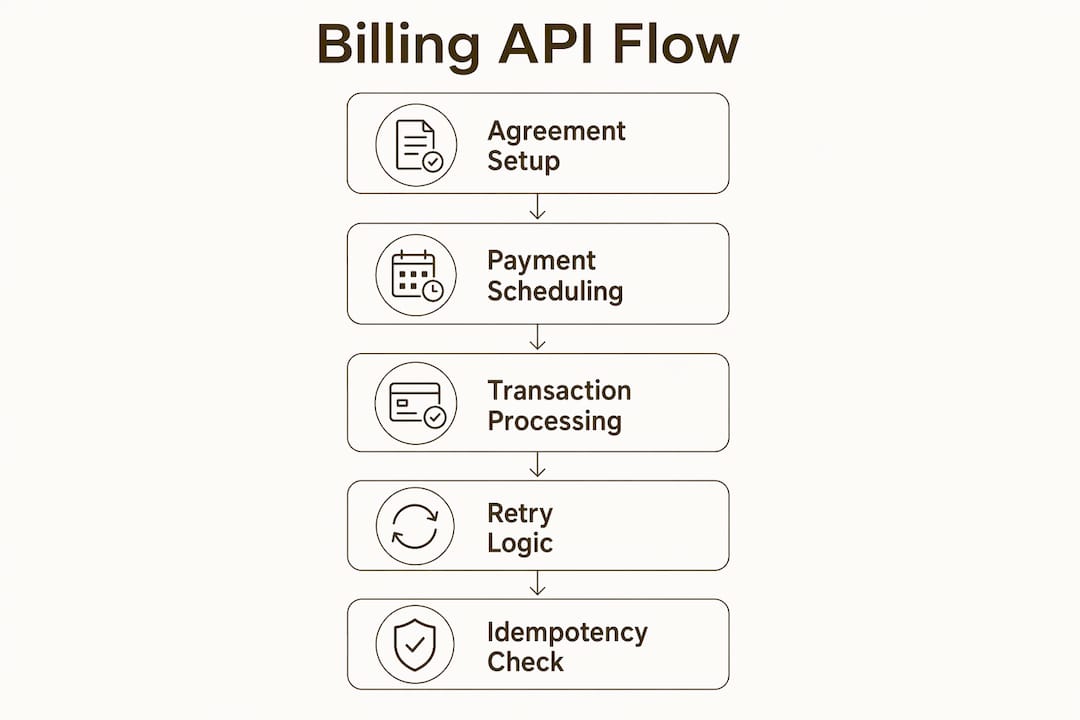
Customers set up billing information once, and the API handles every subsequent payment automatically. This reduces payment friction and improves subscription adherence because customers never face a manual re-entry step.
What are the key features of recurring billing APIs?
The features that separate a capable recurring billing API from a basic one fall into six categories. Each category addresses a specific operational need.
- Subscription plan management. The API stores plan definitions including price, interval, trial periods, and upgrade paths. Your platform calls the API to create, update, or cancel plans without touching payment data directly.
- Automated payment scheduling. Charges fire on preset dates without manual triggers. The API manages the calendar logic across time zones and billing cycle variations.
- Flexible pricing models. Key features include flexible pricing for both fixed and variable amounts, letting businesses handle tiered subscriptions, usage-based billing, and promotional pricing within the same system.
- Retry logic for failed payments. Retry mechanisms can be configured for a set number of days to handle temporary payment failures automatically. This reduces churn from declined cards without requiring manual follow-up.
- Webhook and event notifications. The API sends real-time event data to your platform when charges succeed, fail, or when subscriptions change state. Your system uses these events to trigger emails, update account status, or flag accounts for review.
- Security and PCI-DSS compliance. PCI compliance is a critical requirement for any recurring billing integration. APIs must connect to secure payment gateways and encrypt sensitive billing data so your platform never stores raw card numbers.
| Feature category | What it does for your business |
|---|---|
| Plan management | Centralizes subscription logic and reduces custom code |
| Retry logic | Recovers failed payments automatically before cancellation |
| Webhooks | Keeps your platform in sync with billing events in real time |
| PCI compliance | Protects customer data and reduces your liability exposure |
| Flexible pricing | Supports multiple revenue models without rebuilding the integration |
What are the benefits of implementing a recurring billing API?
The benefits of recurring billing go beyond convenience. They change how a business operates financially and operationally.
- Predictable revenue. Automated billing on fixed schedules creates a revenue stream you can forecast accurately. This matters for cash flow planning, hiring decisions, and investor reporting.
- Reduced manual work. Automating recurring billing shifts focus away from manual transaction tasks. Your team stops chasing payments and starts focusing on customer retention and product improvement.
- Lower churn from payment failures. Retry logic handles temporary card declines automatically. Without it, a declined card on day one of the billing cycle becomes an involuntary cancellation. With it, the system retries over several days and recovers the revenue.
- Better customer experience. Customers never log in to re-enter payment details. The subscription runs in the background, which is exactly what customers expect from modern subscription services.
- Compliance built in. A well-integrated recurring billing API handles PCI-DSS requirements at the gateway level. Your platform inherits that compliance posture instead of building it from scratch.
- Support for growth. As your subscriber count grows, the API scales with it. You do not need to add billing staff proportionally to subscriber volume.
Pro Tip: Track your involuntary churn rate separately from voluntary cancellations. If involuntary churn is above 1–2% of monthly subscribers, your retry logic or dunning process needs adjustment.
The strategic shift here is significant. Businesses reallocate human capital to higher-value activities when billing runs automatically. That reallocation compounds over time as subscriber volume grows.
How to implement a recurring billing API successfully
Implementation quality determines whether your recurring billing system is reliable or a source of ongoing problems. Follow these steps to build it correctly.
- Define your billing requirements first. Map out every subscription plan, pricing tier, trial period, and upgrade path before writing a single line of integration code. Gaps in this planning create expensive rework later.
- Choose an API that matches your compliance needs. If you operate in telehealth, nutraceuticals, or supplements, you need a payment processor for high-risk businesses that supports recurring billing with the right acquiring relationships. Not every gateway approves subscription merchants in regulated categories.
- Implement idempotency from the start. Idempotency prevents duplicate charges during retries of payment requests. Every charge request should include a unique idempotency key so the API can recognize and ignore duplicate submissions. Skipping this step causes double charges, which generate chargebacks and damage customer trust.
- Never store raw card data on your servers. Route all payment data through the API and gateway. Use tokenization so your platform stores only a reference token, not the actual card number. This is the foundation of PCI compliance.
- Test the full subscription lifecycle. Run test scenarios for successful charges, failed charges, retries, upgrades, downgrades, pauses, and cancellations. Most bugs in recurring billing systems appear at state transitions, not during normal payment flows.
- Set up webhook listeners before going live. Your platform needs to receive and process billing events in real time. Build listeners for charge success, charge failure, subscription cancellation, and payment method expiration events.
- Monitor billing operations after launch. Track success rates, retry rates, and churn by payment failure. Set alerts for unusual failure spikes, which often indicate a gateway issue or a problem with your integration.
- Automate customer notifications. Send emails for successful charges, upcoming renewals, failed payments, and subscription changes. Customers who receive clear billing communication cancel less and dispute charges less.
Understanding the how it works side of payment processing before you build saves significant debugging time after launch.
Key takeaways
A recurring billing API is the core infrastructure that turns a one-time payment system into a subscription revenue engine, and idempotency, retry logic, and PCI compliance are the three features that determine whether it works reliably at scale.
| Point | Details |
|---|---|
| Core definition | A recurring billing API automates subscription charges by managing agreements, schedules, and transactions. |
| Idempotency is non-negotiable | Always include unique idempotency keys in charge requests to prevent duplicate billing during retries. |
| Retry logic reduces churn | Configuring automatic retries over several days recovers failed payments before subscriptions cancel. |
| PCI compliance is built in | Route all payment data through the gateway and use tokenization to protect customer data. |
| Benefits compound with scale | Automation frees your team from manual billing tasks, and that advantage grows as subscriber volume increases. |
Why recurring billing APIs are more complex than they look
Most developers underestimate recurring billing APIs when they first encounter them. The surface looks simple: charge a card on a schedule. The reality is that subscription billing is one of the more complex payment problems in ecommerce.
The complexity comes from state management. A subscription is not a single transaction. It is a long-running agreement with dozens of possible state changes: upgrades, downgrades, pauses, cancellations, reactivations, trial conversions, and payment method updates. Each state change has to be handled correctly, or you end up charging the wrong amount, charging at the wrong time, or failing to charge at all.
Idempotency is the piece most teams get wrong first. I have seen integrations go live without unique idempotency keys, and the result is always the same: a batch of double charges, a wave of chargebacks, and a scramble to issue refunds. The fix is simple in theory but requires discipline in practice. Every charge request needs a unique key that the API uses to deduplicate requests. If a network timeout causes your system to retry a charge, the API recognizes the key and returns the original result instead of processing a second charge.
The other underestimated area is dunning, which is the process of recovering failed payments through retries and customer communication. Retry logic alone is not enough. You need a sequence of customer emails that explain the situation, prompt action, and give the customer a chance to update their payment method before the subscription cancels. Businesses that build this correctly recover a meaningful portion of what would otherwise be involuntary churn.
My honest advice: treat your recurring billing integration as a core product, not a payment checkbox. The businesses that get subscription billing right build it with the same care they give their core features.
— Peter
Davincipay’s payment infrastructure for subscription businesses
Subscription businesses in high-risk categories face a specific problem: most standard payment processors decline them or shut them down after the first chargeback spike. Davincipay specializes in exactly these situations.

Davincipay provides recurring billing payment processing for ecommerce brands, telehealth providers, nutraceutical companies, and supplement merchants that need reliable acquiring relationships and compliance support. The infrastructure covers payment gateway integration, fraud prevention, chargeback mitigation, and the underwriting support that high-risk subscription merchants need to stay processing. If your subscription business has been declined elsewhere or needs a processor that understands your industry, apply with Davincipay and get a fast approval decision.
FAQ
What is a recurring billing API?
A recurring billing API is a software interface that automates subscription payments by managing customer billing agreements, scheduling charges, and processing transactions on preset intervals without manual input each cycle.
How does retry logic work in recurring billing?
Retry logic automatically attempts to charge a customer again after a failed payment, typically over a configurable number of days, reducing involuntary subscription cancellations from temporary card declines.
What is idempotency in recurring billing?
Idempotency is a technical safeguard that prevents duplicate charges when a payment request is retried. Each charge request includes a unique key, and the API uses that key to return the original result instead of processing a second charge.
What does PCI-DSS compliance mean for recurring billing?
PCI-DSS compliance means your payment integration meets the Payment Card Industry Data Security Standard, which requires encrypting card data, using secure gateways, and never storing raw card numbers on your own servers.
What industries use recurring billing APIs most?
SaaS platforms, telehealth providers, nutraceutical brands, supplement companies, and subscription ecommerce businesses rely on recurring billing APIs to manage predictable, automated revenue from subscriber bases.


.webp)
