Real-time payment reporting is the live view of what happens to each transaction: its status, amount, timing, and any data attached to it. A real-time payment moves money. Real-time reporting tells you, as it happens, whether that money was accepted, rejected, settled, or flagged. If you run a high-volume merchant account, that visibility decides how fast you catch a failed charge, a spike in declines, or a reserve you did not expect.
This guide separates the two ideas, shows what U.S. networks actually report, compares it with ACH and wire reporting, and lays out how to turn the data into cash flow decisions. We also cover the limits, because a live dashboard is not the same as a final answer.
TL;DR
- A real-time payment is the transfer. Real-time payment reporting is the status and data you see around it, and the two are not always equally fast.
- On the U.S. RTP and FedNow networks, confirmation of receipt or rejection comes back immediately, 24/7/365. ACH and wires generally do not work that way.
- Use the data for cash flow, automated reconciliation, and exception alerts. Do not assume every bank, gateway, or accounting tool shows the same fields.
- For card-based, high-risk merchants, the practical question is whether your processor and gateway give you live transaction, decline, chargeback, and settlement reporting.
Table of Contents
- What real-time payment reporting actually means
- Which real-time payment networks operate in the United States
- How reporting works on a real-time payment
- Real-time reporting vs. ACH and wire reporting
- Real-time reporting for card-based merchants
- How to use real-time payment data
- Limits of real-time reporting you should plan for
- Our perspective: reporting is where continuity starts
- Get live visibility with the right merchant account
- A checklist for evaluating real-time reporting
- FAQ
- Sources
What real-time payment reporting actually means
People use the phrase for three different things. Sorting them out saves confusion when you talk to a bank or processor.
- Network-level status. On an instant payments network, the sending and receiving banks exchange messages as the payment moves. The sender learns right away whether it was accepted or rejected.
- Account-level reporting. Your bank shows the posted payment and its data in your online banking, your treasury portal, or a file or API feed.
- Merchant-level reporting. Your processor and gateway show card authorizations, declines, captures, refunds, chargebacks, and batch settlements, ideally as they happen.
The first two belong to account-to-account payments. The third is what most subscription, telehealth, and supplement merchants use every day. We cover all three, since many established businesses now take cards and bank-to-bank payments at the same time.
The Clearing House, which operates the RTP network, describes the payment itself as a transfer of value. The network also provides real-time posting, immediate confirmation, and secure two-way messages carrying relevant data, according to its Merchant and Network Settlements Playbook. That split is the core idea: money movement and information movement travel together on RTP, but they are still two things you need to monitor.
Which real-time payment networks operate in the United States
Two networks matter for U.S. businesses.
The RTP network. Run by The Clearing House, it lets businesses send and receive funds directly to bank accounts 24/7/365, with real-time posting, immediate confirmation, final settlement, and two-way messaging, per the playbook. The per-transaction limit started at $25,000 and has risen over time. The Clearing House raised it to $10 million, up from $1 million, which opened the network to larger business payments.
The FedNow Service. Built by the Federal Reserve, it began operating in July 2023 and lets banks and credit unions of all sizes offer instant payments, according to the Federal Reserve’s FedNow FAQ. Payments move within seconds, at any time of day, on any day of the year, and the receiver can use the funds immediately.
Your access depends on your bank. Not every institution participates in both networks, and not every institution exposes the same reporting. Ask your bank which network it uses, which message data it passes through to you, and in what format.
How reporting works on a real-time payment
The flow is short. A payer’s bank sends the payment message. The receiving bank accepts or rejects it and replies immediately. If accepted, the funds post to the receiver’s account and the payment is final.
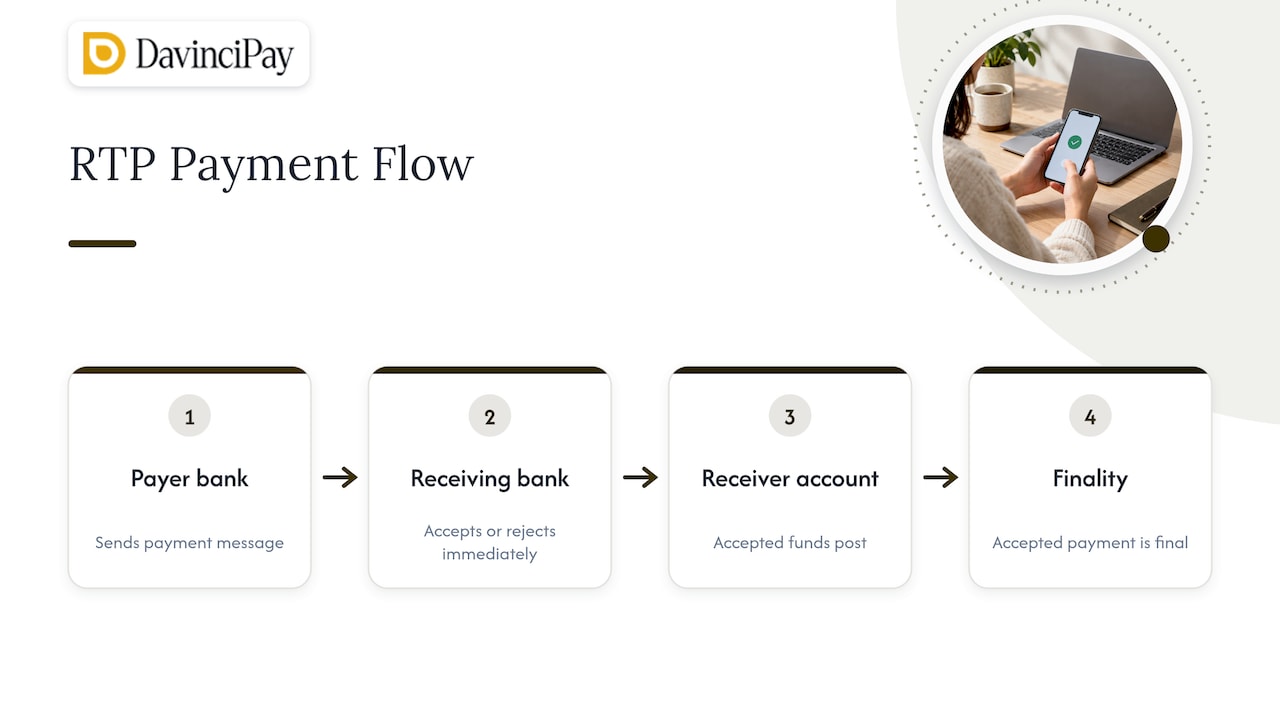
The Faster Payments Council’s operational guideline states that RTP and FedNow require immediate confirmation of receipt and acceptance 24/7/365 and support immediate rejection. You can read the details in its Operational Considerations guideline. That means a rejected payment is known in seconds, not discovered days later when a deposit fails to appear.
The data attached matters too. The RTP network uses ISO 20022, which gives it the capability to share remittance information and real-time status reports, as the Clearing House playbook explains. Remittance data, such as an invoice number or a customer reference, is what lets your accounting team match a payment to an order without guessing.
One point that surprises people: you do not have to build anything to receive. The Clearing House says receiving RTP does not require a corporation to implement sending capability, because the bank can deposit received funds automatically. Integration with accounts receivable is optional but useful, according to the same playbook.
Real-time reporting vs. ACH and wire reporting
The difference is in how payments are processed and when you hear about them.
The Clearing House says RTP payments clear and settle individually with immediate finality, while same-day ACH payments clear in batches and settle after clearing. The Faster Payments Council adds that RTP and FedNow are designed for individual processing and provide immediate acknowledgments, while ACH and wire receive-side flows generally do not require an immediate response.
| Feature | RTP / FedNow | ACH | Wire |
|---|---|---|---|
| Processing | Individual payments | Batches | Individual, typically business-day windows |
| Confirmation of receipt | Immediate, 24/7/365 | Generally no immediate response required | Generally no immediate response required |
| Rejection notice | Immediate | Returns come later | Handled through bank processes |
| Finality | Immediate on acceptance | After clearing and settlement | Depends on the bank and system |
| Data carried | Rich messaging (ISO 20022 on RTP) | Limited addenda | Varies by bank |
The confirmation and processing rows follow the Faster Payments Council’s guideline. Treat the ACH return timing and wire rows as a general orientation and confirm the specifics with your bank.
Bank reporting standards are also catching up. Accredited Standards Committee X9 says its Balance and Transaction Reporting Standard added separate real-time-payment detail and summary codes, so businesses can report and reconcile RTP transactions separately from ACH and wires. See the X9 BTRS page. If your treasury system lumps everything into one “incoming credits” line, ask whether your bank supports those codes.
Real-time reporting for card-based merchants
Most of our merchants earn revenue through cards, recurring billing, and some ACH. For them, real-time payment reporting means something more practical than network messages. It means a dashboard and data feed that answer these questions at any hour:
- How many authorizations were approved and declined in the last hour, and why?
- Which recurring charges failed, and are they retry candidates?
- What is today’s refund and chargeback activity compared with your normal range?
- What is in the current batch, and when does it settle?
- How much is held in reserve, and when is it scheduled for release?
For high-risk and regulated businesses, this view is a risk tool, not a convenience. A telehealth practice, a supplement brand, or a subscription company can see a processor-side problem building in decline codes or dispute counts well before a termination notice. Catching it early gives you time to adjust your fraud rules, fix a billing descriptor, or bring in a second processing relationship.
Our services include real-time reporting alongside chargeback mitigation, fraud prevention tools, recurring billing management, and ACH support. What you see depends on the acquiring bank, processor, and gateway behind your account, and approvals, pricing, reserves, and settlement terms depend on underwriting and processor requirements.
How to use real-time payment data
Live data is only useful if someone acts on it. These are the uses that pay off.
Cash flow and liquidity
When payments settle individually with finality, you know your available position now rather than tomorrow. That helps with vendor payments, payroll timing, and ad spend decisions. On the card side, settlement reports tell you what is coming and what is being held. A clear picture of both lets you plan around a reserve instead of being surprised by it. If you are weighing options beyond cards, a look at business payment options for cash flow can help you compare how different methods affect settlement timing and risk.
Automated reconciliation
The OCC Comptroller’s Handbook describes reconciliation as verifying that records issued by transaction participants match, including reversals and post-transaction analysis where appropriate. The handbook is written for bank examiners, but the logic carries over to any merchant.
The Faster Payments Council describes automated reconciliation as transaction-data matching and record-linking that continuously identifies discrepancies and enables corrective action. It also notes that financial institutions can use real-time recognition and automated reconciliation to keep account positions current, timely, and accurate for reporting and accounting. In practice, that means:
- Pull transaction IDs from your gateway and your bank feed.
- Match them on amount, date, and reference.
- Flag anything that appears on one side only.
- Review the exceptions daily, not monthly.
An exception on day one is a quick fix. The same exception at month-end is an accounting project.
Payment tracking and customer service
When a patient or customer says a payment did not go through, a real-time status record lets support answer in one message. Share a transaction reference with your team’s help desk tools so no one has to ask finance.
Early warning on processor risk
Watch decline rate, refund rate, dispute ratio, and average ticket size. A sudden change is a signal. Merchants who track it daily have more room to act than those who find out from a processor email.
Limits of real-time reporting you should plan for
Live does not mean complete. The OCC’s Comptroller’s Handbook on payment systems is the main reference for operational and fraud risk in this area, and these are the practical limits we see for merchants.
Uneven support. Banks and accounting software do not all support the same networks or the same reporting fields. A payment may be final, yet your software shows less detail than the network carried.
Provider-specific formats. Status names and report layouts differ between processors, gateways, and banks. Mapping them into one internal view takes setup work.
24/7/365 operation. Payments can arrive at 2 a.m. on a holiday. If your team only reviews exceptions during business hours, an alert may sit unread.
Holds and delays. A bank may apply a maintenance or compliance hold. A report can also lag even when settlement is final.
Irreversibility. Instant payments are final. A misdirected or fraudulent payment is not something you can simply pull back, so prevention matters more than correction.
Fraud and operational risks
The handbook lists the risks that come with fast, final payments: misdirected payments, impersonation, unauthorized transactions, insufficient staff readiness, and irreversible losses. The controls it points to are the ones a careful finance team would put in place:
- Strong authentication for anyone who can release payments
- Payee verification before sending
- Transaction limits
- Pre-release screening
- Segregation of duties
- Real-time alerts
- Employee training and customer education
- Onboarding controls
- Automated exception reconciliation
If you send payments, such as refunds or payouts, to patients, affiliates, or vendors, have your bank’s treasury or fraud team walk you through these controls before you go live. If a payment was sent to the wrong party, contact your bank immediately, since speed matters even though the transfer is final.
Our perspective: reporting is where continuity starts
We work with established merchants processing from $100,000 to $5 million or more per month. The pattern we see is consistent. Merchants rarely lose a processor because of one bad day. They lose one because a trend went unnoticed: declines creeping up, a dispute ratio drifting, a reserve changing quietly.
So we treat reporting as part of processing stability, not an add-on. A dashboard you check daily is the cheapest risk control a high-volume merchant has. It also makes the case for redundancy. When you can see that one acquiring relationship is underperforming, a second merchant account with its own MID is a ready answer instead of an emergency.
Our advice is practical:
- Ask every processor for a sample of the reports you will receive before you sign.
- Confirm how fast data appears: at authorization, at capture, at settlement.
- Confirm how you export it, by CSV, API, or direct feed into your accounting tool.
- Assign one person to review exceptions every day.
- Keep a second processing path warm if your volume or industry makes a single-provider failure costly.
We understand how disruptive a sudden termination, a frozen balance, or an unexpected reserve is. Good visibility will not remove every risk, but it gives you time to respond.
— Peter
Get live visibility with the right merchant account
If you run a telehealth, supplement, nutraceutical, subscription, or other regulated online business, your reporting is only as good as the processing relationship behind it. DavinciPay places established merchants with acquiring banks, processors, and gateways that fit their business model, with real-time reporting, fraud prevention tools, chargeback mitigation, and multiple MID options for redundancy.

See how high-risk payment processing with DavinciPay works for merchants at your volume, review the steps in our process, or go straight to the application. If you are in a specific vertical, start with telehealth payment processing, nutraceuticals, or supplements. Approvals, pricing, reserves, and settlement terms depend on underwriting and applicable processor requirements.
A checklist for evaluating real-time reporting
Use this list when you compare banks, processors, or gateways.
| Question | What a good answer looks like |
|---|---|
| How quickly do transactions appear? | Authorizations and declines visible as they occur |
| What data is included? | Decline reason codes, transaction IDs, customer references, refund and dispute status |
| How do I get the data out? | Dashboard, CSV export, and API or webhook options |
| Can I filter by MID? | Yes, with a consolidated view across accounts |
| What alerts exist? | Configurable thresholds for declines, disputes, and large transactions |
| How are reserves shown? | Current balance, release schedule, and history |
| Does it reconcile with my bank deposits? | Settlement reports that match deposits by batch |
If an answer is vague, ask for a written description or a demo account. Reporting you cannot test before you sign is a risk you are taking on.
FAQ
What is real-time payment reporting?
It is the live status and data you get about a payment as it moves: accepted, rejected, settled, held, or disputed. A real-time payment is the transfer itself. The reporting is the information layer, and on networks like RTP it includes immediate confirmation and messaging that carries remittance data.
Is real-time payment reporting the same as RTP?
No. RTP is a specific U.S. instant payment network run by The Clearing House. Real-time reporting is a broader idea that also covers card processing dashboards, gateway reports, and bank account feeds. FedNow is a separate instant payment service from the Federal Reserve.
Do ACH payments have real-time reporting?
Not in the same sense. Same-day ACH payments clear in batches and settle after clearing, and ACH receive-side flows generally do not require an immediate response. Your bank or processor may still give you online status updates, but they are not the immediate network-level confirmations that RTP and FedNow provide.
Can real-time reporting prevent fraud and chargebacks?
It cannot prevent them alone, but it shortens the time to notice them. Daily review of declines, refunds, and dispute activity lets you tighten fraud rules or fix billing issues sooner. Pair it with authentication, payee verification, transaction limits, and chargeback mitigation tools.
What should a high-volume merchant ask a processor about reporting?
Ask how fast data appears, which fields are included, how you can export it, whether you can view multiple MIDs together, and how reserves and settlements are displayed. Request a sample report before signing. Your terms still depend on underwriting and the processor’s requirements.
Sources
- Merchant and Network Settlements Playbook, The Clearing House
- RTP Network $10 Million Transaction Limit, The Clearing House
- FedNow Service Frequently Asked Questions, Federal Reserve
- Operational Considerations for Instant Payments, Faster Payments Council
- Balance and Transaction Reporting Standard, Accredited Standards Committee X9
- Payment Systems, Comptroller’s Handbook, OCC