.png)
Rapid Dispute Resolution (RDR) is Visa’s automated pre-dispute service that lets you issue a merchant-initiated credit for qualifying disputes in real time, before they ever become a chargeback. The system checks the claim against rules you set, resolves eligible cases in seconds instead of days, and keeps those resolved cases off your dispute ratio. For merchants drowning in low-dollar, high-volume disputes, that combination changes the entire chargeback math.
TL;DR:
- RDR is limited to full-amount, Visa transactions supported by participating banks, excluding partial refunds and already partially refunded transactions.
- Typical resolution time for RDR is about one second, significantly faster than the days needed for conventional disputes, reducing the chance of chargebacks.
- Automated refunds via RDR require careful ruleset management to prevent exploitation by friendly fraud and refund creep, especially for high-dispute, low-ticket merchants.
- Effective RDR implementation depends on detailed audit, tight acquirer coordination, conservative pilot thresholds, and ongoing rule monitoring to avoid unintended refund inflation.
- RDR is most beneficial for high-volume, low-value merchants like subscription services and telehealth, but demands active governance and layered dispute strategies for sustained success.
Table of Contents
- What Is Rapid Dispute Resolution (RDR) in Payments?
- How RDR Resolves a Dispute Step by Step
- Why RDR Matters: Real Benefits, Real Trade-Offs
- Implementation Checklist: From Audit to Live Rules
- Monitoring RDR: Metrics That Show It’s Working
- DavinciPay’s View: RDR for High-Risk and Regulated Merchants
- Editorial Take: Where the RDR Conversation Falls Short
- Get RDR Set Up Right the First Time
- Key Documents and Vendor Guides to Read Next
- Sources
What Is Rapid Dispute Resolution (RDR) in Payments?
RDR is a feature of Verifi’s RESOLVE platform that runs on Visa Resolve Online (VROL), the network’s dispute case management system. When an issuer files a qualifying pre-dispute, RDR checks it against a ruleset you configure, then decides on your behalf whether to accept liability and refund the cardholder automatically.
RDR only applies to Visa transactions where the issuing bank participates in the program. Not every issuer supports it, so coverage depends on your customer base’s card mix, not just your own enrollment.
A few things distinguish RDR resolution from a standard chargeback:
- RDR-resolved cases never generate a formal chargeback. They arrive and close as a Dispute Financial message.
- Acquirers and processors must tag these messages with a VROL Financial ID starting with ‘m’ so they get reclassified in reporting and billing.
- Because they’re reclassified, RDR-resolved transactions don’t count against your dispute-to-sales ratio the way a chargeback does.
That last point matters more than it sounds. Staying under Visa’s dispute monitoring thresholds is often the difference between normal processing and landing in a compliance program.
How RDR Resolves a Dispute Step by Step
The mechanics are simple once you see the sequence, but the compressed timeline is what makes RDR different from every dispute process that came before it.
- The issuer files a pre-dispute in VROL on behalf of the cardholder, before it becomes a formal chargeback.
- RDR checks the claim against your ruleset (transaction amount, reason code, currency, risk score, or other criteria you defined).
- If the rule matches, RDR accepts liability automatically. The system generates a Dispute Financial message (TC 15/17/0200) carrying the ‘m’ Financial ID, and your acquirer issues the merchant-initiated credit.
- If no rule matches, the claim proceeds as a normal chargeback, following the standard representment path.
Visa reports that RDR can resolve qualifying cases in about one second, compared with an average of several days under conventional dispute handling, and cites $695 million in potential disputes addressed through CDRN and RDR combined. Verifi’s own guidance confirms that accepted RDR responses do not count against a merchant’s dispute ratio, which is the mechanism behind that ratio protection.
One limitation worth flagging early: RDR generally handles full-amount disputes only. Vendors including Stripe note that it doesn’t support partial resolutions or refunds on transactions that were already partially refunded, so your rules need to account for that gap.
Why RDR Matters: Real Benefits, Real Trade-Offs
The upside is straightforward: fewer chargebacks reaching your dispute ratio, fewer dispute fees, faster refunds for customers, and less staff time spent building representment cases for disputes you were going to lose anyway. Checkout point out that RDR is customizable down to the reason code and risk score, so you’re not accepting every claim blindly.
The trade-off is refund volume. Every case your rules accept becomes an automatic credit, no questions asked. That creates two real risks:
- Friendly fraud exploitation — customers who learn your thresholds can exploit predictable auto-accept rules.
- Refund creep — loose rules quietly raise your refund rate even as your chargeback count drops, which can mask a growing problem instead of solving it.
RDR fits best for merchants with high dispute volume, low average order value, and limited staff to fight representment battles one case at a time. Subscription billers and low-ticket ecommerce brands tend to see the strongest return.
Pro Tip: Start your ruleset with a dollar ceiling well below your average order value. It’s easier to raise the threshold once you trust the data than to walk back a rule that’s been auto-refunding your best customers for a month.
Implementation Checklist: From Audit to Live Rules
Rolling out RDR isn’t a flip-a-switch decision. It touches your acquirer relationship, your reporting stack, and your dispute team’s daily workflow, so treat it like any other operational change with a rollback plan.
- Audit your last 6 to 12 months of disputes. Identify the amount ranges and reason codes that make up the bulk of your losses. These become your first-draft acceptance criteria.
- Coordinate with your acquirer or processor to confirm they handle the ‘m’ Financial ID correctly and reclassify RDR-resolved cases in your reporting and billing, per Visa’s technical requirements.
- Define rules at the BIN or CAID level if you run multiple product lines or merchant IDs, so a supplement subscription and a one-time digital purchase don’t share the same acceptance logic.
- Pilot with conservative thresholds on a single product line or a capped dollar amount before expanding company-wide.
- Build a rollback plan so you can pause specific rules if refund rates spike without a matching drop in disputes.
Keep in mind:
- Your rules should map to actual dispute history, not guesswork about which reason codes seem risky.
- Reporting changes need testing before go-live, or you’ll be reconciling numbers that don’t match your acquirer’s statements.
- Document every rule change with a date, so you can trace a refund-rate shift back to a specific adjustment.
Monitoring RDR: Metrics That Show It’s Working
Once RDR is live, the numbers that matter shift. Track your RDR-resolved case count, refund rate, disputes avoided, and chargeback-to-sales ratio side by side, not as separate reports. Cost-per-resolution and overall ROI round out the picture, since per-dispute fees still apply even when the case does not become a chargeback.
Reporting hygiene matters as much as the metrics themselves: confirm RDR-resolved transactions are excluded from your dispute counts and billed separately, not lumped in with chargebacks that went through representment.
A practical governance cadence:
- Weekly rule reviews for the first 90 days, since early ruleset mistakes compound fast at volume.
- Monthly reviews after that, unless a metric moves sharply.
- Watch for a rising refund rate paired with a flat or falling dispute count. That combination is the clearest sign a rule is being exploited rather than genuinely preventing chargebacks.
Verifi recommends pairing RDR with ongoing analytics or a chargeback management partner precisely because rulesets drift out of tune with real fraud patterns over time.
DavinciPay’s View: RDR for High-Risk and Regulated Merchants
Telehealth, supplements, and subscription merchants carry dispute risk that generic RDR guidance doesn’t fully address. Recurring billing disputes, trial-to-paid conversions, and compliance-driven refund policies all interact with your ruleset in ways a standard ecommerce playbook misses.
Some providers work with merchants in these verticals to design RDR rules that reflect actual dispute patterns, not industry averages, and to coordinate the acquirer-side reporting changes RDR requires. For a telehealth business or a subscription supplement brand, that means aligning RDR thresholds with your specific chargeback history, your card mix, and the acquirer relationships that support your processing.
The goal isn’t blanket automation. It’s a ruleset built on your data, reviewed on a cadence that catches drift before it costs you revenue.
Editorial Take: Where the RDR Conversation Falls Short
Most RDR coverage treats it as a switch you flip and forget. That’s the biggest mistake I see in how merchants approach it. The real work isn’t enrollment, it’s governance: someone has to own the weekly rule review in those first 90 days, and most payments teams underestimate how much refund creep can hide inside a “reduced chargeback ratio” that looks great on paper.
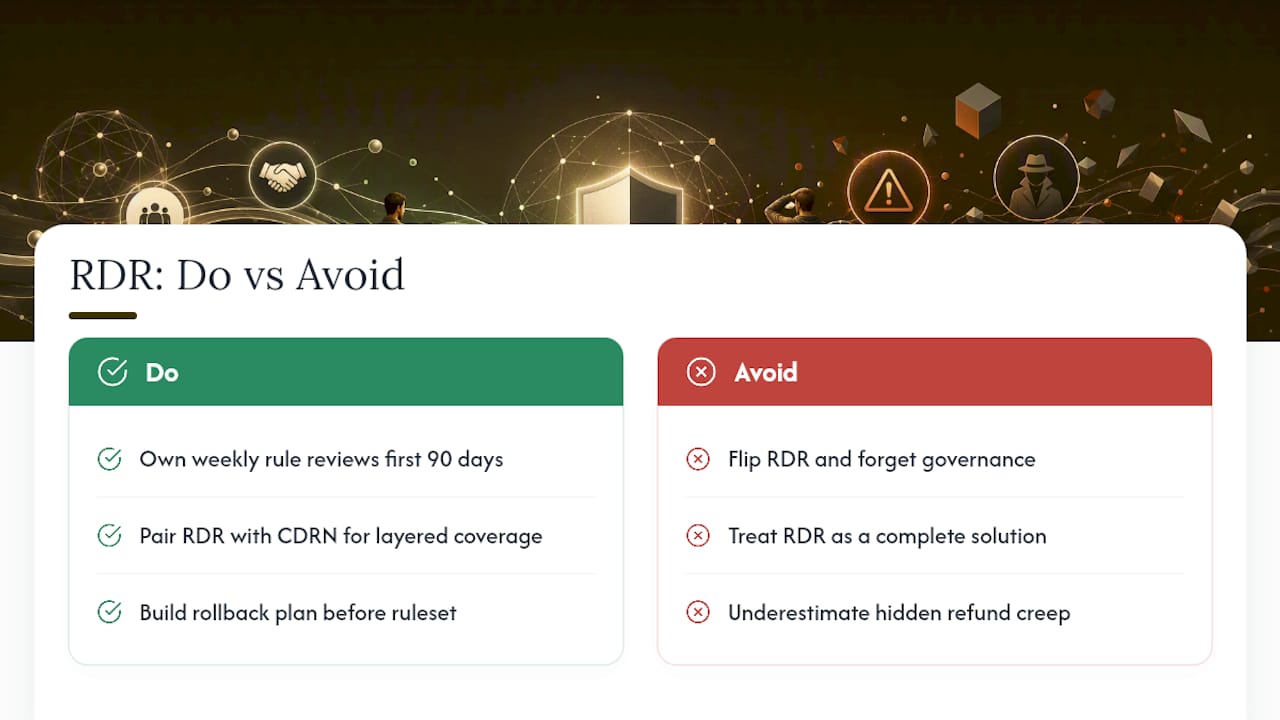
The conventional advice also undersells the CDRN pairing. RDR is fast and Visa-specific, but a layered approach that adds CDRN’s broader, delayed review window catches disputes RDR’s automated rules will never see. Treating RDR as a complete solution instead of one layer in a broader dispute strategy is how merchants end up surprised by a refund-rate problem six months in.
If you take one thing from this: build your rollback plan before you build your ruleset, not after you’ve already lost margin figuring out which rule went wrong.
— Peter
Get RDR Set Up Right the First Time
Setting up RDR rules without acquirer coordination is how merchants end up with reporting mismatches, misclassified disputes, and refund creep nobody catches until the quarterly numbers look off. Specialized services handle the parts that trip most merchants up: mapping rules to actual dispute history, coordinating with acquirers on the reporting side, and setting a governance cadence so the ruleset doesn’t drift.

If you’re running a telehealth, supplement, or subscription business and your dispute volume has become a monthly headache, managed support makes sense the moment your team is spending more hours fighting chargebacks than growing revenue. An underwriting and chargeback mitigation team can review your current setup and help determine whether RDR fits your transaction profile before you build a single rule. Start with an application for merchant services to get that conversation started.
Key Documents and Vendor Guides to Read Next
For technical implementation, review Visa’s dispute management overview and its RDR identification requirements. Verifi’s RDR readiness guide and background on alternative dispute resolution frameworks fill in the broader context.
Sources
- Visa: Manage disputes / fraud management
- Proper identification of RDR transactions and service activation (Visa PDF)
- Get Ready for RDR | Verifi
- Checkout


.webp)
