.png)
Platform payment compliance is defined as adherence to the laws, regulations, and industry standards that govern how digital payment platforms process, store, and transmit financial transaction data and cardholder information. For e-commerce operators and fintech compliance officers, this means satisfying requirements set by bodies including the Financial Crimes Enforcement Network (FinCEN), card schemes like Visa and Mastercard, and international standards such as PCI DSS v4.0.1. The stakes are direct: non-compliance consequences include monthly fines up to $100,000, platform shutdowns, and personal liability for founders and compliance officers. Understanding payment compliance is not optional. It is a core risk management function that determines whether your platform can legally operate, maintain banking relationships, and scale without regulatory interruption.
What is platform payment compliance and why does it matter?
Platform payment compliance covers every legal and operational obligation a payment platform carries when it touches money. That includes how you classify your business under state and federal law, how you verify merchants and customers, and how you protect cardholder data. The importance of payment compliance goes beyond avoiding fines. Compliance failures destroy banking relationships, trigger card scheme terminations, and expose leadership to criminal liability.
The industry uses several overlapping terms for this concept. “Regulatory compliance” covers legal licensing and reporting obligations. “Operational compliance” covers internal controls, merchant monitoring, and data security. Both fall under the broader umbrella of platform payment compliance, and both require active management. Treating one without the other creates gaps that regulators and card schemes exploit during audits.
Platforms in e-commerce and fintech face a compounding challenge: regulations differ by jurisdiction, product type, and the specific functions your platform performs. A subscription billing platform faces different obligations than a marketplace connecting buyers and sellers. Knowing which rules apply to your specific operational model is the starting point for any payment compliance framework.

What legal classifications and licenses apply to payment platforms?
The most consequential classification question for U.S. platforms is whether your business qualifies as a Money Transmitter. State money transmitter licenses require applications in each state where you operate, with fees ranging from $500 to over $5,000 per state, plus surety bonds and minimum net worth requirements. Federal registration as a Money Services Business (MSB) with FinCEN is a separate obligation that runs alongside state licensing, not instead of it.
| License Type | Trigger | Key Obligation |
|---|---|---|
| State Money Transmitter License | Receiving or transmitting funds on behalf of others | Per-state application, surety bond, net worth minimum |
| FinCEN MSB Registration | Operating as a money services business federally | AML program, SAR filing, recordkeeping |
| PSD2/PSD3 Authorization (EU) | Providing payment services in EU member states | Full authorization, capital requirements, operational transparency |
The critical insight most platforms miss is that your contractual label does not determine your regulatory classification. Functional control does. If your platform sets pricing, holds funds, or makes underwriting decisions about merchants, regulators treat you as a Money Transmitter or ISO regardless of what your terms of service say. This distinction has triggered enforcement actions against platforms that genuinely believed they were exempt because a third-party processor handled the actual money movement.
Pro Tip: Conduct a functional control audit at least annually. Document who sets merchant pricing, who approves merchant applications, and who controls fund settlement. If the answer is your platform, your compliance obligations are broader than your contracts suggest.
Misclassification carries serious consequences. Operating as an unlicensed Money Transmitter is a federal crime under 18 U.S.C. § 1960. State regulators have pursued civil penalties and cease-and-desist orders against platforms that delayed licensing while scaling. The cost of retroactive licensing, including back fees, legal defense, and remediation, consistently exceeds the cost of proactive compliance.
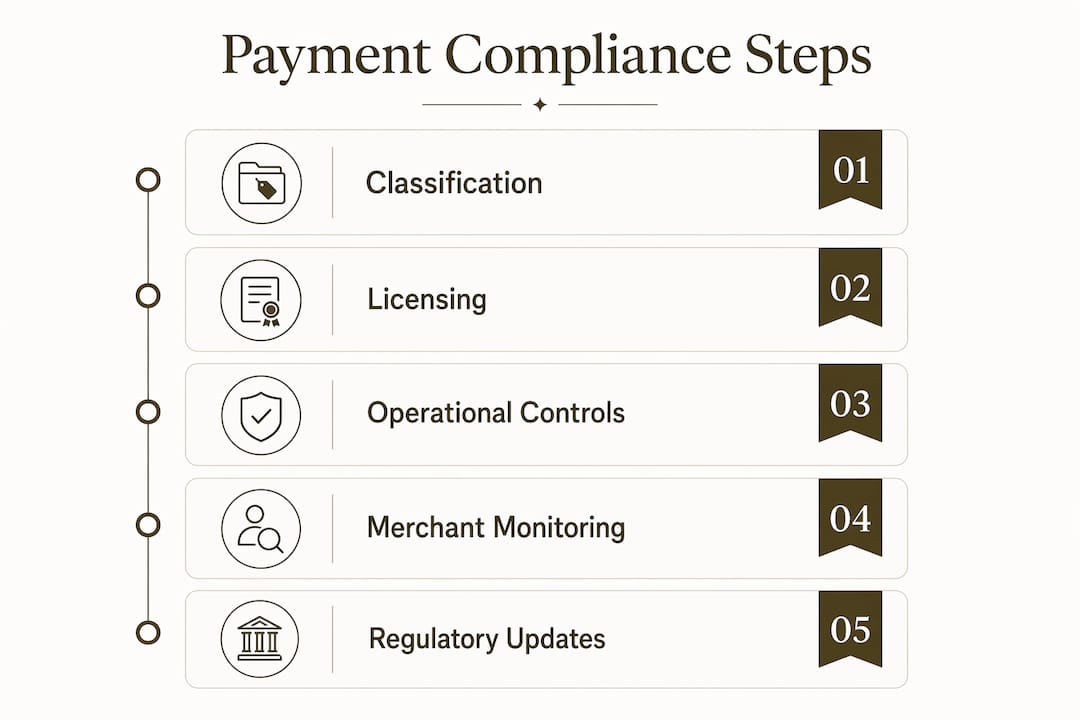
How do operational controls affect payment compliance responsibilities?
Your platform’s day-to-day functions determine your compliance scope more than any legal agreement. Platforms acting as ISOs by controlling merchant onboarding, pricing, or underwriting must hold card scheme registrations and bear direct compliance liabilities. This is not a technicality. Card schemes hold ISOs responsible for the behavior of every merchant in their portfolio.
The activities that trigger ISO classification include:
- Merchant onboarding control: Your platform approves or rejects merchant applications based on your own criteria.
- Pricing authority: Your platform sets the discount rate, transaction fees, or interchange pass-through terms for merchants.
- Underwriting decisions: Your platform determines credit risk, reserve requirements, or processing limits for merchants.
- Transaction routing: Your platform directs transactions to specific acquirers or processors based on internal logic.
Card scheme liability flows directly to ISOs and their acquiring banks when merchants generate fraud, chargebacks, or regulatory violations. This means your compliance program must extend beyond your own operations to cover every merchant you onboard. A single high-risk merchant generating excessive chargebacks can trigger a card scheme audit of your entire portfolio.
Pro Tip: Map every merchant-facing function your platform performs against the ISO classification criteria before signing new acquiring agreements. Acquirers increasingly require this documentation upfront, and providing it proactively signals operational maturity.
Platforms frequently evolve from technology providers into de facto ISOs as they grow. A platform that starts by connecting merchants to a processor often assumes pricing and underwriting control over time to improve margins or reduce churn. Each operational shift increases compliance obligations. Ongoing classification assessments catch these changes before regulators do.
Merchant monitoring must be continuous, not just a one-time onboarding check. Transaction pattern analysis, geographic anomaly detection, and rapid fund cycling alerts are the controls that protect your banking relationships and satisfy AML obligations after a merchant goes live.
What are the core payment compliance guidelines platforms must follow?
Payment compliance guidelines for platforms fall into four primary frameworks, each with distinct requirements and enforcement mechanisms.
-
PCI DSS v4.0.1: Mandatory for any platform that processes, stores, or transmits cardholder data. PCI DSS violations carry monthly fines from $5,000 to $100,000, depending on severity and duration. The standard covers 12 technical and operational security requirements, including network segmentation, access controls, encryption, and vulnerability management. Platforms that use third-party payment processors are not automatically exempt. Your scope depends on how cardholder data flows through your systems.
-
AML/KYC obligations: Platforms classified as MSBs must implement a written AML program covering customer identification, beneficial ownership verification, transaction monitoring, and Suspicious Activity Report (SAR) filing. AML/KYC compliance extends to merchants, not just end consumers. Merchant risk profiling based on industry, transaction volume, and geography is a required component of a complete AML program.
-
Sanctions screening: Real-time screening against OFAC, UN, and EU sanctions lists is mandatory for platforms processing cross-border transactions. A single payment to a sanctioned entity can trigger civil penalties regardless of intent.
-
Data privacy regulations: GDPR applies to any platform processing payment data of EU residents. CCPA applies to California residents. Both require explicit consent frameworks, data minimization practices, and breach notification procedures. Payment data is among the most sensitive categories under both regimes.
Merchant identity verification must include beneficial ownership checks, not just business registration verification. Regulators expect platforms to know who ultimately controls and benefits from each merchant account. Gaps in beneficial ownership documentation are a common finding in regulatory examinations.
How are emerging regulations shaping payment compliance in 2026?
The regulatory environment for payment platforms is tightening across every major jurisdiction. The most significant structural change in the EU is the transition from PSD2 to PSD3. PSD3 and the Payment Services Regulation remove the commercial agent exemption that many marketplace platforms relied on to avoid full payment institution authorization. Platforms acting for both buyers and sellers now face full authorization requirements, capital minimums, and operational transparency obligations.
| Requirement | PSD2 | PSD3 / PSR |
|---|---|---|
| Commercial agent exemption | Available for dual-sided platforms | Removed; full authorization required |
| Authorization scope | National, per member state | Standardized across EU via PSR |
| Enforcement timeline | Active | Expected 2027–2028 |
| Operational transparency | Limited disclosure requirements | Expanded reporting and audit obligations |
PSD3 enforcement is expected by 2027–2028, but platforms must begin authorization processes now. Authorization timelines in major EU markets routinely run 12–18 months. Waiting until enforcement begins guarantees a compliance gap.
In the U.S., the GENIUS Act introduces a federal framework for stablecoin issuers, and the EU’s MiCA regulation establishes licensing requirements for crypto asset service providers. Platforms processing digital asset payments face a new layer of compliance obligations on top of existing AML and licensing requirements. Cross-border payment compliance is becoming the most complex area of platform payment regulations, with jurisdictional conflicts between U.S., EU, and UK rules creating genuine legal uncertainty for global platforms.
The practical response is to build compliance programs that can absorb new requirements without full restructuring. Modular compliance frameworks, where AML, data privacy, and licensing obligations are managed as separate but connected workstreams, adapt more efficiently than monolithic programs built around a single regulatory regime.
Key Takeaways
Platform payment compliance requires active management of legal classification, operational controls, and regulatory frameworks simultaneously. No single element alone satisfies the full scope of obligations.
| Point | Details |
|---|---|
| Classification drives obligations | Functional control over pricing, onboarding, or underwriting triggers Money Transmitter or ISO status regardless of contracts. |
| PCI DSS v4.0.1 is non-negotiable | Monthly fines from $5,000 to $100,000 apply to platforms mishandling cardholder data. |
| AML/KYC covers merchants, not just consumers | Merchant risk profiling, beneficial ownership checks, and SAR filing are required components. |
| PSD3 removes key exemptions | EU platforms acting for buyers and sellers must pursue full payment institution authorization by 2027–2028. |
| Compliance is continuous, not one-time | Ongoing merchant monitoring and periodic classification audits prevent regulatory exposure as platforms evolve. |
What I’ve learned about compliance that most platforms get wrong
After working with high-risk merchants and payment platforms across e-commerce, telehealth, and nutraceuticals, one pattern stands out clearly. Platforms consistently treat compliance as a technology integration problem. They connect a KYC vendor, add a fraud tool, and consider the work done. That approach fails because compliance is a regulatory and legal risk management function, not a software configuration.
The platforms that stay out of trouble share one habit: they reassess their own classification regularly. They ask whether their operational footprint has expanded beyond what their licenses and registrations cover. They do this before an acquirer audit or a regulatory inquiry forces the question.
The other mistake I see constantly is assuming that delegating compliance to a third-party processor transfers the legal obligation. It does not. Your platform remains responsible for the compliance of your merchant portfolio and the accuracy of your regulatory filings. A processor can support your compliance program. They cannot own it for you.
The best compliance officers I have worked with treat payment compliance guidelines as a living framework, not a checklist. They update merchant risk profiles when transaction patterns shift. They track regulatory changes in every jurisdiction where their platform operates. They build compliance into product decisions before launch, not as a retrofit after a regulator calls. That proactive posture is what separates platforms that scale from platforms that stall.
— Peter
How Davincipay helps you build a compliant payment operation
Davincipay specializes in payment processing for high-risk and compliance-sensitive businesses, including e-commerce brands, telehealth companies, nutraceutical sellers, and subscription merchants. We understand the specific payment compliance framework requirements these verticals face, and we build that knowledge into every merchant relationship.

Our onboarding process integrates KYC and AML verification from the start, so your merchant accounts are structured for compliance before the first transaction processes. We work with domestic and international acquiring relationships to give your business processing continuity even as regulations shift. If you are ready to secure compliant payment processing built for your industry, apply with Davincipay and get a fast approval decision from a team that knows your compliance environment.
FAQ
What is platform payment compliance?
Platform payment compliance is adherence to the laws, regulations, and industry standards governing how digital payment platforms process, store, and transmit financial transaction data. It covers licensing, PCI DSS, AML/KYC, and data privacy obligations.
What triggers Money Transmitter licensing for a platform?
Receiving or transmitting funds on behalf of others triggers Money Transmitter licensing in the U.S. State licenses are required per state, with fees from $500 to over $5,000, plus separate federal MSB registration with FinCEN.
How does PCI DSS apply to payment platforms?
PCI DSS v4.0.1 applies to any platform that processes, stores, or transmits cardholder data. Violations carry monthly fines from $5,000 to $100,000 depending on severity and how long the violation persists.
What changes does PSD3 bring for EU payment platforms?
PSD3 removes the commercial agent exemption previously available to dual-sided marketplace platforms, requiring full payment institution authorization. Enforcement is expected by 2027–2028, but authorization timelines make early preparation necessary.
Does using a third-party processor eliminate compliance obligations?
No. Delegating payment processing to a third party does not transfer your platform’s legal compliance obligations. Your platform remains responsible for merchant portfolio compliance, AML program implementation, and regulatory reporting.


.webp)
