A payment gateway sends each transaction down one path to one processor or acquirer. A payment orchestration layer sits above that path. It connects several gateways, processors and acquirers and decides, transaction by transaction, which one should handle the payment. If you sell in one market, with one provider and steady approval rates, a gateway is usually enough. If you run several providers, sell across borders or can’t afford downtime, orchestration starts to earn its cost.
For high-risk and regulated merchants, the choice has an extra twist. Your bank relationships matter more than your software layer. Here is how the two compare, what each costs you in time and money, and how to decide.
TL;DR
- A gateway connects your checkout to one processor or acquirer and returns an approval or decline. Orchestration manages many of them through one integration.
- Orchestration adds routing, automatic retries, failover and consolidated reporting. It also adds a platform fee and another vendor to manage.
- A gateway is usually enough for one market, a few payment methods and one stable provider. Add orchestration when complexity justifies it.
- For high-risk merchants, a strong acquiring relationship and chargeback control come first. Orchestration only helps once you have more than one real route to send volume down.
- Compare total cost, not just per-transaction rates: platform fees, integration work and who owns the merchant accounts.
Table of Contents
- What a payment gateway does
- What payment orchestration adds
- Payment orchestration vs gateway: side-by-side
- Costs and implementation: what to weigh
- When a gateway is enough
- When orchestration makes sense
- The high-risk merchant’s view
- Perspective: what we see from the merchant side
- How to decide: a short framework
- Work with a team built for high-risk processing
- FAQ
- Sources
What a payment gateway does
A payment gateway is the technology that encrypts a customer’s card details and carries them between your checkout, the payment processor or acquiring bank, and the issuing bank. It then returns an authorization or a decline so you can complete the sale. Salesforce describes gateways as supporting credit cards, debit cards and digital wallets, with security controls such as encryption and PCI DSS compliance.
The key word is single. A gateway normally connects you to one processor or bank on a largely fixed path. That has real advantages:
- Simple setup. One integration, one contract, one dashboard.
- Predictable costs. Per-transaction fees and a monthly fee, scaling with volume.
- Clear accountability. When something breaks, you know whom to call.
The weakness shows up when that one path fails. If your processor has an outage, or your acquirer declines a spike of valid cards, every transaction feels it.
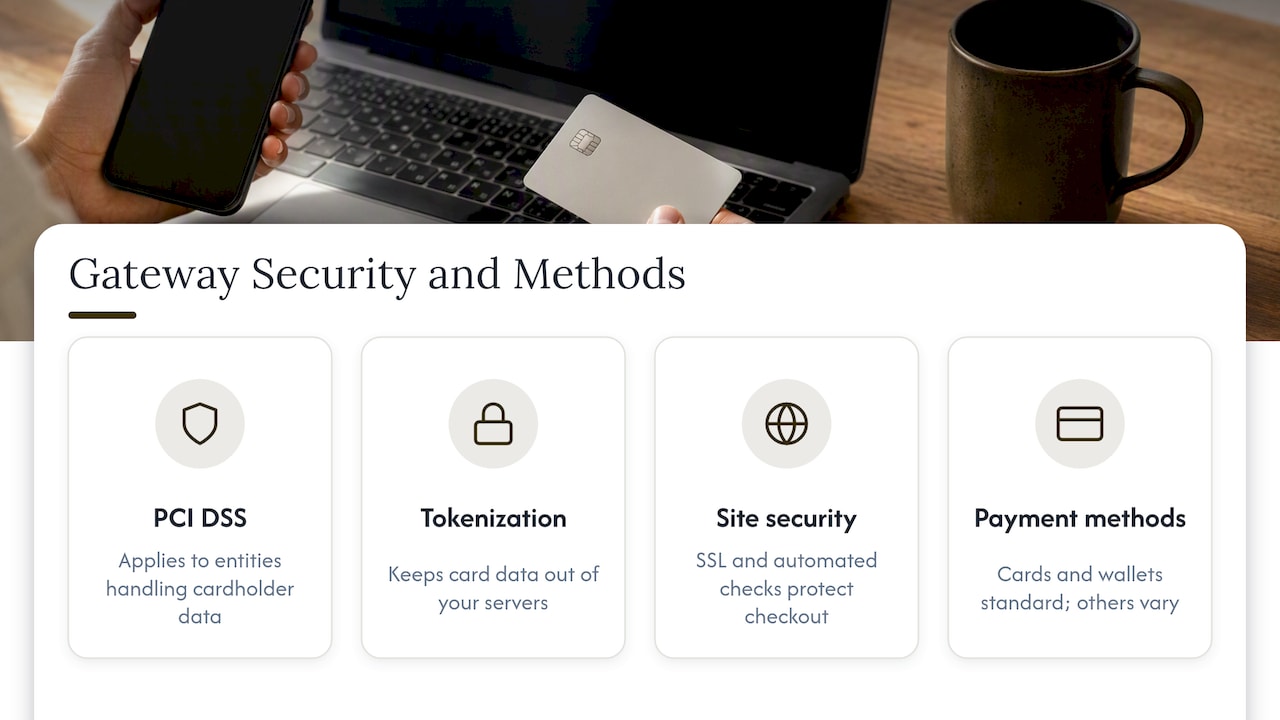
Gateway security and payment methods
Whatever you choose, card data handling falls under PCI DSS. The PCI Security Standards Council states that the standard applies to all entities that store, process or transmit cardholder data. A gateway that tokenizes card data and keeps it out of your servers narrows your own exposure. The same logic applies to the site around your checkout: basic site security features such as SSL certificates and automated security checks protect the page where customers type their card numbers.
Also check which payment methods the gateway supports. Cards and wallets are standard. ACH, local methods and recurring billing tools vary by provider.
What payment orchestration adds
A payment orchestrator is a software layer. NetSuite’s guide describes it as connecting multiple gateways, processors, acquirers and other services through one integration, then managing routing, authorization, failover and consolidated reporting.
PYMNTS frames the idea as a connectivity layer. Its value is letting a merchant build a best-of-breed payment stack without building every connection by hand.
In practice, orchestration gives you four things a single gateway doesn’t:
- Smart routing. Rules send each payment to the route that fits, based on cost, performance or availability.
- Failover and retries. If a route times out, errors or declines, the payment can retry through a backup without the customer doing anything.
- Provider flexibility. You can add or swap processors without rebuilding your checkout.
- One view of the data. Settlement and transaction data from every provider land in one place.
How a transaction moves through each setup
With a gateway, the path is short:
- The customer submits payment at checkout.
- The gateway encrypts and forwards the data to your processor or acquirer.
- The issuing bank approves or declines.
- The gateway returns the result to your site.
With orchestration, there is a decision step up front. According to NetSuite, you send one API request to the orchestrator. Rules and real-time factors pick a gateway, processor or acquirer. That provider authorizes the payment. If it fails, the orchestrator can fail over to another route. When every route fails, the transaction is declined and can trigger a fallback workflow.
Payment orchestration vs gateway: side-by-side
| Factor | Payment gateway | Payment orchestration |
|---|---|---|
| Connections | One processor or acquirer | Many gateways, processors and acquirers |
| Routing | Fixed path | Rule-based, dynamic |
| Failover | Limited to what that provider offers | Automatic retry through backup routes |
| Integration | One integration per provider | One integration to the orchestrator |
| Reporting | Per provider | Consolidated across providers |
| Costs | Transaction fees, monthly fees | Platform fees on top of provider costs |
| Best for | Single market, simple stack | Multi-provider, multi-region, complex stacks |
| Your effort | Low | Higher: rules, testing, vendor management |
The difference in one line: a gateway is a pipe, and orchestration is the switchboard that chooses between pipes. Wise’s U.S. guide makes the same split, with a gateway on a fixed path and orchestration managing several providers and choosing routes dynamically.
Costs and implementation: what to weigh
Price is where merchants get surprised, so work through it before you sign anything.
Gateway costs. You typically pay a setup fee where one applies, a monthly fee and a per-transaction fee. These scale in a straight line with volume, which makes budgeting easy.
Orchestration costs. You pay the underlying processor and acquirer costs, plus the orchestration platform’s own fees. Those fees may be monthly, per transaction or tied to volume. Any saving has to come from better routing, higher approval rates, fewer lost sales and less engineering time. Those gains are real for some merchants and negligible for others. Ask any vendor to model your actual volume and mix before you assume savings.
Implementation. A gateway integration is one project. Orchestration is one integration to the orchestrator plus a contract and an onboarding for every provider behind it. You also write and maintain routing rules. A badly tuned rule can send good volume to a worse route.
Ownership. Ask who holds the merchant accounts. If the accounts sit in your name, you keep them if you change platforms. If they sit under the vendor’s umbrella, moving may mean starting underwriting again.
A short checklist to bring to any vendor call:
- What are the total fees: platform, per-transaction, monthly, and any minimums?
- Whose name is on the merchant accounts?
- Which acquirers and processors are already connected, and which would you need to add yourself?
- How are reserves and rolling holds set, and where are they published?
- What happens to routing and reporting if you leave?
- How long does onboarding take for your business type?
When a gateway is enough
Based on Wise’s guidance for U.S. businesses, a gateway usually covers you when:
- You operate in one market.
- You accept a limited set of payment methods.
- You rely on one provider.
- Your processing performance is stable.
That describes a lot of merchants. A U.S.-only store with a stable approval rate, a single processor and a steady chargeback ratio gets little from an extra layer. The same guidance says orchestration should be justified by operational complexity, not added by default alongside a gateway. We agree.
When orchestration makes sense
Orchestration becomes worth the added layer when you recognize yourself in several of these:
- You sell internationally and want local acquiring in more than one region.
- You use several providers and want one integration and one report.
- You add payment methods faster than your developers can integrate them.
- Uptime is critical. A processor outage costs you real revenue, and you want automatic backup routes.
- You want central control over a growing payments stack.
PYMNTS also points to benefits such as less infrastructure to build and maintain, a consistent checkout across methods, and a lighter security and compliance load. Treat the last one carefully. Orchestration can shift some of that burden, but you remain responsible for your own compliance obligations and for what your acquirers require.
The high-risk merchant’s view
Most articles on this topic assume you can open as many processing accounts as you like. If you sell supplements, telehealth services, subscriptions, CBD or other regulated or higher-risk products, you know it isn’t that simple.
Two things change the math:
- Access comes before routing. Routing logic needs routes. If you have one approved acquiring relationship, there is nothing to route between. The first job is getting approved on stable terms, with reserves and fees you understand.
- Declines often come from risk, not technology. Chargeback ratios, descriptor clarity, refund handling and age or compliance controls drive many declines and account reviews. Retrying a bad transaction through a second route doesn’t fix the cause.
So the order of operations for a high-risk merchant is usually:
- Secure a primary acquiring relationship that fits your vertical.
- Put fraud prevention and chargeback mitigation in place.
- Add a second route, domestic or international, as a backup or for growth.
- Only then ask whether a routing layer on top is worth its fee.
Perspective: what we see from the merchant side
We work with merchants whose processing gets complicated fast: supplement brands, telehealth companies, subscription businesses and other regulated online sellers. Here is how we think about the gateway or orchestration question.
First, the label matters less than the structure behind it. Many merchants come to us asking for orchestration when what they need is a better acquiring relationship, clear reserve terms and a second route they can fall back on. We understand why. A sudden freeze or a surprise termination hurts, and failover sounds like the cure. Failover helps with outages. It doesn’t help if the underlying account is the problem.
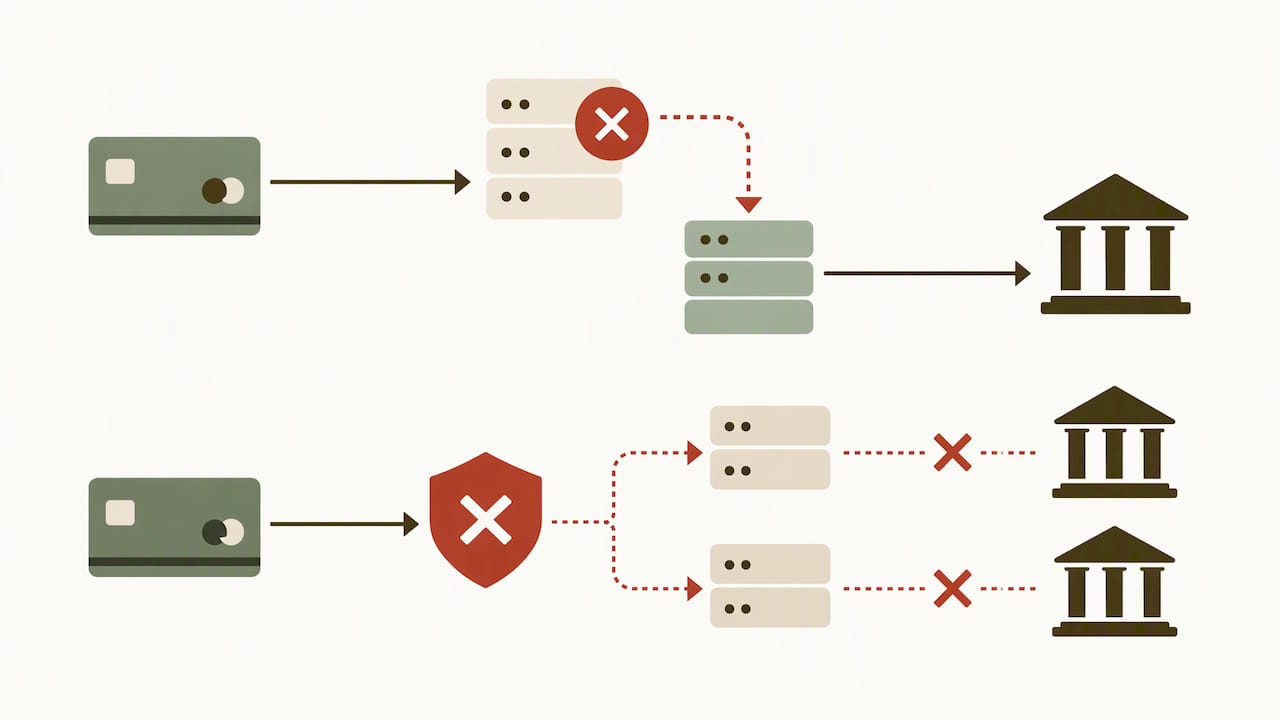
Second, specialization beats flexibility early on. A network of banking partners built for complex merchant placement gives you more practical resilience than a routing engine with nothing connected behind it. That is why we focus on domestic and international acquiring, gateway integration, fraud prevention, chargeback mitigation and underwriting support as one package. We are PCI Level 1 certified, and we build age verification and real-time monitoring into the setup.
Third, add layers when you can name the problem they solve. If you can say “we lose X percent of valid subscription renewals when one processor soft-declines” or “we need local acquiring in a second region,” a multi-route setup is worth discussing. If you can only say “it seems more advanced,” it probably isn’t the next step.
Our advice: get the foundation right, measure your approval and chargeback rates, then expand your routes in a planned way.
— Peter
How to decide: a short framework
Work through these questions in order.
- How many acquiring routes do you have today? One route means a gateway. Two or more means routing logic may help.
- Where are your customers? One country points to a gateway. Several regions with local acquiring needs point to orchestration.
- What do outages and declines cost you? Put a dollar figure on a day of downtime and on the valid transactions you lose each month.
- What is your chargeback and risk profile? If ratios are high, fix that first. Routing won’t cure it.
- Who will manage the rules? Orchestration needs ongoing tuning and monitoring. If nobody owns that, you’ll pay for features you don’t use.
- What is the total cost? Add platform fees to provider fees and compare against realistic gains.
If you answered “one route, one market, stable results,” stay with a gateway. If you answered “several routes, several regions, real money at stake,” evaluate orchestration, and still start by making sure each route is solid.
Work with a team built for high-risk processing
If you run a regulated or high-risk online business, you need approvals, fair reserves and tools that keep your account healthy. We help merchants secure domestic and international acquiring, integrate a gateway, and set up fraud prevention and chargeback mitigation, with approvals and onboarding in as little as 24 hours. You can start with our high-risk payment processing page. If you sell in a specific category, see our pages for telehealth payment processing, nutraceuticals payment processing and supplements payment processing.
FAQ
Is payment orchestration a replacement for a payment gateway?
No. Orchestration sits above gateways and manages them. You still need gateways, processors or acquirers underneath to authorize payments. Some platforms bundle a gateway with orchestration features, but the functions remain distinct.
Do small merchants need payment orchestration?
Usually not. A single market, one provider and stable performance are the conditions where a gateway is sufficient. Consider orchestration once you add providers, regions or payment methods and the complexity costs you more than the extra layer.
Does orchestration lower processing costs?
It can, through routing to cheaper or better-performing routes and by recovering declined sales. It also adds platform fees on top of provider costs. Whether it saves money depends on your volume, mix and routes, so ask for a model based on your own numbers.
Can a high-risk merchant use payment orchestration?
Yes, but approval comes first. Each acquirer behind the orchestrator still underwrites your business and sets its own terms. Secure a stable primary acquiring relationship, then add routes as your volume justifies it.
What is the difference between a payment gateway and a payment processor?
The gateway captures and securely transmits payment data from your checkout. The processor or acquiring bank handles the transaction with the card networks and issuing banks and settles funds to you. Many providers bundle the two, which is why people often mix them up.