.png)
Payment orchestration centralizes routing, risk controls, and compliance management so high-risk merchants keep acceptance rates high while limiting fraud exposure and acquirer risk. It works through three levers: smart transaction routing, integrated fraud and authentication controls, and underwriting or reporting discipline that keeps acquirers confident. Card-brand programs and PCI requirements shape what you can actually build, so the right setup respects those constraints from day one.
TL;DR:
- High-risk merchants benefit most from orchestration platforms capable of batch routing, fraud controls, and ongoing monitoring to prevent account freezes and revenue loss.
- Effective orchestration requires features such as intelligent retry logic, layered fraud detection, and adaptive authentication that balance risk management with conversion rates.
- Compliance depends on continuously updated documentation, monitoring of dispute ratios, and adherence to PCI DSS and card network standards, especially for regulated categories.
- Implementing orchestration properly involves staged rollout, real-time KPI monitoring, and thorough testing of failure scenarios before full deployment.
- Outsourcing to specialists like DavinciPay.ai simplifies placement, reduces compliance overhead, and maintains account stability through tailored controls and rapid underwriting.
Table of Contents
- What Payment Orchestration Is and Why High-Risk Merchants Need It
- Key Orchestration Features That Matter for High-Risk Accounts
- Risk, Regulation, and Card-Brand Controls: What Compliance Looks Like
- How to Implement Payment Orchestration for a High-Risk E-Commerce Business
- Monitoring, KPIs and Operational Playbook for Live Orchestration
- DavinciPay.ai Perspective: Delivering Orchestration and Underwriting for High-Risk Merchants
- Practical Trade-Offs and When Orchestration Is the Right Move
- How DavinciPay.ai Helps High-Risk Merchants Implement Orchestration and Underwriting
- FAQ
- Sources
- Perspective: Where Orchestration Actually Earns Its Keep
What Payment Orchestration Is and Why High-Risk Merchants Need It
An orchestration layer sits between your checkout and the patchwork of payment service providers, gateways, and acquirers you use to process transactions. Instead of wiring your store directly into a single gateway, you route transactions through a system that can shift traffic across multiple processors, apply fraud rules consistently, and reconcile settlement data from every connection point.
The typical build includes a few core pieces:
- A PSP abstraction layer that lets you add or swap processors without rebuilding checkout code.
- Rules-based routing that sends transactions to the acquirer most likely to approve them.
- A token vault that stores card data securely and reduces how much sensitive information touches your servers.
- Fraud and authentication integrations that screen transactions before and after authorization.
- Reconciliation tools that match settlements across every acquirer in your stack.
High-risk merchants need this layer more than most. Nutraceutical brands, telehealth providers, subscription services, and similar businesses typically carry higher dispute and chargeback rates than standard retail, which draws closer scrutiny from acquirers and card networks. Many also get classified under merchant category codes that restrict which banks will underwrite them at all, leaving fewer acquiring options and less room for error.
A single-gateway setup means a single point of failure. If one acquirer freezes your account, tightens a reserve, or simply declines a batch of valid transactions during a routing hiccup, your revenue stops. Orchestration lets you place transactions across multiple acquirers and fall back automatically when one connection underperforms, which matters most for merchants who already have a thin margin for acquirer patience.
Key Orchestration Features That Matter for High-Risk Accounts
Not every orchestration platform is built with high-risk volume in mind. Here’s what to check for when evaluating a vendor or scoping an internal build.
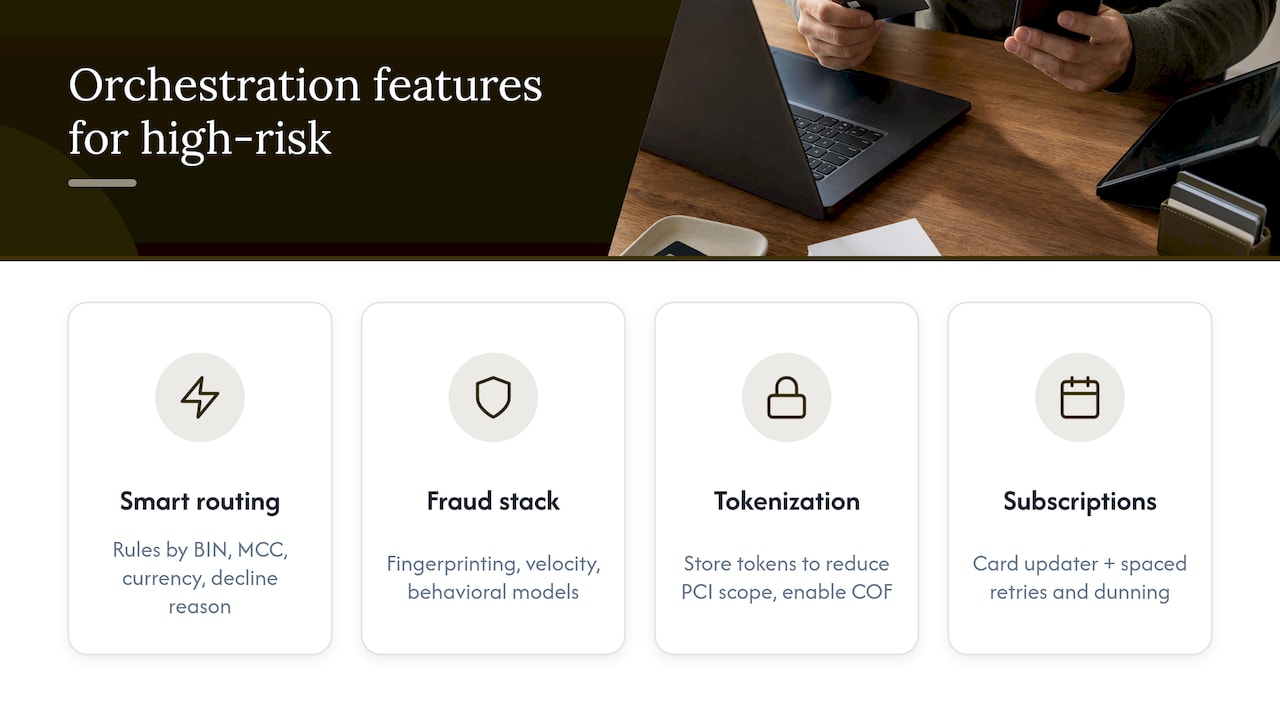
Smart routing and retry logic. Routing rules should consider BIN, BIN country, MCC, currency, and the specific decline reason returned by the acquirer. A soft decline on insufficient funds calls for a different retry strategy than a hard decline for fraud suspicion.
Integrated fraud stack. Device fingerprinting, velocity checks, and behavioral models catch different fraud patterns, and layering them reduces blind spots. Third-party signal providers add context your own data can’t surface alone, and a manual review queue catches the edge cases automated rules flag but can’t resolve confidently.
Adaptive authentication. 3D Secure shifts chargeback liability to the issuer when triggered correctly, but applying it to every transaction adds friction that costs you conversions. The better approach triggers 3DS selectively, based on risk score, transaction value, or returning-customer status, so loyal buyers face less friction while risky transactions get the extra verification step.
Tokenization and vaulting. Storing card data as a token rather than raw card numbers reduces how much of your environment falls inside PCI DSS scope, and it’s what makes card-on-file billing and one-click checkout possible without re-collecting payment details every time.
Recurring and subscription handling. Card updater services catch expired or reissued cards automatically. Smart retry logic spaces out failed renewal attempts instead of hammering a declined card repeatedly, and dunning flows notify customers before a subscription lapses.
Chargeback mitigation. Evidence bundling and rebuttal automation speed up dispute responses, which matters because response windows are short and manual compilation eats staff time you don’t have during a dispute spike.
Reconciliation and reporting. Settlement matching across acquirers, exception flagging, and daily reporting keep your finance team from chasing missing funds manually.
Pro Tip: Map your decline reasons to specific routing rules before you launch, rather than after a spike in failed transactions forces the issue.
Risk, Regulation, and Card-Brand Controls: What Compliance Looks Like
Orchestration platforms don’t operate in a vacuum. Card networks, the PCI Security Standards Council, and federal regulators all set boundaries that determine what a compliant implementation looks like for a high-risk merchant.
Visa’s acceptance risk standards require acquirers to apply underwriting, ongoing monitoring, and portfolio controls to merchants flagged as high-integrity or high-brand risk. That includes velocity checks, screening against politically exposed persons and sanctions lists, and continuous anomaly detection across daily transaction patterns. Visa’s payment facilitator and marketplace risk guide goes further for merchants in high-brand risk categories, requiring enhanced due diligence and registration, with reserves or account holds as the remediation lever when a merchant exceeds dispute or fraud thresholds.
Underwriting doesn’t end at onboarding. Acquirers expect ongoing monitoring of volume, average ticket size, and dispute counts, backed by documentation that supports your business model and transaction patterns. An orchestration platform that can feed acquirer-grade telemetry, meaning the volume, dispute, and velocity data acquirers actually want to see, helps you maintain placement instead of triggering a review that freezes funds.
PCI DSS compliance adds another layer. PCI SSC guidance on payment page security addresses e-skimming risk directly, tightening requirements under PCI DSS 6.4.3 and 11.6.1 for merchants and third-party providers alike. How you integrate your payment forms matters here: hosted fields and secure iframes keep more of the checkout flow outside your own servers, which reduces your PCI scope and your eligibility for a simpler self-assessment questionnaire, compared to building card capture directly into your own code.
Consumer protection rules matter too, especially for merchants experimenting with newer payment rails. The CFPB’s proposed interpretive rule on EFTA and Regulation E signals that emerging payment mechanisms may trigger the same consumer protections as traditional electronic transfers. If your orchestration setup routes through non-traditional settlement paths or alternative accounts, document the consumer disclosures and dispute rights that apply, because regulators are paying closer attention to this gap.
Visa’s auto fuel dispenser program shows how quickly network monitoring can escalate a merchant into a remediation program once thresholds are breached, through the VFMP-AFD framework, and acquirers respond by requiring AVS, velocity controls, and other mitigations. The same pattern applies across high-brand risk categories: breach a threshold, and the consequences arrive quickly.
What this means operationally:
- Expect reserves or holds if dispute ratios climb past acquirer-set thresholds.
- Keep documentation current: business model descriptions, source-of-funds records, and processing history should be ready for review at any time.
- Build remediation steps into your playbook before you need them, not during an active freeze.
How to Implement Payment Orchestration for a High-Risk E-Commerce Business
Rolling out orchestration safely means sequencing the work so compliance and risk controls are built in, not bolted on after launch.
- Assess your risk profile and assemble your underwriting pack. Pull together business documentation, processing history, chargeback rates, and any licensing or age-verification requirements specific to your vertical.
- Choose your integration pattern. Hosted fields, secure iframes, and server-to-server flows each carry different PCI scope implications. Hosted fields and iframes keep card data off your servers entirely, which narrows your e-skimming exposure under current PCI guidance. For PCI DSS 4.0 scoping specifics, a structured readiness roadmap can help you sequence the work over 30 to 90 days.
- Configure routing rules and fraud flows. Build out BIN-based and MCC-based routing, then test against realistic failure scenarios: acquirer declines, AVS mismatches, velocity spikes, and simulated chargebacks.
- Onboard with your acquirers. Expect to provide business licensing, processing history, bank statements, and a volume forecast. Orchestration helps here because you can present split routing across multiple acquirers upfront, which reduces concentration risk and often speeds approval.
- Roll out in stages. Start with a portion of live volume, set clear rollback criteria, and monitor closely during the first few weeks before shifting full volume onto the new setup.
Pro Tip: Run your chargeback simulation test before go-live, not after your first real dispute spike. It’s the fastest way to find gaps in your evidence-bundling workflow.
Monitoring, KPIs and Operational Playbook for Live Orchestration
Once orchestration is live, the work shifts from building to watching. A handful of metrics tell you whether the system is performing: approval rate, authorization-to-settlement lag, fraud rate, chargeback ratio, dispute-to-transaction ratio, and false-positive rate on fraud screening. Track these daily, not monthly, because high-risk portfolios can shift quickly.
Set alerting thresholds that trigger automated responses before a human needs to step in:
- A sudden drop in approval rate on a specific acquirer should trigger a routing shift, not a support ticket.
- A velocity spike from a single BIN range or IP cluster should trigger an automatic block or challenge.
- A chargeback ratio approaching acquirer-set limits should trigger a reserve review before the acquirer flags it first.
Reconciliation needs its own cadence. Match settlements against expected volume daily, set a reasonable variance tolerance, and escalate anything outside that range immediately rather than letting it roll into the next batch.
When disputes or fraud spike, a documented triage process matters more than instinct. Pull the affected transaction set, identify the common thread (a BIN, a traffic source, a promotion), and be ready to present remediation steps to your acquirer during any investigation. For merchants dealing with cryptocurrency payment fraud or complex scam cases, forensic investigation services can trace fund flows and build the documentation an acquirer or law enforcement contact may request.
DavinciPay.ai Perspective: Delivering Orchestration and Underwriting for High-Risk Merchants
We built our underwriting process around the reality that high-risk merchants need acquiring relationships that understand their vertical, not generic risk scoring that treats a supplement brand the same as a standard retailer. Our banking partner network is structured specifically for complex merchant placement, which aims to shorten the back-and-forth that normally stalls high-risk approvals.
Operationally, we emphasize the controls that keep an account stable over time, not just approved on day one:
- Fraud stack integration that screens transactions in real time rather than after settlement.
- Reserve structures that are disclosed upfront instead of adjusted without warning.
- Age verification and compliance controls built for regulated categories like telehealth and nutraceuticals.
- Chargeback mitigation tools that catch disputes early enough to respond within the evidence window.
For decision-makers preparing to apply, having your documentation ready speeds everything up: business licensing, processing history, a realistic volume forecast, and a clear description of your product and customer base. Our high-risk payment processing approach is designed to move merchants through underwriting quickly when that documentation is complete, and our telehealth payment processing page outlines the specific controls that regulated verticals typically need to have in place before approval.
Practical Trade-Offs and When Orchestration Is the Right Move
Building orchestration in-house makes sense when you have engineering capacity to spare and enough volume to justify maintaining multiple acquirer integrations. For most high-risk merchants, that math doesn’t work. The compliance overhead, acquirer fragmentation, and ongoing monitoring burden outweigh the control you gain.
A specialist processor that brings orchestration and underwriting together removes most of that overhead, because the routing logic and acquirer relationships already exist. That’s usually the better path unless you’re processing at a scale where dedicated engineering and compliance headcount pays for itself.
Before committing either way, check your organizational readiness: does your ops team have bandwidth for daily reconciliation, does compliance have documentation current, and does engineering have capacity for ongoing maintenance, not just initial setup.
How DavinciPay.ai Helps High-Risk Merchants Implement Orchestration and Underwriting

We specialize in exactly the gap this article covers: getting high-risk merchants placed with acquirers that understand their vertical, then keeping that placement stable through the controls underwriters actually check. Rather than asking you to build routing logic and fraud integrations from scratch, we bring the acquiring relationships, fraud stack, and chargeback tools together so you can focus on running your business.
- Our nutraceuticals payment processing and supplements payment processing services are built around the compliance patterns those categories face most often.
- We handle reserve structures with transparent terms disclosed before you sign, not adjusted after the fact.
- Our underwriting process moves quickly when your documentation, licensing, processing history, and volume forecasts, is ready up front.
If you’re ready to see what placement looks like for your business, apply now and our underwriting team will walk you through what to expect.
This article is general information, not a substitute for advice from a qualified financial advisor. Consult a qualified financial professional about your own circumstances before acting on anything here.
FAQ
What Is Considered a High Risk Merchant?
A high-risk merchant is a business that acquirers and card networks classify as carrying elevated chargeback, fraud, or regulatory exposure, often based on industry (such as nutraceuticals, telehealth, or subscription billing), transaction patterns, or merchant category code. Classification affects which acquirers will underwrite the account and what reserves or monitoring apply.
Is PayPal a PSP?
Yes, PayPal operates as a payment service provider, aggregating merchant transactions and handling payment processing on their behalf. PSPs like PayPal typically apply their own risk tolerance and category restrictions, which can make them a poor fit for merchants in higher-risk verticals.
What Are Payment Operations?
Payment operations cover the day-to-day work of keeping transactions flowing correctly: monitoring approval rates, reconciling settlements, managing disputes, and maintaining compliance documentation. For high-risk merchants, payment operations also include ongoing acquirer relationship management and reserve monitoring.
What Are the Risks in an Electronic Payment System?
Electronic payment systems carry fraud risk, chargeback exposure, data security risk tied to PCI compliance, and regulatory risk around consumer protections like those addressed in the CFPB’s proposed interpretive rule on emerging payment mechanisms. Orchestration platforms address several of these risks at once by centralizing fraud controls and routing logic across acquirers.
Sources
- Electronic Fund Transfers Through Accounts Established Primarily for Personal, Family, or Household Purposes Using Emerging Payment Mechanisms (CFPB proposed interpretive rule)
- Visa acceptance risk standards
- Coffee with the Council podcast: Guidance for PCI DSS e-commerce requirements
Perspective: Where Orchestration Actually Earns Its Keep
The common assumption is that orchestration is primarily a technical upgrade, a way to add redundancy and shave a few points off decline rates. That undersells what it actually does for a high-risk merchant. The real value sits in the compliance layer, not the routing layer.
Most merchants who get frozen or terminated don’t lose their acquirer because their fraud rate spiked overnight. They lose it because documentation went stale, monitoring gaps went unnoticed, or a dispute ratio crept past a threshold nobody was watching closely. Routing logic doesn’t fix that. Operational discipline does, and orchestration is only as good as the monitoring and reporting built around it.
The merchants who treat orchestration as a compliance and relationship management tool first, and a conversion optimization tool second, tend to keep their accounts the longest.
— Peter


.webp)
