.png)
A scalable payment infrastructure lowers your cost per transaction, keeps checkout running during traffic spikes, speeds up settlement, and lets you launch in new markets without rebuilding your stack. That is the whole case in one sentence, and it’s why more merchants are treating payment architecture as a growth lever rather than a back-office expense.
Global e-commerce volume keeps climbing, and every point of growth adds transaction load your systems have to absorb without breaking, according to Trade. Research from the Bank for International Settlements’ Project FuSSE proof of concept found a modular microservices design settled up to ten thousand transactions per second in staged tests, and Davincipay applies the same scaling logic to keep high-risk merchant accounts stable under pressure.
Here’s what scalable payment infrastructure buys you:
- Lower cost per transaction → wider margins as volume grows instead of costs growing with it
- Fewer outages during peak demand → protected revenue during your highest-traffic hours
- Faster settlement cycles → cash in your account sooner, improving working capital
- Readiness to enter new markets or add payment methods → expansion without a re-architecture project
A payment system that can’t absorb a 10x traffic spike without manual intervention isn’t a payment system. It’s a liability waiting for a busy Tuesday.
Key Takeaways
Scalable payment infrastructure lowers cost per transaction, protects authorization rates during peak demand, and shortens the path to new markets and payment methods.
| Point | Details |
|---|---|
| Sub-linear cost growth is achievable | Project FuSSE showed a 4x throughput increase required under 4x the computing resources. |
| Independent scaling matters most | Isolate cryptography and reconciliation services so they don’t force overprovisioning everywhere else. |
| Track p99, not just averages | The slowest 1% of transactions reveals problems average latency hides. |
| Vendor claims need proof | Ask for real customer footprint and authorization data, not marketing-only scale claims. |
| Davincipay fits high-risk scaling needs | Acquiring relationships, fraud tools, and chargeback mitigation are built for merchants outgrowing standard processors. |
Table of Contents
- What Payment Infrastructure Scalability Actually Means
- The Real Business Benefits of Scaling Your Payment Systems
- Architecture Patterns Behind Scalable Payment Systems
- How to Roll Out Scalable Payment Infrastructure
- Metrics and ROI: How to Measure Scalability
- Security and Compliance Risks That Come With Scaling
- What Real Scaling Data Shows
- How Davincipay Helps You Scale Without the Growing Pains
- Sources
What Payment Infrastructure Scalability Actually Means
Payment infrastructure scalability planning starts with four numbers: throughput (transactions per second, or TPS), concurrency (how many transactions your system processes at the same instant), latency (how fast each one resolves), and geographic reach (how many regions and currencies you support without added friction).
Scaling happens two ways. Vertical scaling makes existing servers bigger and more powerful. Horizontal scaling adds more machines and spreads the load across them, which is generally the more resilient approach for payment volume that spikes unpredictably. Elasticity is the ability to scale out automatically when demand rises and scale back in when it falls, so you aren’t paying for peak capacity around the clock.
Why this matters now: e-commerce transaction volume keeps rising year over year, according to trade.gov, and every increase in baseline volume raises the odds that an inflexible payment stack becomes the bottleneck that caps your growth.
- Throughput: transactions processed per second under load
- Concurrency: simultaneous transactions the system can handle without queuing failures
- Latency: time from authorization request to response
- Geographic scale: number of markets, currencies, and payment methods supported natively
The Real Business Benefits of Scaling Your Payment Systems
The advantages of payment expansion show up in three places: operations, finance, and strategy. Each one compounds the others.
Operationally, a scalable setup improves authorization success rates because routing logic can shift volume to whichever acquirer is performing best at that moment. Latency drops because stateless services scale horizontally instead of choking a single database connection. Timeouts fall, and your team stops spending hours reconciling failed transactions by hand.

Financially, cost per transaction tends to fall as volume rises, since fixed infrastructure costs get spread across more revenue. Platforms built on APIs and microservices can reduce development, maintenance, and operational costs compared with rigid legacy systems, according to Pismo’s scalability explainer. Faster settlement cycles mean cash reaches your account sooner, which matters directly to working capital if you’re running a subscription or nutraceutical business with tight margins.
Strategically, scalable infrastructure shortens the distance between “we want to launch in a new market” and “we’re live.” It also means you can add a new payment method, a buy-now-pay-later option, or a regional wallet without a multi-quarter engineering project. Customers notice faster checkout and fewer declined cards, and that shows up in conversion.
Pro Tip: When architecture teams size infrastructure, they should scale cryptographic and reconciliation services independently from the rest of the stack. These functions are computationally expensive, and bundling them with lightweight services forces you to overprovision everything just to keep pace with the heaviest workload.
Translate the technical wins into numbers your finance team can track:
- Authorization rate (target: consistent or improving as volume grows)
- p99 latency (the slowest 1% of transactions, a better health signal than average latency)
- Cost per authorization (should trend down as TPS rises)
- Manual reconciliation hours per week (should shrink as automation improves)
Architecture Patterns Behind Scalable Payment Systems
Most systems built to handle high concurrency lean on a handful of proven patterns, each with a real trade-off attached.
Microservices with independent scaling let you scale the components that actually need it, like fraud scoring or cryptographic signing, without scaling everything else. The trade-off is added orchestration complexity.
Event-driven ingestion using tools like Kafka, with partitioning and tiered storage, lets you absorb bursts of transaction data without losing events, and keeps storage costs manageable by moving older data to cheaper tiers.
Distributed transactional databases support multi-region settlement when you need consistency across data centers, though they add latency and licensing cost that a single-region merchant doesn’t need.
Edge and orchestration controls, including API gateways, service meshes like Envoy, layered rate limiting, and priority queues, keep critical transactions moving even when non-critical traffic gets throttled during a spike.
| Pattern | Main Benefit | Main Cost or Risk |
|---|---|---|
| Microservices, independent scaling | Scale only what needs it | Orchestration complexity |
| Event streaming with tiered storage | Absorbs traffic bursts cheaply | Requires careful retention tuning |
| Distributed SQL, multi-region | Consistent settlement across regions | Added latency and licensing cost |
| Edge/API gateway controls | Protects critical transactions under load | Extra configuration layer to maintain |
A partner guide on platform-level payment scalability breaks down how these patterns interact in practice, which is worth a look if your team is scoping a migration.
How to Roll Out Scalable Payment Infrastructure
Getting to scalability in payment processing without a chaotic migration takes a sequence, not a single cutover.
Pre-deployment, define your capacity targets and service-level objectives before writing a line of code. Run sandbox tests that simulate your worst historical peak, then double it. Stage the migration so you have a rollback path.
Deployment checklist:
- Use feature flags to control rollout exposure
- Canary a small percentage of live traffic before full cutover
- Migrate merchants in phases, not all at once
- Validate data migration integrity at each phase, not just at the end
Operational practices matter as much as the initial build. Chaos engineering, deliberately breaking pieces of your system in a controlled test, exposes weak points before real traffic does. Rehearse peak load scenarios quarterly. Alert on p99 latency and failed-authorization spikes, not just system-down events.
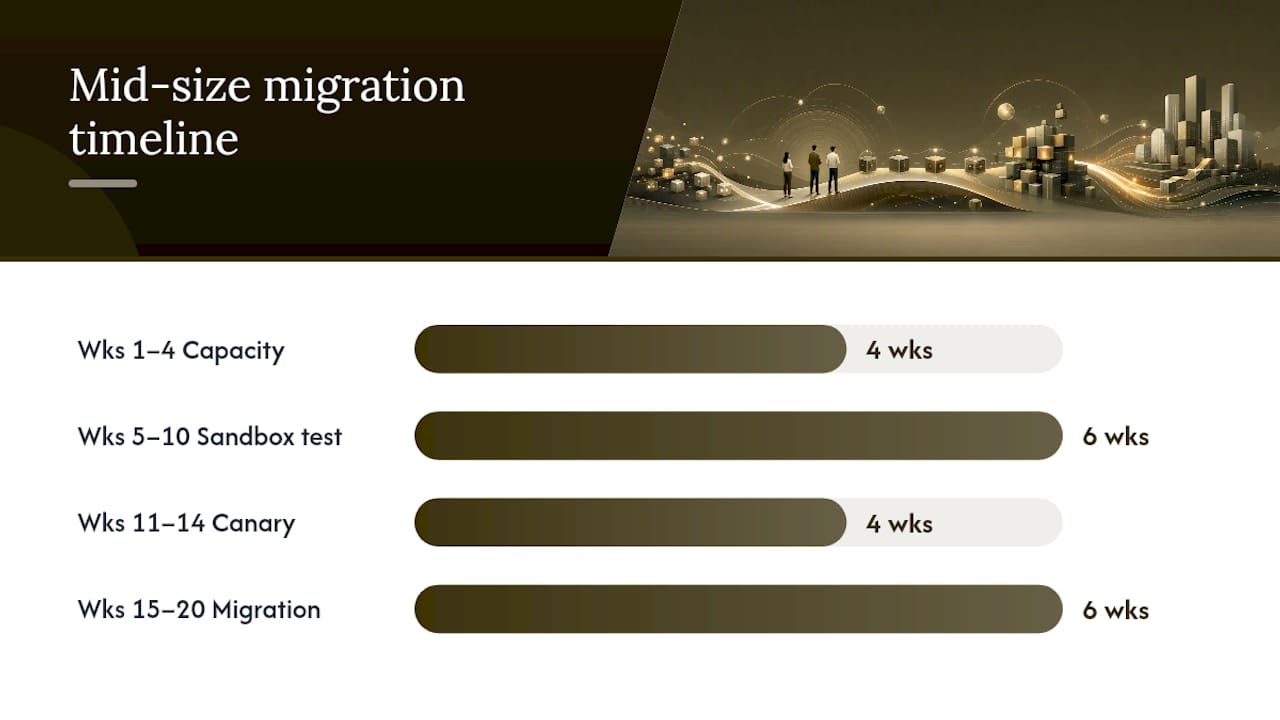
A realistic timeline for a mid-size migration:
- Weeks 1 to 4: capacity planning, SLO definition, and vendor evaluation
- Weeks 5 to 10: sandbox testing and architecture buildout
- Weeks 11 to 14: canary rollout to a small merchant segment
- Weeks 15 to 20: phased migration and full cutover
Cloud migration case studies, including a PayPal deployment on Google Cloud, show that moving payment workloads to managed cloud platforms can shorten this timeline and improve observability along the way.
Metrics and ROI: How to Measure Scalability
Impact of scalability on payment systems is measurable, and the numbers that matter fall into two tiers.
Primary KPIs: TPS, p99 latency, authorization rate, cost per transaction, settlement lag, and straight-through-processing (STP) rate.
Secondary KPIs: operator hours saved on manual reconciliation, chargeback and dispute trend lines, and storage cost per terabyte.
A simple ROI formula for the business case: annualized savings from improved authorization rate, plus reduced operations headcount hours, plus the cash-flow value of faster settlement, minus the infrastructure and migration cost.
That’s roughly $60,000 a month in previously declined revenue recovered, before counting the operations hours saved on manual retries. Even with conservative migration costs, payback often lands inside the first year. E-commerce transaction volumes are only rising, according to trade.gov, which makes that recovered revenue a compounding gain rather than a one-time win.
Security and Compliance Risks That Come With Scaling
Payment network scalability issues don’t stop at throughput. Scaling introduces or amplifies four risk categories: a larger attack surface as you add services and regions, heavier cryptographic compute overhead as transaction volume rises, fraud that scales alongside legitimate volume, and regulatory fragmentation as you expand across jurisdictions.
The mitigations are specific, not abstract:
- Scale cryptographic services independently so encryption load never becomes a bottleneck or a weak point
- Use strong tokenization to keep raw card data out of most of your infrastructure
- Layer fraud controls (velocity checks, device fingerprinting, behavioral scoring) rather than relying on one filter
- Build region-aware data handling into your architecture from the start, not as a retrofit
Any vendor in this space should hold current PCI DSS certification and be able to show how their controls map to it operationally, not just on paper. Compliance and vendor SLAs should be reviewed together, since a fast payment stack that fails an audit isn’t actually fast.
What Real Scaling Data Shows
Project FuSSE, a proof of concept from the Bank for International Settlements, tested a modular microservices settlement architecture in stages: 2,500 TPS, then 5,000, then 10,000. Throughput substantially increased while computing resources grew sub-linearly, evidence that well-designed microservices scale sub-linearly on cost, according to BIS’s Project FuSSE report.
A separate engineering teardown of a high-volume payment gateway documents a real Black Friday peak event handled with Go, Kafka using tiered storage, and distributed SQL, a stack combination that cut infrastructure cost and lowered p99 latency at extreme peak volume.
Sub-linear resource growth is the detail that gets missed in most scaling conversations. It means every doubling of your transaction volume doesn’t have to double your infrastructure bill. That gap is where the real payment infrastructure scalability benefits live.
Both examples share a lesson: independent scaling of the heaviest components, cryptography in one case, streaming and storage in the other, is what made the sub-linear cost curve possible.
When to Build In-House vs. Bring in a Specialist Partner
Building in-house makes sense when you have unique settlement logic, genuinely massive scale, or proprietary reconciliation needs no vendor supports. For most high-risk or fast-growing merchants, a specialist partner wins on speed to market, existing acquirer relationships, and mature fraud operations. Before choosing, check: does the vendor have proven work with merchants your size, not just marketing claims, per Pismo’s vendor guidance? Can they show real uptime and authorization data?
How Davincipay Helps You Scale Without the Growing Pains
Davincipay is built specifically for merchants who hit scaling walls that generic processors can’t handle, high-risk and complex e-commerce, telehealth, and subscription businesses where volume swings and chargeback exposure are part of daily operations.

Here’s how that maps to the benefits covered above:
- Domestic and international acquiring relationships give you routing flexibility that protects authorization rates as volume grows
- Fraud prevention tools and chargeback mitigation handle the risk that scales alongside your transaction count
- Recurring billing and subscription support keep settlement moving smoothly as your customer base compounds
- Underwriting support speeds up approval so growth doesn’t stall waiting on paperwork
If you’re running a telehealth business or another regulated vertical, the compliance controls are built into the account setup, not bolted on afterward. Davincipay pairs that with an onboarding process designed to get high-risk merchants approved and processing without the delays traditional banks impose.
If your current payment setup is straining under growth, apply now to see what a merchant account built for scale actually looks like.
Sources
- Project FuSSE (Fully Scalable Settlement Engine) — BIS
- Johal
- Trade
- PayPal case study on Google Cloud
- What is payments scalability? - Pismo
This article is general information, not a substitute for advice from a qualified financial advisor. Consult a qualified financial professional about your own circumstances before acting on anything here.


.webp)
