.png)
A multiple payment processor strategy is the practice of routing transactions across more than one payment gateway to maximize approval rates, reduce downtime risk, and lower processing costs. Also called payment orchestration or multi-acquirer routing, this approach has moved from a niche tactic to a mainstream infrastructure decision. 60% of merchants in the EU had adopted multi-gateway infrastructure by june 2026 to reduce operational risk. That figure signals a clear shift: single-processor dependence is now the exception, not the rule, for serious ecommerce operations.
What are the primary drivers for a multiple payment processor strategy?
Ecommerce businesses adopt multi-processor setups for four concrete reasons: redundancy, cost reduction, higher authorization rates, and broader geographic coverage.
Operational redundancy is the most urgent driver. A single processor outage can take your checkout offline entirely. With a failover processor in place, transactions automatically reroute when your primary gateway degrades or goes down. No customer sees an error. No revenue disappears.

Cost reduction is the second driver, and it is often underestimated. Multi-acquirer routing reduces fees by directing transactions to processors with regionally optimized pricing and higher authorization likelihood. A card issued in Germany may cost less to process through a European acquirer than through a US-based one. Routing by card type, geography, and issuer bank turns that difference into real savings.
Authorization rate improvement is the third driver. Different processors have different relationships with card networks and issuing banks. A transaction declined by one processor may be approved by another. Smart routing based on BIN, card type, and geography lets you send each transaction to the processor most likely to approve it.
Payment method coverage rounds out the picture. Customers in different markets expect different payment options. A diversified payment solution lets you support local methods, digital wallets, and alternative payment types without forcing every transaction through a single gateway that may not support them all.
- Failover routing prevents checkout downtime during processor outages
- Regional routing lowers interchange and processing fees
- BIN-based routing improves authorization rates per card type
- Multi-method support increases conversion across geographies
How do you architect a multi-processor payment infrastructure?
Multi-gateway architecture patterns fall into three main types: active-passive failover, intelligent routing, and split-by-function. Each balances complexity against benefit differently.
Active-passive failover is the simplest. One processor handles all traffic. A second sits on standby and activates only when the primary fails. This is low overhead and easy to maintain, but it does not optimize for cost or approval rates.
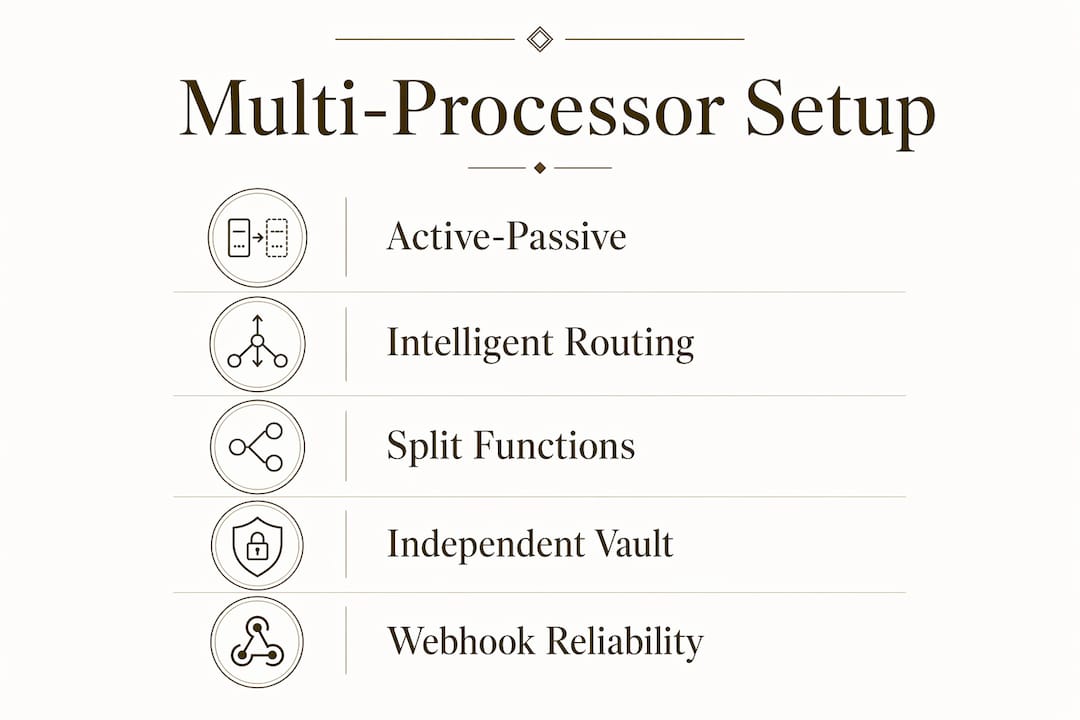
Intelligent routing is the most powerful pattern. Every transaction is evaluated in real time against rules based on BIN data, card type, geography, and processor performance history. The system sends each transaction to the processor most likely to approve it at the lowest cost. This pattern requires more integration work but delivers the best results.
Split-by-function assigns different transaction types to different processors. Subscriptions go to one gateway. One-time purchases go to another. Refunds or disputes route to a third. This approach works well when processors have specialized strengths.
Token vaults and data ownership
The most overlooked architectural decision is where your cardholder data lives. Owning cardholder data independently via a PCI DSS Level 1 compliant vault is critical for flexible multi-processor routing. If your tokens are locked inside a single processor’s proprietary format, you cannot switch processors without asking customers to re-enter their payment details. An independent token vault breaks that dependency entirely.
Using a hosted or embedded payment form reduces your PCI DSS compliance scope by handling sensitive card data externally. This matters in a multi-processor setup because it keeps your integration cleaner and your compliance burden lower across all connected gateways.
Webhook reliability and idempotency
Robust webhook handling requires cryptographically verified, asynchronous server-to-server events to prevent duplicates and fraud. Every payment event, whether a charge confirmation or a refund, should arrive with a verifiable signature. Idempotency keys prevent the same event from triggering duplicate order fulfillment, even when network instability causes a webhook to fire more than once.
Pro Tip: Build your webhook handler to log every incoming event with its idempotency key before processing it. This single habit prevents duplicate charges and makes debugging far easier.
How do you implement a multi-processor strategy step by step?
Implementing a multi-gateway payment approach requires deliberate sequencing. Rushing the integration creates technical debt that compounds quickly.
-
Audit your current payment flow. Map every transaction type, payment method, and geography you support. Identify where declines cluster and where fees are highest. This baseline tells you exactly where a second or third processor adds the most value.
-
Onboard additional processors. Each processor requires KYC documentation, contract negotiation, and underwriting review. For high-risk merchants in categories like nutraceuticals or subscription billing, this step takes longer. Plan for it. Davincipay specializes in securing payment processing for high-risk businesses and can accelerate this process through established acquiring relationships.
-
Build or adopt routing logic. You can write custom routing rules in your backend, or you can use a payment orchestration platform that provides a unified API and drag-and-drop routing configuration. Orchestration platforms remove engineering overhead and let finance teams modify routing rules without developer input.
-
Configure failover and retry logic. Set your system to automatically reroute to a backup processor when your primary returns a gateway error or timeout. Retry logic applies only to soft declines or infrastructure failures, never to hard card declines. Retrying a hard decline flags suspicious activity and can trigger compliance issues.
-
Implement an independent token vault. Store cardholder tokens outside any single processor’s system. This gives you the freedom to reroute recurring transactions to a different processor at any time without customer friction.
-
Test every integration path. Run end-to-end tests for each processor, including failure scenarios, refunds, and chargebacks. Confirm that webhooks fire correctly and that idempotency keys prevent duplicate processing.
-
Monitor continuously. Track authorization rates, decline reasons, latency, and fees per processor. Use that data to refine your routing rules over time.
Pro Tip: Start with two processors before adding a third. Two is enough to capture most of the redundancy and cost benefits. Adding complexity before you understand your routing data creates more problems than it solves.
For merchants navigating multi-jurisdiction payment compliance, understanding regulatory requirements across acquiring regions is a necessary part of the onboarding process.
What mistakes should you avoid with multiple payment processors?
Most multi-processor failures trace back to a small set of avoidable errors.
- Retrying hard declines across processors. A hard decline means the issuing bank rejected the card. Sending that same transaction to a second processor does not change the outcome. It only generates additional failed attempts that card networks flag as suspicious behavior.
- Ignoring webhook verification. Unverified webhooks are a fraud vector. Always validate the cryptographic signature on every incoming event before acting on it.
- Locking tokens inside a single PSP. Proprietary token formats trap your customer data. When you need to switch processors or add a new one, you face a painful migration or a worse customer experience.
- Skipping authorization data analysis. Your decline reason codes tell you exactly why transactions fail. Ignoring them means your routing rules never improve. Review decline data weekly and adjust routing logic accordingly.
- Treating all processors as interchangeable. Each processor has different strengths by card network, geography, and transaction type. Routing every transaction the same way wastes the advantage of having multiple processors.
Balancing cost against approval rate is the ongoing optimization challenge. A processor with lower fees may have a lower approval rate for certain card types. The right routing decision depends on your margin per transaction and your customer’s lifetime value. High-value subscription customers warrant routing to the highest-approval processor, even at a slightly higher fee.
Analytics tools that surface authorization rates, fee breakdowns, and decline reasons by processor give you the data to make those decisions confidently. Without that visibility, you are guessing.
Key Takeaways
A multi-processor payment infrastructure is the most reliable way to protect ecommerce revenue from processor outages, high fees, and declining authorization rates.
| Point | Details |
|---|---|
| Independent token vault | Store cardholder tokens outside any single processor to enable free routing without customer friction. |
| Intelligent routing beats failover | BIN-based, real-time routing improves approval rates and lowers fees beyond what simple failover achieves. |
| Retry only soft declines | Retrying hard declines triggers compliance flags; apply retry logic only to infrastructure failures or soft declines. |
| Webhook idempotency is non-negotiable | Cryptographic verification and idempotency keys prevent duplicate charges and fraud in async payment flows. |
| Start with two processors | Two processors capture most redundancy and cost benefits before adding complexity with a third. |
Why data ownership is the real differentiator in multi-processor setups
After working with ecommerce merchants across high-risk verticals, the pattern I see most often is this: businesses invest in multi-processor routing and then discover their tokens are locked inside their original processor’s vault. All the routing logic in the world cannot help you if your cardholder data is not portable.
The merchants who get this right treat their token vault as core infrastructure, not an afterthought. They choose a PCI DSS Level 1 compliant vault before they sign their second processor contract. That sequence matters. Retrofitting data portability after the fact is expensive and disruptive.
The other trend worth watching is AI-driven routing. Static rules based on BIN and geography are effective, but they do not adapt in real time to processor performance shifts. AI models that continuously update routing weights based on live authorization data will become the standard for high-volume merchants. The infrastructure you build today should be designed to plug into that capability.
My advice: choose an integration framework that separates routing logic from processor-specific code. That separation is what lets you add, remove, or swap processors without rewriting your payment stack. Merchants who build that way spend less time on maintenance and more time on growth. The cross-border payments landscape in 2026 rewards merchants who can adapt their acquiring relationships quickly.
— Peter
How Davincipay supports your multi-processor payment setup
Davincipay connects ecommerce merchants to multiple domestic and international acquirers through a single integration, with built-in routing logic that requires no custom engineering to configure.

The platform includes an independent PCI-compliant token vault, so your cardholder data stays portable across every processor you add. Automated failover and retry logic handle soft declines without manual intervention, keeping your approval rates high even when a processor degrades. Davincipay’s monitoring dashboard surfaces authorization rates, decline reasons, and fee breakdowns by processor in real time. If you operate in a high-risk vertical like nutraceuticals, supplements, or subscription billing, apply now to get your multi-processor infrastructure in place with fast approvals and compliance support built in.
FAQ
What is a multiple payment processor strategy?
A multiple payment processor strategy is the practice of connecting your ecommerce checkout to more than one payment gateway, then routing each transaction to the processor most likely to approve it at the lowest cost.
How does intelligent routing improve authorization rates?
Intelligent routing evaluates each transaction against BIN data, card type, and geography in real time, then sends it to the processor with the strongest approval history for that combination. This approach consistently outperforms single-processor setups on authorization rates.
Why do I need an independent token vault?
An independent token vault stores cardholder data outside any single processor’s proprietary system. Without one, switching processors forces customers to re-enter their payment details, which breaks recurring billing and increases churn.
When should retry logic be applied across processors?
Retry logic applies only to soft declines, such as temporary issuer unavailability, or to infrastructure failures like gateway timeouts. Retrying hard declines across multiple processors triggers fraud flags and can result in compliance penalties.
What is the easiest way to implement multi-processor routing?
Payment orchestration platforms provide a unified API to multiple processors with drag-and-drop routing configuration, removing the need for custom engineering and letting finance teams adjust routing rules without developer support.


.webp)
