.png)
Multi acquirer routing directs each transaction to the best-fit acquiring bank from a pool of connected providers, instead of forcing every payment through a single processor. We see payment teams adopt it to lift authorization rates, trim processing costs, and remove the single point of failure that comes with relying on one acquirer. It matters most to high-volume merchants, high-risk verticals, and any business that has felt the pain of an unexpected processor outage.
TL;DR:
- Multi acquirer routing can improve approval rates by redirecting declined transactions to alternative banks, especially benefiting high-volume and high-risk merchants.
- Routing decisions rely on real-time signals like card data, acquirer health, historical acceptance, and fraud risk, often using machine learning models for accuracy.
- Implementing multi acquirer routing requires supporting multiple settlement streams, centralized fraud policies, and compliance with regulations like Regulation II and PCI standards.
- Cost savings depend on selecting acquirers with the lowest combined markup and fees per transaction, accounting for size and risk profile differences.
- Operational challenges include reconciliation complexity, inconsistent data formats, and maintaining unified fraud rules, which require proactive planning and tools for smooth execution.
Table of Contents
- What Multi Acquirer Routing Is and How Teams Build It
- Core Objectives and Measurable Benefits
- How Routing Engines Decide Which Acquirer Gets the Transaction
- Building the Integration: Connectors, Data, and Reconciliation
- Regulatory and Security Guardrails to Build Around
- When It’s Time to Pilot Multi Acquirer Routing
- What Multi Acquirer Routing Looks Like in Practice
- Common Integration Hurdles and How to Clear Them
- Understanding Fee Structures Across Multiple Acquirers
- Where Multi Acquirer Routing Is Headed
- A Practitioner’s View on What Actually Breaks
- How DavinciPay Supports Merchants Building a Routing Strategy
- FAQ
- Sources
What Multi Acquirer Routing Is and How Teams Build It
A single-acquirer setup sends every transaction to one bank, so a decline, an outage, or a rate hike hits every sale. Multi acquirer routing spreads volume across two or more acquiring banks and picks the best one per transaction based on rules or real-time signals. Two architectures dominate how teams build this:
- PSP-level smart routing: your payment service provider routes between acquirers it already works with, which is fast to deploy but limited to that provider’s network.
- Payment orchestration layers: a standalone platform sits above multiple PSPs and acquirers, giving you full control over routing logic and the freedom to add new acquirers without a platform migration.
The trade-off is control versus effort. PSP routing gets you live quickly with less engineering work, while orchestration demands connector development and ongoing maintenance but removes vendor lock-in. An orchestration layer typically includes a routing engine, acquirer connectors, a token vault, and a reconciliation module that maps settlements back to each transaction.
Core Objectives and Measurable Benefits
Payment teams measure three things when they add acquirers: approval rate, cost per transaction, and uptime. Each acquirer has its own risk appetite and issuer relationships, so a transaction declined by one bank often clears through another, which is the core mechanic behind approval-rate gains.
Multi acquirer routing can raise authorization rates by a small but meaningful margin for high-volume merchants, a gain that compounds quickly once you are processing thousands of transactions a month.
The benefits break down into three categories:
- Approval uplift: routing a declined transaction to a second acquirer recovers revenue that would otherwise be lost at checkout.
- Cost control: weighting routing decisions by interchange and gateway fees lets you send volume to the cheapest qualifying acquirer first.
- Resilience: when one acquirer has an outage or a sudden reserve freeze, traffic shifts automatically instead of halting checkout entirely.
High-risk merchants feel the resilience benefit hardest, since a single processor freeze can stop revenue overnight.
How Routing Engines Decide Which Acquirer Gets the Transaction
Routing decisions run on signals collected at the moment of checkout, then scored against rules or a model trained on historical outcomes. The strongest routing setups combine several signal types rather than relying on one.
- Card and transaction data: BIN, issuing country, currency, and transaction amount all affect which acquirer is likely to approve.
- Acquirer health signals: real-time latency and recent decline rates tell the router which acquirer is performing well right now.
- Historic acceptance patterns: an acquirer that consistently approves a specific card type or merchant category gets priority for similar future transactions.
- Fraud score: transactions flagged as higher risk may route to an acquirer with stronger fraud tolerance or get stepped up for review.
Rules engines range from simple priority lists to cost-weighted logic to machine learning models that score each acquirer’s approval probability in real time. On the execution side, most platforms use synchronous routing for the first attempt, then fall back to asynchronous retry or cascade logic when the first acquirer declines or times out.
Pro Tip: Tag every routing attempt with a persistent trace-id that follows the transaction into settlement records, so retries never create duplicate charges or break reconciliation.
Building the Integration: Connectors, Data, and Reconciliation
Adding acquirers changes more than your checkout flow. It changes how you integrate, monitor, and close your books.
- Connector patterns: most orchestration platforms support API-based adapters, hosted payment pages, and tokenized flows, so you can match the integration method to each acquirer’s capabilities.
- Telemetry: your routing engine needs latency, decline reason codes, and acceptance history streamed in near real time to make good decisions.
- Settlement mapping: each acquirer settles on its own schedule and fee structure, so your reconciliation process has to map multiple settlement streams back to individual transactions.
- Operational workflows: alerting, runbooks, and dispute handling all need updates, since a chargeback now has to route to the correct acquirer’s dispute process instead of one familiar system.
Centralized reporting across acquirers is the piece teams underestimate most. Without it, finance ends up reconciling several disconnected statements by hand every month, which defeats much of the cost benefit routing was supposed to deliver.
Regulatory and Security Guardrails to Build Around
Adding acquirers expands your compliance surface, and two frameworks matter most: card network routing rules and data security standards.
Regulation II prohibits issuers and networks from restricting debit card routing to fewer than two unaffiliated networks, and it blocks routing restrictions that limit a merchant’s ability to direct debit transactions. Map which of your transactions are debit cards subject to this rule before you build routing logic around them.
PCI DSS sets the baseline for how you store, transmit, and process card data, and PCI Security Standards Council guidance points toward tokenization and encryption patterns that reduce scope. A well-designed orchestration layer can centralize tokenization once and apply it across every connected acquirer, instead of each integration handling card data separately.
Fraud monitoring needs the same consistency. FDIC payments infrastructure guidance notes that adding third parties increases operational and compliance surface area, and inconsistent fraud rules across acquirers create detection gaps that fraudsters learn to exploit.
- Enforce one fraud-scoring standard across every connected acquirer.
- Maintain a unified audit trail that spans all routing decisions, not one per acquirer.
- Centralize tokenization so card data touches as few systems as possible.
| Control area | What to enforce | Why it matters |
|---|---|---|
| Debit routing | Two unaffiliated network minimum | Required under Regulation II |
| Data security | Centralized tokenization and encryption | Reduces PCI scope per PCI Security Standards Council guidance |
| Fraud monitoring | Uniform scoring and audit logs | Closes gaps flagged in FDIC infrastructure guidance |
When It’s Time to Pilot Multi Acquirer Routing
Three triggers usually mean it’s time to test routing: a rising decline rate, visible interchange leakage, or an outage that exposed how exposed you are with one acquirer.
- Check technical readiness: confirm you have the telemetry, integration capacity, and reconciliation tooling to support a second acquirer before you sign anything.
- Define pilot KPIs: track authorization rate, false-decline rate, and cost per transaction against your current baseline.
- Set a duration and sample size: run the pilot long enough to capture a representative volume across card types and geographies, not just a few days of traffic.
- Write rollback criteria upfront: agree on what a failed pilot looks like before you start, so you aren’t deciding under pressure.
- Scope your ROI categories: include engineering time, connector fees, and reconciliation overhead alongside the processing fee comparison, since the engineering cost is often the real deciding factor.
What Multi Acquirer Routing Looks Like in Practice
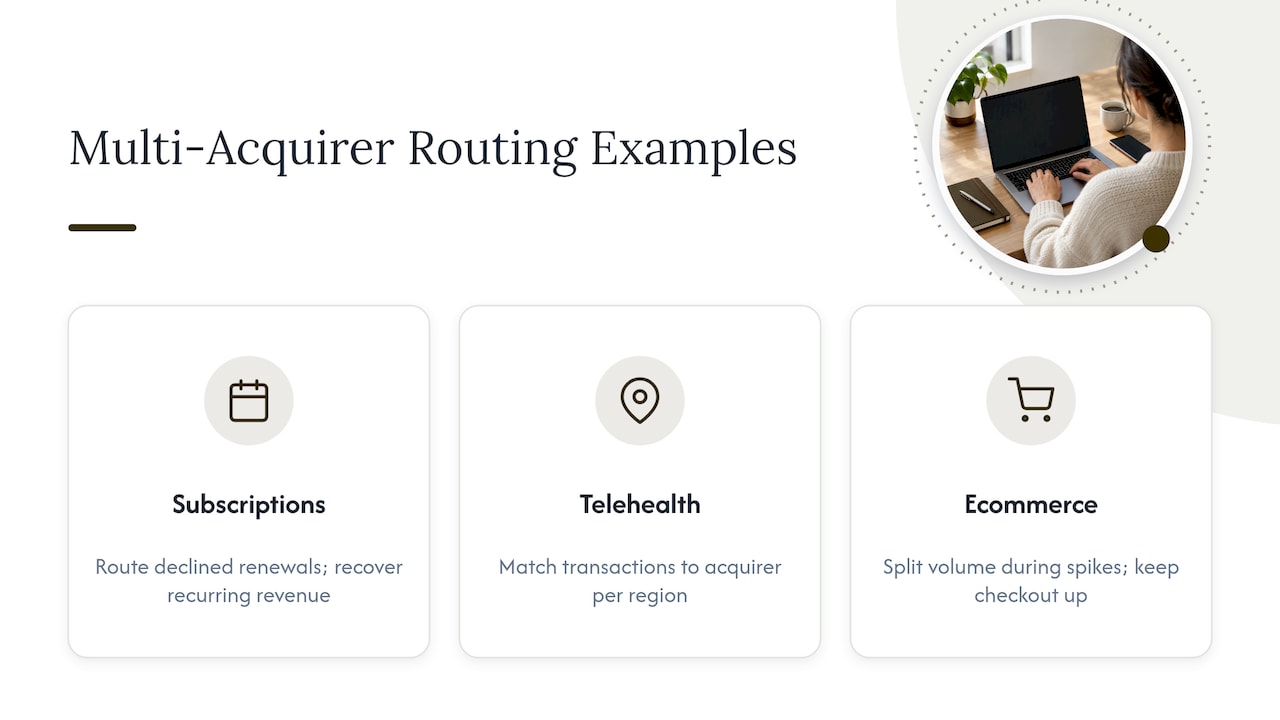
A subscription merchant processing recurring nutraceutical orders typically sees its highest decline rates on renewal attempts, where expired cards and issuer risk flags stack up. Routing a declined renewal to a second acquirer with a different issuer relationship recovers transactions that a single-acquirer setup would simply lose, directly protecting monthly recurring revenue.
A telehealth platform billing across multiple states faces a different problem: issuer risk tolerance varies by region, and one acquirer may decline transactions from certain states more aggressively than another. Routing by region lets the platform match each transaction to the acquirer most likely to approve it, rather than accepting a flat decline rate across the entire customer base.
An ecommerce brand running flash sales faces volume spikes that can push a single acquirer past its processing limits or trigger temporary holds. Splitting volume across two acquirers during peak periods keeps checkout available even when one processor throttles traffic.
Each of these examples shares a pattern: the acquirer that performs best changes by transaction type, region, or volume pattern, and no single acquirer wins every case. The measurable outcome is the same across verticals too: fewer false declines, steadier checkout uptime, and processing costs that reflect the best available rate per transaction rather than one negotiated rate applied everywhere.
Common Integration Hurdles and How to Clear Them
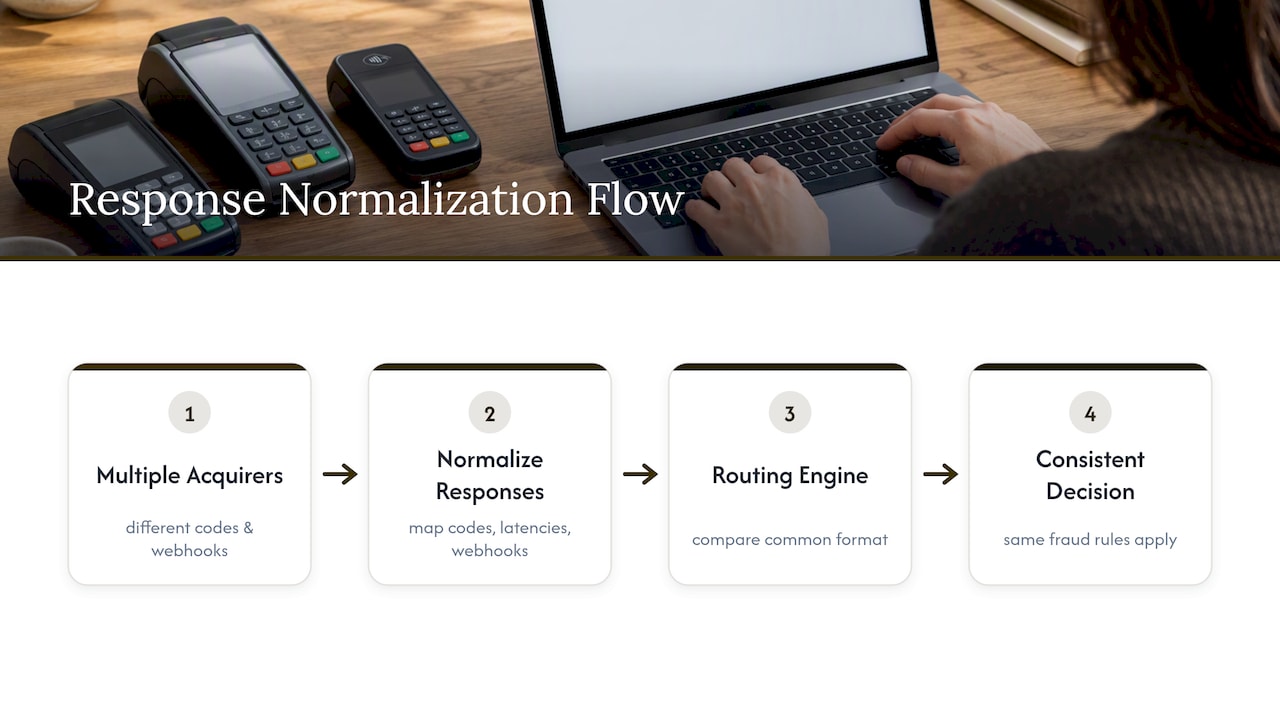
Most integration problems trace back to one of three sources: inconsistent data formats between acquirers, reconciliation systems built for a single settlement stream, and fraud rules that don’t travel with the transaction.
Acquirers return different decline codes, different latency profiles, and different webhook formats, so your routing engine needs a normalization layer that translates each acquirer’s response into a common format before your logic can compare them fairly. Skipping this step leads to routing decisions based on incomplete or mismatched data.
Reconciliation breaks the moment a second settlement stream appears, since most accounting systems were built assuming one processor and one deposit schedule. The fix is a settlement mapping layer that ties every transaction’s trace-id through to its specific acquirer’s settlement batch, so finance can close the books without manually matching line items across statements.
Fraud rules often live inside a single PSP’s dashboard, which means a rule you built for one acquirer simply doesn’t apply when a transaction routes elsewhere. Centralizing fraud logic in the orchestration layer, rather than inside each acquirer’s own tools, keeps your risk posture consistent no matter where a transaction lands.
Legacy systems built around a single processor integration are the hardest constraint to work around. Teams that plan for multi acquirer routing from the start build an abstraction layer between their checkout and their acquirers, which makes adding a second or third acquirer later a configuration change instead of a rebuild.
Understanding Fee Structures Across Multiple Acquirers
Each acquirer sets its own pricing, and the structure typically includes interchange fees set by the card networks, an acquirer markup, and a gateway or processing fee layered on top. Interchange rates vary by card type, transaction method, and merchant category code, which is the same across acquirers, but the markup and gateway fee on top of it is where acquirers differentiate.
Routing purely for cost means weighting decisions toward the acquirer with the lowest combined markup and gateway fee for a given transaction type, as long as approval odds are comparable. The complexity comes from the fact that the cheapest acquirer for a $20 transaction may not be the cheapest for a $500 transaction, since markup structures often scale differently by ticket size.
High-risk verticals add another layer: acquirers that accept supplements, telehealth, or subscription billing typically charge higher markups and may require reserves to offset chargeback risk. Comparing fee structures across acquirers without accounting for reserve requirements and chargeback fee schedules gives an incomplete picture of true cost per transaction.
Reconciliation costs belong in this calculation too. Running multiple settlement streams means more hours spent matching deposits to transactions, and that operational cost should factor into any real comparison between a single-acquirer setup and a routed one.
Where Multi Acquirer Routing Is Headed
Routing logic is shifting from static rule lists toward models that score approval probability per acquirer in real time, adjusting as acceptance patterns change rather than waiting for a manual rule update. This matters most for high-risk merchants, where issuer risk tolerance can shift quickly and a rule written last quarter may already be stale.
Orchestration platforms are also extending beyond card payments to route across alternative payment methods and local payment rails, giving merchants a single routing layer for cards, ACH, and region-specific methods instead of separate systems for each. Expect reconciliation tooling to keep pace, since multi-rail routing only works operationally if settlement mapping can handle every payment type in one place.
Fraud scoring is moving toward shared signals across acquirers, where a decline or fraud flag at one acquirer informs the routing decision for the next attempt rather than treating each acquirer as an isolated system. That kind of cross-acquirer intelligence is what closes the detection gaps that come from running fraud rules in silos.
None of these shifts change the fundamentals: the merchants who benefit most are still the ones with enough volume and enough operational discipline to act on what the routing engine tells them.
A Practitioner’s View on What Actually Breaks
The pitfalls we see most often aren’t technical. They’re operational: fraud rules that drift out of sync between acquirers, onboarding delays that stall a pilot before it starts, and reconciliation mismatches that surface weeks after go-live instead of on day one. Telehealth and supplement merchants feel this hardest, since compliance requirements compound the routing complexity. A realistic onboarding timeline runs from initial underwriting through live connector testing, and the merchants who move fastest are the ones who map their reconciliation process before their first routed transaction, not after.
— Peter
How DavinciPay Supports Merchants Building a Routing Strategy
Running multi acquirer routing well means managing acquirer relationships, underwriting, and connector setup at the same time, which is a heavy lift for an internal team already stretched thin. We handle that work directly for high-risk and complex merchants, bringing established acquiring relationships, underwriting support, and managed orchestration setup so you don’t have to build it from scratch.

- We bring domestic and international acquiring relationships built for high-risk categories.
- We handle underwriting and connector setup to simplify negotiations with multiple acquirers.
- We provide ongoing support and fraud tooling to maintain consistency as processing volume grows.
If your decline rate or processor concentration risk has you considering a change, a managed partner makes sense when you’d rather focus engineering time elsewhere. Apply now to start the conversation about your high-risk payment processing setup.
FAQ
What are the top payment processors for high-risk merchants?
The right processor depends on your vertical, since high-risk categories like telehealth, supplements, and subscription billing each need acquirers with specific risk tolerance and compliance experience. Rather than a single best option, most high-risk merchants work with a processor that specializes in their category and can place them with acquirers suited to that risk profile.
Can a business use multiple acquiring bank relationships at once?
Yes, merchants commonly maintain relationships with more than one acquiring bank, which is the foundation of multi acquirer routing. Running multiple relationships lets a business split volume, improve approval rates, and avoid relying on a single bank for all processing.
What does “acquirer” mean in payment processing?
An acquirer is the bank or financial institution that processes card payments on behalf of a merchant, moving funds from the card network to the merchant’s account. Acquirers differ in risk appetite, pricing, and which merchant categories they’re willing to support.
What are the main types of payment methods merchants accept?
The most common categories are card payments (credit and debit), bank transfers like ACH, digital wallets, and buy-now-pay-later options. Multi acquirer routing applies most directly to card payments, though orchestration platforms increasingly route across other methods too.
How does Regulation II affect debit card routing decisions?
Regulation II requires that debit card transactions be able to route through at least two unaffiliated networks, and it prohibits issuers or networks from restricting a merchant’s ability to direct that routing. Payment teams building routing logic need to confirm which transactions are debit cards subject to this requirement.


.webp)
