.png)
Diversify your merchant services portfolio across five operational dimensions — acquirers/sponsors, gateways and payment rails, merchant verticals, geographies, and risk tiers — you reduce the concentration risk that suppresses valuation multiples and creates continuity failures. The single most important action you can take right now: run a portfolio concentration snapshot before your next stakeholder meeting.
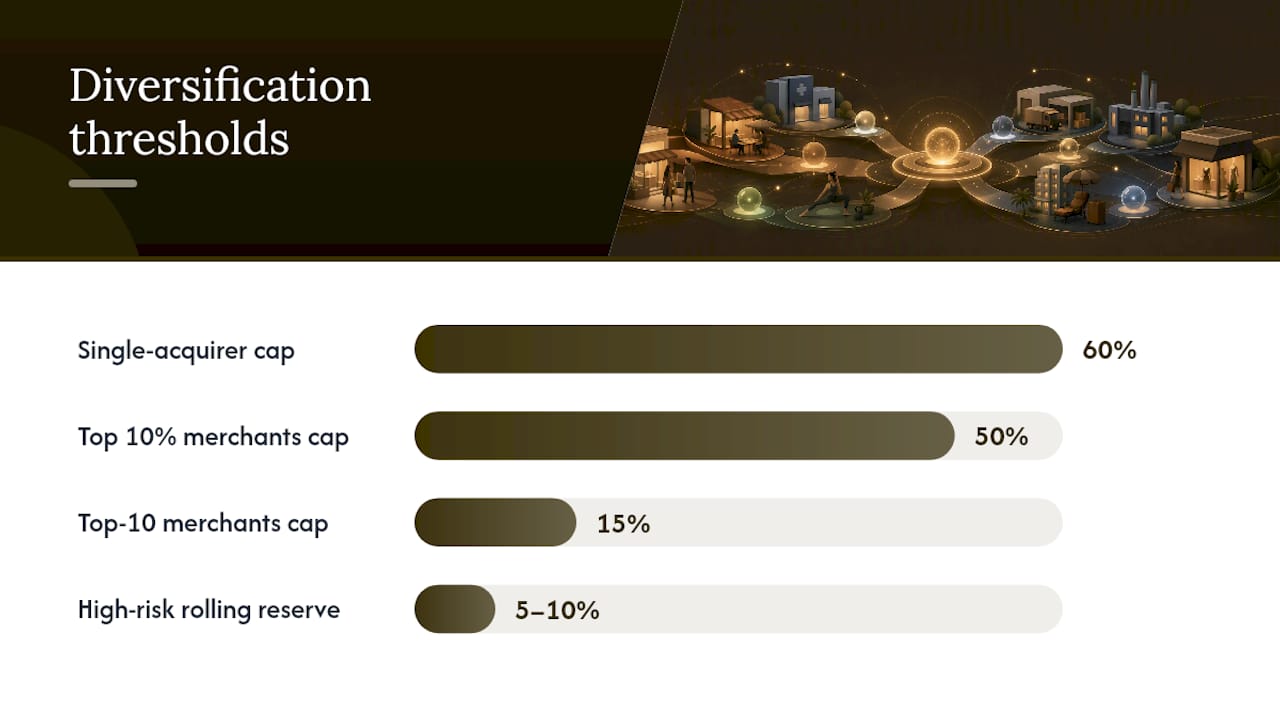
- Map your top-10 merchants by residual revenue share (institutional benchmarks from The Green Sheet recommend top-10 merchants should represent less than 15% of total residual revenue, and top 10% of merchants less than 50%)
- Identify processor concentration: how many of your merchants settle through a single underlying acquirer
- Present findings with a recommended diversification roadmap tied to valuation impact
Pro Tip: Davincipay works with ISOs and payment facilitators to structure multi-acquirer relationships and vertical-specific underwriting for high-risk ecommerce merchants — a practical starting point if your snapshot reveals heavy concentration.
Table of Contents
- How do you build a step-by-step diversification playbook?
- What should you check before adding a new acquirer or gateway?
- Which KPIs should you monitor to keep a diversified portfolio healthy?
- How do you plan a merchant migration without disrupting settlement?
- What does a diversification project actually cost and how long does it take?
- How does Davincipay implement diversification for high-risk merchants?
- Key Takeaways
- When diversification is the wrong answer
- Davincipay helps you build a diversified, high-risk merchant portfolio
- Useful sources for further reading
How do you build a step-by-step diversification playbook?
Prioritize actions by valuation impact first, then by ease of implementation. That sequencing keeps your stakeholder case clean and your team focused.
- Portfolio discovery and segmentation. Pull concentration reports by merchant, vertical, and acquirer. Identify your top-10 revenue contributors and flag any single acquirer handling more than 60% of volume.
- Update underwriting templates per vertical. Add vertical-specific fields: product category, subscription model, refund policy, chargeback history, and regulatory status. Tailored onboarding and comprehensive risk assessments are core to handling high-risk merchants without downstream compliance events.
- Build tiered pricing and reserve structures. Assign reserve requirements by risk tier, not by portfolio average. High-risk verticals like nutraceuticals warrant rolling reserves of 5–10%; lower-risk digital services may need none.
- Productize by vertical. Package underwriting, gateway configuration, chargeback tooling, and reporting as a vertical-specific offering. High-risk verticals carry higher margins and retention when you build 2–3 deep processor relationships, maintain concentration benchmarks — top-10 merchants below 15% of residual revenue, top 10% below 50% — and deploy monitoring technology to support them.
- Configure technical routing and orchestration. Set your primary acquirer to handle 90–95% of production volume, with automated failover to your secondary for declines or outages. Deploy orchestration only after the secondary relationship is underwritten and live.
Pro Tip: Ask prospective sponsors three questions before signing: What is your exit notice period? Do you share underwriting with other ISOs on this program? What is your remediation process if a merchant exceeds scheme thresholds?
What should you check before adding a new acquirer or gateway?
Demand independently underwritten acquiring relationships and written SLAs confirming separate underwriting and settlement before signing any new partner agreement.
Due diligence checklist:
- Confirm the acquirer holds its own BIN and settles independently — not through a shared underlying bank
- Review underwriting policy alignment with your vertical mix (especially for regulated categories)
- Check MATCH list and MID-sharing policies
- Verify E&O and cyber insurance coverage
- Confirm program monitor assignments and escalation contacts
- Review exit and termination clauses, including reserve release timelines
- Validate onboarding timelines and technical integration footprint (API documentation, sandbox availability)
Red flags to walk away from:
- Multiple PSPs sharing the same underlying acquirer (this is multi-MID, not multi-acquirer)
- Vague or discretionary reserve policies with no written release schedule
- Single-point-of-failure settlement routing with no documented failover
- Limited or undocumented reporting APIs
- Weak sponsor monitoring processes that do not align with ETA ISO sponsoring guidelines
Which KPIs should you monitor to keep a diversified portfolio healthy?
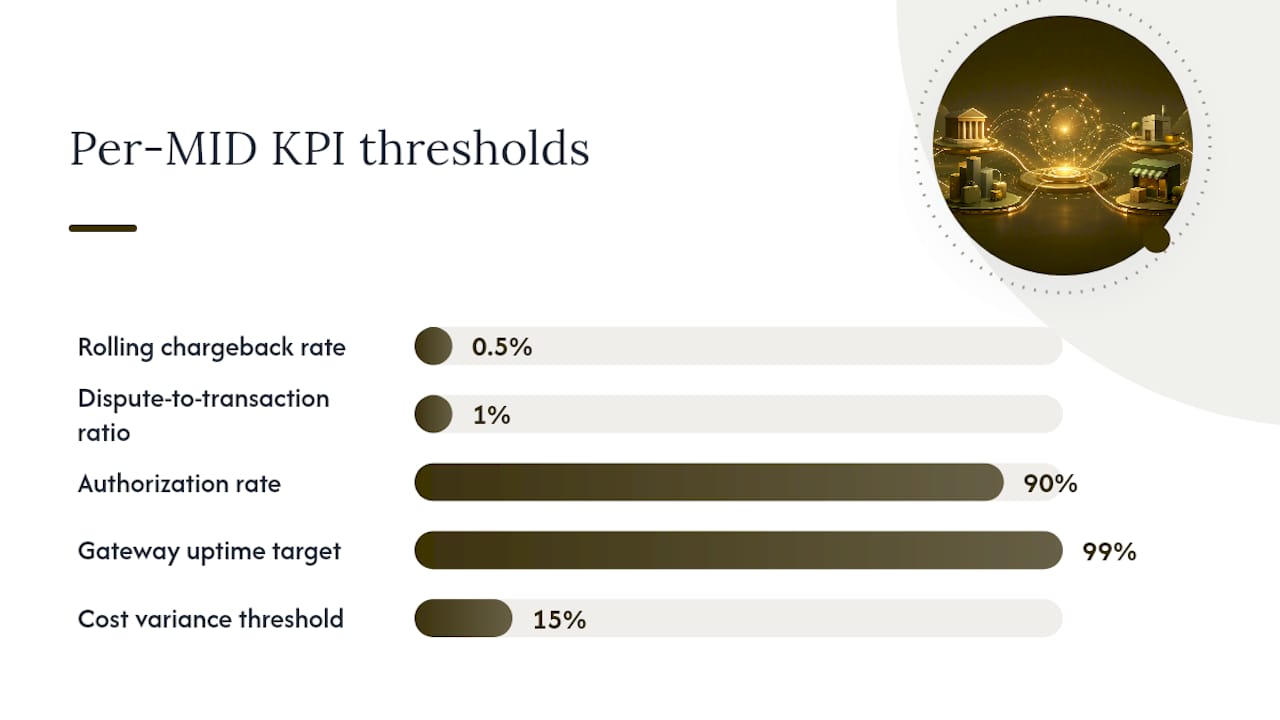
Monitor per-MID KPIs and enforce per-MID controls rather than relying on portfolio-wide aggregation. Aggregation masks problems until they become scheme violations.
| KPI | Alert Threshold | Action Trigger |
|---|---|---|
| Rolling chargeback rate (Visa/MC) | >0.5% (buffer below ECM entry at ~1%) | Merchant review and dispute mitigation plan |
| Authorization rate by acquirer | <90% sustained over several days | Routing review and issuer outreach |
| VAMP ratio | Approaching scheme program entry | Immediate merchant-level investigation |
| Dispute-to-transaction ratio | >1% per MID | Reserve increase and underwriting reassessment |
| Uptime/latency per gateway | >99% target; alert at <98% | Failover activation and vendor escalation |
| Cost per transaction by acquirer | Variance >15% from baseline | Renegotiation or routing rebalance |
Policy checklist (ETA-aligned):
- Conduct periodic merchant reviews on a documented schedule (monthly for high-risk MIDs, quarterly for standard)
- Maintain written remediation steps and escalation paths for each threshold breach
- Document all ISO monitoring activities per ETA guidance requirements
- Run independent monitoring rhythms separate from merchant self-reporting
How do you plan a merchant migration without disrupting settlement?
Always plan migration as a staged, measured program with merchant consent and clear SLA terms in writing before any credential or routing change.
- Obtain record-of-consent from each merchant before initiating any MID or gateway change
- Draft a technical test plan covering BIN testing, issuer acceptance, and batch settlement validation
- Run a parallel settlement window (minimum 5 business days) to confirm no mismatch before cutover
- Validate credential portability: confirm tokenization, stored payment methods, and subscription billing continuity
- Define explicit rollback triggers before go-live: settlement mismatch, authorization degradation below 80%, or unexplained decline spikes
- Communicate timeline and contact points to merchants in writing
Merchant communication outline:
- Subject: Your payment processing is being upgraded
- Body points: what is changing, why it benefits them, the exact cutover date, who to contact with questions, and confirmation that no action is required on their end
Pro Tip: Route 90–95% of volume to your primary acquirer post-migration and measure challenger acquirer performance after 60 days of live history before increasing its share.
Signed SLAs and fall-back routing rules in your gateway or orchestration layer are non-optional. Without them, a settlement dispute has no contractual resolution path.
What does a diversification project actually cost and how long does it take?
Expect multi-acquirer diversification to take 8–16 weeks per new acquiring relationship and require budget across four cost categories.
| Cost Category | Typical Scope |
|---|---|
| Underwriting and legal | Sponsor agreements, program terms, compliance review |
| Integration and engineering | API build, gateway configuration, testing environment |
| Reserve and working capital | Rolling reserves, chargeback holdbacks per new acquirer |
| Monitoring tooling | Reporting dashboards, alert configuration, dispute management |
ROI KPIs to present to executives:
- Authorization lift from routing optimization (measure per acquirer, not portfolio average)
- Recovered revenue from failover routing during outages or declines
- Reduction in single-acquirer volume concentration (target: no single acquirer above 60%)
- Valuation uplift signals: maintain top-10 merchants below 15% of total residuals and top 10% of merchants below 50%, per institutional benchmarks.
A multi-account banking structure that mirrors your multi-acquirer setup also strengthens treasury resilience and simplifies reserve management across relationships.
How does Davincipay implement diversification for high-risk merchants?
Davincipay uses multi-acquirer relationships, vertical productization, and integrated orchestration to reduce continuity risk for high-risk and regulated ecommerce merchants.
Capabilities Davincipay brings to a diversification project:
- Domestic and international acquiring relationships, independently underwritten
- Vertical-specific underwriting support for nutraceuticals, telehealth, supplements, subscription commerce, and digital services
- Gateway orchestration with failover routing configuration
- Chargeback mitigation tooling and dispute management workflows
- Real-time reporting by MID, vertical, and acquirer for per-segment KPI monitoring
- ACH support, recurring billing management, and age/compliance controls for regulated categories
Merchants in supplements and nutraceuticals or telehealth who need specialized underwriting and multi-acquirer continuity can start the process at Davincipay.
Key Takeaways
Effective merchant services portfolio diversification requires independent acquirer relationships, per-MID monitoring, and vertical productization — not just multiple MIDs under one bank.
| Point | Details |
|---|---|
| Concentration benchmarks matter | Top-10 merchants should represent less than 15% of total residual revenue; top 10% of merchants should represent less than 50%, per institutional analysis. |
| Multi-acquirer means independent underwriting | Multiple PSPs sharing one underlying bank do not eliminate acquirer concentration risk. |
| Sequence relationships before technology | Secure a second underwritten acquirer before deploying routing or orchestration software. |
| Monitor per-MID, not portfolio-wide | Aggregated KPIs mask chargeback and dispute problems until they become scheme violations. |
| Davincipay as a diversification partner | Davincipay provides multi-acquirer relationships, vertical underwriting, and orchestration for high-risk ecommerce merchants. |
When diversification is the wrong answer
Diversification is not always the right lever. Cost, merchant size, and marginal valuation impact all matter before you commit engineering and capital resources to a second acquirer relationship.
The case for selective consolidation is real. If your portfolio is under $2M in annual residuals, the overhead of managing two independently underwritten acquiring relationships — separate compliance reviews, separate reserve accounts, separate monitoring rhythms — may exceed the valuation benefit. In that range, technology entrenchment (getting merchants onto integrated billing, reporting, or compliance tools) often delivers a stronger valuation signal than acquirer count alone.
The scenarios where consolidation beats diversification:
- Your merchant base is small and stable, with low chargeback rates and no single-vertical concentration
- You are pre-acquisition and a buyer has already indicated they will consolidate onto their own acquiring infrastructure
- Your second acquirer candidate shares the same underlying bank as your primary (adding it creates paperwork, not resilience)
- Your team lacks the monitoring capacity to run per-MID controls across two acquirer programs simultaneously
The right test is an A/B migration pilot: move a defined merchant segment to a secondary acquirer for 60 days, measure authorization rates, dispute ratios, and cost per transaction, then decide whether the economics justify full rollout. That data is far more persuasive to stakeholders than a theoretical diversification argument.
Davincipay helps you build a diversified, high-risk merchant portfolio
High-risk merchants in nutraceuticals, telehealth, subscription commerce, and digital services need more than a single acquiring relationship. They need vertical-specific underwriting, chargeback controls, and a gateway setup that keeps processing live when one acquirer tightens terms. That’s exactly what Davincipay delivers.

Davincipay provides domestic and international acquiring relationships, underwriting support tailored to regulated ecommerce categories, and orchestration configuration that routes volume intelligently across acquirers. No generic merchant account. No single point of failure. If your portfolio snapshot shows concentration risk, the next step is a conversation with a team that has already solved this problem for merchants in your verticals.
Apply now to start the underwriting process, or review Davincipay’s full capabilities at davincipay.ai.
Useful sources for further reading
The ETA guidelines and institutional valuation analysis are the two priority sources for any team building or auditing a diversification program.
- The Green Sheet :: E-Magazine
- Guidelines for Sponsoring and Monitoring of Independent Sales Organizations (ISOs) (ETA)
- Multi-Acquirer Strategy for High-Risk Merchants (2026)
- High-Risk Merchant Processing: Why ISOs Are Leaving Money on the Table | Twill
- Handling High-Risk Merchants as an ISO - The Event Within


.webp)
