.png)
Merchant chargeback liability means this: when a cardholder disputes a transaction, the money leaves your account first and you have to prove you deserve to keep it. For most card-not-present sales, that liability sits with you by default. It only shifts to the issuing bank when you have used an available authentication tool, like 3D Secure, and that authentication actually succeeded.
Two things change your odds immediately:
- Turn on strong authentication for card-not-present transactions wherever your checkout flow supports it.
- Keep transaction records, shipping confirmations, and customer communications organized before a dispute ever lands, not after.
Everything else in chargeback management builds on those two habits.
Key Takeaways
Merchant chargeback liability defaults to the seller for card-not-present sales unless successful authentication, like 3D Secure, shifts it to the issuer.
| Point | Details |
|---|---|
| Liability defaults to you | Card-not-present sales stay your responsibility unless authentication succeeds and shifts it to the issuer. |
| Match evidence to reason codes | A rebuttal letter tied directly to the dispute’s reason code wins more often than generic documentation. |
| Deadlines are non-negotiable | Missing a network’s presentment or arbitration deadline typically ends your case regardless of evidence quality. |
| Costs stack beyond the refund | Fees, lost goods, unrefunded processing costs, and staff time push the real cost well past the sale price. |
| Prevention outperforms disputing | Authentication, clear descriptors, and subscription notices stop chargebacks before they start. |
| Specialized processing helps high-risk sellers | Davincipay pairs high-risk merchants with underwriting and fraud tools built for their actual dispute patterns. |
Table of Contents
- Understanding Chargeback Liability: Who’s Involved and Why
- How Liability Shifts: 3D Secure, EMV, and the Exceptions That Trip Up Online Sellers
- Chargeback Lifecycles, Reason Codes, and the Deadlines That Decide Everything
- The Real Cost of a Chargeback Goes Well Beyond the Refund
- Reducing Chargebacks Starts Before the Sale, Not After
- Building a Representment Case That Actually Wins
- Why Specialized Payment Partners Matter for High-Risk Verticals
- What the Data Actually Tells Merchants to Prioritize
- How Davincipay Reduces Your Chargeback Exposure
- Frequently Asked Questions
- Sources
Understanding Chargeback Liability: Who’s Involved and Why
A chargeback started as a consumer-protection tool: a way for cardholders to reverse a charge without having to sue a merchant over a bad transaction. That original purpose still shapes how the system works today, and it explains why the process favors the cardholder from the first step.
Four parties sit inside every dispute:
- The cardholder, who contacts their bank to contest a charge.
- The issuing bank, which reviews the claim and decides whether to accept it.
- The acquiring bank, which processes payments on the merchant’s behalf and receives the dispute notification.
- The card network (Visa, Mastercard, American Express, Discover), which sets the rules everyone else has to follow.
The sequence matters more than most merchants realize. The issuer often grants the cardholder a provisional credit almost immediately, before your side of the story gets heard. The acquirer then notifies you of the dispute, and the disputed amount gets pulled from your account. You are financially out the money before you have submitted a single piece of evidence. That is why merchants bear most of the financial risk in this system, and why representment, not prevention alone, has to be part of your playbook.
How Liability Shifts: 3D Secure, EMV, and the Exceptions That Trip Up Online Sellers
Card networks built liability-shift rules to reward merchants who adopt stronger security. For in-person transactions, an EMV chip read shifts counterfeit-fraud liability to the issuer. Skip the chip, swipe the stripe instead, and you keep that liability yourself.
Online sellers work with a different tool: 3D Secure. When you route a card-not-present transaction through 3DS and the cardholder completes authentication successfully, the issuer generally absorbs the fraud loss instead of you.
That protection has real limits, though:
- Mail order and telephone orders (MOTO) typically fall outside 3DS entirely, leaving the merchant on the hook.
- Subsequent recurring charges on a subscription, after the first authenticated payment, usually do not carry the same shifted liability.
- Failed or abandoned authentication attempts often default the transaction back to standard merchant liability.
One of the clearest patterns in the data: friendly fraud has grown substantially in recent years, and Visa’s own research finds that prevention through stronger authentication outperforms fighting disputes after the fact.
For subscription and recurring-billing merchants, this creates a real gap. Your first charge might be protected. Your fifth renewal charge, months later, probably is not. That is worth building into how you think about subscription risk from day one.
Chargeback Lifecycles, Reason Codes, and the Deadlines That Decide Everything
Every dispute arrives tagged with a reason code, and that code tells you exactly what the issuer needs to see to rule in your favor. Treat every dispute the same way and you will lose cases you should have won.
The major categories break down like this:
- Fraud codes (“card not present, unauthorized”), which need authorization logs, IP data, and device fingerprints.
- Goods not received, which need tracking numbers, delivery confirmation, and signatures.
- Not as described, which need product listings, order confirmations, and customer service correspondence.
- Processing errors, like duplicate charges or incorrect amounts, which need billing records showing the charge was accurate.
Timelines are strict and network-specific. Visa and Mastercard generally give merchants a matter of weeks to respond to the first presentment, and Mastercard’s own chargeback guide lays out separate windows for presentment, pre-arbitration, and arbitration, each with its own paperwork requirements. American Express runs a similar structure with its own deadlines. Miss the window and you lose by default, regardless of how strong your evidence actually is.
The fix isn’t more documentation. It’s the right documentation, matched to the specific reason code you’re fighting.
The Real Cost of a Chargeback Goes Well Beyond the Refund
A single chargeback rarely costs you just the sale price. Stack up the components and the total climbs fast: the chargeback fee itself, the lost merchandise, the processing fee you already paid and will not get back, shipping costs, staff hours spent gathering evidence, and, if you escalate, arbitration fees on top of all of it.
Industry data on the true cost of chargebacks puts the all-in multiplier well above the original transaction amount once every line item is counted.
There’s a second, quieter cost that catches merchants off guard: chargeback ratio monitoring. Visa and Mastercard both track your dispute rate as a percentage of total transactions, and cross a threshold, and you land in a monitoring program. That typically means:
- Higher per-transaction fees imposed by your acquirer.
- Additional reserve requirements holding back a portion of your revenue.
- In severe cases, termination of your merchant account entirely.
A high chargeback ratio doesn’t just cost you individual disputes. It puts your entire processing relationship at risk.
Reducing Chargebacks Starts Before the Sale, Not After
Prevention beats representment on cost and on your time, every time. Here’s the sequence that actually moves the needle:
- Deploy 3D Secure on card-not-present transactions wherever your gateway supports it, understanding it protects new authenticated charges, not every future renewal.
- Layer in fraud-detection tools, including device fingerprinting, IP geolocation checks, and velocity rules that flag unusual order patterns before you ship.
- Fix your billing descriptor. A confusing line item on a bank statement is one of the most common triggers for “I don’t recognize this charge” disputes, and it is entirely within your control.
- Send clear post-sale receipts that include your cancellation and return policy, plus customer service contact information, right in the email.
- Give subscription customers advance notice before recurring charges, especially the first renewal after a trial period.
- Hold fulfillment for manual review on orders that trip multiple fraud signals at once, like a new account, a rush shipping request, and a billing address that does not match the shipping address.
Pro Tip: Route your highest-risk order segments, first-time customers on rush shipping paying with a new card, through manual review before you ship. That single rule catches a disproportionate share of fraud before it ever becomes a chargeback.
Building a Representment Case That Actually Wins
Your evidence has to answer the specific question the reason code is asking, not just prove you are an honest business. For fraud claims, submit authorization codes, AVS and CVV match results, and device or IP data tying the order to a legitimate session. For “goods not received,” submit tracking numbers, delivery timestamps, and signature confirmation where available. For “not as described,” submit the product listing as it appeared at checkout alongside any support tickets.

Write your rebuttal letter as a direct response to the reason code, referencing each piece of evidence by name rather than attaching a folder of documents and hoping the reviewer connects the dots. Escalating to arbitration costs real money, so weigh the arbitration fee against your realistic odds of recovery before you commit to that step.
Why Specialized Payment Partners Matter for High-Risk Verticals
Merchants selling supplements, telehealth services, subscriptions, or other regulated products often face chargeback rates well above the retail average, simply because of how those industries get flagged by issuers. A specialized processing partner brings:
- Acquirer relationships built specifically for high-risk categories, rather than a generalist bank likely to shut you down at the first ratio spike.
- Fraud tools and chargeback mitigation workflows tuned to your vertical’s actual dispute patterns.
- Underwriting that accounts for your business model up front, instead of treating every recurring charge as a red flag.
If your chargeback ratio is climbing or your current processor is vague about liability terms, that’s usually the signal to look at specialized routing.
What the Data Actually Tells Merchants to Prioritize
Most chargeback advice treats prevention and representment as equally important. They are not. The research is consistent on this point: authentication and documentation prevent disputes from happening, while representment only recovers money after you have already absorbed the operational cost, the staff hours, and the ratio hit. Winning a dispute after the fact is damage control, not a strategy.
The conventional wisdom oversells 3D Secure as a blanket fix. It protects the transaction it authenticates. It does not protect your third subscription renewal, your MOTO orders, or a customer who claims the item didn’t match the listing. Merchants who treat 3DS as a complete solution get blindsided by the categories it never covered.
If you take one thing from this, prioritize matching evidence to reason codes over generic documentation habits. A representment case built around what the specific reason code demands wins more often than a thick folder of loosely related paperwork. That discipline, paired with authentication at checkout, does more for your chargeback ratio than any single tool you could buy.
How Davincipay Reduces Your Chargeback Exposure
Davincipay is built specifically for merchants who carry elevated chargeback risk, ecommerce brands, subscription businesses, telehealth providers, and nutraceutical sellers, where a generalist processor tends to overreact to normal dispute volume.

Instead of a one-size-fits-all merchant account, Davincipay pairs you with acquiring relationships that understand your vertical, layers in fraud prevention and chargeback mitigation tools built for card-not-present risk, and structures underwriting around your actual business model rather than a generic risk score. If your dispute ratio is climbing or your current processor keeps threatening a monitoring program, that’s the moment to look at specialized routing instead of waiting for a shutdown notice. Merchants in telehealth and nutraceuticals face particularly sharp scrutiny on recurring billing, and the right underwriting partner changes how those disputes get handled from day one. Start by reviewing your current chargeback ratio and processing terms, then apply now for a consult on where your liability exposure actually sits.
Frequently Asked Questions
What is chargeback liability, in plain terms? It is the financial responsibility for a disputed transaction. For most online sales, that responsibility falls on you as the merchant unless you used authentication that shifted it to the card issuer.
Does 3D Secure guarantee I won’t be liable for a chargeback? No. It shifts liability only for the specific transaction it authenticates, and only when authentication succeeds. Later recurring charges on the same subscription typically are not covered by that same shift.
How long do I have to respond to a chargeback? It depends on the card network, but Visa, Mastercard, and American Express each set strict windows, often just a few weeks, for your first response. Check your Mastercard chargeback guide reference or your acquirer’s notice for the exact deadline on each case.
What happens if my chargeback ratio gets too high? You typically enter a card network monitoring program, which brings higher fees, added reserve requirements, and, in severe cases, termination of your merchant account.
Is it ever smarter to skip fighting a chargeback? Yes. If the dispute amount is small and arbitration fees would exceed your likely recovery, letting it go can cost less than escalating.
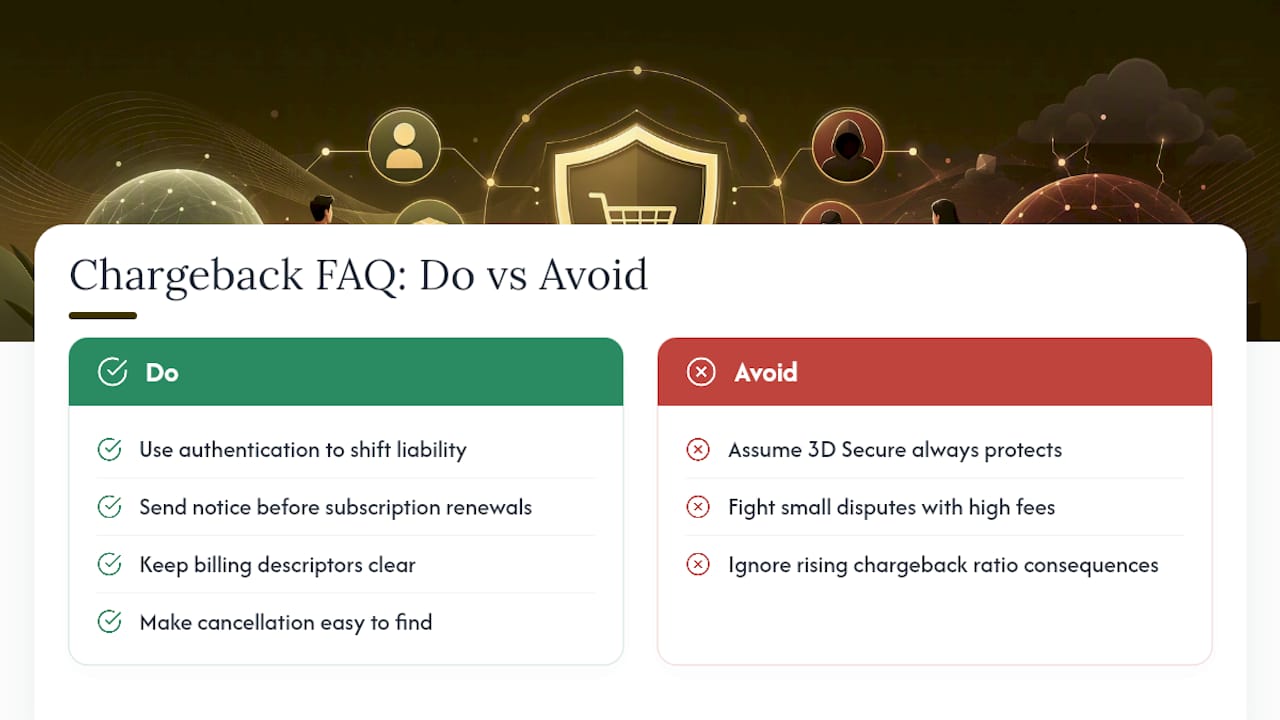
What’s the single best way to reduce chargebacks for a subscription business? Send advance notice before renewal charges, keep billing descriptors clear, and make cancellation easy to find, since confusion about a recurring charge is one of the most common dispute triggers.


.webp)
