.png)
Yes, U.S. lenders can accept loan repayments by card, but only with the right infrastructure behind it. That means acquirer sponsorship, proper underwriting, recurring-eligible tokenization, and compliance with card-network and supervisory guidance. The tradeoff is real: card rails typically improve borrower enrollment and cut delinquency compared to ACH, but they carry higher interchange costs and a different chargeback exposure than a bank-debit program.
TL;DR:
- Card repayment acceptance requires sponsorship, compliance, and proper underwriting to manage higher interchange costs and chargeback risks.
- Using cards for loan payments improves enrollment and reduces missed payments, especially for small loans or borrowers on autopay elsewhere.
- Ensuring BIN-level reliability and thorough dispute-response plans minimizes silent failures and revenue loss from merchant-initiated recurring charges.
- Settlement timing is slower than ACH, so accurate reconciliation and interest calculation based on actual settlement dates are critical for accounting.
- Partnering with specialized high-risk payment processors like DavinciPay streamlines onboarding and configures recurring billing to prevent silent payment failures.
Table of Contents
- Why Add Card-Based Loan Repayment?
- Compliance and Card-Network Rules US Lenders Must Follow
- Technical Options for Accepting Recurring Card Repayments
- Underwriting and Risk Controls for Card Repayment Programs
- Settlement, Reconciliation, and Back-Office Rules
- How DavinciPay Supports Card Repayment Programs for Lenders
- What Actually Matters in a Card Repayment Program
- Start Your Card Repayment Program the Right Way
- Sources
- FAQ
Why Add Card-Based Loan Repayment?
Borrowers set up card autopay faster than ACH autopay, mostly because card authorization happens in real time and ACH requires routing and account numbers that borrowers frequently mistype. That friction difference shows up directly in enrollment numbers, and enrollment is the single biggest lever a lender has over future delinquency.
Debit-first repayment strategies tend to reduce missed payments compared to ACH, according to Glenbrook Partners, largely because real-time authorization catches insufficient funds before the transaction posts instead of days later. ACH returns still have to be manually reprocessed, chased, and re-presented, which quietly eats collections staff time even when the sticker cost of ACH looks cheaper.
Card acceptance isn’t free, though. Interchange runs higher than ACH’s flat-fee model, and that gap matters more on larger loan balances. Here’s how lenders typically decide which rail to lead with:
- Small-dollar, high-frequency loans (payday-adjacent, short installment): debit-first usually wins on delinquency reduction alone.
- Larger installment or auto loans: ACH often stays primary, with card as a backup or catch-up payment option.
- Subprime or thin-file borrowers: card enrollment ease can outweigh the interchange premium.
- Borrowers already on autopay elsewhere: card-on-file tends to have fewer failed-payment retries than ACH.
Compliance and Card-Network Rules US Lenders Must Follow
Acquirers don’t hand out merchant accounts to lenders without oversight, and that oversight is the backbone of any card repayment program. Visa’s own guidance requires acquiring banks to register and continuously monitor any payment facilitator or marketplace model, maintain underwriting policies for sponsored merchants, and in higher-risk cases register those merchants as High-Risk Internet Payment Facilitators. Lending falls squarely into that higher-scrutiny bucket.
The OCC’s Merchant Processing booklet frames this from the supervisory side: merchant processing creates contingent liabilities for the acquiring bank, and settlement flows (often via Fedwire between issuers and card associations, and ACH for merchant credits) need controls around holds and fraud review before funds release. A written processing agreement with clear liability allocation is not optional paperwork. It’s the document that determines who eats a loss when a dispute goes wrong.
Chargeback timelines matter more in lending than in typical retail because loan repayments touch two overlapping frameworks: the card network’s dispute rules and, depending on the loan type, Truth in Lending Act and Electronic Fund Transfer Act protections around unauthorized transactions and error resolution.
A practical onboarding checklist should include:
- A signed processing agreement specifying chargeback liability and reserve terms.
- KYC/AML documentation consistent with the lender’s own regulatory obligations, not just the processor’s.
- Written authorization and consent language for recurring card debits, retained for the life of the loan.
- A reconciliation process that flags disputed transactions before they age into forced chargebacks.
Pro Tip: Build your chargeback response window into your servicing calendar, not just your compliance policy. Missing a 10 or 20 day network deadline because it lived in a PDF nobody checked is the single most avoidable dispute loss in card-based lending.
Technical Options for Accepting Recurring Card Repayments
Four decisions shape almost every card repayment build: how you tokenize, how you route authorization to settlement, whether you go hosted or API, and whether you sit under a payment facilitator or a direct acquirer.
- Tokenization, but the recurring-eligible kind. Standard tokenization protects card data at rest. It does not guarantee an issuer will approve a merchant-initiated recurring charge later. Some debit BINs allow a one-time purchase but flag or decline recurring debits from the same token, which is why a $0 or $1 verification charge can pass while the actual repayment fails weeks later, according to Introxl’s guidance on debit tokenization.
- Understand the authorization-to-settlement chain. Your gateway handles authorization and captures the token; the acquirer or processor handles clearing and settlement with the card networks. Your platform rarely touches the middle step directly, which is exactly why acquirer choice matters more than gateway choice for reliability.
- Pick hosted checkout, API orchestration, or a virtual terminal based on use case. Hosted checkout suits self-service borrower portals. API-based card-on-file billing suits automated recurring debits triggered by your loan management system. A virtual terminal covers keyed-in or phone-collected payments, common in collections calls.
- Choose payfac-sponsored or direct acquiring deliberately. A payfac model gets you live faster because the payfac absorbs some underwriting layers, but it also means the payfac assumes financial responsibility for your merchant account and can impose tighter reserves or velocity limits. Direct acquiring takes longer to underwrite but usually gives a mature lender more control over terms.
- Design for failure, not just success. Build retry logic that respects network rules on retry timing, send pre-debit notifications before large or first-time charges, and monitor for expiring tokens so a borrower’s autopay doesn’t silently lapse.
Underwriting and Risk Controls for Card Repayment Programs
Underwriting for a lending merchant runs through multiple layers, and each layer asks a slightly different question. The sponsor bank asks whether your business model creates acceptable contingent liability. The payment facilitator, if one is involved, asks whether your processing history and average ticket size fit its risk appetite. The platform layer checks your refund and chargeback ratios against network thresholds. Expect to submit processing statements, bank records, and a clear description of your loan products, and expect conditional approval terms rather than a flat yes.
BIN-level reliability deserves its own line item in your risk policy. Certain debit programs simply were not built for merchant-initiated recurring transactions, and pushing repayment through them produces silent failures that look like borrower error but are actually issuer policy. Lenders should maintain a blocklist for unreliable BIN ranges and re-verify tokenization behavior periodically, not just at initial signup.
The gap between “the card was tokenized successfully” and “the recurring charge will actually process” is where most card-repayment programs quietly bleed revenue. A successful $1 verification proves the card exists. It does not prove the issuer will honor a merchant-initiated debit six months from now.
Mitigation tools worth building into the program from day one:
- Rolling reserves sized to your actual chargeback history, not a generic industry default.
- Velocity caps on transaction count and dollar volume per borrower per period.
- A monitoring dashboard that flags rising decline or dispute rates before they trigger network scrutiny.
- A documented chargeback response workflow with assigned ownership, not an ad hoc email chain.
Settlement, Reconciliation, and Back-Office Rules
Card settlement doesn’t move at ACH speed or through the ACH network. Funds typically clear between the issuer and card association, and the acquirer nets settlement to your account, sometimes using Fedwire on the back end, per OCC guidance. That timing difference matters for a lender in a way it doesn’t for a typical retailer, because interest accrual and late-fee triggers are date-sensitive.
Build reconciliation around these steps:
- Map every settlement file line item to a specific loan account, not a batch total.
- Automate exception queues for partial refunds, reversed transactions, and split settlements so they don’t sit unresolved in a spreadsheet.
- Time your interest and late-fee calculations to the actual settlement date, not the authorization date, to avoid accounting mismatches that surface during audits.
Get this wrong and you’ll spend more staff hours untangling ledger discrepancies than you saved by adding card repayment in the first place.
How DavinciPay Supports Card Repayment Programs for Lenders
DavinciPay specializes in payment processing for high-risk and complex merchants, and lending fits that description more often than not. The work centers on domestic and international acquiring relationships, gateway integration, fraud prevention, chargeback mitigation, and underwriting support built for merchants that standard processors turn away.
Clients include telehealth companies, nutraceutical and supplement brands, subscription merchants, and other regulated or high-growth businesses that need payment infrastructure matched to their risk profile. Lenders sit in that same category: recurring billing, higher scrutiny, and a real need for an acquiring partner that understands the model instead of flagging it on sight.
Merchants can start the process through DavinciPay’s application page, which walks through the documentation and underwriting steps needed before onboarding. If your team is weighing card repayment against your current ACH setup, a direct conversation about your specific loan mix and volume will get you further than a generic FAQ ever could.
What Actually Matters in a Card Repayment Program
Most of the advice circulating about card-based loan repayment treats it as a checkout feature. It isn’t. It’s a risk decision wearing a payments costume, and the lenders who get burned are usually the ones who bolted card acceptance onto their servicing stack without touching underwriting or reconciliation.
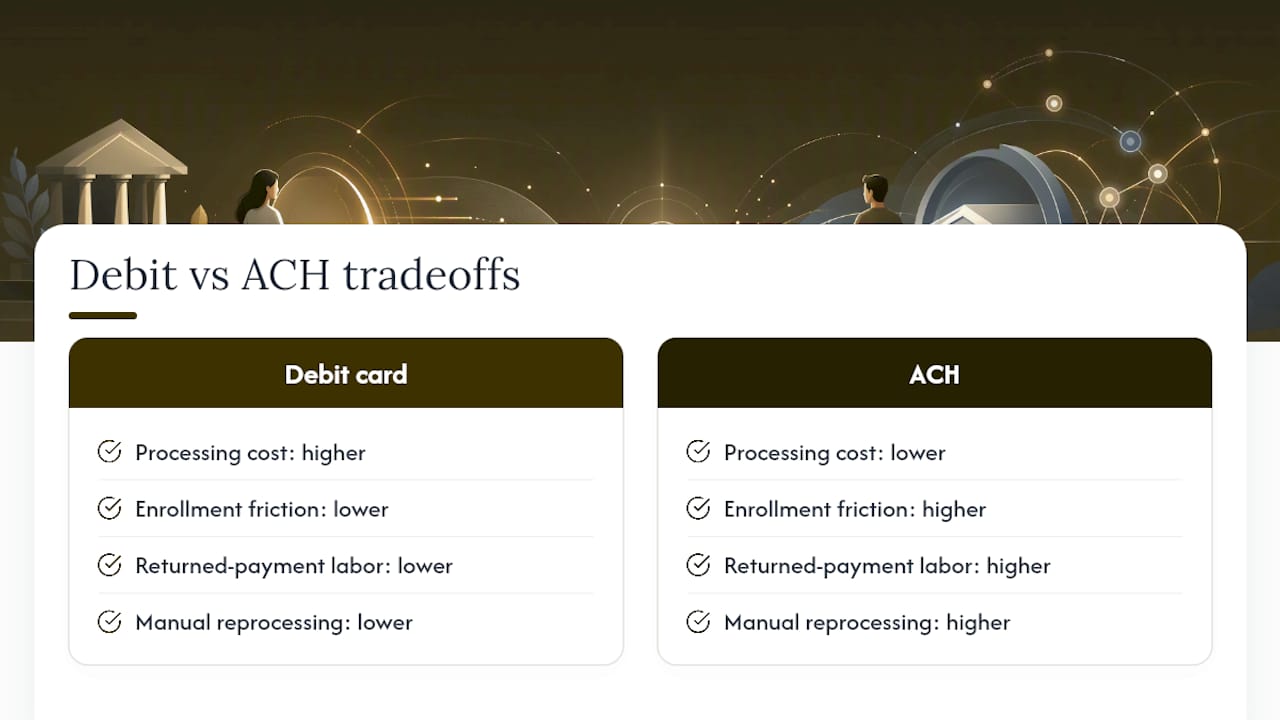
The conventional wisdom says debit is simply “cheaper enrollment, worse economics.” That’s backwards once you count the full cost of ACH: the returned-payment labor, the manual reprocessing, the delinquency that stacks up while a borrower’s ACH sits in limbo. Modeled end to end, debit frequently wins on real-world cost, not just borrower convenience.
Where lenders consistently underinvest is BIN-level reliability testing and dispute-response infrastructure. A $1 verification charge feels like due diligence. It isn’t. It tells you almost nothing about whether that same card will honor a recurring debit in month four.
Prioritize underwriting conversations and settlement reconciliation before you prioritize a slick borrower checkout page. The checkout page is the easy part.
— Peter
Start Your Card Repayment Program the Right Way
Adding card repayment without the right acquiring relationship is how lenders end up frozen mid-portfolio, and that’s exactly the gap DavinciPay closes. Instead of a generic processor that treats lending as an afterthought, DavinciPay builds underwriting, reserves, and dispute handling around what recurring loan repayment actually requires, with approvals that can move in as little as 24 hours once documentation is in.

Onboarding starts with a straightforward document review: processing history, average ticket size, and your loan product structure. From there, DavinciPay maps you to acquiring partners suited to lending risk instead of forcing your business into a generic ecommerce underwriting box, and helps configure tokenization and recurring billing so failed debits don’t quietly drain your portfolio.
If you’re weighing whether to add card rails to your servicing stack, start with the High-Risk Payment Processing overview, then apply directly through the merchant application to get a technical integration conversation on the calendar.
Sources
- Merchant processing, Comptroller’s Handbook (OCC)
- Visa: Payment facilitator and marketplace risk guide
- Loan repayment with debit cards, Glenbrook Partners white paper (2025)
- Why some debit cards should not be saved or tokenized for loan repayments (Introxl help)
FAQ
Can Lenders Legally Accept Loan Repayments by Card?
Yes, provided the lender works through a properly sponsored acquiring relationship with underwriting and compliance controls in place. Card-network guidance from Visa requires that sponsoring acquirers register and monitor any payment facilitator or platform handling recurring lending transactions.
Is Debit or Credit Better for Loan Repayment?
Debit is generally the stronger choice for automated repayment because real-time authorization catches insufficient funds immediately, which Glenbrook Partners links to lower delinquency versus ACH. Credit card repayment is technically possible but faces tighter network restrictions and higher dispute exposure.
Why Would a Tokenized Card Still Fail a Recurring Payment?
Some issuers approve a one-time charge on a card but block merchant-initiated recurring debits from the same token, a BIN-level policy that a standard $1 verification won’t reveal. Lenders should test and monitor BIN reliability rather than assume tokenization equals recurring approval.
How Does DavinciPay Help Lenders Set Up Card Repayment?
DavinciPay provides acquiring relationships, gateway integration, and underwriting support specifically for high-risk and complex merchants, including lenders, through its application process. Pricing and reserve terms are set during underwriting based on the lender’s processing history and loan mix.
What Happens When a Borrower Disputes a Card Repayment?
The dispute follows card-network chargeback timelines, and the lender’s processing agreement determines liability allocation between merchant and acquirer. Fast, well-documented refund policies and clear merchant descriptors reduce the odds a dispute escalates into a forced chargeback.


.webp)
