.png)
High ticket ecommerce payment solutions are specialized platforms built to handle large-value transactions securely, with high authorization rates and flexible customer payment options. Standard payment gateways fail merchants selling premium products because they cap transaction values, flag large orders as fraud, and offer no financing tools. The industry term for this category is “high-value payment processing,” and it covers everything from card-linked installments to payment orchestration across multiple acquiring banks. Card-linked installment solutions support transaction values up to $65,000, enabling merchants to offer interest-free payment plans over 3, 6, or 12 months without requiring new credit checks from customers. For ecommerce entrepreneurs in regulated or high-risk markets, getting this infrastructure right is the difference between consistent revenue and a frozen merchant account.
What are the essential features of high ticket ecommerce payment solutions?
The right payment infrastructure for large transactions goes well beyond accepting credit cards. These are the features that separate purpose-built solutions from generic gateways.
- High authorization rates. Top-tier processors achieve 96–98% domestic authorization rates and 93–97% cross-border rates. Those numbers matter because a 5% decline rate on a $10,000 order costs you real revenue, not just a failed transaction.
- Card-linked installment financing. Installment options tied to existing credit cards let customers split large purchases without applying for new credit. Merchants using installment plans see 3.1x higher average order values. That is not a marginal lift. It fundamentally changes what customers are willing to buy.
- Multi-currency and local payment method support. Merchants selling internationally need local payment methods, not just USD card processing. Accepting bank transfers, digital wallets, and region-specific methods reduces cart abandonment on cross-border orders.
- L2/L3 data enrichment. L2/L3 data passes additional transaction details, including tax amounts, shipping data, and purchase order numbers, to card networks. This lowers interchange fees and reduces disputes. Most standard gateways do not automate this submission.
- Tokenization and fraud management. Tokenization replaces sensitive card data with a unique identifier, reducing PCI scope. Combined with velocity checks and device fingerprinting, it keeps fraud rates low without blocking legitimate high-value orders.
Pro Tip: Request L2/L3 data enrichment capabilities specifically when evaluating any gateway. Many providers offer it as an add-on, not a default, and the fee savings on large B2B transactions can offset gateway costs entirely.
How do pricing models and transaction costs differ for premium ecommerce payments?

Pricing for high-value payment processing is not one-size-fits-all. The model you choose has a direct impact on your margins, especially at scale.
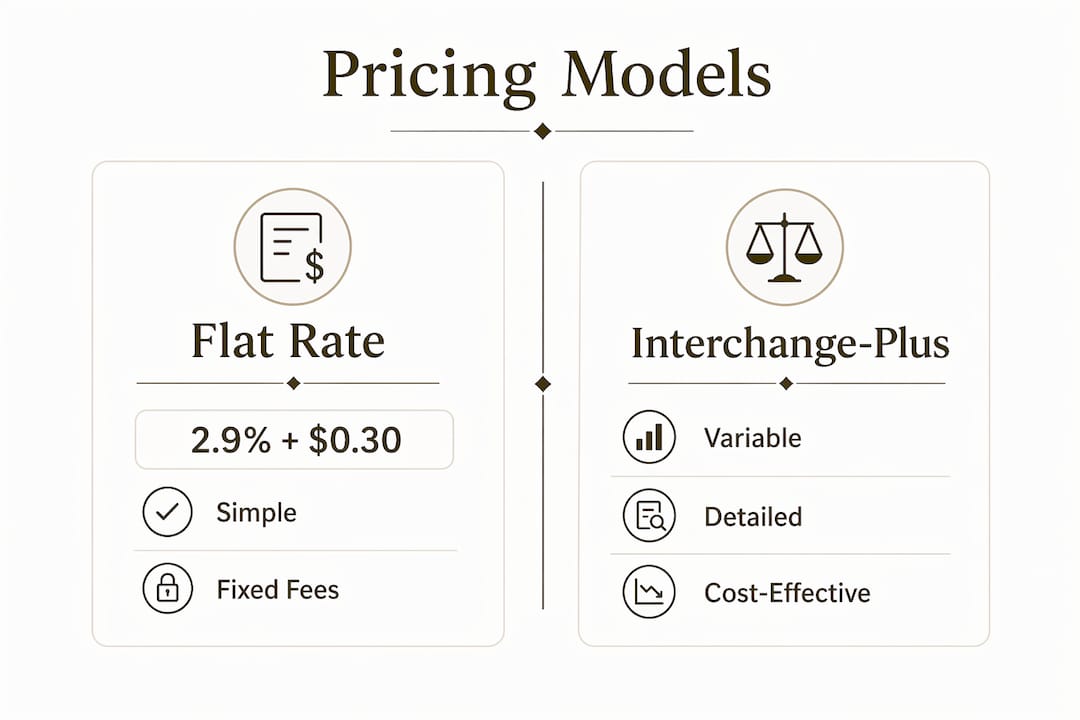
Standard U.S. card processing costs 2.9% + $0.30 per transaction. That rate works for low-volume merchants, but it becomes expensive fast. Interchange-plus pricing reduces effective rates to 1.8%–2.1% for merchants processing over $250,000 per month. On a $1 million monthly volume, that difference saves between $7,000 and $11,000 every month.
| Pricing Model | Typical Rate | Best For |
|---|---|---|
| Blended flat rate | 2.9% + $0.30 | Merchants under $250K/month |
| Interchange-plus | 1.8%–2.1% effective | Merchants over $250K/month |
| Tiered pricing | Variable by card type | Mid-market with mixed card portfolios |
Interchange-plus pricing requires more sophisticated accounting because each transaction settles at a different rate. That complexity is worth it at volume, but you need reconciliation workflows that can handle it. Total cost of ownership includes gateway fees, chargeback penalties, and currency conversion costs, not just the per-transaction rate. Merchants who focus only on headline rates often underestimate their true processing costs by 30–40 basis points.
Pro Tip: Ask your processor for a blended effective rate analysis across your actual card mix before signing any contract. A rate that looks competitive on Visa credit cards may be expensive when you factor in corporate cards, which carry higher interchange.
What integration and setup considerations should merchants know?
Deploying a high-value payment solution requires more than plugging in an API key. These are the steps that determine whether your setup runs reliably from day one.
- Map your ecommerce platform and ERP connections. Your payment gateway must connect to your order management system and accounting software. Payment orchestration embedded in order-to-cash workflows automates up to 90% of reconciliation processes. Without this, your finance team manually matches settlements to orders, which creates errors and delays.
- Choose your acquiring strategy. Domestic-only acquiring works for merchants with minimal international revenue. If international sales exceed 15% of your gross merchandise volume, you need local acquiring relationships in your key markets to protect authorization rates.
- Implement tokenization before go-live. Tokenization must be configured at the gateway level before you process your first transaction. Retrofitting it later requires re-tokenizing existing customer cards, which is operationally painful.
- Configure installment and alternative payment methods. Card-linked installments, digital wallets, and bank transfers each require separate integration work. Build these into your initial setup rather than adding them as afterthoughts.
- Test PCI compliance scope. Confirm your integration method (hosted fields, redirect, or direct API) and its impact on your PCI DSS scope. Hosted payment fields reduce your compliance burden significantly compared to direct card data collection.
- Plan your go-live window carefully. Schedule your cutover during a low-traffic period. Have a rollback plan ready if authorization rates drop unexpectedly in the first 48 hours.
The integration phase is where most merchants underinvest. A rushed setup leads to settlement gaps, reconciliation errors, and compliance exposure that costs far more to fix than to prevent.
How do you optimize authorization rates and reduce friction in high ticket transactions?
Authorization rate optimization is the highest-leverage activity for high-value merchants. A 2% improvement in approval rates on a $5 million monthly volume adds $100,000 in recovered revenue.
- Use payment orchestration to route transactions intelligently. Payment orchestration platforms unify multiple payment providers and route each transaction to the processor most likely to approve it. This is especially valuable for cross-border orders where a single processor’s network may have weak coverage.
- Adopt local acquiring in key international markets. Local acquiring means your transactions settle through a bank in the customer’s country. This reduces cross-border declines caused by issuer risk flags on foreign transactions.
- Offer card-linked installments at checkout. High-value customers sometimes decline not because they cannot afford the product but because they prefer to spread the cost. Installment options with fast approval and no new credit checks remove that friction without adding risk to you as the merchant.
- Minimize manual review queues. Manual review delays frustrate customers and increase order cancellation rates. Use automated fraud scoring with clear rules for auto-approval and auto-decline, reserving manual review for a narrow band of edge cases.
- Support multi-channel customer assistance. High-ticket buyers often want to confirm their order by phone or chat before completing payment. Offering live support during checkout reduces abandonment on large orders.
Dedicated payment orchestration is recommended when international revenue exceeds 15% of GMV or when you are processing above $30 million in international volume annually. Below those thresholds, a well-configured single processor with local acquiring in your primary markets is usually sufficient.
Key takeaways
High ticket ecommerce payment solutions require purpose-built infrastructure that combines high authorization rates, installment financing, L2/L3 data enrichment, and payment orchestration to protect revenue and reduce processing costs at scale.
| Point | Details |
|---|---|
| Authorization rates determine revenue | Top processors achieve 96–98% domestic approval rates; every declined transaction is lost revenue. |
| Installments increase order values | Card-linked installment plans produce 3.1x higher average order values without new credit checks. |
| Interchange-plus saves money at volume | Merchants over $250K/month reduce effective rates to 1.8%–2.1% versus the standard 2.9% + $0.30. |
| Total cost of ownership matters | Gateway fees, chargebacks, and currency conversion costs add up beyond the per-transaction rate. |
| Orchestration is essential at scale | Adopt payment orchestration when international revenue exceeds 15% of gross merchandise volume. |
What I’ve learned about picking the right payment infrastructure
Peter here. After working with high-risk and high-value merchants across nutraceuticals, telehealth, and premium ecommerce, the single biggest mistake I see is merchants choosing a payment solution based on the headline processing rate alone.
The rate is almost never the real cost. Chargeback fees, reserve requirements, currency conversion spreads, and gateway fees routinely add 40–80 basis points to what looks like a competitive offer. I have seen merchants switch processors to save 0.2% per transaction, only to discover their new provider holds 10% of their volume in a rolling reserve for six months. That cash flow hit far outweighs the rate savings.
The second thing I would tell any merchant is to take L2/L3 data enrichment seriously. Most people skip it because it sounds technical. In practice, it is a straightforward configuration that passes extra transaction fields to the card networks. For B2B merchants processing corporate cards, it can reduce interchange costs meaningfully and cut dispute rates at the same time.
My honest recommendation: evaluate your international revenue mix before you commit to any infrastructure. If you are selling to customers in Europe, Canada, or Australia, you need local acquiring in those markets. A single domestic processor with international reach is not the same thing. The authorization rate difference is real, and it compounds across thousands of transactions.
— Peter
Davincipay’s approach to high-value payment processing
Ecommerce merchants in high-risk and regulated markets need more than a standard gateway. They need a payment partner that understands their business and can secure reliable processing from day one.

Davincipay specializes in secure payment processing for high-value and high-risk ecommerce businesses, including nutraceuticals, telehealth, supplements, and subscription merchants. The platform supports domestic and international acquiring relationships, multi-currency processing, fraud prevention, and chargeback mitigation. Merchants get the infrastructure they need without the guesswork of building it from scratch. If you are ready to secure processing that matches your transaction volume and risk profile, apply for an account and get started with a team that knows your market.
FAQ
What is a high ticket ecommerce payment solution?
A high ticket ecommerce payment solution is a payment processing platform built for large-value transactions, typically above $1,000, with features like high authorization rates, installment financing, and fraud controls suited to premium or high-risk merchants.
How do card-linked installments work for high-value purchases?
Card-linked installments split a large purchase across 3, 6, or 12 payments charged to the customer’s existing credit card, with no new credit application required. Approval rates reach 85%, and merchants see average order values increase by 3.1x compared to standard checkout.
What is interchange-plus pricing and when should I use it?
Interchange-plus pricing charges the actual card network interchange rate plus a fixed processor markup, resulting in effective rates of 1.8%–2.1% for merchants processing over $250,000 per month. It is the most cost-effective model for high-volume merchants willing to manage variable per-transaction reconciliation.
When does a merchant need payment orchestration?
Payment orchestration becomes necessary when international revenue exceeds 15% of gross merchandise volume or when annual international processing volume surpasses $30 million. Below those thresholds, a well-configured single processor with local acquiring in primary markets is typically sufficient.
What is L2/L3 data enrichment and why does it matter?
L2/L3 data enrichment passes additional transaction details, including tax amounts, shipping costs, and purchase order numbers, to card networks during authorization. This reduces interchange fees and lowers dispute rates, particularly for B2B merchants processing corporate purchasing cards.


.webp)
