.png)
High risk payment referral commissions are recurring or one-time earnings paid to affiliates and partners who refer paying customers to payment processors serving industries flagged as high-risk. These industries include nutraceuticals, telehealth, supplements, and subscription e-commerce. The standard industry term for this model is “revenue-share affiliate commission,” and it operates differently from standard SaaS referral programs because chargebacks, refunds, and regulatory scrutiny directly affect what you actually get paid. Programs like Spiffy, Wave, Xanguard, and RiskPay each structure these commissions differently, and understanding those differences is the difference between predictable income and frustrating surprises. This guide breaks down every variable that matters.
What are high risk payment referral commissions and how do they work?
Commission rates for high-risk merchant referral programs range from 2% to 30%, with recurring revenue share being the standard model for sustained affiliate income. That range exists because risk level, transaction volume, and program generosity all vary significantly across providers. A 2% lifetime share from a high-volume merchant can outperform a 30% share that caps after 12 months.
The mechanics are straightforward. You receive a unique referral link. A merchant clicks it, signs up, and starts processing payments. Once they generate qualifying revenue, you earn a percentage of that revenue for a defined period. The word “qualifying” is critical here. Most programs exclude taxes, processing fees, refunds, and chargebacks from the commission base. What you earn is calculated on net revenue, not gross transaction volume.

High risk payment affiliates face one additional layer of complexity: the merchants they refer operate in sectors with elevated dispute rates. That means clawback provisions and hold periods are more aggressive than in standard affiliate programs. Knowing this upfront lets you set realistic income projections rather than chasing advertised rates that rarely reflect actual payouts.
What are the main types of commission structures in high risk payment referral programs?
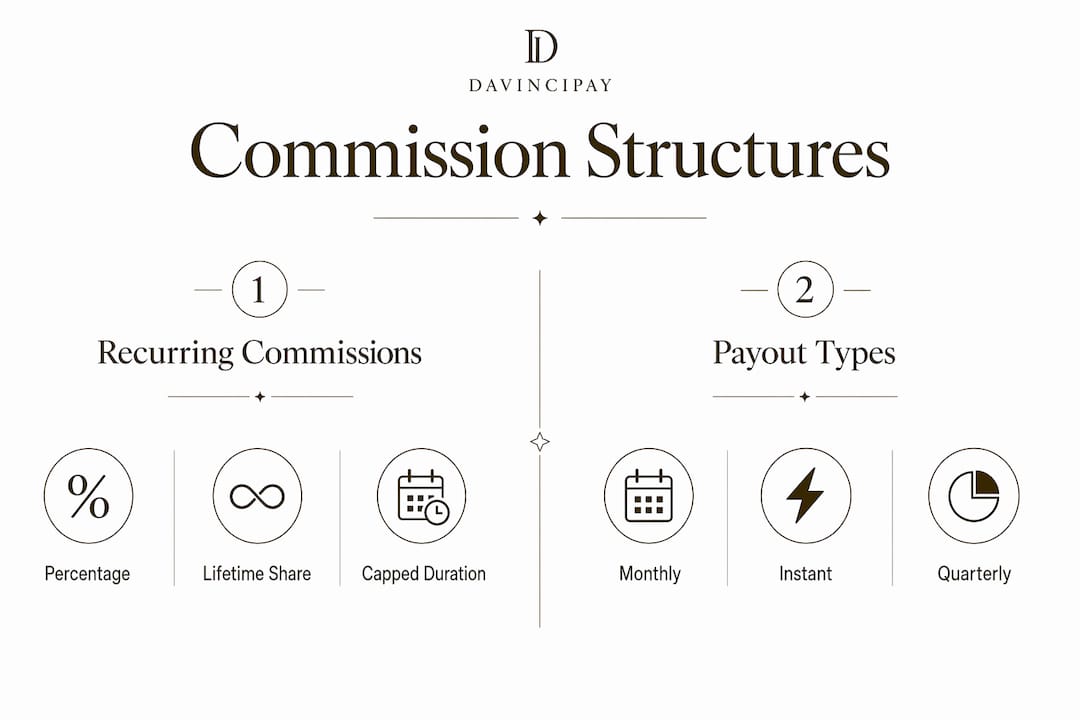
The four primary commission models you will encounter are percentage-of-payment recurring, lifetime revenue share, capped-duration recurring, and one-time flat commissions. Each has a different risk-reward profile.
Commission ModelExample ProgramRateDurationPayout MethodCapped recurringSpiffy20% of net subscription12 monthsPayPal (quarterly)Capped recurringWave30% of net subscription12 monthsACH, PayPal, stablecoinLifetime revenue shareRiskPay2%–15% by volumeLifetimeUSDC (instant)Lifetime recurringYukoUp to 30%24 monthsQuarterly in arrearsPer-payment instantXanguard10% per paymentPer renewalSolana wallet (instant)
Spiffy’s 2026 referral program offers 20% commissions on net subscription revenue for up to 12 monthly payments or a one-time 20% of the annual payment value. Commissions are paid quarterly after a hold period of 45 to 60 days. That hold period exists to absorb refund and dispute activity before money moves to your wallet.
Wave’s partner program pays 30% on all paid subscriptions from referred users for 12 months, with a 90-day cookie window. The 90-day window is generous compared to the 30-day standard in most SaaS programs, giving you more time to convert traffic into commissionable signups.
RiskPay’s affiliate platform offers lifetime revenue-share commissions ranging from 2% to 15% based on volume, paid instantly in USDC with no commission cap. Lifetime terms sound attractive, but the 2% floor means you need high-volume merchants to generate meaningful income.
Yuko’s agency partner program provides up to 30% recurring commissions for up to 24 months, paid quarterly in arrears with no caps on total earnings. The 3-month delay before first payout is designed to confirm client retention before any money changes hands.
Pro Tip: When evaluating high risk commission structures, calculate the expected lifetime value of a referred merchant rather than focusing on the headline rate. A 10% lifetime share from a merchant processing $50,000 per month beats a 30% share that expires after 12 months of a $5,000-per-month account.
How do payout timing and payment methods affect your referral earnings?
Payout timing in high-risk affiliate programs is where advertised earnings and actual earnings diverge most sharply. Hold periods of 30 to 90 days are standard practice to protect against refunds and chargebacks, which occur at higher rates in high-risk merchant categories. A 90-day hold on a quarterly payout schedule means your first check could arrive six months after your first referral converts.
Here is what the payout landscape looks like across the programs covered in this guide:
Tax documentation is a practical concern that many affiliates overlook. U.S.-based affiliates earning above $600 annually from a single program must submit a W-9 form. Non-U.S. affiliates typically submit a W-8BEN. Programs that pay via stablecoin or on-chain wallets still generate taxable income in the United States, and the IRS treats crypto payments as property at fair market value on the date received.
Pro Tip: If cash flow matters to your business, prioritize programs with instant or monthly payouts over quarterly schedules. Xanguard and RiskPay both offer instant on-chain payouts, which eliminates the cash flow gap that quarterly programs create.
What are the best practices to maximize earnings with high risk payment referral commissions?
Maximizing payment referral earnings requires more than picking the highest-rate program. The merchants you refer, the tracking setup you use, and the program terms you accept all determine your actual take-home income.
Pro Tip: Track your referral links with a UTM parameter system in Google Analytics or a dedicated affiliate dashboard. Knowing which content pieces, channels, and audiences drive the highest-converting referrals lets you double down on what works instead of spreading effort evenly.
How do high risk payment referral commissions compare across popular providers?
The table in the commission structures section covers the basics. Here is the deeper comparison that matters for decision-making.
Spiffy and Wave both cap commissions at 12 months, which means your income from any single referred merchant has a defined ceiling. That is not necessarily bad. Both programs offer rates of 20% to 30% on net subscription revenue, which is high relative to the broader affiliate market. The tradeoff is that you need a consistent pipeline of new referrals to maintain income levels as older referrals age out of their commission windows.
RiskPay’s lifetime model solves the pipeline problem but introduces a volume dependency. At 2% to 15% based on volume, a referred merchant processing $10,000 per month generates between $200 and $1,500 in annual commissions for you. Scale that across 20 referred merchants and the math becomes compelling. The instant USDC payout is a genuine differentiator, particularly for affiliates who want to avoid the cash flow uncertainty of quarterly schedules.
Xanguard’s per-payment model is the most transparent structure available. You earn 10% on every payment the referred merchant processes, paid instantly to a Solana wallet. There is no cap, no minimum, and no waiting period. The limitation is that your earnings are entirely dependent on the merchant’s transaction frequency. A merchant who processes payments monthly generates far less commission than one processing daily.
Yuko’s 24-month window is the longest capped duration in this comparison. The 3-month delay before first payout and quarterly payment schedule make it better suited for affiliates with patience and a long-term client relationship focus, such as agency partners who manage merchant accounts directly.
Pro Tip: Match the commission model to your referral audience. If you refer subscription merchants with predictable monthly billing, Wave or Spiffy’s recurring models work well. If you refer high-volume transaction processors, RiskPay’s lifetime share or Xanguard’s per-payment model will outperform.
Key takeaways
High risk payment referral commissions reward affiliates who understand program terms, qualifying payment rules, and payout timing before they commit to promoting a program.
PointDetailsCommission rates vary widelyRates range from 2% to 30%; lifetime models favor volume, capped models favor high-rate short-term referrals.Qualifying payments define real earningsCommissions apply to net revenue only; refunds, fees, and free signups are excluded across all major programs.Payout timing affects cash flowHold periods of 30 to 90 days and quarterly schedules can delay your first payment by up to six months.Instant payout models existXanguard and RiskPay pay instantly via Solana and USDC, eliminating the cash flow gap in traditional programs.Diversification reduces income riskRunning referrals across multiple programs protects against policy changes and payout delays from any single provider.
Why program terms matter more than headline rates
I have reviewed dozens of affiliate programs in the high-risk payment space, and the pattern is consistent: affiliates who focus on the advertised commission rate almost always earn less than they expect. The affiliates who earn the most are the ones who read the terms document before they promote anything.
Cookie duration and refund clawback windows significantly influence actual commission earnings versus advertised rates, especially in high-risk environments prone to disputes. That insight sounds obvious, but most affiliates skip the terms entirely and then wonder why their quarterly payout is 40% lower than their dashboard projected.
The programs I find most trustworthy are the ones that define qualifying payments with precision. Spiffy’s terms explicitly state what counts as commissionable revenue and what adjustments occur during subscription changes. That level of transparency lets you build a realistic income model. Programs that leave qualifying payment definitions vague are the ones that generate disputes between affiliates and program managers.
Instant payout models like Xanguard and RiskPay have changed my thinking on cash flow management for affiliate income. Waiting 90 days for a quarterly check while your referred merchants are actively processing payments creates unnecessary financial pressure. On-chain payouts are not just a novelty. They are a structural improvement for affiliates who treat this as a real revenue stream rather than a side experiment.
My practical advice: start with one or two programs, track your results for 90 days, and then expand to additional programs based on actual conversion data. Diversifying too early spreads your promotional effort thin before you understand which channels and audiences convert best for high-risk payment referrals.
Earn more with Davincipay’s high-risk affiliate program
Davincipay specializes in payment processing for high-risk merchants across nutraceuticals, telehealth, supplements, and subscription e-commerce. If you refer merchants in these verticals, you need a processor with the underwriting depth and acquiring relationships to actually approve and retain them.
Davincipay’s affiliate program offers competitive recurring commissions, transparent qualifying payment terms, and dedicated support for regulated verticals. Referred merchants get fast approvals, reliable payment infrastructure, and chargeback mitigation tools that keep their accounts in good standing, which directly protects your commission stream. Visit Davincipay’s high-risk processing page to review program details, or go directly to the affiliate application to get started. You can also explore how the program applies to specific verticals like supplement payment processing to match your referral audience.
FAQ
What are referral commissions in high-risk payment processing?
Referral commissions in high-risk payment processing are earnings paid to affiliates or partners who refer paying merchants to a payment processor. Commissions are calculated on net qualifying revenue and typically exclude refunds, fees, and taxes.
How much can you earn from high-risk payment referral programs?
Commission rates range from 2% to 30% depending on the program and merchant volume. Lifetime revenue-share models like RiskPay pay 2% to 15% indefinitely, while capped programs like Wave pay 30% for 12 months.
How long do hold periods last before you receive your commission?
Hold periods typically run 30 to 90 days to protect against refunds and chargebacks. Spiffy holds commissions for 45 to 60 days, while Wave applies a 30-day clawback window before releasing funds.
Do instant payout options exist for high-risk affiliate commissions?
Yes. Xanguard pays 10% per payment instantly to Solana wallets with no minimum payout. RiskPay pays lifetime commissions instantly in USDC, making both programs the fastest payout options currently available in this category.
What qualifies as a commissionable payment in these programs?
Only paid subscription revenue qualifies in most programs. Free trial signups, refunded transactions, and payments that include taxes or processing fees are excluded from the commission calculation across Spiffy, Wave, and similar programs.


.webp)