.png)
High-risk MCC codes are the four-digit merchant category codes that Visa, Mastercard, and acquiring banks flag for elevated fraud, chargeback, or regulatory exposure. Landing in one of these codes usually means higher processing rates, rolling reserves, and closer transaction monitoring. If your business sells supplements, runs a subscription model, or operates in telehealth, your MCC directly shapes your bottom line, and the sections below show you how to manage it.
TL;DR:
- High-risk MCC codes significantly increase transaction costs, reserves, and monitoring, especially for business models like supplements, telehealth, and subscriptions.
- Different acquirers can assign varying MCCs to the same business, affecting processing terms and compliance requirements due to risk interpretation differences.
- High-risk classifications often lead to higher rates, reserves, stricter reporting, and longer contracts, with some categories facing ongoing regulatory and legal scrutiny.
- Proper documentation, proactive disclosure of new products, and implementation of fraud controls can help merchants negotiate better terms and avoid reclassification.
- International differences in MCC risk assessment mean merchants must requalify when expanding abroad, and misclassification can impact future processing and financing options.
Table of Contents
- What Are Merchant Category Codes and Who Assigns Them?
- Which MCCs Are Commonly Treated as High Risk?
- How High-Risk MCCs Change Your Processing Terms
- Card-Network Rules and Mandatory Registration Programs
- How Acquirers Underwrite High-Risk Merchants
- Practical Steps to Reduce Your High-Risk Exposure
- How a Specialist Processor Handles High-Risk MCC Accounts
- Your Next Steps If You’re Facing a High-Risk MCC
- Do High-Risk MCCs Affect Your Merchant Credit Profile?
- Does High-Risk MCC Classification Vary by Country?
- Can a Business Model Change Trigger MCC Reclassification?
- What If Your MCC Was Assigned Incorrectly?
- Why the Standard MCC Playbook Falls Short for Growing Merchants
- Get Underwriting Built for Your Actual MCC, Not a Generic Risk Tier
- Sources
What Are Merchant Category Codes and Who Assigns Them?
Merchant category codes trace back to standards maintained through ISO and adopted by the major card networks to classify what a business sells. Every authorization and clearing message carries an MCC, and that code tells the network and the issuing bank what kind of transaction just happened.
You don’t pick your own MCC. Your acquirer or payment processor assigns it based on your stated business type, your website content, and sometimes your actual transaction history, according to Stripe’s guide to merchant category codes. A few things worth knowing before you apply for a merchant account:
- Merchants can request a specific MCC designation, but the final call belongs to the processor.
- Card-not-present transactions, common in ecommerce and telehealth, carry more inherent risk than card-present retail, since there’s no physical card or signature to verify.
- Two acquirers can legitimately assign different MCCs to the same business, depending on how each bank interprets your product mix.
That last point catches a lot of merchants off guard, and it’s worth remembering as you shop for a processor.
Which MCCs Are Commonly Treated as High Risk?
Processors don’t all use identical high-risk lists, but a consistent core shows up across Visa’s Merchant Data Standards Manual and industry aggregators like Tagada. Here’s how the usual suspects break down by vertical:
- Direct marketing and subscription (5966, 5967, 5968): outbound telemarketing and direct-response merchants face high dispute rates tied to recurring billing and negative-option enrollment.
- Gambling and betting (7995): heavy regulatory scrutiny plus high chargeback volume from disputed wins and losses.
- Financial and quasi-cash, including crypto (6051): money-services activity draws anti-money-laundering attention and volatile settlement risk.
- Digital goods and delivery (5122, 4829): drug stores and wire-transfer money orders carry fraud exposure tied to fulfillment disputes and cash-equivalent transfers.
- Health, wellness, and nutraceuticals (5912): pharmacies and supplement sellers face regulatory review over claims and ingredient sourcing.
- Adult and dating: elevated chargeback rates and reputational risk push these into restricted territory at most acquirers.
- Tobacco and vape: age verification failures and shifting state regulations keep this category under constant watch.
- Travel and ticketing (4722, 7911 in some lists): future-delivery services create chargeback exposure if a trip or event gets canceled.
- High-value retail and quasi-cash equivalents (5993, 7273): pawn shops and dating/escort services round out the most-restricted list.
Every processor maintains its own version of this list, so confirm your specific classification with your acquirer rather than assuming based on a generic table.
How High-Risk MCCs Change Your Processing Terms
Getting classified as high risk doesn’t just add a line item. It restructures your entire pricing agreement.
Standard-risk merchants typically pay around 2.5% to 3.5% per transaction, while high-risk merchants often pay 4% to 8%, and in the most restricted categories, sometimes above 10%, according to processing benchmarks from Tagada. That gap comes from interchange fees stacked with acquirer risk premiums.
Beyond the per-transaction rate, expect these terms to shift:
- Rolling reserves: acquirers commonly hold back 5% to 25% of your revenue for a set period, often 90 to 180 days, to cover potential chargebacks.
- Chargeback thresholds: card networks flag merchants who exceed 0.9% to 1% of transactions in disputes, triggering monitoring programs with escalating fines.
- Setup and monthly fees: high-risk accounts frequently carry higher onboarding costs and monthly minimums than standard retail accounts.
- Contract terms: expect longer commitment periods and early termination fees baked into high-risk merchant agreements.
None of this is arbitrary. Acquirers price for the actual claims history of your MCC, and merchants who understand the mechanics can negotiate better terms than the sticker price suggests.
Card-Network Rules and Mandatory Registration Programs
Visa designates a specific set of codes, including 5122, 5912, 5966, 5967, 5968, 5993, 7273, and 7995, as high-integrity MCCs requiring accurate categorization in card-absent transactions, with special condition codes applied in certain circumstances. Mastercard enforces similar precision through its DE26 data element, which must carry an accurate MCC in every authorization and clearing message under its merchant quick reference rules.
Falling into one of these designated categories often triggers:
- Mandatory registration with the card network, sometimes with an annual fee attached.
- Ongoing transaction reporting and periodic audits of your business practices.
- Stricter enforcement if your actual product mix drifts from your registered category.
Misreporting your MCC to dodge these requirements isn’t a workaround. It’s grounds for account termination.
How Acquirers Underwrite High-Risk Merchants
Underwriters treat your MCC as a risk signal, not a fixed label, which is why the same business can receive different codes from different banks. When your application shows ambiguity, most acquirers default to the more conservative, more expensive classification.
Mixed lines of business create the most common pitfall. If you sell supplements and run a subscription telehealth consultation service under one account, expect the acquirer to require separate merchant IDs for each line rather than blending them under one MCC.
Prepare these documents before you apply, and underwriting moves faster:
- Business licensing and, where relevant, product-specific certifications (age verification for tobacco, RNG licensing for gaming).
- Three to six months of prior processing statements, if you have them.
- A clear breakdown of product lines and expected transaction volume per line.
- Website content that accurately reflects what you sell and how you bill.
- Refund, return, and cancellation policies posted and accessible to customers.
Practical Steps to Reduce Your High-Risk Exposure
You can’t change your MCC through better fraud controls, but you can change the terms attached to it. Start with operations: post clear delivery timelines, disclose subscription terms in plain language, and make refund policies easy to find. Vague billing practices are the single fastest route to a chargeback spike.
On the technical side, layer in defenses that actually move the numbers:
- 3D Secure authentication for card-not-present transactions.
- AVS and CVV verification rules enforced at checkout, not optional.
- Device fingerprinting to catch repeat fraud attempts.
- Velocity limits that flag unusual order frequency from a single account or card.
A payment gateway integration guide can help your development team implement these controls correctly the first time. It’s also worth reviewing how finance teams handle vendor impersonation attempts, since the same social-engineering patterns often show up in payment fraud schemes.
Track your dispute ratio, chargeback rate, and refund rate monthly. If any of them trend upward for two consecutive cycles, that’s your signal to tighten controls before your acquirer does it for you.
Pro Tip: Build your fraud-control documentation before an acquirer asks for it. Merchants who can show a working chargeback-prevention system during underwriting routinely negotiate lower reserve percentages than those who scramble to produce it after the fact.
How a Specialist Processor Handles High-Risk MCC Accounts
Specialist processors often work with merchants in nutraceuticals, telehealth, subscription commerce, and other regulated verticals that standard acquirers may decline. They provide underwriting support related to MCC, domestic and international acquiring relationships, fraud prevention tools, and chargeback mitigation designed for dispute-heavy categories.
Before reaching out to a specialist, have your processing history, product documentation, and chargeback data ready. Peter, who covers payment processing and merchant risk for Davincipay, has spent years tracking how card-network rule changes ripple down to actual underwriting decisions for high-risk merchants.
Your Next Steps If You’re Facing a High-Risk MCC
Start by confirming your exact MCC with your current acquirer. Don’t assume based on industry guides. Next, audit your product lines. If you’re running multiple business types under one account, separate them into distinct MIDs before an underwriter forces the issue.
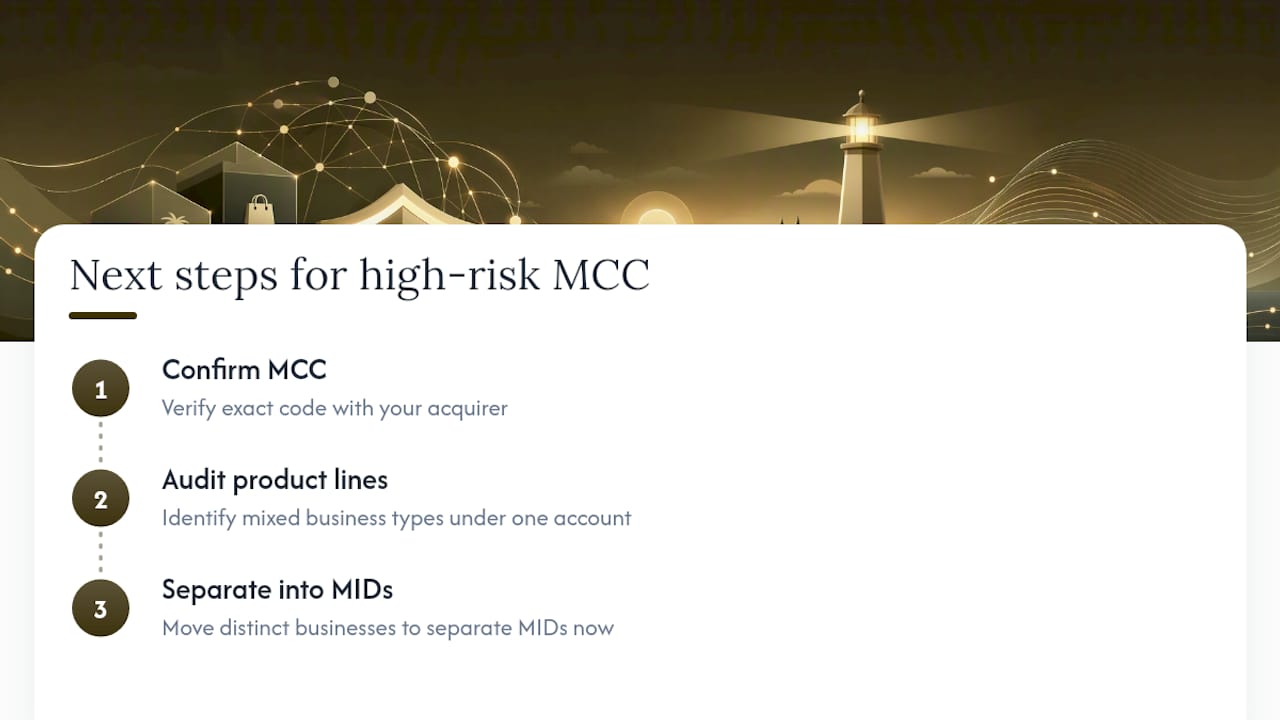
Implement at least two fraud controls, like 3D Secure and velocity limits, this quarter. Build your documentation pack now rather than during a crisis. If your rolling reserve or processing rate feels disproportionate to your actual dispute history, that’s the moment to talk to a specialist processor built for your category.
Do High-Risk MCCs Affect Your Merchant Credit Profile?
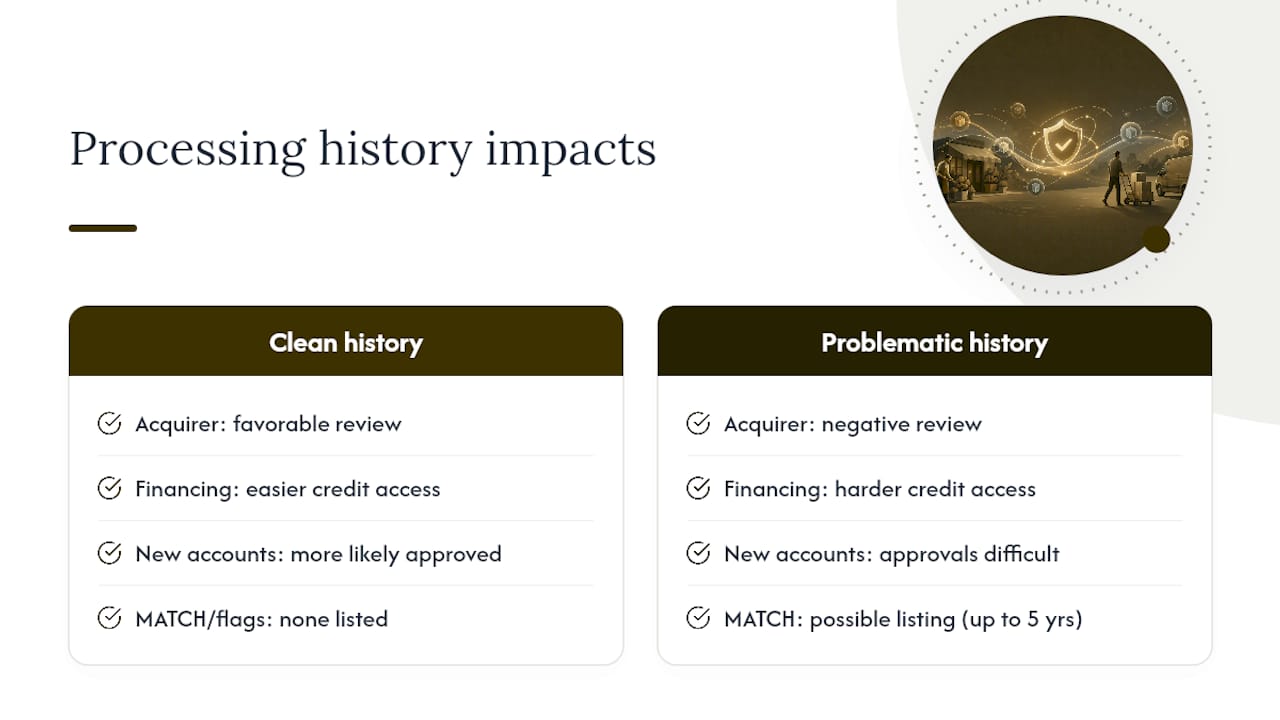
Your MCC itself doesn’t appear on a personal or business credit report the way a loan does, but it shapes something arguably more consequential for a growing merchant: your processing history and underwriting file. Acquirers and future processors pull prior account performance, including chargeback ratios, reserve draws, and termination flags, when they evaluate a new application.
A merchant terminated for excessive chargebacks lands on the MATCH list (Mastercard’s Member Alert to Control High-risk Merchants), formerly called the Terminated Merchant File. Getting listed there makes securing any new merchant account dramatically harder for up to five years, regardless of your actual business quality at that point.
This history matters just as much when you seek business financing. Lenders and revenue-based financing companies increasingly pull processing data to gauge business health, and a high-risk MCC combined with a spotty chargeback record signals instability even if your revenue looks strong. Conversely, a clean processing history within a high-risk category, low disputes, consistent reserve compliance, steady volume, actually strengthens your position when you apply for a business line of credit or seek investment.
The practical takeaway: protect your processing history as carefully as you’d protect a credit score. One bad stretch of unmanaged chargebacks can follow your business for years, independent of how your MCC gets labeled going forward.
Does High-Risk MCC Classification Vary by Country?
Yes, and the differences catch international merchants off guard more than any other part of this system. Card networks publish global MCC standards, but individual acquirers and regulators layer their own risk interpretations on top, based on local law and market history.
A supplement brand might process smoothly as a standard-risk account with a European acquirer but then get flagged as high risk the moment it applies with a North American bank, because regulatory scrutiny on nutraceutical health claims differs sharply between jurisdictions. Gambling offers the starkest example: an MCC that processes routinely in a country with regulated gaming law becomes nearly unbankable in a market where the activity sits in a legal gray zone or is outright restricted.
Cannabis and CBD merchants face this most acutely. Classification and banking access shift not just by country but by state or province, tied directly to local legal status. Cross-border merchants need to underwrite market by market rather than assuming one acquirer’s risk tolerance applies globally.
If you’re expanding internationally, build in time to requalify with a local or regional acquirer rather than assuming your domestic MCC and reserve terms travel with you. What reads as a routine category in one market can trigger a full high-risk review in another.
Can a Business Model Change Trigger MCC Reclassification?
Absolutely, and it happens more often than most merchants expect. Your MCC reflects what your acquirer believes you sell right now, not what you sold when you opened the account. Add a subscription tier to a one-time-purchase supplement business, and you’ve just introduced negative-option billing risk that didn’t exist before. Expand from wellness coaching into telehealth consultations with prescription referrals, and you’ve shifted into a regulated healthcare category entirely.
Acquirers monitor for this kind of drift, sometimes through automated transaction pattern analysis, sometimes through manual account reviews. A sudden spike in recurring billing volume, a jump in average order value, or new product categories appearing on your site can all prompt a reclassification review.
The safest approach is proactive disclosure. Notify your acquirer before you launch a new product line or billing model, not after a monitoring flag forces the conversation. Merchants who wait for the acquirer to notice usually face a less favorable renegotiation, sometimes with a forced MCC change mid-contract and new reserve terms attached. Merchants who disclose early often get a smoother transition, occasionally without any reserve change at all if the new line carries comparable risk to the existing account.
What If Your MCC Was Assigned Incorrectly?
Merchants do have recourse when they believe an acquirer misclassified their business, though the process runs through your processor rather than directly through Visa or Mastercard. Start by requesting a formal MCC review from your acquirer, in writing, with documentation showing your actual product mix and transaction patterns.
Useful evidence includes your website content, product descriptions, sample invoices, and a breakdown of revenue by category if your business spans multiple lines. If your MCC was assigned based on outdated information or a misunderstanding of your business model, this documentation package is what moves the review forward.
Acquirers aren’t obligated to change your classification just because you disagree with it, and a review can go either direction. If the acquirer confirms the original MCC after review, ask specifically what evidence would change the determination. That answer tells you whether the classification is negotiable or whether it’s time to shop for a processor whose risk appetite better matches your actual business.
Why the Standard MCC Playbook Falls Short for Growing Merchants
Most guidance on this topic treats MCCs as a static problem: find your code, accept your fate, pay the fees. That framing misses the more useful reality, which is that MCC risk is a negotiation, not a sentence.
The merchants who do best don’t just accept whatever code lands on their account. They document their actual dispute performance, separate risky product lines before an acquirer forces the issue, and treat underwriting readiness as an ongoing discipline rather than a one-time application task. The businesses that get burned are almost always the ones that discover their reserve terms, chargeback thresholds, or reclassification risk after the fact, not before.
If there’s one priority to take from this, it’s proactive disclosure. Tell your acquirer about new products before launch. Build your fraud-control stack before your dispute ratio climbs. Prepare your documentation pack before you need it for a review or a new application. Reactive merchants pay the highest rates in this industry. Prepared ones negotiate.
— Peter
Get Underwriting Built for Your Actual MCC, Not a Generic Risk Tier
Generic processors price your account against a broad risk category and hope for the best. Specialist payment processors build underwriting around your specific business, so your rates and reserve terms reflect your actual performance rather than someone else’s worst-case history in your MCC.

If you sell nutraceuticals, Davincipay’s nutraceutical payment processing team understands the specific documentation acquirers expect for that category. Supplement merchants can find similar vertical-specific support through the supplements processing page. Whatever your product line, Davincipay’s merchant services overview covers underwriting support, fraud prevention, chargeback mitigation, and both domestic and international acquiring relationships built for regulated and high-growth ecommerce.
Ready to see where you actually stand? Apply now and get your business matched with underwriting built for your real risk profile, not a worst-case assumption.


.webp)
