.png)
Yes, a US gaming business can get an approved merchant account, but approval hinges on one thing first: which legal category you fall into. Real-money iGaming is license-gated state by state, while video and mobile gaming microtransactions are generally legal nationwide and easier to place. Confirm your category, assemble a complete underwriting file, and contact a high-risk specialist. With a clean file, approval can happen in days to weeks; licensing gaps or missing documentation add months.
TL;DR:
- Approval depends heavily on whether your business is classified as real-money iGaming or microtransactions, with licensing required for the former and nationwide legality for the latter.
- A complete and consistent underwriting file, including incorporation documents, managerial IDs, bank statements, and published policies, is crucial for faster approval.
- Licensing gaps, missing validation, or mismatched documents can extend approval timelines from days to months, especially for real-money gaming.
- Pricing is significantly higher than typical retail processing, with setup fees, transaction rates, and rolling reserves all contributing to costs, which can be negotiated down based on processing history.
- Managing chargebacks involves implementing a fraud prevention stack, including 3D Secure, tokenization, and dispute alerts, and demonstrating active monitoring during the application process.
Table of Contents
- What Is a Gaming Merchant Account Guide Supposed to Cover?
- What Documents Do Underwriters Require for Gaming Applications?
- How Much Do Gaming Merchant Accounts Cost?
- How Do You Keep Chargebacks Under Control?
- Your Step-By-Step Path to Going Live
- How Do You Pick the Right Payment Partner?
- How Does DavinciPay Support Gaming Merchants?
- A Straight Answer on What Actually Gets Gaming Merchants Approved
- Ready to Apply? Here’s What to Check First
- Where to Look Next for Reliable Data
- Sources
What Is a Gaming Merchant Account Guide Supposed to Cover?
A gaming merchant account guide worth reading has to start with underwriting logic, not just a list of providers. Mainstream processors like Stripe or Square won’t touch real-money gaming and often shut down mobile gaming apps mid-stream once transaction volume spikes. That’s not an accident. It’s a deliberate risk decision, and understanding it changes how you prepare your application.
Two categories drive every decision an underwriter makes. Real-money iGaming, meaning sportsbooks, online casinos, and poker platforms, requires state-level licensing before most acquirers will even review your file. Video and mobile gaming microtransactions, like in-app purchases and loot boxes, carry no licensing requirement and are generally legal nationwide, which opens the door to a wider pool of processors.
Underwriters weigh several risk drivers when they classify your account:
- Chargeback profiles, since gaming consistently runs hotter than typical retail categories
- Card-not-present fraud exposure, given that nearly all gaming transactions happen online
- Jurisdictional licensing status, especially for real-money operators targeting multiple states
- Merchant Category Code assignment, which determines pricing and reserve requirements from day one
Expect operational consequences too. Geo-fencing to block unlicensed states, layered KYC checks, and PCI-compliant tokenization aren’t optional extras. They’re baseline requirements Von Payments flags as standard for any gaming acquirer relationship.
What Documents Do Underwriters Require for Gaming Applications?
Underwriters build their decision around a specific document set, and missing even one item slows everything down. The names on every document need to match exactly. A mismatch between your incorporation papers and your bank letter is one of the fastest ways to get flagged for manual review, according to processor checklists built specifically for gaming applicants.
Here’s the core file you need before you apply:
- Certificate of Incorporation and EIN documentation
- Government-issued ID for every owner and director with meaningful equity
- A business bank account with a voided check or bank letter confirming ownership
- Three to six months of prior processing or bank statements, if you have them
- Published website policies, including refund terms, privacy policy, and support contact information
- Proof of active customer support channels, since underwriters check that these actually work
New launches without processing history aren’t automatically declined. Underwriters commonly approve high-volume launches when applicants bring a credible volume story instead, meaning signed marketing or distribution contracts and realistic financial projections paired with a staged ramp plan.
Real-money iGaming applicants face an added layer: state gaming licenses, a documented KYC/AML program, and a written geo-restriction plan for any state where you’re not licensed to operate.
Pro Tip: Draft your geo-restriction plan before you apply, not after. Underwriters read it as proof you understand your own regulatory exposure, and that single document often speeds up the entire review.
How Much Do Gaming Merchant Accounts Cost?
Pricing for gaming merchant accounts runs well above standard retail rates, and rolling reserves are the line item that surprises most first-time applicants. Setup fees typically range from $0 to $5,000, monthly platform fees from $0 to $500, and per-transaction rates from 2.5% to 7%, according to published fee tables for gambling merchant accounts.
The bigger cost driver is the rolling reserve:
- Reserve percentages typically start at 5% to 10% of processing volume at launch
- Hold periods usually run for several months before funds are released
- Chargeback fees usually range from a modest to a moderate amount per incident
- Minimum processing thresholds often carry penalty fees if you fall short
A rolling reserve isn’t a fee you lose. It’s working capital the processor holds as a buffer against future chargebacks, and you can negotiate it down. Volume, processing history, and license status all shift your pricing tier. A licensed operator with six months of clean statements gets meaningfully better terms than a brand-new launch with no track record.
Negotiate for staged reserve caps that step down as you build history, and use offers from two or three providers as leverage. Processors compete for gaming volume more than they let on during the first call.
How Do You Keep Chargebacks Under Control?
Chargeback ratio is the metric that determines whether you keep your account or lose it. Card networks flag accounts that cross their thresholds, and gaming merchants start closer to that line than almost any other vertical. Your goal for the first 90 days is staying well under the flag point while you build a clean history.
The technical stack underwriters expect to see includes:
- 3D Secure 2 authentication on higher-risk transactions
- AVS and CVV matching rules tuned to your fraud pattern, not just default settings
- Tokenization for saved cards, which also improves checkout conversion
- Pre-dispute alert tools like Ethoca or Verifi that catch disputes before they become formal chargebacks
- Velocity rules and in-flow KYC checks that catch suspicious account behavior early
Saved-card tokenization paired with a low-friction cashier interface measurably raises authorization and conversion rates while cutting complaints tied to failed payments.
Pro Tip: Bring your fraud stack to the underwriting call, not just to your launch checklist. Naming your specific tools by brand during the application signals operational maturity that generic risk statements never do.
Build a daily monitoring habit for transaction anomalies and a weekly cadence for dispute representment. Presenting this workflow during your application, rather than promising to build it later, is often what tips a marginal file into an approval.
Your Step-By-Step Path to Going Live
Getting from application to stable processing follows a predictable sequence, and skipping steps is what creates 90-day holdbacks and surprise account reviews.
- Confirm your legal category first. Real-money iGaming or video/mobile microtransactions changes everything downstream, from which providers will talk to you to what licenses you need.
- Lock down your licensing and geo-fencing plan. Publish it internally even if you haven’t finalized every state.
- Publish your refund policy, terms of service, and privacy policy live on your site. Underwriters check these pages before they read your application.
- Gather your bank documents and incorporation papers, matching business names exactly across every file.
- Apply to two or three providers in parallel, mixing provider types so you’re not dependent on one underwriting team’s timeline.
- Track every document request per provider so nothing falls through the cracks during parallel review.
- Run sandbox testing to verify webhook behavior and settlement timing before you accept live transactions.
- Launch with a staged ramp plan, increasing processing caps on a schedule tied to clean chargeback history.
- Monitor daily for the first 90 days, since this window determines your long-term reserve and pricing tier.
How Do You Pick the Right Payment Partner?
Choosing between a direct acquirer, a payment service provider, or a payment orchestrator comes down to a trade-off between speed, price, and control. Direct acquirers often offer better long-term pricing but slower onboarding. PSPs move faster and add a layer of fraud tooling, usually at a higher per-transaction cost. Orchestrators route across multiple acquirers at once, which adds resilience but also complexity you need in-house expertise to manage.
Ask every provider these questions before you sign anything:
- What’s the exact reserve policy, and is there a documented step-down schedule?
- How does the chargeback handling process work, and who owns representment?
- What’s the settlement cadence, and how granular is the reporting?
- What KYC support and geo-fencing tools come built into the platform?
- What’s the actual PCI scope you’re responsible for versus what the provider covers?
Red flags worth walking away from include vague reserve language, no sample term sheet, and reluctance to provide references from other gaming merchants. A provider confident in its terms will hand you a written schedule without hesitation.
How Does DavinciPay Support Gaming Merchants?
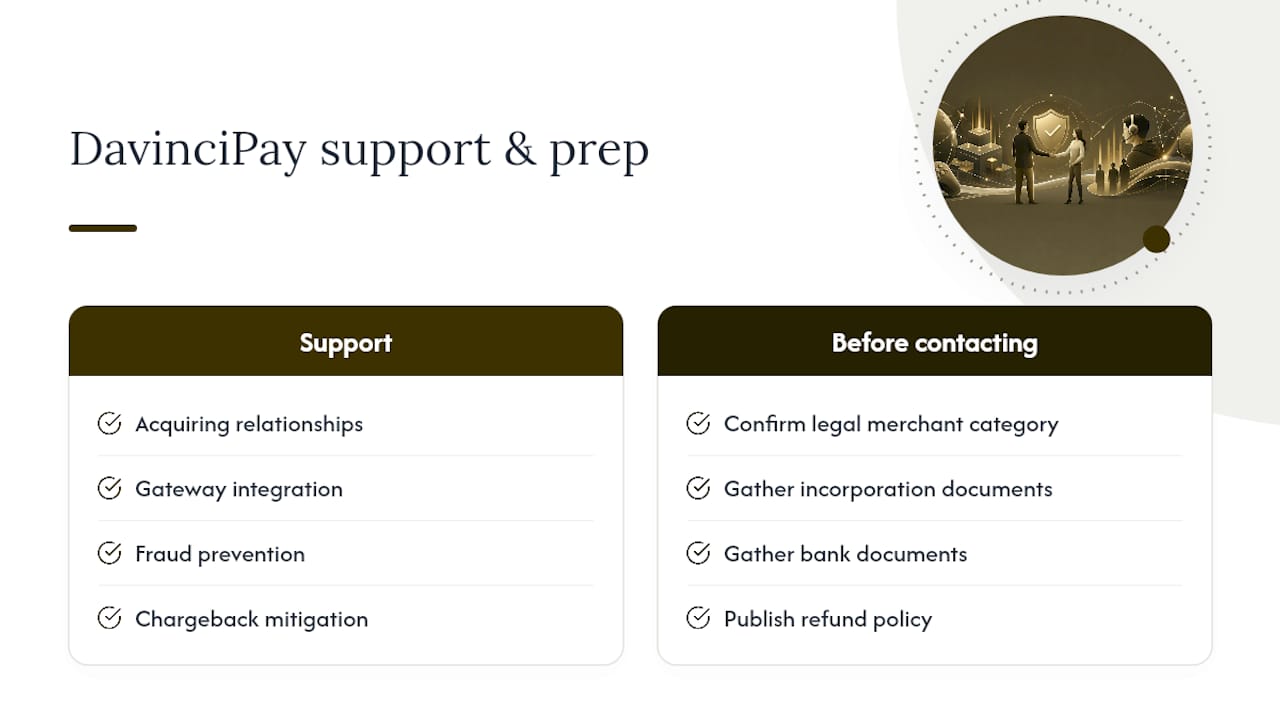
DavinciPay builds acquiring relationships, gateway integration, fraud prevention, and chargeback mitigation specifically for high-risk merchants, gaming included. The goal is stable processing you can build on: negotiated reserve terms, a staged ramp plan instead of an arbitrary cap, and sandbox support before you go live.
Before reaching out, confirm your legal category, gather your incorporation and bank documents, and publish your refund and terms policies. Review how onboarding works so you know what to expect from the first call.
A Straight Answer on What Actually Gets Gaming Merchants Approved
Most gaming operators overcomplicate their pitch to underwriters when the fix is duller than they expect. Complete files win. Incomplete files, no matter how impressive your projected volume looks, get stuck in review or declined outright.
Ramp conservatively. Publish clear refund and support information before you apply, layer in in-flow KYC from day one, and treat your first 90 days of processing as the audition that sets your reserve terms for the next two years.
— Peter
Ready to Apply? Here’s What to Check First
Some payment providers work with gaming merchants who need stable processing without the guesswork of piecing together acquiring relationships on their own. Instead of cobbling together a fraud stack and negotiating reserve terms blind, you get underwriting support built around what gaming applications actually require.

Before you click apply, run through three things: confirm your legal category (real-money iGaming versus video/mobile microtransactions), have your incorporation papers and bank documents matched and ready, and publish your refund policy and terms of service live on your site. A clean PCI compliance posture also speeds up review, so check your SSL setup and payment page security before you submit.
Once that file is ready, head to the Apply Now page and start the review. If you’re still weighing providers or want a broader look at how DavinciPay handles other regulated verticals, the DavinciPay for Nutraceuticals page shows the same underwriting approach applied to a different high-risk category.
Where to Look Next for Reliable Data
- Visa Consulting & Analytics on gaming payments: revenue models and fraud priorities for gaming payments.
- myPayAdvisor’s gaming merchant account guide: how the iGaming versus microtransaction distinction affects approvals.


.webp)
