.png)
Embedded subscription payments are defined as recurring billing capabilities built directly into a software platform, so customers pay without leaving your product. The industry term for this broader category is “embedded finance,” and subscription billing is one of its most commercially important applications. Subscription customers generate 3–5x more revenue over their lifetime than one-time purchasers. That single fact explains why business owners and finance professionals are prioritizing understanding subscription billing as a core revenue strategy, not an afterthought. Davincipay works with subscription merchants across high-risk and complex industries to make this infrastructure reliable, compliant, and built for growth.
What are the main subscription payment models?
Subscription billing is not one-size-fits-all. The model you choose directly shapes your cash flow, churn rate, and customer lifetime value. Billing model choice is one of the highest-leverage decisions a subscription business makes.
The six core models break down like this:
| Model | Best Use Case | Key Advantage | Key Risk |
|---|---|---|---|
| Flat-rate | Simple SaaS, content platforms | Predictable revenue | Underprices heavy users |
| Tiered | SaaS with multiple customer segments | Captures varied willingness to pay | Complex to manage |
| Usage-based | APIs, cloud infrastructure | Scales with customer growth | Unpredictable MRR |
| Freemium | Consumer apps, lead generation tools | Low acquisition friction | Low conversion rates |
| Prepaid | Gift cards, credits, telehealth visits | Upfront cash collection | No guaranteed renewal |
| Hybrid | Mature SaaS, nutraceuticals, supplements | Balances predictability and flexibility | Billing complexity |
Tiered pricing is the most widely adopted model for SaaS and ecommerce, while hybrid models combining base fees with usage-based charges are the fastest growing. Hybrid structures now account for 28% of subscription operators. That growth reflects a real market shift: businesses want the revenue floor of a flat fee plus the upside of usage charges.

Pricing strategy also determines churn. Hybrid pricing models are built to optimize churn and lifetime value continuously, because they can be adjusted by segment without rebuilding the entire billing structure. Cost-plus pricing, where you set price based on your costs rather than customer value, is the most common mistake subscription businesses make. Price based on perceived value, then test from there.
Pro Tip: If you sell physical subscription products like supplements or nutraceuticals, the optimal subscribe-and-save discount sits at 10–15%. Go higher and you compress margins. Go lower and you lose the conversion lift.
How does subscription billing work end-to-end?
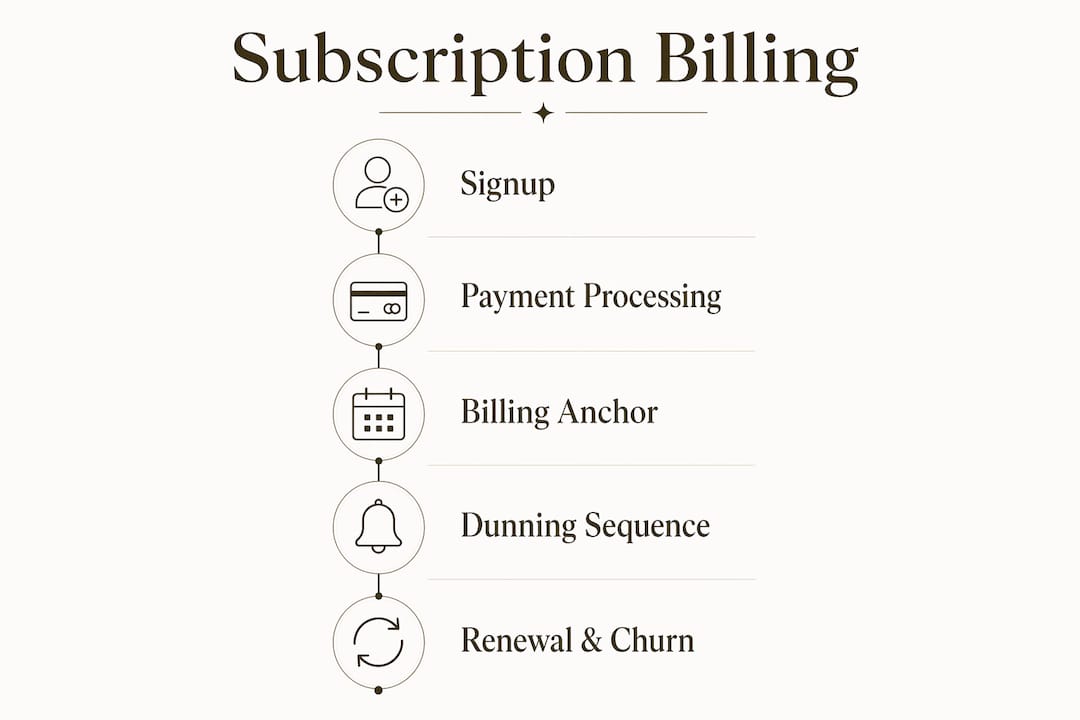
Understanding subscription billing at the process level prevents expensive errors. The full billing lifecycle runs from signup through renewal, with several automated steps in between.
- Signup and payment method capture. The customer enters payment details at checkout. The platform tokenizes the card or bank account data immediately, replacing sensitive numbers with a secure token. Tokenization is the foundation of PCI compliance in subscription billing.
- Billing anchor date assignment. Each customer receives a unique anchor date tied to their signup day, not a global calendar date. Each billing cycle is dynamically tailored per customer, which prevents billing errors when months have different day counts.
- Invoice generation. The billing engine creates an invoice automatically at each renewal. For mid-cycle changes, such as a plan upgrade, the system calculates proration to the day. The customer pays only for the time they used each plan tier.
- Charge attempt. The platform submits the charge to the payment gateway using the stored token. If the charge succeeds, the subscription renews and the cycle resets.
- Retry logic for failed payments. Failed charges trigger a dunning sequence. The system retries on a smart schedule, typically spacing attempts across several days to avoid hitting the same temporary block twice.
- Customer notification. Personalized emails prompt the customer to update an expired card or fix a billing issue. Automated communication at this stage is critical.
- Renewal or cancellation. A recovered payment renews the subscription. An unrecovered payment after the full dunning sequence cancels or pauses the account, depending on your grace period policy.
Chargeback dispute windows range 60–120 days depending on the card network and dispute type. That window matters for subscription merchants because a customer can dispute a renewal charge weeks after it processed. Keeping clear billing descriptors and sending renewal reminders reduces dispute rates significantly.
Pro Tip: Set your billing anchor date logic to handle February correctly. A customer who signs up on January 31 should bill on the last day of February, not skip a cycle. Most enterprise billing engines handle this automatically. Entry-level platforms often do not.
How do you manage payment failures and reduce churn?
Payment failures are not just technical errors. They are churn events. Every failed charge that goes unrecovered is a subscriber you lose without them ever deciding to cancel. This is called involuntary churn, and it is distinct from voluntary churn where a customer actively cancels.
The primary defense against involuntary churn is automated dunning. A well-configured dunning sequence does three things:
- Retries the charge on a smart schedule. Spacing retries across different days and times increases recovery odds. A card declined on a Monday morning may succeed on a Wednesday afternoon after the customer’s paycheck clears.
- Sends personalized notifications. Generic “your payment failed” emails perform poorly. Personalized messages that address the customer by name, explain the issue clearly, and link directly to a payment update page recover more accounts.
- Applies a grace period. A grace period keeps the subscription active for a defined window after a failed payment. This gives the customer time to fix the issue without losing access, which reduces support tickets and cancellation requests.
Well-configured dunning recovers 30–40% of initially failed payments. That recovery rate has a direct impact on monthly recurring revenue. For a business with $100,000 in MRR, recovering 35% of failed payments instead of 0% can mean tens of thousands of dollars retained each month.
Clear proration and dunning policies also reduce inbound support volume. When customers understand what happens after a failed payment, they are less likely to panic and cancel. Transparency in billing is a retention tool, not just a compliance requirement.
Voluntary churn requires a different approach. Exit surveys, pause options instead of cancellations, and win-back campaigns address the reasons customers choose to leave. Involuntary churn is purely operational. Fix the billing infrastructure and it largely disappears.
How do you integrate embedded subscription payments effectively?
Integrating subscription payments into your platform requires decisions at three levels: pricing model, technical architecture, and operational policy. Getting all three right from the start saves significant rework later.
Annual plans reduce churn by roughly 51% compared to monthly plans and deliver 2.4x higher profitability per subscriber. Offering an annual billing option should be a default for any subscription business, not an optional add-on. The standard industry discount for annual plans runs 15–20%, which is enough to motivate the switch without destroying margin.
For choosing effective subscription billing models, the key integration steps are:
- Map your customer segments first. Different segments have different willingness to pay. A tiered or hybrid model only works if the tiers reflect real usage patterns.
- Choose a billing engine with flexible anchor date logic. Not all payment platforms handle proration and mid-cycle changes correctly. Test edge cases before going live.
- Implement tokenization at the point of capture. Never store raw card data. Tokenization protects your customers and keeps you out of scope for the most demanding PCI DSS requirements.
- Automate invoice delivery. Customers who receive invoices immediately after a charge dispute less often. Automated invoicing is a simple step that reduces chargebacks.
- Build dunning into your launch plan. Dunning is not a feature you add after you see failed payments. Configure retry schedules, grace periods, and notification templates before your first subscriber signs up.
- Monitor Net MRR growth monthly. New MRR minus churned MRR gives you the clearest signal of whether your billing model is working.
Davincipay supports subscription payment processing for high-risk merchants, including nutraceutical brands, telehealth companies, and supplement businesses that face additional underwriting complexity. The platform includes gateway integrations, fraud prevention tools, and chargeback mitigation built for the specific risks these industries carry.
For multi-jurisdiction payment compliance, subscription merchants operating across borders need billing engines that handle currency conversion, local tax rules, and varying chargeback windows by region. This is a layer of complexity that generic payment platforms often underestimate.
Key Takeaways
Embedded subscription payments succeed when billing infrastructure, pricing strategy, and dunning automation work together from day one.
| Point | Details |
|---|---|
| Model selection drives revenue | Hybrid pricing models balance predictable base revenue with usage-based upside for mature businesses. |
| Anchor dates prevent billing errors | Each customer’s billing cycle is tied to their signup date, not a global calendar day. |
| Dunning recovers real revenue | Smart retry sequences recover 30–40% of failed payments, directly protecting monthly recurring revenue. |
| Annual billing cuts churn | Annual plans reduce churn by roughly 51% and deliver 2.4x higher profitability per subscriber. |
| Tokenization is non-negotiable | Storing payment tokens instead of raw card data keeps subscription merchants PCI compliant and reduces fraud exposure. |
What I’ve learned about subscription billing that most guides skip
Most articles about integrating subscription payments focus on the pricing model decision and stop there. The real operational risk sits in the billing engine details that nobody talks about until something breaks.
Proration is the clearest example. When a customer upgrades mid-cycle, the billing engine needs to calculate the credit for unused days on the old plan and the charge for remaining days on the new plan, to the day. I’ve seen businesses go live with billing platforms that round to the nearest week. The result is customers getting overcharged by small amounts repeatedly. Small amounts generate disproportionate churn and chargebacks.
Billing anchor date logic is the second underestimated issue. A customer who signs up on the 31st of a month will hit billing errors in February, April, June, September, and November if your platform doesn’t handle variable month lengths. This sounds like a minor edge case until you have 10,000 subscribers and 800 of them hit billing errors in the same month.
The businesses I’ve seen succeed with embedded subscription payments share one habit: they test their billing engine against edge cases before launch, not after. Run a subscriber through a February 28 renewal. Run one through a mid-cycle upgrade on the last day of the month. Run one through three consecutive failed payments. If the platform handles all three correctly, you have a billing engine worth building on.
The other thing I’d push back on is the instinct to start with the most complex pricing model. Flat-rate billing is boring. It is also easy to support, easy to explain to customers, and easy to audit. Start simple, measure churn and lifetime value carefully, and add pricing complexity only when the data tells you to.
— Peter
Davincipay’s subscription payment solutions for complex businesses
Subscription merchants in high-risk industries face a harder path to reliable payment processing. Standard acquiring banks decline accounts in nutraceuticals, telehealth, and supplements at a high rate, leaving businesses without the infrastructure they need to bill subscribers consistently.

Davincipay specializes in exactly this problem. The platform connects high-risk subscription merchants to domestic and international acquiring relationships, with built-in fraud prevention, chargeback mitigation, and tokenized payment security. Whether you run a telehealth subscription service or a supplement brand with recurring orders, Davincipay provides the payment infrastructure to keep billing running without interruption. Apply now to get your subscription payment processing in place fast.
FAQ
What are embedded subscription payments?
Embedded subscription payments are recurring billing capabilities built directly into a software platform, so customers pay without leaving the product. This is a subset of embedded finance, where financial services are integrated into non-financial software.
What subscription payment model reduces churn the most?
Annual billing reduces churn by roughly 51% compared to monthly billing and delivers 2.4x higher profitability per subscriber. Offering an annual option with a 15–20% discount is the most effective single change a subscription business can make.
How does dunning work in subscription billing?
Dunning is an automated sequence of charge retries and customer notifications triggered by a failed payment. Well-configured dunning recovers 30–40% of initially failed payments, which directly protects monthly recurring revenue.
What is a billing anchor date?
A billing anchor date is the day of the month tied to a specific customer’s signup, used to calculate all future renewal dates. Each customer has a unique anchor date, which prevents billing errors caused by months with different day counts.
Why do subscription merchants need tokenization?
Tokenization replaces raw card data with a secure token at the point of capture, keeping subscription merchants out of scope for the most demanding PCI DSS requirements. It also reduces fraud exposure on stored payment methods used for recurring charges.


.webp)
