.png)
Embedded payments for high-risk platforms means bundling merchant accounts, gateway integration, acquiring, fraud tools, chargeback mitigation, and underwriting support into one working system built for regulated ecommerce. Expect higher fees, rolling reserves, and longer approval timelines than a standard business would face. The fastest path forward: assemble your documentation now and choose a payments partner with real underwriting experience in your vertical, whether that’s Davincipay or a comparable specialist.
TL;DR:
- Providers must support all six components—merchant account, gateway, acquiring, fraud tools, chargeback management, and underwriting support—to ensure compliance and volume scalability.
- Underwriters require specific documentation, including bank statements, government IDs, industry certificates, and a transparent refund and subscription policy, to expedite approval.
- High-risk processing incurs higher fees and longer holds, with reserves acting as collateral, and hybrid crypto-card solutions offer cost-effective alternatives with trade-offs.
- Selecting a partner with multi-acquirer support, clear reserve policies, and vertical-specific underwriting experience minimizes delays and operational risks.
- Preparing a clean, well-documented application and building a relationship with an expert underwriter can significantly shorten approval times.
Table of Contents
- What Does Embedded Payments for Platforms Actually Cover?
- What Do Underwriters Actually Check Before Approval?
- How Much Do Reserves and Fees Really Cost You?
- Which Integration Model Fits a High-Risk Checkout?
- How Do You Vet a High-Risk Payments Partner?
- What’s the Application Timeline From Start to Approval?
- What I’ve Learned Working With High-Risk Platforms
- Ready to Apply for High-Risk Payment Processing?
- Sources
What Does Embedded Payments for Platforms Actually Cover?
For a nutraceutical brand, telehealth practice, or subscription commerce operator, embedded payments is not a single tool. It’s a stack of merchant-facing components that have to work together under one roof.
That stack includes your merchant account itself, the payment gateway that processes transactions, the acquiring bank relationship behind it, fraud screening, chargeback management tools, recurring billing infrastructure, and the underwriting support that gets you approved in the first place. Generic payment processors rarely handle all six pieces well for regulated categories. A CBD brand or gaming platform needs fraud rules tuned to its risk profile, not a one-size template built for low-risk retail.
Here’s what to map against any provider you evaluate:
- Merchant account and acquiring relationships (domestic and international)
- Gateway integration with tokenization support
- Fraud prevention rules tuned to your vertical
- Chargeback mitigation and dispute management
- Recurring or subscription billing tools
- Underwriting support that understands your industry’s paperwork
Miss any one of these and you’re patching gaps with workarounds that break under volume.
What Do Underwriters Actually Check Before Approval?
Underwriters aren’t guessing. They run a specific checklist, and knowing it ahead of time is the single biggest lever you have over approval speed.
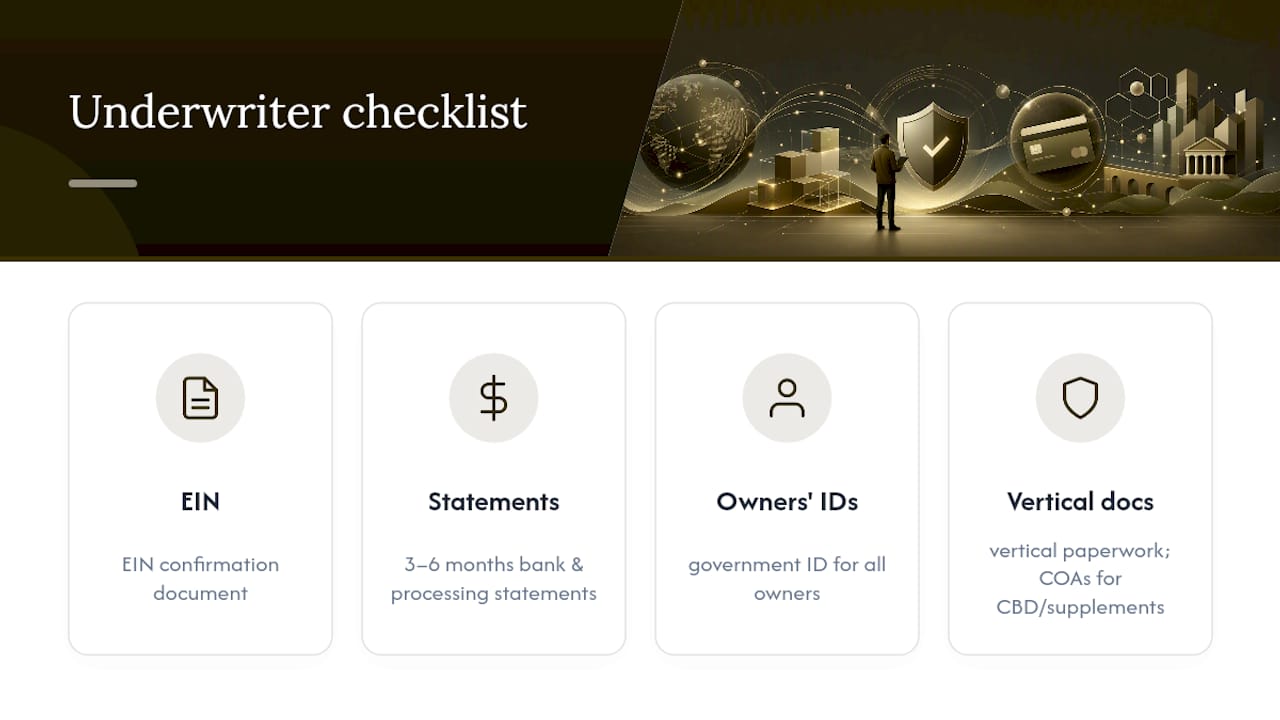
You’ll need your EIN confirmation, three to six months of bank and processing statements, government ID for all owners, and vertical-specific paperwork. Supplement and CBD merchants should have Certificates of Analysis ready. Underwriters routinely require these exact documents before they’ll move a file past initial review.
Beyond paperwork, underwriters review your website directly: refund policy, subscription disclosure language, visible contact information, and age gating where relevant. A missing subscription disclosure is one of the most common reasons a clean application still gets bounced.
On the numbers side, chargeback ratio comfortably under 1% by count is the target underwriters want to see, alongside a clean MATCH screening result and processing volume that doesn’t swing wildly month to month.
If you have a prior MATCH listing or terminated account, don’t bury it. Disclose it upfront with context: what caused it, what you fixed, and what’s different now. Underwriters see hidden history as a bigger red flag than the history itself.
Pro Tip: Pull your own MATCH status and a fresh chargeback report before you apply anywhere. Walking into underwriting with your own numbers in hand signals you run a tight operation, and it lets you get ahead of any conversation before it becomes a decline.
How Much Do Reserves and Fees Really Cost You?
High-risk processing costs more, and the pricing structure works differently than standard merchant accounts.
Expect fees at higher rates than standard accounts, with rolling reserves held for extended periods typically used as a financial safeguard. That reserve isn’t a penalty. It’s collateral against future chargebacks, and it directly affects your cash flow planning. Settlement on approved transactions typically runs 3 to 7 business days, slower than the near-instant settlement lower-risk merchants often get.

Crypto rails offer an alternative worth understanding: fees around 0.5 to 1 percent with no chargebacks at all, though volatility and limited customer adoption make pure-crypto setups impractical for most subscription businesses. Many established operators run hybrid card-plus-crypto models for redundancy rather than betting everything on one rail.
Your best defense against chargebacks is operational, not contractual:
- Make pre-authorization terms unmistakably clear at checkout
- Document fulfillment and delivery for every order
- Build a dispute evidence file before you need it
- Send renewal reminders ahead of every recurring charge
None of that is optional if you’re running subscription billing. A clean chargeback trend, even if the absolute number isn’t perfect yet, is your strongest negotiating chip for lowering that reserve later.
Which Integration Model Fits a High-Risk Checkout?
Your integration choice affects both conversion and your compliance burden, so this isn’t purely an engineering decision.
You have three basic paths: hosted redirect (simplest, lowest PCI scope), hosted fields with tokenization (better conversion, moderate scope), or a full API integration with tokenized data (maximum control, maximum PCI responsibility). Most regulated merchants land on hosted fields as the practical middle ground.
- Choose your integration tier based on engineering resources and PCI appetite, not just conversion targets.
- Build in orchestration so transactions route across multiple acquirers rather than depending on one. Multi-acquirer routing is standard practice for high-risk merchants specifically to avoid a single point of failure taking down your revenue.
- Layer in EMV 3-D Secure for additional fraud liability shift on card-not-present transactions.
- Add token and credential-updater services for subscription billing, since expired or reissued cards are a leading cause of involuntary churn.
- Confirm your PCI SAQ level with whichever integration model you pick, since e-skimming guidance from the PCI Security Standards Council now shapes how embedded checkout pages get scoped.
Pro Tip: Ask any prospective platform partner exactly how failover routing works when an acquirer drops a transaction. If they can’t describe the mechanism specifically, they probably haven’t built one.
How Do You Vet a High-Risk Payments Partner?
The wrong partner costs you more than money. It costs you approval time, operational stability, and sometimes frozen funds when things go wrong.
Require specialist underwriting experience in your specific vertical, not general ecommerce. Ask for multi-acquirer support and real orchestration, not a single MID with a backup story. Confirm chargeback tooling and subscription billing support exist natively, not bolted on. And get the reserve policy in writing, including the schedule for review and reduction.
Watch for these red flags during due diligence:
- Aggregator-only models with no dedicated merchant account path
- Vague or shifting reserve terms that change after you sign
- No references from merchants in your actual vertical
- Reluctance to explain their release schedule for held reserves
Mainstream aggregators routinely exclude high-risk verticals entirely, and termination on those platforms typically means frozen funds with little recourse. That’s not a partner, it’s a liability waiting to surface. Ask for a sample release schedule and speak to at least one reference merchant in your category before signing anything.
What’s the Application Timeline From Start to Approval?
A clean application moves faster, and most of the work happens before you ever submit it.
- Clean up your chargeback trend first. A falling trend beats a high but stable ratio in underwriting decisions, so timing your application after a remediation period pays off.
- Assemble every document in advance, including bank statements, processing history, owner ID, and vertical-specific certificates.
- Publish your policies clearly, especially refund terms and subscription disclosures, before underwriting reviews your site.
- Test your checkout flow end to end, confirming tokenization and 3-D Secure work as intended.
- Submit and expect a conditional response. Onshore approvals often run one to three weeks; offshore or crypto-hybrid setups can vary more depending on the acquirer.
- Once approved, monitor weekly, not monthly. Chargeback ratio and decline rate need close tracking in the first 90 days.
- Request reserve review after 90 to 180 days of clean processing history.
A borderline file rarely gets an outright no. The most common outcome is conditional approval with a reserve attached, and that reserve percentage is negotiable, not fixed.
Pro Tip: Come to reserve renegotiation with three months of clean processing data in hand. Underwriters respond to trend lines, not promises.
For platforms building on regulated rails more broadly, resources like Bitrupt’s overview of payments and regulated infrastructure are worth a look when you’re scoping custom integration work, and Workanova’s breakdown of KYC verification is a useful companion for tightening your compliance documentation before underwriting ever sees it.
What I’ve Learned Working With High-Risk Platforms
The mistake I see most often isn’t a weak business model. It’s mismatched documentation: a bank statement that doesn’t match the processing volume claimed, or a website missing the subscription disclosure that underwriting flags on sight. Both are fixable in an afternoon, yet they sink applications that would otherwise sail through.
Davincipay works exclusively in this space, across telehealth, nutraceuticals, subscription commerce, and other regulated categories, which means the underwriting conversations happen with someone who already knows what a COA is and why your chargeback ratio moved last quarter.
The founders who do best treat underwriting as a relationship to build early, not a hurdle to clear once. Reach out before you’re desperate, not after a shutdown notice.
— Peter
Ready to Apply for High-Risk Payment Processing?
If you’ve read this far, you already know the alternatives: patch together a mainstream processor that might terminate you without warning, or spend months piecing together your own multi-acquirer setup from scratch. Neither gets your processing faster.

Davincipay handles the pieces you’d otherwise assemble yourself: specialist underwriting for regulated categories, multi-acquirer relationships for routing resilience, built-in fraud and chargeback mitigation, and recurring billing tools designed for subscription models. If you run a telehealth practice, Davincipay’s telehealth-specific payment support is built around exactly the compliance questions your underwriter will ask. Supplement and nutraceutical brands get the same vertical fit through Davincipay’s nutraceutical payment services.
A specialist partner cuts the back-and-forth that stalls generalist applications for months. Start your application today at Apply Now with Davincipay and get your documents in front of underwriters who already speak your industry’s language.
This article is general information, not a substitute for advice from a qualified financial advisor. Consult a qualified financial professional about your own circumstances before acting on anything here.
Sources
- High-Risk Payment Processing Guide 2026 | BankMyCapital
- High-Risk Merchant Account Underwriting: What They Check | The Payments Edge
- How to Get a High-Risk Merchant Account: The Complete 2026 Guide | GetBanked


.webp)
