.png)
The best dunning strategy for subscription payments combines intelligent automated retries with staged, empathetic customer communications and segment-specific policies. You automate the technical recovery using retry logic and webhooks, guide customers through clear, well-timed messages, and treat different customer segments differently based on value and risk. Then you measure everything and adjust.
TL;DR:
- Automated retries using intelligent timing, like Stripe’s Smart Retries, typically span one to two weeks with multiple attempts to maximize recovery.
- Customer communication should be staged and empathetic, starting with light notices and escalating in urgency without sounding threatening.
- Segmentation by customer value, payment method, and failure history helps tailor retry attempts and messaging policies, improving overall recovery and retention.
- Reliable webhook event logging and monitoring of key metrics like recovery rate and response rate are essential for continuous improvement of the dunning process.
- High-risk or regulated subscription businesses must carefully balance retry aggressiveness with compliance and fraud prevention measures.
Table of Contents
- What is dunning and how it fits in subscription billing
- Why dunning matters for subscription businesses
- Core components of an effective dunning process
- Retry scheduling and automation: smart retries vs custom rules
- Messaging, tone, and channel strategy for dunning communications
- Segmentation and policy design: who gets which dunning path
- Metrics to track and KPIs for dunning success
- Practical implementation checklist and playbook
- Applying dunning best practices to high-risk and regulated subscription merchants
- Expert perspective: balance automation with human touch
- How DavinciPay can help subscription merchants improve payment recovery
- Sources
- FAQ
What is dunning and how it fits in subscription billing
Dunning management is the process of recovering revenue after a payment fails. It triggers the moment a card decline, expired payment method, or insufficient funds event stops a scheduled charge from going through. From there, your system takes over: retrying the payment, notifying the customer, and eventually escalating if nothing works.
People often confuse dunning with retries, but they are not the same thing. A retry is a technical action: your payment processor attempts the charge again at a scheduled interval. Dunning is the broader communication and decision layer wrapped around those retries. It decides when to notify the customer, what to say, and what happens if every retry fails.
A dunning sequence typically ends in one of three ways:
- The payment succeeds and the subscription continues without interruption.
- Access gets suspended while the account sits in a grace period, waiting on the customer to update billing details.
- The account moves to cancellation or, in rare cases, a collections process for outstanding balances.
Most subscription businesses want the vast majority of failed payments to land in that first outcome. Getting there consistently is what separates a strong dunning process from one that quietly bleeds revenue every month.
Why dunning matters for subscription businesses
Failed payments are routine in subscription billing. Cards expire, banks flag transactions, and balances run dry. What varies enormously is how much of that failed revenue you get back.
A structured dunning approach shortens the time it takes to close out failed payments and reduces lost recurring revenue, according to Gartner’s analysis of automated payment recovery. That matters because even a modest lift in recovery rate compounds across your entire subscriber base every billing cycle, month after month.
The churn angle matters just as much as the revenue angle. A customer whose card simply expired is not choosing to leave. Handle that moment poorly, with a cold, generic notice or no notice at all, and you turn a fixable billing hiccup into a canceled account. Handle it well, with a clear message and an easy way to update payment details, and most of those customers stay.
There is a real operational trade-off here. Aggressive retry schedules and frequent messaging can recover more revenue, but they also risk annoying customers who are still deciding whether to stay subscribed. The businesses that get this right treat dunning as a measurable function with clear owners and regular review, not a background process left on autopilot.

Core components of an effective dunning process
A working dunning process is built from a few distinct layers that all have to talk to each other.
- Detection. Your payment gateway fires a webhook event, typically something like
invoice.payment_failed, the moment a charge fails. Capture the metadata immediately: failure reason, card type, and timestamp all shape what happens next. - Retry scheduling. The system schedules another attempt based on your retry rules. Track
attempt_countandnext_payment_attemptso you always know where each customer sits in the sequence. - Staged communication. Each retry attempt (or a failure to reach one) triggers a message tuned to that stage, starting gentle and growing more urgent as the sequence progresses.
- Escalation. After a defined number of failed attempts, the account moves to a grace period, a support queue, or suspension, depending on your policy.
- Self-service recovery. A payment update link or in-app billing page lets the customer fix the problem in seconds rather than waiting for a human to intervene.
- Access management. Decide, in advance, whether access continues, is limited, or is cut off during the grace period. This decision affects both recovery rates and customer goodwill.
The webhook layer is the piece most teams underinvest in. Without reliable event capture, you are guessing at what state a customer’s payment is in, and that guesswork shows up as either premature cancellations or accounts that quietly keep access for weeks past when they should have lost it. Get the detection and logging layer right first. Everything else in the sequence depends on knowing exactly what happened and when.
Retry scheduling and automation: smart retries vs custom rules
Modern payment platforms have moved past fixed retry intervals. Stripe’s Smart Retries use time-dependent, dynamic signals and a model that picks the best moment to retry a failed payment based on patterns in when charges tend to succeed, rather than retrying on a flat schedule regardless of context.
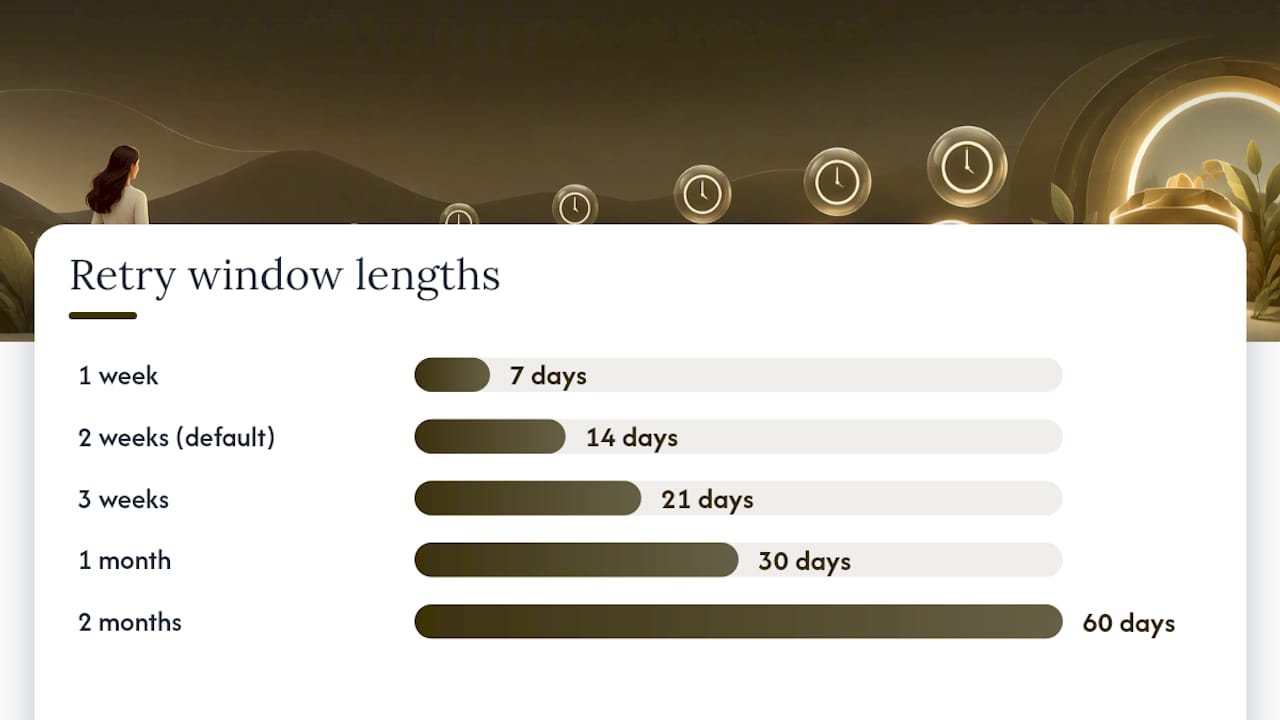
For most subscription businesses, a solid default is several retry attempts spread across one to two weeks. Stripe’s own documentation points to a default retry schedule with multiple attempts within a two-week period, while also supporting configurable windows of one week, two weeks, three weeks, one month, or two months depending on your risk tolerance and customer base.
A few integration points matter here:
- Listen for
invoice.payment_failedto detect the initial failure and kick off your communication sequence. - Watch
invoice.updatedfor changes in status as retries progress. - Use
attempt_countandnext_payment_attemptto keep your internal records and customer-facing messaging in sync with what the processor is actually doing. - Consider custom schedules instead of automated defaults when you operate in a regulated vertical, face unusual chargeback exposure, or serve a customer base with predictable payment timing, like paydays.
Pro Tip: Pair your retry schedule with segment rules so you are not spending the same number of attempts on a $9 trial account as you do on a high-value annual subscriber.
Messaging, tone, and channel strategy for dunning communications
The tone of a dunning message should shift as the sequence progresses, but it should never sound like a threat. Most failed payments are the result of an expired card or a temporary bank issue, not a customer trying to avoid paying you.
Every message needs a few core elements regardless of stage: a clear call to action (update payment, retry now, contact support), the exact amount and invoice details, and a direct link to fix the problem without logging into a full account dashboard.
- The first notice should be light and informational: “We had trouble processing your payment. Here’s how to update your card.”
- Middle-stage messages can add urgency and mention the access or cancellation timeline more directly.
- The final notice before suspension should state plainly what happens next and by when.
- Escalating to phone outreach or a collections process only makes sense for higher-value accounts or older balances, and should follow your own written policy so decisions are not made case by case.
Email remains the primary channel for most sequences, with in-app notifications and SMS reinforcing the message for customers who might miss an email. Keep the legal and collections boundary in mind: dunning communications are billing reminders, not collections notices, and that distinction should stay clear in both tone and timing until an account genuinely moves into a collections process.
Segmentation and policy design: who gets which dunning path
Treating every failed payment the same way wastes effort and, worse, can push good customers toward cancellation while barely nudging accounts that were never going to pay anyway.
- Segment by lifetime value, so high-value or long-tenured customers get more retry attempts, more communication touches, and longer grace periods than a brand-new trial account.
- Segment by payment method, since expired cards behave differently than insufficient-funds declines and often warrant different messaging.
- Segment by decline history, so an account with a pattern of repeated failures gets flagged for manual review rather than another automated retry.
- Set grace periods and cancellation timing per segment rather than applying one blanket rule across your entire subscriber base.
- Decide in advance whether failed-payment fees apply, and to which segments, so support teams are not making that call ad hoc.
Test your assumptions here instead of guessing. Run A/B tests on message timing, subject lines, and grace period length within a single segment before rolling a change out across your whole base. A change that improves recovery for annual subscribers might do nothing, or even hurt, for monthly trial accounts.
Metrics to track and KPIs for dunning success
You cannot improve what you do not measure, and dunning produces several numbers worth tracking closely.
- Recovery rate: the percentage of failed payments that eventually succeed, calculated as recovered payments divided by total failed payments over a given period.
- Effective collection rate: recovered revenue divided by total revenue at risk, which accounts for the dollar value of failures rather than just the count.
- Retry success rate: how often a given retry attempt, at a specific stage in the sequence, actually results in a successful charge.
- Response rate: how many customers engage with a dunning message, whether by clicking a link, updating a card, or contacting support.
Structured, measured dunning programs shorten time to recovery and reduce lost recurring revenue when paired with regular review, per Gartner’s guidance on automated payment recovery, and that review cycle is where the real gains come from.
Webhook events like invoice.payment_failed and invoice.updated feed most of these metrics directly, so your logging layer doubles as your measurement layer. Build a simple dashboard that breaks recovery rate down by segment, then use it to spot which segments are underperforming and deserve a policy change or a new message test.
Practical implementation checklist and playbook
Launching or upgrading a dunning program comes down to a short list of concrete actions.
- Set up webhook listeners for
invoice.payment_failedandinvoice.updated, and logattempt_countandnext_payment_attemptfor every account. - Configure retry rules, either the platform’s automated retry logic or a custom schedule suited to your risk profile.
- Build a self-service payment update flow that customers can complete in under a minute.
- Write message templates for each stage of the sequence, from first notice to final warning.
- Define customer segments and assign each one a distinct policy for retries, grace periods, and escalation.
- Assign an owner for manual escalations, so ambiguous or high-value cases do not fall through the cracks.
- Run a smoke test with a small batch of real failed payments before rolling the sequence out fully.
- Set a review cadence, monthly or quarterly, to check recovery rate and adjust segments or messaging.
Pro Tip: Roll out policy changes to one segment at a time so you can attribute any shift in recovery rate to the change you actually made.
Applying dunning best practices to high-risk and regulated subscription merchants
Dunning gets more complicated for merchants operating in high-risk or regulated categories, where chargeback exposure and compliance requirements shape how aggressive you can afford to be with retries and messaging. DavinciPay specializes in payment solutions and merchant services for high-risk and complex ecommerce businesses, including subscription merchants in nutraceuticals, telehealth, and supplements.
- Retry aggressiveness needs adjusting based on chargeback risk. A vertical with tighter dispute ratios calls for fewer, more carefully timed retries rather than the maximum allowed by default settings.
- Compliance requirements, particularly for telehealth and nutraceutical subscription billing, shape what a dunning message can say and how quickly access can be suspended.
- Underwriting, fraud prevention, and customer support need to stay coordinated, since a dunning sequence that ignores fraud signals can end up retrying a card that was already flagged for suspicious activity.
Getting these pieces to work together takes more coordination than a standard subscription business needs, which is exactly where specialized payment infrastructure earns its keep.
Expert perspective: balance automation with human touch
Automation should handle the routine cases so people can focus on the ones that need judgment. High-value accounts, unusual decline patterns, or customers who reply to a dunning email with a question deserve a person, not another automated retry.
Route those cases to an account team with clear ownership, not a shared inbox nobody checks. The goal of automation is freeing up that attention, not replacing it entirely.
— Peter
How DavinciPay can help subscription merchants improve payment recovery
Recovering failed payments is only half the equation if your underlying payment infrastructure was not built for subscription billing in complex verticals to begin with. Some payment providers work with subscription merchants in nutraceuticals, supplements, and telehealth, pairing recurring billing support with fraud prevention tools and chargeback mitigation so dunning sequences run against a stable processing foundation rather than one at risk of sudden freezes.

If your business operates in a high-risk or regulated category and needs payment infrastructure built around that reality, you can apply now to see what DavinciPay’s underwriting and support team can set up for your subscription model.
Sources
For deeper technical detail, review Stripe’s Smart Retries documentation and Gartner’s analysis of automated payment recovery. For a broader look at recurring payment mechanics, see this overview of recurring payments and this explanation of automated customer follow-up.
FAQ
What is dunning in payment?
Dunning is the process of recovering revenue after a subscription payment fails, combining automated retries with customer communications. It typically starts the moment a card decline or expired payment method blocks a scheduled charge and continues until the payment succeeds or the account is suspended or canceled.
What is a dunning strategy?
A dunning strategy is the combined set of retry rules, message sequences, and segmentation policies a business uses to recover failed payments. The strongest approach pairs automated retry scheduling, like Stripe’s Smart Retries, with staged, empathetic messaging and different rules for different customer segments.
What happens if you get mailed a dunning?
Receiving a dunning notice means a payment tied to your account, usually a subscription charge, has failed and needs attention. The notice typically explains what happened and gives a link or instructions to update your payment method before access is suspended.
What are the four stages of a dunning letter?
Definitions vary across industries, but a common structure moves through a friendly first reminder, a firmer follow-up notice, a final warning before suspension or cancellation, and, in some cases, a formal notice tied to a collections process. The exact stages and timing depend on the business’s own dunning policy.


.webp)
