.png)
Low-risk merchants selling to one country usually do best with domestic acquiring, since it typically improves approval rates and settles funds in local currency. High-risk, subscription-heavy, or cross-border sellers often need offshore acquiring, or a blend of both, to secure reliable approval. We built our service around placing merchants correctly across both models, especially in regulated and high-risk verticals.
TL;DR:
- Domestic payouts arrive within one to three business days, while offshore settlement can take a week or longer and adds currency conversion costs and reconciliation.
- Offshore transactions incur interchange, acquirer markup, international assessment fees, and foreign exchange spreads, while domestic transactions typically carry only interchange and acquirer markup.
- Visa rules restrict where acquirers may hold merchant relationships, so confirm which international exceptions cover your vertical before relying on offshore placement.
- A blended setup can route local transactions domestically and international volume offshore, with each relationship underwritten separately against its own risk profile.
- Underwriters require processing history, chargeback records, business licensing, and vertical compliance documents, so prepare these before applying for either acquiring model.
Table of Contents
- What Domestic and Offshore Acquiring Actually Mean
- How Domestic Acquiring Works in Practice
- How Offshore Acquiring Handles Cross-Border Transactions
- What Domestic and Offshore Acquiring Actually Cost
- Why Approval Rates and Settlement Speed Diverge
- Card Network Rules and Underwriting Constraints to Know
- A Practical Checklist for Choosing Your Acquiring Model
- How We Structure Acquiring for High-Risk Merchants
- Chargeback Management: Domestic vs Offshore Disputes
- How Acquiring Choice Shapes Checkout Conversion
- What Merchants Get Wrong About Choosing a Model
- Get Placed With the Right Acquiring Model
- FAQ
- Sources
What Domestic and Offshore Acquiring Actually Mean
Domestic acquiring means your acquiring bank sits in the same country as your business and, usually, your customer’s card issuer. Offshore (cross-border) acquiring means your acquirer operates outside the market where your customers hold their cards, routing transactions internationally before they land at your bank.
The schematic is simple. In domestic acquiring, a transaction travels from the customer’s card issuer to a local acquirer, then to your merchant account, often settling the next business day in your home currency. In offshore acquiring, that same transaction crosses borders before settlement, which adds network hops, FX conversion, and processing time.
- Domestic acquiring keeps the transaction path short and the currency consistent.
- Offshore acquiring adds cross-border routing, which can mean added fees and slower payouts.
- The model you choose shapes approval rates, cost structure, and how fast you see your money.
This distinction matters because every downstream decision, from pricing to compliance to customer experience, traces back to which model is handling your transactions.
How Domestic Acquiring Works in Practice
Domestic acquiring puts you in a direct relationship with a local acquiring bank, often paired with a payment gateway and sometimes a payment service provider that bundles the two. Here’s what that relationship typically looks like:
- You sign a merchant agreement with a domestic acquirer or a PSP that places you with one.
- You integrate a gateway that connects your checkout to the acquirer’s processing rails.
- The acquirer underwrites your business, reviewing your vertical, processing history, and risk profile before approval.
- Transactions settle in your local currency, usually within one to three business days.
- You reconcile deposits against your bank statement, with minimal currency conversion to track.
Underwriting for domestic accounts tends to move faster for low-risk, well-documented businesses. High-risk verticals, including supplements, telehealth, and subscription billing, face more scrutiny even within domestic models, since acquirers weigh chargeback history and industry risk heavily before approval.
How Offshore Acquiring Handles Cross-Border Transactions
Offshore acquiring routes your transactions through an acquirer based outside your customers’ home market. That acquirer processes multi-currency transactions, converts them at its own FX rate, and settles proceeds to you, often in a currency different from what your customer paid in.
- Foreign acquirers typically batch transactions across multiple markets, applying FX conversion before your payout.
- Payout timing often runs longer than domestic settlement, sometimes stretching to a week or more depending on the banking relationship.
- Reconciliation gets more complex, since you’re matching gross sales in one currency against net deposits in another after fees and FX spreads.
- Some merchants turn to offshore acquiring specifically because domestic banks in their market decline their vertical outright, whether for CBD, adult content, or certain lending products.
- Offshore placement can open acceptance in markets where no domestic acquirer will take the risk.
For merchants locked out of domestic banking because of their product category, offshore acquiring isn’t a workaround. It’s often the only functioning path to accepting cards at all.
What Domestic and Offshore Acquiring Actually Cost
Your all-in cost depends on four layers stacking on top of each other: interchange (set by the card networks), acquirer markup, cross-border or assessment fees, and FX spreads. Domestic transactions typically only carry the first two. Offshore transactions carry all four.
- Interchange rates vary by card type and transaction category, regardless of acquiring model.
- Cross-border and international assessment fees apply specifically when the acquirer sits outside the cardholder’s market.
- FX spreads, charged on top of network-set conversion rates, add further cost whenever a transaction converts currency.
- Offshore accounts often carry higher reserve requirements and longer chargeback windows than domestic counterparts.
Industry explainers consistently note that cross-border acquiring carries higher fees and FX costs than domestic acquiring, while offering broader market reach, a trade-off every high-risk merchant should price into their margins before choosing a model.
Reserves and extended hold periods matter as much as the per-transaction fees.
Why Approval Rates and Settlement Speed Diverge
Issuers generally approve domestic transactions more readily than cross-border ones, since foreign-acquired transactions trigger additional fraud scrutiny by default. That scrutiny isn’t arbitrary: cross-border card-not-present transactions carry a statistically higher fraud rate across the industry, so issuers respond by declining more of them at the authorization stage.
- Domestic acquiring tends to produce higher approval rates because issuers recognize local acquirer identifiers and apply less friction.
- Offshore routing often triggers additional verification steps, which can lower approval rates even for legitimate transactions.
- Settlement timing differs sharply: domestic payouts often land in one to three days, while offshore payouts can take a week or longer depending on the banking chain.
- Slower settlement ties up working capital, which matters most for subscription and recurring-billing merchants managing tight cash cycles.
For merchants running high transaction volume with thin margins, the gap between domestic and offshore approval rates can matter more than the fee difference.
Card Network Rules and Underwriting Constraints to Know
Card network rules set firm boundaries on where acquirers and merchants can legally operate together. The Visa Core Rules and Visa Product and Service Rules require acquiring entities to be licensed within the jurisdictions where they provide merchant services, with specific tables governing permitted cross-border exceptions.
- Visa’s framework restricts where an acquirer can legally hold a merchant relationship, which limits pure offshore setups for some merchant types.
- Payment Facilitator and marketplace rules add location and equity requirements that shape how sub-merchants get onboarded under a PF model.
- PCI DSS applies regardless of acquiring model, and the PCI Compliance Requirements for US SMBs provide practical guidance on reducing scope and planning compliance to limit exposure effectively.
- High-risk verticals, including telehealth and nutraceuticals, commonly need underwriting tailored to their category, sometimes across multiple jurisdictions at once.
Pro Tip: Ask any prospective acquirer directly which Visa cross-border exceptions apply to your vertical before signing, since the answer determines whether offshore placement is even viable for your business.
A Practical Checklist for Choosing Your Acquiring Model
Run through these factors before committing to one model:
- Where do most of your customers hold their cards, and does that match your target acquirer’s market?
- What’s your average ticket size, and does it change your fraud exposure?
- What’s your refund and chargeback rate over the past six months?
- Does your vertical carry elevated risk flags with domestic banks in your market?
- Do you need to settle in multiple currencies, or is one currency enough?
- Are you planning to expand into new markets in the next 12 to 24 months?
Favor domestic acquiring when your customer base, bank relationships, and growth plans stay within one market. Favor offshore, or a blended setup, when domestic banks decline your vertical or your customer base spans borders.
| Factor | Favors domestic | Favors offshore |
|---|---|---|
| Customer location | Single market | Multiple markets |
| Vertical risk | Low to moderate | High-risk category |
| Settlement need | Local currency only | Multi-currency |
| Bank access | Domestic approval available | Domestic decline |
Before switching or adding a model, prepare your processing history, chargeback reports, and business documentation, since underwriters request these regardless of which route you choose.
How We Structure Acquiring for High-Risk Merchants
We work with high-risk and complex ecommerce merchants every day, and the pattern repeats: a single acquiring relationship rarely covers every scenario a growing merchant faces. We place merchants across domestic and international acquiring relationships, payment gateways, and underwriting support, matching the acquiring structure to the vertical and the customer base rather than forcing one model to fit everything.
When we onboard a merchant, we typically request processing history, chargeback ratios, business licensing, and product documentation specific to the vertical. For merchants needing mixed routing, we structure relationships so domestic transactions settle through a local acquirer while cross-border volume routes through a separate offshore relationship, each underwritten against its own risk profile. Our structure supports age verification tools, real-time monitoring, and built-in chargeback mitigation without adding separate vendors for each piece.
Chargeback Management: Domestic vs Offshore Disputes
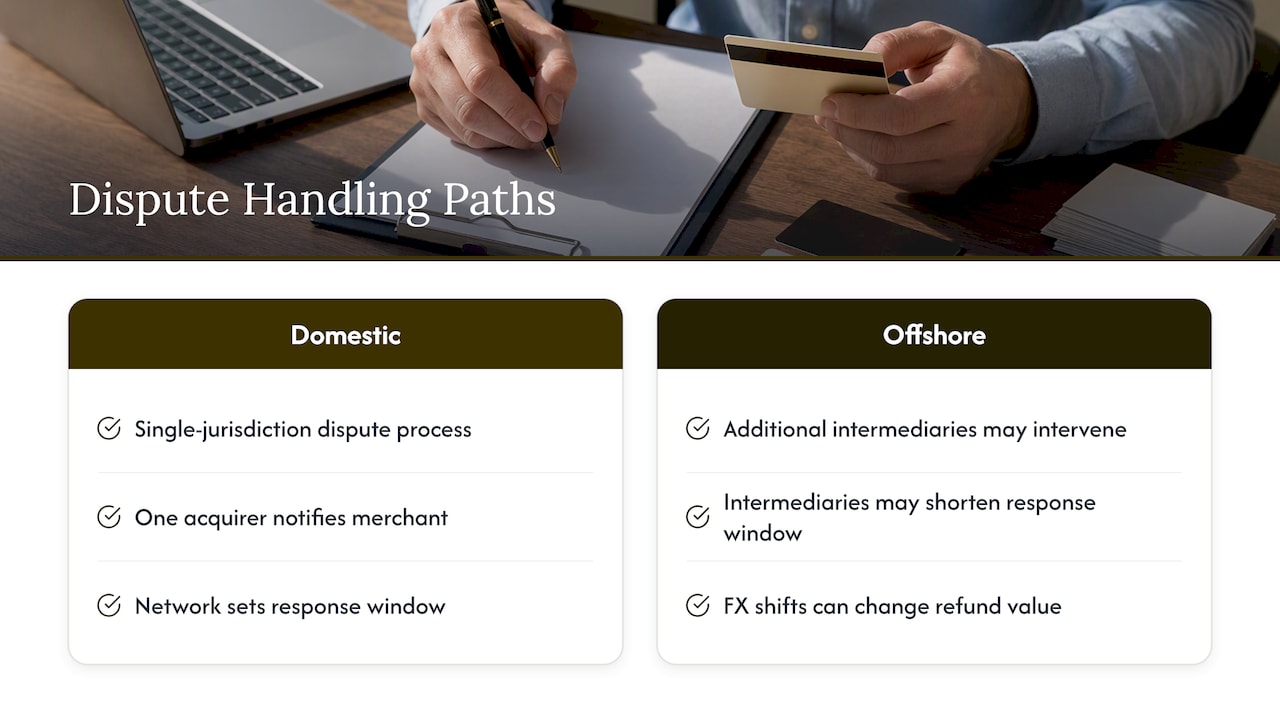
Chargeback handling changes meaningfully depending on which acquirer sits behind your transaction. Domestic disputes typically move through a single-jurisdiction process: the issuer files, your acquirer notifies you, and you respond within a window set by the card network, usually with documentation submitted directly to that one acquirer.
Offshore disputes add layers. Because the acquirer operates outside the cardholder’s market, dispute notifications sometimes pass through additional intermediaries before reaching you, which can shorten your effective response window even when the stated deadline looks the same. Currency conversion on refunded amounts adds another wrinkle, since the refund value in your settlement currency may not match the original sale value once FX rates shift between the transaction and the chargeback.
High-risk verticals feel this most. Subscription merchants, telehealth providers, and supplement brands already carry higher baseline dispute rates, and an offshore acquiring relationship without strong chargeback tooling can compound that risk quickly. Reserve requirements often rise in response, and repeated disputes can trigger closer account review or account freezes regardless of acquiring model.
The practical fix isn’t choosing one model purely to avoid disputes. It’s pairing whichever model you use with real-time transaction monitoring and documented evidence trails, so you can respond fast regardless of how many parties sit between you and the issuer.
How Acquiring Choice Shapes Checkout Conversion
Customers rarely know what acquiring model is processing their card, but they feel the results. A decline at checkout, a longer authorization delay, or an unexpected currency conversion on their statement all trace back to acquiring architecture, even though the customer only sees a failed payment or a confusing charge.
Domestic acquiring tends to produce faster authorization responses and fewer unexpected declines, since issuers process local acquirer requests with less friction. That translates directly into checkout conversion: a customer who gets approved on the first attempt completes the purchase, while one who gets declined often abandons the cart rather than retrying.
Offshore acquiring can introduce a different kind of friction. Extra fraud screening steps, slightly longer authorization times, or a statement descriptor that lists a foreign currency can all raise customer doubt mid-checkout, particularly for first-time buyers unfamiliar with the brand.
For subscription and recurring-billing merchants, the stakes compound over time. A failed renewal charge because of acquirer-related decline patterns doesn’t just cost one transaction, it risks losing the customer relationship entirely. Getting the acquiring model right at setup, rather than troubleshooting declines after launch, protects both the first sale and the recurring revenue that follows it.
What Merchants Get Wrong About Choosing a Model
Most merchants treat domestic versus offshore acquiring as a binary choice, when the stronger move is almost always a blend calibrated to actual transaction patterns. The conventional advice, pick the cheapest acquirer and optimize later, ignores that approval rates and reserve terms affect cash flow far more than headline processing rates do.
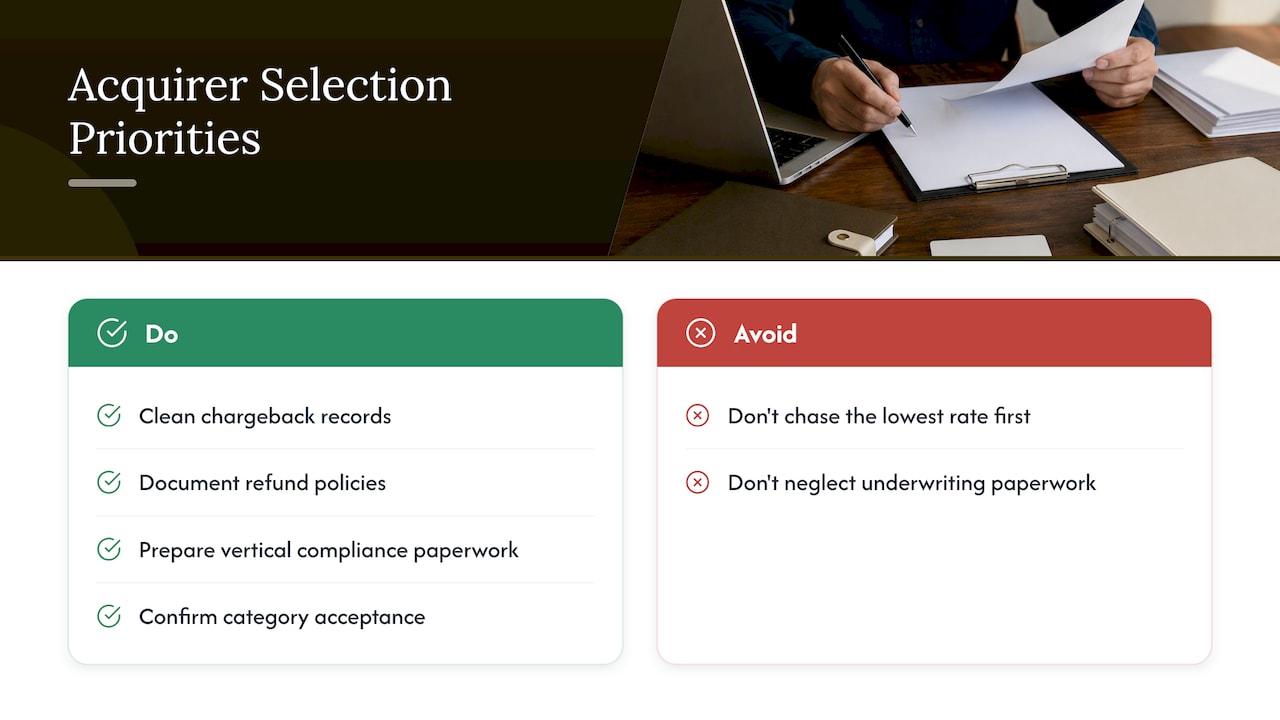
The bigger blind spot is underwriting readiness. Merchants spend weeks comparing fee schedules and almost no time preparing the documentation, chargeback history, and compliance paperwork that actually determine whether an acquirer approves them at all. A slightly higher rate from an acquirer that approves you in days beats a cheaper rate from one that takes months or declines outright.
Prioritize readiness first: clean chargeback records, documented refund policies, and vertical-specific compliance paperwork. Then evaluate cost. High-risk merchants especially should resist the urge to chase the lowest rate before confirming which acquirers will even take their category.
— Peter
Get Placed With the Right Acquiring Model
We specialize in high-risk and complex ecommerce placement, focusing on matching merchants to the acquiring model, domestic, offshore, or both, that actually gets approved and stays approved. Our onboarding moves fast, with approvals possible in as little as 24 hours for qualifying merchants, backed by transparent pricing and reserve terms instead of surprise holds.

If you’re ready to see where you fit, apply now and we’ll walk you through underwriting requirements for your vertical. Want to understand the process first? Our how it works page breaks down onboarding, integration, and account structure step by step.
FAQ
What are the four types of payment methods?
The four broad categories merchants typically accept are credit cards, debit cards, bank transfers (including ACH), and digital wallets. Each carries different authorization, settlement, and fraud characteristics that interact differently with domestic versus offshore acquiring setups.
How is offshore banking different from onshore banking?
Onshore banking means your financial accounts sit within your home country’s regulatory jurisdiction, while offshore banking means your accounts sit in a different country’s jurisdiction. In payment processing terms, this mirrors domestic versus offshore acquiring: the acquirer’s jurisdiction determines which banking rules, currencies, and compliance requirements apply to your transactions.
What is a TT and LC payment?
TT (telegraphic transfer) refers to a direct bank wire transfer between accounts, while LC (letter of credit) is a bank-issued guarantee that a seller receives payment once trade conditions are met. Both are trade finance tools used mainly for large B2B or international wholesale transactions, separate from the card-acquiring models discussed here.
Does DavinciPay offer both domestic and offshore acquiring?
Yes, we place merchants with domestic and international acquiring relationships depending on their vertical, customer base, and risk profile. Many high-risk merchants benefit from a blended setup rather than relying on a single model.
How fast can a high-risk merchant get approved?
Approval timelines vary by vertical and documentation readiness, though we offer onboarding in as little as 24 hours for qualifying merchants. Preparing processing history, chargeback records, and compliance documentation in advance speeds up underwriting significantly.


.webp)
