.png)
Digital subscription billing is the automated process that charges customers on a recurring schedule, manages plan changes, and handles payment retries to keep revenue flowing without manual intervention. The industry term for this discipline is recurring revenue management, and understanding how it works is the first step to building a predictable, scalable business. The subscription billing management market was valued at $8 to $10 billion in 2025. That figure reflects just how much operational complexity sits behind a simple monthly charge. Whether you run a nutraceutical brand, a telehealth platform, or a SaaS product, getting digital subscription billing explained clearly and completely is not optional. It is foundational.
How does digital subscription billing work?
Subscription billing follows a defined sequence of events from the moment a customer signs up to the moment their payment clears. Each step is automated, but each step also carries real financial and compliance weight.
-
Customer enrollment. The customer selects a plan and enters payment details. The billing system immediately tokenizes the card data. Tokenization replaces sensitive card data with a non-sensitive token used for all future charges. This is mandatory under PCI DSS and removes raw card numbers from your environment entirely.
-
Invoice generation. At each renewal interval, whether monthly, quarterly, or annually, the system generates an invoice automatically. The invoice reflects the current plan, any applicable discounts, and taxes based on the customer’s location.
-
Payment processing. The charge request travels from your payment gateway through card networks to the customer’s issuing bank. Payment authorization completes in under 2 seconds despite the multiple parties involved. That speed is what makes real-time subscription billing feel invisible to the customer.
-
Mid-cycle adjustments. When a customer upgrades or downgrades mid-cycle, proration applies automatically in most subscription billing systems. The customer pays only for the time they used each plan tier. This keeps billing fair and reduces disputes.
-
Failed payment recovery. Not every charge succeeds on the first attempt. Automated dunning workflows combine retry logic and customer notifications over several days to recover failed payments. This process directly reduces involuntary churn, which is churn caused by payment failure rather than a customer’s decision to leave.
-
Revenue recognition and reporting. The billing engine acts as a revenue subledger between CRM and ERP, transforming raw subscriber data into clean, compliant financial records. This integration keeps your accounting accurate and your audits manageable.
Pro Tip: Set your dunning sequence to span at least five to seven days with a mix of automatic retries and direct customer emails. A single retry attempt recovers far fewer failed payments than a structured multi-step sequence.
What are the benefits of subscription billing for your business?
Subscription billing delivers advantages that go well beyond collecting a monthly fee. The structure of the model itself creates compounding business value.

Predictable revenue. Fixed recurring charges let you forecast cash flow with real accuracy. You know what revenue to expect next month before the month begins. That predictability makes hiring, inventory, and marketing decisions far less risky.
Higher customer retention. Automated lifecycle management keeps customers active without requiring your team to chase renewals. The system handles reminders, retries, and plan communications. Customers who stay enrolled longer generate more lifetime value with no additional acquisition cost.
Operational efficiency. Automation removes the manual work of generating invoices, tracking payments, and updating records. Your finance team spends less time on data entry and more time on analysis. Errors that come from manual processing drop significantly.
The analytics layer is where subscription billing creates a genuine competitive edge. Subscription billing systems provide data on churn, plan popularity, and discount effectiveness that directly informs product and pricing decisions. Knowing which plan tier retains customers longest, or which discount converts trials to paid accounts, gives you a clear picture of where to invest next.
- Churn rate tracking shows you exactly how many customers cancel each month and when in the lifecycle they leave.
- Customer lifetime value (CLV) reporting quantifies the total revenue a customer generates over their relationship with your business.
- Plan mix analysis reveals which pricing tiers drive the most revenue and which underperform.
- Dunning recovery rates measure how effectively your failed payment workflows recapture lost revenue.
- Usage data (for consumption-based models) shows which features or services customers actually use, guiding product development.
How does subscription billing differ from standard recurring billing?
Standard recurring billing charges a fixed amount at a set interval. That is the full extent of its capability. It works for simple use cases like a fixed monthly retainer, but it breaks down the moment your business needs any flexibility.
Subscription billing handles the complex financial events that standard recurring billing cannot. Subscription billing manages dynamic lifecycle events including mid-cycle proration, usage metering, and automated compliance tracking. A customer who upgrades from a $29 plan to a $79 plan on day 15 of a 30-day cycle should pay a prorated difference, not a full month at the new rate. Standard recurring billing cannot calculate that. Subscription billing does it automatically.
Usage-based billing is another area where the gap is clear. If your product charges by the API call, the gigabyte, or the active user, you need a system that meters consumption and translates it into accurate invoice line items. Standard recurring billing has no mechanism for this.
Pro Tip: If your business offers trials, discounts, or any form of plan flexibility, you need a full subscription billing system. Standard recurring billing will create billing errors and customer disputes the moment your pricing gets more complex than a single flat fee.
The compliance dimension also separates the two. Subscription billing platforms automate revenue recognition under standards like ASC 606, which governs how and when revenue can be recorded. Standard recurring billing tools leave that work to your accounting team. For any business with investors, auditors, or plans to raise capital, automated revenue recognition is not a luxury.
What features matter most in subscription billing management?
Choosing or building a subscription billing system requires clarity on which features actually drive results. Not every feature in a billing platform earns its complexity.
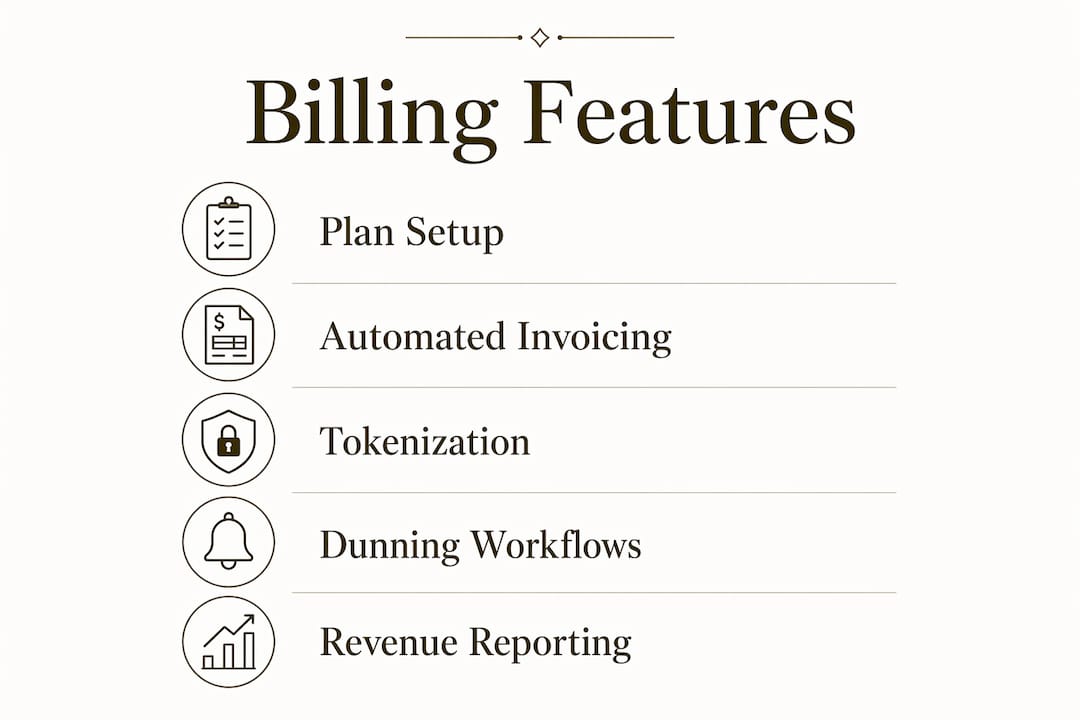
Plan and pricing management is the foundation. Your system must support multiple plan tiers, free trials, promotional pricing, and coupon codes without requiring developer intervention for each change. Marketing teams need to test pricing without filing a ticket.
Automated invoicing and payment collection removes the single biggest source of billing errors: human handling. Every invoice should generate, send, and reconcile without manual steps.
Tokenization and PCI DSS compliance protect your business and your customers. Storing raw card data creates liability. A compliant tokenization system eliminates that exposure entirely.
Dunning workflows are the most underestimated feature in subscription billing. Automated dunning reduces involuntary churn by recovering payments that would otherwise be lost to expired cards or temporary declines. A well-configured dunning sequence is one of the highest-return investments in your billing infrastructure.
Revenue recognition and reporting keep your financials audit-ready. The billing engine should produce clean journal entries that your ERP can consume directly, without manual reconciliation.
Integration with CRM and ERP systems is what turns billing data into business intelligence. When your billing platform connects to your CRM, your sales and support teams see the same customer status your finance team sees. That alignment prevents the common problem of a customer receiving a sales call while their account is in collections.
Pro Tip: Before selecting a billing platform, map every pricing scenario your business currently uses or plans to use in the next 12 months. Test each scenario in any platform you evaluate. Billing edge cases, like mid-cycle upgrades combined with a trial credit, expose system limitations faster than any sales demo.
Key Takeaways
Digital subscription billing is the most complete system for managing recurring revenue because it automates every stage from enrollment to revenue recognition, including the complex events that standard billing tools cannot handle.
| Point | Details |
|---|---|
| Tokenization is non-negotiable | PCI DSS requires replacing card data with tokens; this protects your business and reduces compliance scope. |
| Dunning drives recovery | Multi-step retry and notification workflows recover failed payments that a single retry attempt misses. |
| Proration builds customer trust | Automatic mid-cycle adjustments prevent billing disputes and reduce cancellations caused by perceived overcharges. |
| Analytics inform strategy | Churn, CLV, and plan mix data from your billing system directly guide pricing and product decisions. |
| Integration closes the data gap | Connecting billing to CRM and ERP gives every team a single, accurate view of customer and revenue status. |
What I’ve learned about subscription billing that most guides skip
Most articles on this topic focus on the mechanics and stop there. The mechanics matter, but the real leverage in subscription billing comes from treating it as a data system, not just a payment system.
Every billing event is a signal. A failed payment is not just a revenue problem. It is a customer health indicator. A mid-cycle upgrade is not just a billing adjustment. It is a product signal showing which features drive perceived value. Businesses that read those signals and act on them consistently outperform businesses that treat billing as back-office infrastructure.
The second thing I see businesses get wrong is underinvesting in dunning. Failed payments are not rare edge cases. Card declines, expired cards, and temporary bank holds affect a meaningful share of any subscriber base every month. A dunning sequence that spans multiple days with varied retry timing and direct customer communication recovers a substantially higher share of that revenue than a single automatic retry. The businesses that configure this well treat it as a revenue recovery program, not a billing afterthought.
The third gap is integration. Billing data sitting in isolation is billing data wasted. When your billing platform feeds your CRM, your support team knows a customer’s payment status before picking up the phone. When it feeds your ERP, your finance team closes the month faster with fewer reconciliation errors. The payment processing infrastructure you build around your billing system determines how much of that value you actually capture.
Usage-based pricing is also worth watching closely. More businesses are moving away from flat-rate tiers toward consumption models that charge customers based on actual use. This model aligns cost with value for the customer, which improves retention. It also adds complexity to your billing engine. If you plan to move in this direction, build for it before you need it.
— Peter
Davincipay and subscription billing for complex businesses
Subscription businesses in high-risk categories face payment processing challenges that standard billing setups cannot solve. Nutraceutical brands, telehealth platforms, and supplement merchants often encounter account terminations, high chargeback thresholds, and limited acquiring options that disrupt their recurring revenue entirely.
Davincipay specializes in payment processing for high-risk businesses that run subscription models. We connect merchants to domestic and international acquiring relationships, provide payment gateways built for recurring billing, and offer chargeback mitigation tools that protect your revenue. Our underwriting team understands the compliance requirements specific to subscription merchants, including PCI DSS tokenization and dunning infrastructure. If your business needs a payment partner that knows subscription billing from the inside, apply for an account and get a fast approval decision from our team.
FAQ
What is digital subscription billing?
Digital subscription billing is the automated system that charges customers on a recurring schedule, manages plan changes, and handles failed payment recovery. It covers the full revenue lifecycle from enrollment to revenue recognition.
How does tokenization protect subscription billing data?
Tokenization replaces a customer’s card number with a non-sensitive token stored by the billing system. This removes raw card data from merchant environments and reduces PCI DSS compliance scope significantly.
What is dunning in subscription billing?
Dunning is the automated process of retrying failed payments and notifying customers over a set period. A well-structured dunning workflow recovers a meaningful share of payments lost to card declines or expired credentials.
When should a business use subscription billing instead of standard recurring billing?
Use subscription billing when your pricing includes trials, proration, usage-based charges, or multiple plan tiers. Standard recurring billing handles only fixed charges at fixed intervals and cannot manage complex lifecycle events.
How does subscription billing integrate with CRM and ERP systems?
The billing engine acts as a revenue subledger that passes clean financial records to your ERP and customer status updates to your CRM. This integration keeps billing data consistent across finance, sales, and support teams.


.webp)