Device fingerprinting identifies the device behind a payment by combining browser, hardware, software and network signals into a profile. A merchant or processor then compares that profile with past activity to judge risk. It helps you spot repeat fraudsters, account takeovers and suspicious velocity. It does not prove who the person is, and it works best as one layer among several. This guide explains how it works, where it breaks, what U.S. regulators say, and how to use it without turning away good customers.
TL;DR
- Device fingerprinting collects attributes such as browser, operating system, screen settings, time zone and language, then scores how familiar or risky a device looks.
- It is stronger than a cookie alone, but it is probabilistic. It recognizes a device, not a person, and attackers can mimic fingerprints.
- In the U.S., the FTC Act bars unfair and deceptive data practices, so what you collect and what you tell customers must match.
- Pair fingerprints with other controls such as 3-D Secure, velocity rules, identity checks and chargeback tools to cut fraud and false declines.
- High-risk merchants gain the most when fingerprinting sits inside a full risk stack, not on its own.
Table of Contents
- What device fingerprinting means in online payments
- What a fingerprint can collect
- How merchants and payment teams use fingerprints
- Fingerprints versus cookies and IP addresses
- How reliable is it?
- Privacy and legal considerations in the United States
- Sharing device data across the payments chain
- Using fingerprints without adding friction
- Our perspective
- How DavinciPay supports high-risk merchants
- A practical rollout plan
- FAQ
- Sources
What device fingerprinting means in online payments
Every browser and device presents a bundle of details when it loads your checkout page. Device fingerprinting gathers enough of those details to tell one device from another, without asking the customer to do anything.
One U.S. patent publication describes a common design. JavaScript on a merchant page collects the device data, stores the fingerprint, and ties it to a transaction through a session key so the transaction can be analyzed for fraud risk. That is the basic pattern behind most systems today: collect on the page, store server-side, and link to the order.
The result is a device ID or a risk profile. If the same device shows up on ten accounts in an hour, or a device that has always bought from Texas suddenly looks like a different machine, the system can flag it before you ship product or release funds.
What a fingerprint can collect
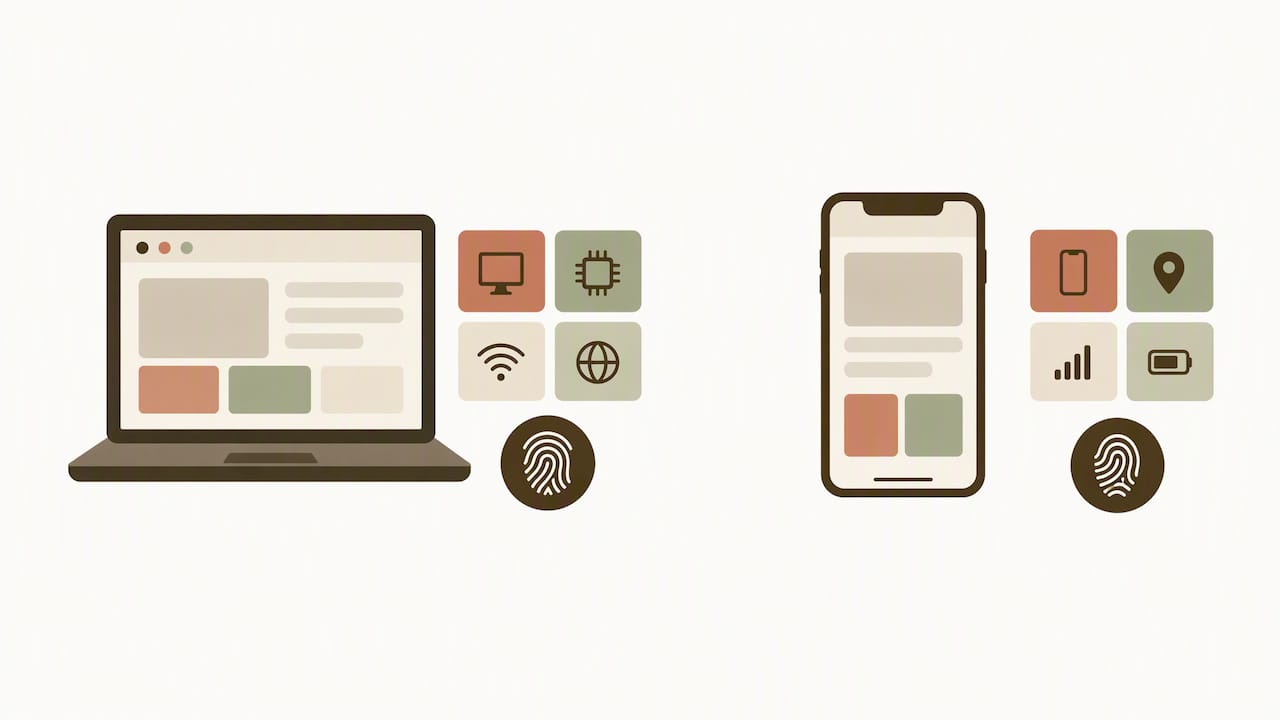
The exact list depends on the vendor and the channel. Documentation for one issuer-side risk platform says its machine fingerprinting gathers browser information, operating-system details, screen settings, time zone, language and system locale, then analyzes them in real time to build a device risk profile.
Browsers and apps differ a lot. A Secure Technology Alliance white paper notes that browser-based authentication collects roughly a dozen primary device data elements, while EMVCo has defined more than 150 for in-app authentication. So an app transaction gives a risk engine far more to work with than a web checkout.
Typical signal groups include:
| Signal group | Examples | What it tells you |
|---|---|---|
| Browser | User agent, language, installed features | Whether the browser looks standard or tampered with |
| Operating system | Version, locale, time zone | Whether the device matches the billing region |
| Display | Screen size, color settings | Whether it matches known real devices |
| Network | IP address, connection type | Proxy or VPN use, location mismatch |
| History | Prior orders, accounts, declines | Whether this device is known, trusted or burned |
No single row proves anything. The value comes from how the signals fit together and how they change over time.
How merchants and payment teams use fingerprints
Once a fingerprint exists, the system compares each new session with what it has stored. The same issuer documentation says systems compare incoming fingerprints with stored information and can apply known-device, fingerprint-match and device-velocity rules.
In practice, that supports several decisions:
- Trust a returning device. A device with a history of valid transactions can raise confidence in a payment. The Secure Technology Alliance says a previously used device with a history of valid transactions may increase confidence in the transaction.
- Catch multi-accounting. One device creating many accounts or cards is a classic sign of abuse, especially on trial offers and promotions.
- Limit velocity. Many attempts from one device in a short window, whatever card numbers it uses, is a card-testing pattern.
- Flag account takeover. A login from a device that looks new or inconsistent can trigger step-up verification instead of a hard block.
- Link repeat chargebacks. If a device was tied to earlier disputes, you can review new orders from it more closely.
For subscription and telehealth merchants, the same logic protects recurring billing. A stolen-card test on a $1 trial can look harmless until you see that one device ran it forty times.
Fingerprints versus cookies and IP addresses
Cookies live on the customer’s device, and customers can delete them. IP addresses change with every coffee shop, mobile network and VPN. A fingerprint is built from many attributes at once, and the resulting profile is kept on the merchant’s or provider’s side. One industry write-up notes that data collected through fingerprinting is stored on the server rather than the user’s device, so the user cannot modify or delete it.
That is also why the technique draws privacy attention. Customers cannot easily see or clear it. We cover that below.
In practice, systems mix these tools. The issuer documentation above notes that a server-generated device ID can be stored in a browser cookie and, in encrypted form, in the risk database. A fingerprint and a cookie often work together: the cookie gives a quick match, and the fingerprint helps when the cookie is gone.
How reliable is it?
Device fingerprinting is useful, but it is not a source of truth. Three limits matter most.
It recognizes instances, not people
The Secure Technology Alliance says a device ID can help recognize a user within a specific instance, such as one browser on one operating system. It is not a source of truth across instances: IDs can differ across vendors and between browser and app channels, and collection can be partial or fail. A customer who buys on a laptop Monday and a phone Friday looks like two strangers.
Quality depends on the method
An academic evaluation of fingerprinting for web authentication, published by the ACM in 2016, judged methods on stability, repeatability, resource use, passiveness, difficulty of spoofing and distinguishability. The takeaway for a merchant: reliability depends on which attributes your vendor uses and how it handles change, such as browser updates.
Attackers can copy fingerprints
This is the limit that matters most for fraud teams. A 2022 USENIX Security study found that fingerprints can be collected through JavaScript and attackers can mimic the attributes. In the researchers’ test of 16 popular services, they bypassed risk-based authentication at 10 of them, or 62.5%. Their conclusion is that a fingerprint match should not be treated as a strong standalone authentication factor.
Fraud tooling has the same problem in the wild. Anti-detect browsers can return a fabricated fingerprint, and stolen real fingerprints can be loaded into them, as one identity-verification provider describes. A fraud ring using those tools can look like a clean, returning customer.
The practical rule: treat a fingerprint as a signal that adjusts risk, never as proof of identity.
Privacy and legal considerations in the United States
The U.S. has no single federal law that governs device fingerprinting for payments. The main federal lever is the FTC Act, which prohibits unfair and deceptive practices. According to FTC staff, that means companies cannot engage in practices where consumer harm outweighs the benefits, or make false claims about privacy and security. The same FTC document cites a company that shared a device’s precise location and unique ID with ad networks contrary to its claims.
Two lessons follow for merchants:
- Say what you do. If your privacy policy promises limited data use, do not reuse fingerprint data for ads or unrelated profiling.
- Be careful with sensitive audiences. The FTC’s proposed Edmodo settlement alleged that the company collected persistent identifiers from students’ devices and used them for advertising without parental permission. If you serve minors or health patients, get legal advice on how device data is handled.
The Consumer Financial Protection Bureau has also looked at the other side of the coin. Its working paper argues that lax data security and aggregation of personal information can give fraudsters high-quality data to impersonate people. It also reports that 11% of financial companies in its complaint sample collected and shared user data with third parties through mobile device identifiers.
Google’s web platform guidance sums up the trade-off. Fingerprinting can support fraud detection, but is hard for users to see or control and can be used for covert tracking. Use it for fraud and risk, disclose it, limit retention, and keep it out of marketing. State privacy laws add their own requirements, so ask your counsel which apply to your customers.
Sharing device data across the payments chain
Merchants, processors and issuers each see part of the picture. The Secure Technology Alliance notes that the ecosystem struggles to share collected device data, though sharing it effectively would have a much greater impact on detecting fraud among all three groups.
For a merchant, that means the device signals you collect are most useful when they travel with the transaction to your gateway and acquirer, so the risk decisions downstream have the same context you do. It also means the data needs protecting. Anything tied to card transactions sits close to your cardholder data environment, so a clear PCI DSS compliance guide is worth reading before you add new collection scripts to a checkout page.
Using fingerprints without adding friction
The aim is to approve more good orders and stop more bad ones. Fingerprinting helps on both sides when you use it to decide how much friction to apply, not just whether to block.
The U.S. Payments Forum says that using extra mobile data points such as device fingerprinting helps issuers make more informed decisions, potentially reducing false declines and raising approval rates. The same paper stresses that realizing these benefits takes cooperation among many stakeholders.
The Secure Technology Alliance adds that device identification works as one component of online security, and that authentication is stronger when device data is combined with transaction and cardholder data, as in EMV 3-D Secure.
A layered setup might look like this:
| Risk level | Device signal | Action |
|---|---|---|
| Low | Known device, consistent with history | Approve with no extra steps |
| Medium | New device, matching billing region | Approve, or add 3-D Secure |
| Medium-high | New device, high velocity or proxy | Step-up verification or manual review |
| High | Fingerprint tied to prior chargebacks or many accounts | Decline or hold |
Tune the thresholds with your own data. Review declined orders each month to find good customers you are turning away, and check which fraud cases slipped through as approvals.
Our perspective
We work with merchants who get scrutinized more than most: telehealth, supplements, nutraceuticals, subscriptions and other regulated or fast-growing online brands. For them, one bad pattern can mean higher reserves, a frozen account or a terminated agreement. So we do not treat device fingerprinting as a gadget. We treat it as evidence that supports a stable processing relationship.
Here is what we tell merchants:
- Fingerprints help you prove your traffic is clean. Banks want to see that you can spot card testing, multi-accounting and repeat abusers. Showing the controls you run makes underwriting easier.
- Never rely on one signal. Fingerprints can be spoofed. Combine them with velocity rules, address and card checks, 3-D Secure where it fits, age verification for restricted products and real-time monitoring.
- Chargebacks are the scoreboard. Fraud tools exist to keep your dispute ratio low. If your fingerprint data helps you contest disputes and block repeat offenders, it is paying for itself.
- Be honest with customers. Disclose device data collection in your privacy policy and use it only for security and risk.
Our approach is to place merchants with banking partners that understand complex verticals, then build the risk controls around the business instead of fighting it later.
— Peter
How DavinciPay supports high-risk merchants
If you run a high-risk or regulated online business, fraud tools are only half the job. You also need an acquiring relationship that will stay put. DavinciPay provides domestic and international acquiring, gateway integration, fraud prevention tools, chargeback mitigation, underwriting support and recurring billing management. We are PCI Level 1 certified and offer age verification and real-time monitoring, and approvals can take as little as 24 hours.
See our high-risk payment processing overview, or go straight to the pages for telehealth, nutraceutical and supplement payment processing. Ready to start? Apply now.
A practical rollout plan
If you are adding device fingerprinting to a checkout, work in this order:
- Map your fraud types. List card testing, account takeover, multi-accounting, friendly fraud and refund abuse, and note which ones cost you the most.
- Choose where to collect. Checkout, login and account creation usually matter most. App channels give richer data than web.
- Write the disclosure. Update your privacy policy to describe device data collection and its purpose before launch.
- Set rules in review mode first. Run velocity and device rules in monitoring mode for a few weeks and compare against real fraud and real good orders.
- Add step-up paths. Use 3-D Secure, one-time codes or document checks for medium-risk sessions instead of outright declines.
- Feed results back. Tag confirmed fraud and confirmed good customers so the rules improve.
- Share context with your processor. Make sure your gateway and acquirer can see the signals that explain why an order is safe.
FAQ
Is device fingerprinting legal in the United States?
No federal statute bans it for fraud prevention. The FTC Act does bar unfair and deceptive practices, so your collection must match what you tell customers. State privacy laws may add notice and opt-out duties, so check them with your attorney.
Can device fingerprinting stop all payment fraud?
No. It recognizes devices probabilistically and does not authenticate the person. Attackers can mimic fingerprint attributes, so you need it paired with other checks such as 3-D Secure, velocity limits and identity verification.
How is a device fingerprint different from a cookie?
A cookie is stored on the customer’s device and can be deleted. A fingerprint is built from many device and browser attributes, and the profile is stored on the merchant’s or provider’s server. That makes it harder for customers to clear, which is why you should disclose it.
Does fingerprinting reduce false declines?
It can. Extra device data lets risk engines tell a returning legitimate customer from a stranger, which can reduce false declines and raise approvals. Results depend on your data and rule tuning, so measure declines before and after.
What should a high-risk merchant do first?
Set up layered fraud controls and keep your dispute ratio low, then work with a processor that understands your vertical. That combination matters more to acquirers than any single tool.
Sources
- US20150006384A1: Device fingerprinting (Google Patents)
- How Is Device Identification Data Used (Broadcom TechDocs)
- Device Identification white paper (Secure Technology Alliance, 2024)
- Why device intelligence is essential to combat fraud
- Device fingerprinting for augmenting web authentication (ACM, 2016)
- Phish in Sheep’s Clothing (USENIX Security, 2022)
- How device fingerprinting improves fraud prevention
- Beyond Cookies: Privacy Lessons for Online Advertising (FTC)
- Consumer Surveillance and Financial Fraud (CFPB, 2024)
- Oh no, you don’t, Edmodo (FTC business blog)
- Fingerprinting (web.dev)
- Exploring Data Elements in Mobile Payment Transactions (U.S. Payments Forum, 2024)