The best billing descriptor is the name your customer saw at checkout, followed by a way to reach you, kept short enough that it never gets cut off. Get that right and fewer customers call their bank about a charge they do not recognize. Get it wrong and you pay for it in chargebacks, fees and processor scrutiny.
This guide covers how to build a descriptor, how to handle trials and subscriptions, how to manage descriptors across several brands, and how to keep them working over time. We wrote it for ecommerce, telehealth, supplement and subscription merchants, where a single confusing line on a statement can start a dispute.
TL;DR
- Use the brand name customers saw at checkout, not your legal entity or your processor’s name.
- Add a customer service phone number or URL so a confused cardholder contacts you first.
- Ask your acquirer for its exact character limit and test how the line appears on real statements.
- If you run free trials or intro offers that roll into a subscription, follow Visa’s descriptor rule for the first paid charge.
- Audit descriptors every quarter, one per brand or product line, and repeat the name in receipts and emails.
Table of Contents
- What a billing descriptor does
- Why descriptors drive disputes
- Core rules for a good descriptor
- Examples: weak and strong descriptors
- Trials, intro offers and subscriptions
- Managing descriptors across brands and products
- Support and receipts: make the descriptor findable
- How to audit your descriptors
- Our perspective
- Getting a descriptor set up the right way
- Common mistakes to avoid
- FAQ
- Sources
What a billing descriptor does
A billing descriptor is the text that appears on a cardholder’s statement next to a charge. It is sent with the transaction and shows the merchant name and, usually, extra details such as a phone number or website. You may also see it called a statement descriptor or merchant descriptor. Readers also search for “billing descriptor management”: that simply means choosing, configuring, testing and updating this text across your accounts.
The descriptor is the only part of your brand the customer sees at the moment they review a bill. They may not open your email or remember your site. They read one line and decide: recognize it, or dispute it.
Why descriptors drive disputes
Visa’s dispute resolution guidance for businesses describes disputes as reversals of a transaction’s value by the issuer, which can be costly for merchants. Visa’s guidance also points to unrecognized merchant names as a source of avoidable disputes, and encourages merchants to use the name most prominently displayed to the cardholder rather than the registered legal entity.
That matters most for high-risk and complex merchants. A supplement brand that sells under a consumer-facing name but bills under a holding company name invites “I don’t know this charge” calls. A telehealth company whose descriptor reads like a generic payments line may also get calls from customers who want privacy and do not connect the charge to the service. Disputes lead to chargeback ratios, and ratios lead to reserves, monitoring programs or account termination. A descriptor costs nothing to fix compared with that.

Core rules for a good descriptor
Lead with the name customers know
Put the brand from your website, checkout page and receipts first. If your store is “Northpeak Wellness” and your company is “NP Holdings LLC,” the descriptor should say Northpeak. Match the spelling, too. If the site says “Northpeak,” do not abbreviate to “NPK WLNS.”
Avoid:
- Your legal entity name when it differs from the brand
- Gateway, processor or ISO names
- Cryptic abbreviations customers would not guess
- Internal product codes or SKU names
Add a way to reach you
A phone number or short URL gives a puzzled customer a faster option than a dispute. Choose a number your support team answers. A number that rings out defeats the purpose. If you use a URL, use the domain your customers actually visited.
Respect the character limit
Descriptors are truncated when they run too long, and the cutoff can land in the middle of your brand name. The exact limit and format depend on your acquirer and the card network, so ask your account contact for the limits for your setup and write to the shortest one. Put the brand first so that, if anything is cut, the contact details go and not the name.
Keep it accurate and consistent
Use the same name in the descriptor, on the checkout page, on receipts and in order emails. Consistency is what makes recognition work. Do not describe a product you do not sell, and do not use another company’s trademark.
Test it on a real statement
Submit a live low-value transaction and check how it appears in a banking app and on a statement. Banks and apps sometimes display the text differently, so check more than one issuer if you can. Fix problems before launch, not after your first batch of disputes.
Examples: weak and strong descriptors
These are illustrative formats, not real merchants.
| Situation | Weak descriptor | Stronger descriptor |
|---|---|---|
| Supplement brand, legal entity differs | NP HOLDINGS LLC | NORTHPEAK 800-555-0100 |
| Subscription box, processor name shows | PAYGATE*ORDER 4471 | BRIGHTBOX.COM SUBSCR |
| Telehealth service | TELEMED SVC | CLEARCARE HEALTH 800-555-0142 |
| Intro offer rolling into a plan | NORTHPEAK | NORTHPEAK TRIAL ENDED 800-555-0100 (subject to your acquirer’s limit and format) |
The last row connects to the next section: when a trial converts to paid, the descriptor has a specific job.
Trials, intro offers and subscriptions
Subscription billing is where descriptor mistakes get expensive. A customer signs up for a free or discounted trial, forgets, then sees a full-price charge. If nothing on the statement explains it, the dispute is predictable.
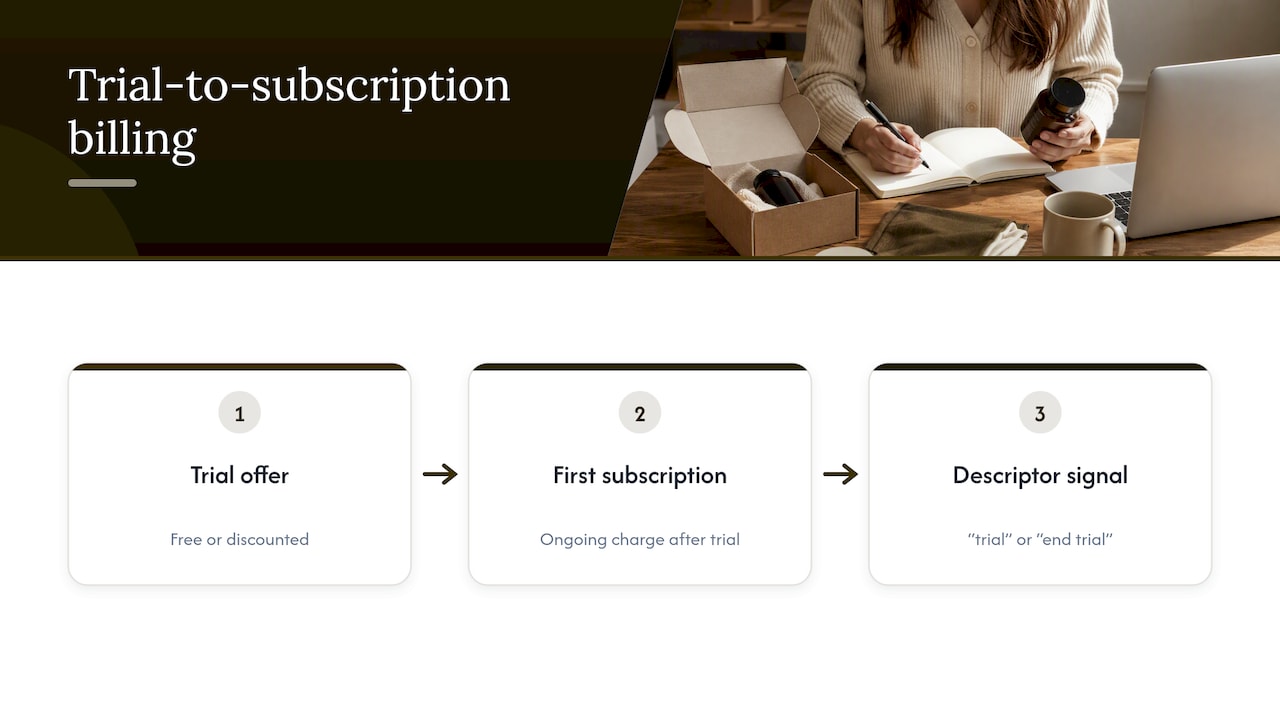
Visa has issued a policy for subscription merchants offering free trials or introductory promotions. According to that document, the change applies to the merchant descriptor field for merchants whose trial or introductory offer rolls into an ongoing subscription, and there are no new indicators for acquirers or issuers to prepare for. In practice, the first transaction after the trial should carry a clear signal, such as “trial” or “end trial,” so the cardholder knows regular billing has started. A separate Visa notice, the clarification on free trials and discounted introductory promotions, adds that when the trial or promotional period is seven days or less, the initial confirmation to the cardholder should include specific details, including the date the trial expires.
Because the rules are detailed and can change, read both documents in full and confirm with your acquirer how the descriptor field should be formatted for your account. Do not guess at the wording.
A subscription checklist
- Say plainly at checkout when the trial ends and what the first charge will be.
- Send a confirmation email with the trial end date and how to cancel.
- Mark the first paid charge in the descriptor as Visa’s policy describes.
- Send a reminder before the first charge.
- Make cancellation as easy as sign-up, and answer support fast.
The descriptor is one layer. Clear disclosure and easy cancellation do more to prevent “I didn’t know” disputes than any descriptor alone, and the descriptor works best when it backs them up.
Managing descriptors across brands and products
If you run more than one brand, product line or billing model, a single descriptor rarely fits. Consider:
- One descriptor per brand. A customer who bought from Brand A should not see Brand B on the statement.
- Separate descriptors for one-time and recurring purchases. Adding a hint such as “SUBSCR” or “MEMBERSHIP” can help customers place a recurring charge, if your acquirer’s format allows it.
- Dynamic descriptors where supported. Some gateways let you pass different text per transaction. That can help marketplaces and multi-brand operators, but it adds testing work, and support varies by acquirer.
- A written register. Keep a simple sheet listing each merchant ID, its descriptor, the phone number and the brand it maps to. Support staff should be able to search it.
Changing a descriptor is not instant in every setup. Some changes need underwriting or acquirer approval, and a new account may require its own descriptor registration. Plan ahead of launches and rebrands, not on the day.
Support and receipts: make the descriptor findable
Even a perfect descriptor needs reinforcement. Add the exact descriptor text to:
- Order confirmation emails and receipts
- Your FAQ or help center, under a question like “What will appear on my statement?”
- Support scripts, so agents can match a statement line to an order quickly
For privacy-sensitive categories, such as telehealth, you may want the descriptor to be discreet but still recognizable. A neutral version of your brand name can work if customers know in advance what to expect. Tell them at checkout.
How to audit your descriptors
Run this review every quarter, and after any rebrand, new processor or new product:
- List every active descriptor by merchant ID and brand.
- Check the live text with a test charge, in more than one banking app.
- Read dispute reasons. Look for “unrecognized” or “I don’t know this merchant” patterns tied to a specific descriptor.
- Compare with support tickets. Calls asking “what is this charge” point to a weak descriptor.
- Check the phone number and URL still work.
- Update and re-test after any change.
Track the numbers that matter: dispute rate by descriptor, unrecognized-charge disputes as a share of all disputes, and support contacts about charges. One brand with a bad descriptor can pull up your overall ratio.
Our perspective
We work with merchants whose businesses sit in categories banks watch closely: supplements, nutraceuticals, telehealth, subscriptions and other regulated or fast-growing online brands. Descriptor problems are among the most fixable issues we see, and they are often overlooked because they look cosmetic.
Here is how we think about it. A descriptor is part of your risk profile. Acquirers and card networks look at dispute and chargeback activity, and a share of that activity starts with a customer who could not place a charge. When you clean up naming, add contact details and confirm the format with your acquiring partner, you are removing a cause of disputes you did not need to have.
We also believe descriptors should be set up with underwriting, not after it. When a merchant is placed with an acquiring bank, we want the brand name, website, checkout flow and descriptor to line up from day one. That alignment makes approval easier to defend, and it makes life easier for you once volume grows. Pair it with real-time monitoring and chargeback mitigation tools, and you spot trouble early instead of finding it in a monthly report.
My advice is simple. Use the name customers know. Give them a number that gets answered. Test it. Then review it again every quarter.
— Peter
Getting a descriptor set up the right way
If your processor will not let you control your descriptor, or you are worried that your current account setup is feeding disputes, talk to a team that works with high-risk and complex merchants every day. DavinciPay offers high-risk payment processing with underwriting support, fraud prevention tools and chargeback mitigation, and we have pages for supplements, nutraceuticals and telehealth merchants. When you are ready, you can apply now and we will review your business model, brand names and descriptor needs as part of onboarding.
Common mistakes to avoid
- Using the legal entity name. It is the most common cause of unrecognized-charge disputes.
- Letting a gateway name appear. Customers do not know your vendors.
- Skipping the trial signal. Subscription merchants who ignore the Visa descriptor policy invite misrepresentation disputes.
- Using a phone number nobody answers. A dead line pushes customers to their bank.
- Never testing. What you typed in a setup form may not be what appears on a statement.
- Forgetting to update after a rebrand. Old descriptors linger when new brands launch.
- Making cancellation hard. No descriptor can fix a customer who feels trapped.
FAQ
What is a statement descriptor example?
A simple example is a brand name plus a phone number, such as “NORTHPEAK 800-555-0100.” The customer sees the name they bought from and a number to call. Your acquirer sets the exact format and length.
What is the difference between a billing descriptor and a statement descriptor?
In everyday use they mean the same thing: the text that appears on the cardholder’s statement for a charge. Some payment platforms use “statement descriptor” and others use “billing descriptor” or “merchant descriptor.” Check your gateway’s terms so you edit the right field.
Should my descriptor use my legal name or my brand name?
Use the brand name customers saw at checkout. Visa’s guidance encourages merchants to use the most prominently displayed name rather than the registered legal entity, because customers recognize what they saw. Confirm any registration requirements with your acquirer.
What should the descriptor say after a free trial ends?
Visa’s subscription policy applies to the descriptor field for the first charge after a trial or introductory offer. A clear signal such as “trial” or “end trial” tells the cardholder that regular billing has begun. Confirm the exact format with your acquirer before launch.
How often should I review my descriptors?
Review them every quarter and after any rebrand, processor change or new product launch. Test a live charge, check the phone number and URL, and compare dispute reasons against each descriptor.