If you sell Delta-8 in the U.S., the reliable way to accept cards is a specialized high-risk payment provider with cannabinoid underwriting, gateway integration, and compliance controls. We built Davincipay.ai to serve high-risk and complex ecommerce businesses. Have the key materials ready before you apply: valid COAs, age verification with restricted-state blocking, and clear product labeling and site policies.
TL;DR:
- Post a COA tied to each lot on every product page, with matching labels and batch details, to prevent a second underwriting review.
- Block restricted states before payment, not after shipment; even one order can trigger review, and carriers may impose stricter rules than state law.
- Test refunds, webhooks, and duplicate captures in a sandbox, then soft launch and track declines and chargebacks daily before increasing traffic.
- Treat rolling reserves as unavailable capital, budget inventory and advertising around the delay, and notify your processor before planned sales spikes.
- Avoid international sales until you confirm destination import rules and your processor approves foreign cards, since unexpected overseas volume can freeze funds.
Table of Contents
- Why Delta-8 payment processing counts as high-risk in the U.S.
- What underwriters require from Delta-8 merchants
- How to set up gateway integration without surprises
- How to manage reserves, chargebacks, and fraud
- How to apply: checklist, timeline, and pricing expectations
- How federal and state rules shape Delta-8 payment compliance
- What interstate commerce means for Delta-8 sellers
- How to handle international sales and currency
- How to verify customers for cannabis-adjacent products
- What transaction limits and volume thresholds to expect
- What support and dispute resolution should look like
- What we tell Delta-8 merchants after hundreds of applications
- How Davincipay helps Delta-8 merchants apply and go live
- FAQ
- Sources
Why Delta-8 payment processing counts as high-risk in the U.S.
Mainstream processors rarely touch Delta-8, and the reason is not mysterious. Underwriters read the same federal signals you can read, and those signals point to risk. The FDA says Delta-8 products have not been evaluated or approved for safe use, and it keeps warning companies about unsafe marketing and labeling. Platforms like Stripe, PayPal, and Square generally prohibit Delta-8, so merchants who try to run it through a standard account often face terminations, frozen funds, and bans.
Enforcement is not theoretical. The FDA issued warning letters to five companies for illegally selling Delta-8 products, noting psychoactive effects, safety concerns, and no FDA-approved medical uses. A warning letter to Delta 8 Hemp dated May 4, 2022 cited unapproved new drug claims, misbranding, and adding Delta-8 to foods without approval.
The FDA’s December 2021 scientific memorandum concluded that delta-8 THC does not meet GRAS criteria for use in food, citing inadequate safety data and a lack of prior food use.
Then there is the regulatory split. The 2018 Farm Bill and USDA’s hemp final rule, effective March 22, 2021, govern hemp production. The FDA regulates products made for human consumption. Under USDA’s hemp rules, hemp can be legally farmed while the finished consumer product still draws FDA scrutiny. Underwriters see that gap and price it in.
In practice, a bank that sponsors a processor sees reputational exposure, so the account lands in a high-risk class. You should expect extra reserves, tighter monitoring, and the possibility of holds if your numbers drift.
The signals underwriters track most closely:
- FDA warning letters to Delta-8 sellers, and whether your marketing resembles the flagged language
- COA consistency across lots, labs, and product pages
- State bans and restrictions, and whether you block those destinations
- Therapeutic or disease claims anywhere on your site or social channels
What underwriters require from Delta-8 merchants
Underwriting goes fast when your packet is complete and slow when it is not. We see the same gaps again and again, so here is the list to build against.
- COAs for your products. Include the lab name, lot or batch numbers, test dates, and a chain-of-custody record. Make sure the COA on file matches what customers see on the product page.
- Business documents. Have your EIN, recent bank statements, prior processing history if you have any, ownership information, and a product catalog with SKUs. Underwriters may also ask for trade references.
- Compliant website content. Product descriptions should be factual and free of therapeutic claims. Refund, shipping, and privacy policies must be visible. Contact details should be easy to find.
- Age-gate flow. Show a clear gate on entry and enforce age checks at checkout, not only on the landing page.
- Restricted-state blocking. Document which states you refuse to ship to and show where that rule is enforced in your cart or shipping logic.
- Batch tracking. Be able to tie each order to a lot and a COA, so a dispute or a regulator question can be answered in minutes.
The point of this packet is to show an underwriter that you already run the controls they would otherwise have to demand. A merchant who arrives with COAs, policies, and blocking rules documented looks like a lower risk than one who promises to add them later.
Pro Tip: Put a COA link or download on every product page and name the file with the lot number. Underwriters spot-check this first, and a match between page, COA, and label removes a common reason for a second review round.
We handle the same kind of documentation for other regulated consumables. If you want to see how that looks in practice, our pages for supplements and nutraceuticals walk through the controls we expect.
How to set up gateway integration without surprises
Two architectures work in the high-risk world, and both are easy to describe in category terms. The first is a dedicated high-risk merchant account paired with a gateway that tokenizes card data. The second is a high-risk-friendly gateway that manages acquiring relationships behind the scenes. The first gives you more control over your processing relationship. The second can shorten setup. Either way, the gateway should keep raw card numbers off your servers.
A practical integration checklist for common ecommerce platforms:
- Tokenize every card so your PCI scope stays small
- Handle webhooks for payment success, failure, refund, and dispute events, and make them idempotent
- Test recurring billing and refund flows before launch, not after
- Log the order, lot number, and COA reference together
- Plan how your platform behaves if the gateway times out
For deeper technical detail on tokenization and webhook handling, this payment gateway integration guide covers the mechanics well.
Checkout configuration matters as much as the connection. Enforce AVS and CVV checks, turn on 3-D Secure where your acquirer supports it, and set velocity rules that flag repeated attempts from one device or address. Block restricted shipping states at the cart, and enforce age verification before payment is authorized.
Roll out in stages. Test in the sandbox, run a small-volume soft launch, and watch declines and chargebacks daily before you push traffic. Keep a named contact for underwriting questions so a request for a document never sits unanswered.
| Stage | What you do | What to watch |
|---|---|---|
| Sandbox | Test cards, refunds, webhooks | Failed events, duplicate captures |
| Soft launch | Run limited real orders | Decline rate, AVS/CVV failures |
| Full launch | Scale traffic gradually | Chargeback ratio, order value spikes |
How to manage reserves, chargebacks, and fraud
High-risk accounts usually carry a rolling reserve, which means the processor holds a portion of your sales for a set period as protection against refunds and disputes. Plan cash flow around that delay. Treat held funds as unavailable working capital, and size your inventory purchases and ad spend accordingly. A clean record over time is the usual path to better terms.
Chargeback prevention starts after the sale. Clear billing descriptors that customers recognize cut “I don’t know this charge” disputes. Send order confirmations and shipping updates. Make subscription cancellation easy, because a hard-to-find cancel button becomes a dispute. Keep delivery proof, COA references, and policy screenshots organized so you can answer a dispute in one sitting. For a tactical walkthrough, this chargeback reduction playbook is a useful companion.
A sensible fraud stack for Delta-8 includes:
- Device intelligence to spot repeat abusers across new emails
- AVS and CVV enforcement on every order
- 3-D Secure on higher-risk transactions
- Manual review triggers for oversized orders or mismatched billing and shipping
- Chargeback alerts so you can refund before a dispute becomes official
Watch these KPIs weekly, and daily during launch: chargeback ratio, decline rate, and sudden jumps in average order value. If one climbs, pause the traffic source behind it, tighten review rules, and contact your processor before they contact you. Early disclosure builds trust with an acquirer.
Pro Tip: Refund an obviously unhappy customer before they call their bank. A refund costs you the sale. A chargeback costs the sale, a fee, and a mark on your ratio.
How to apply: checklist, timeline, and pricing expectations
Here is the order we recommend:
- Gather COAs, lab details, and batch records for every SKU you plan to sell.
- Collect your EIN, bank statements, processing history, and ownership details.
- Audit your site for therapeutic claims, missing policies, and age-gate gaps.
- Document your restricted-state list and where it is enforced.
- Submit the application with all documents attached in one pass.
- Answer underwriting follow-ups the same day.
- Complete test transactions, then go live in a soft launch.
Timelines vary by merchant. An initial quote can come quickly, underwriting review takes longer when documents are missing, and remediation adds days if the site needs edits. Common causes of delay are mismatched COAs, absent policies, and unanswered requests. Complete packets move fastest.
On pricing, expect the general shape rather than a single number: a setup fee, a monthly fee, per-transaction fees, and a rolling reserve percentage. We do not publish a price list for our services, so ask for a quote tied to your volume and average order size.
If you are declined, ask what triggered it. Fix the specific issue, whether that is claims language, missing COAs, or weak age verification, and then approach a specialist for direct placement instead of reapplying blindly.
How federal and state rules shape Delta-8 payment compliance
Compliance here is a moving target, so build your process around the principle, not a single snapshot. At the federal level, the split described earlier stays central: USDA oversees hemp production, while the FDA oversees products brought to market. The FDA’s literature update through October 2023 found nothing that changed its earlier conclusion and noted continuing safety concerns, which tells underwriters the posture is not softening.
State rules add the patchwork. Some states restrict or ban Delta-8 sales, others set age limits, licensing, or testing requirements, and these rules change. Your processor will expect you to know the rules for every state you ship to and to block the ones you cannot serve.
For payments, that means three habits. Keep a written, dated list of states you serve and states you block. Review it on a schedule, not only when something breaks. And tell your processor before you change product lines or ship into a new state. For legal conclusions about your specific products and destinations, consult a qualified attorney who knows cannabinoid law.
What interstate commerce means for Delta-8 sellers
Shipping across state lines is where many Delta-8 businesses get tripped up. A product may be sold openly in one state and restricted in the next, so one national storefront can create exposure in places you never meant to serve. Processors see this in your shipping data, and a single order to a restricted state can trigger a review.
The answer is enforcement at the point of sale. Validate the shipping address against your blocked-state list before payment, not after. Do the same for billing addresses where it makes sense, and flag freight-forwarder or reshipper addresses that could route product around your rules.
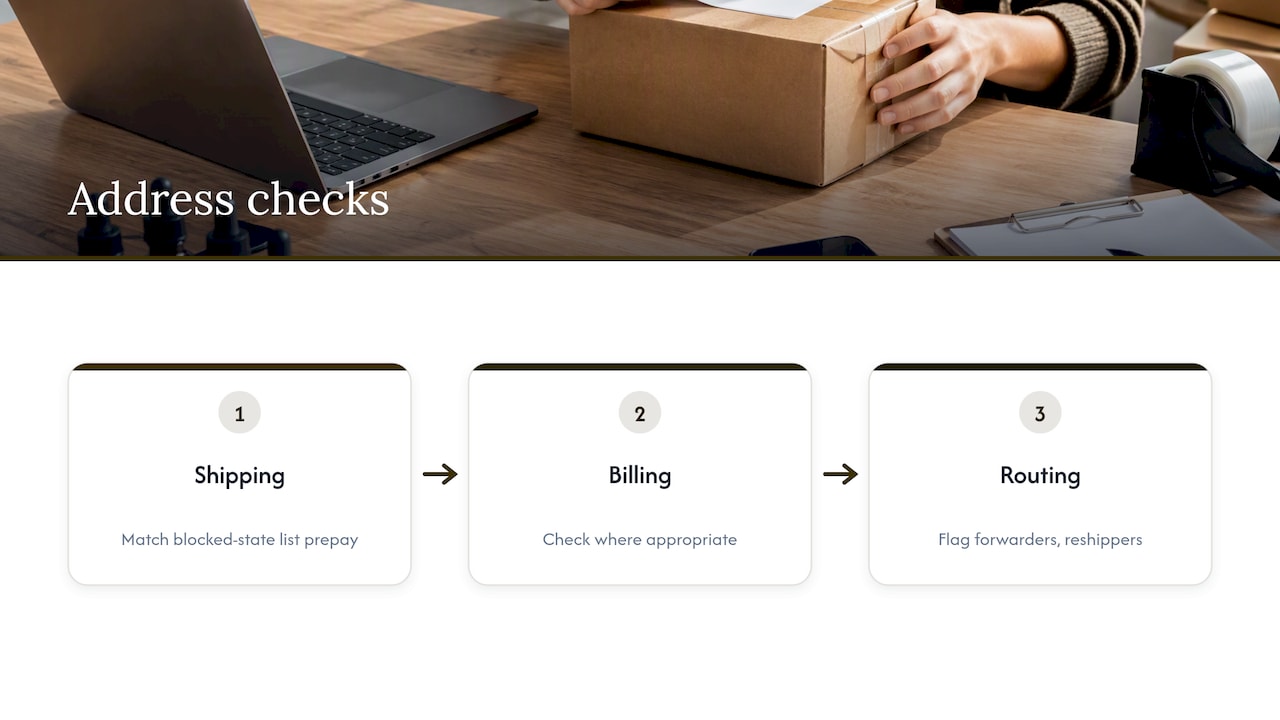
Carriers add another layer. Shipping companies set their own policies on hemp-derived and cannabinoid goods, and those can be stricter than state law. Confirm your carrier’s rules in writing and keep them on file.
Finally, keep records. If an acquirer asks where orders went, you should be able to pull a report by state in minutes. Clean geographic data shows underwriters that your blocking rules work in practice, not only on paper.
How to handle international sales and currency
Selling Delta-8 across borders is harder than selling domestically, and for most merchants the right first move is not to. Many countries treat cannabinoids very differently from the U.S., and cross-border shipping can create customs and legal problems that payment providers will not cover for you. Check import rules for each destination before you accept a single order.
If you do pursue international buyers where it is lawful, the payment side needs planning. Decide whether you will price in U.S. dollars or in local currency. Local pricing can lift conversion, but it introduces conversion fees and exchange-rate swings that affect your margin. Ask your provider how multi-currency settlement works and what fees apply.
Cross-border cards also carry higher decline and fraud rates, so lean on 3-D Secure and AVS where they are supported. Keep your billing descriptor recognizable to foreign cardholders, because unrecognized charges turn into disputes quickly.
Tell your processor in advance if you plan to accept foreign cards. Sudden international volume on a domestic account looks like fraud, and it can freeze funds. Talk first, then scale.
How to verify customers for cannabis-adjacent products
Age is the legal baseline, and your verification should be strong enough to prove it. A simple age-confirmation checkbox rarely satisfies an underwriter. Layer your controls instead.
- Entry gate: a clear age prompt before any product is shown
- Checkout verification: a check at payment that confirms age against the customer’s details, ideally through an identity verification service
- Delivery control: adult signature on delivery where your carrier supports it
- Records: logs that show when and how each customer was verified
Pair identity with address logic. Compare billing and shipping data, flag mismatches, and hold high-value first orders for review. Repeat customers who have passed verification once can move through faster, which keeps friction low for loyal buyers.
Privacy matters too. Collect only the data you need, store it securely, and state how you use it in your policy. Verification that is strict, documented, and respectful of customer data satisfies both underwriters and shoppers.
What transaction limits and volume thresholds to expect
Every high-risk account is set up with limits, and Delta-8 accounts are no exception. Processors typically define a monthly processing cap, an average ticket size, and a maximum single transaction amount. These come from the volume and order values you project in your application, so projections should be realistic.
Underestimating hurts as much as overestimating. If you project a small monthly volume and then double it after a viral promotion, you can breach your cap and trigger a hold. If you overstate, you may land in a stricter risk tier than you need. Base your numbers on real data from your store or comparable sales.
Limits can usually be raised once you have a clean track record. Ask your processor how an increase request works, what history they want to see, and how much notice they need. Share planned promotions, new product launches, and seasonal spikes ahead of time.
Because limits vary by provider and merchant profile, treat any figure you read online as a rough guide. Ask for your own limits in writing before you sign.
What support and dispute resolution should look like
Support quality matters more on a high-risk account, because a delayed answer can mean delayed funds. Look for a provider that gives you a named contact, clear response expectations, and a direct path to the underwriting team. You should not have to restart the story with each ticket.
When a dispute arrives, the clock is short. A typical flow runs like this: the cardholder disputes the charge, your processor notifies you, you submit evidence by the deadline, and the issuing bank decides. Strong evidence for Delta-8 includes the order record, proof of age verification, delivery confirmation, your posted policies, and the COA tied to the lot shipped.
Keep that evidence organized by order so you can assemble it quickly. Respond to every dispute, even ones that seem hopeless, since a pattern of ignored cases hurts your standing.
Ask your provider how they help. Some offer alerts, representment support, and monthly reviews of dispute trends. Use those reviews to find repeat causes, such as unclear descriptors or slow shipping, and fix them at the source.
What we tell Delta-8 merchants after hundreds of applications
Here is my editorial view: most Delta-8 declines are self-inflicted. The product is not usually the problem. The packet is. Missing COAs, medical-sounding claims on product pages, and age checks that exist only on the landing page sink applications that otherwise had a fair shot.
The fixes are boring and quick. Strip therapeutic language, match every COA to its product page, and move age verification to the payment step. Those three changes address most of what an underwriter worries about before they even open your processing history.
I would also push back on the idea that compliance is a tax on growth. Merchants who run clean controls tend to get steadier approvals, fewer holds, and better terms over time. Cutting corners saves a week and costs an account.
— Peter
How Davincipay helps Delta-8 merchants apply and go live
You do not need to piece this together alone. We specialize in payment processing for high-risk and complex ecommerce businesses, and we handle the parts of this guide that slow merchants down. Our high-risk payment processing service gives you:
- Underwriting support so your packet is complete before it is reviewed
- Gateway integration
- Fraud prevention tools and chargeback mitigation built in
- Age and compliance controls, with real-time reporting
- Onboarding help from application through live processing
Here is how it works. You submit your application and documents so we can review your site and controls in relation to underwriting needs. Our How It Works page lays out each step.
If your COAs, policies, and age controls are ready, you are closer than you think. Apply now and we will start reviewing your account, or visit our high-risk payment processing page to see what we offer before you begin.
FAQ
Which payment processor is best for CBD and hemp merchants?
The best fit is a provider that specializes in high-risk hemp and cannabinoid merchants and offers underwriting support, gateway integration, and chargeback tools. Mainstream platforms often prohibit these products. We built Davincipay.ai to serve high-risk and complex ecommerce businesses.
Why do Stripe, PayPal, and Square block Delta-8?
Their policies restrict Delta-8, and the FDA has said these products have not been evaluated or approved for safe use. Merchants who try anyway often see account terminations and frozen funds. A specialized high-risk account avoids that mismatch.
What documents do I need to get a Delta-8 merchant account?
Prepare COAs showing Δ9 THC at or below 0.3%, your EIN, bank statements, a product catalog, and ownership details. You also need compliant product pages, visible policies, age verification, and restricted-state blocking.
Is Delta-8 safe, and does that affect payments?
The FDA has raised safety concerns and found no new evidence to change its position, according to its updated 2024 memorandum. Those concerns are a big reason underwriters classify Delta-8 as high-risk.
Sources
- 5 Things to Know about Delta-8 Tetrahydrocannabinol – Delta-8 THC | FDA
- Hemp Laws and Regulations | Agricultural Marketing Service