.png)
Consultant payment gateway recommendations are defined as structured guidance that advisors provide to help clients select, configure, and manage payment processing systems matched to their specific business model, invoice size, and risk profile. The right gateway choice affects authorization rates, processing costs, compliance standing, and cash flow. Platforms like Stripe, PayPal, and Davincipay each serve different client needs. Matching the gateway to the client’s industry, billing cycle, and regulatory environment is the core skill that separates a good payment recommendation from a costly mistake.
What are the best payment gateways for consultants working with high-risk clients?
The top payment processing solutions for consultants cover a range of use cases, from standard B2B invoicing to regulated and subscription-based ecommerce. Each platform has a distinct strength.
- Stripe handles global card acceptance, subscription billing automation, and developer-friendly API integration. It supports ACH transfers, digital wallets, and over 135 currencies. Stripe works well for SaaS, subscription merchants, and tech-forward clients.
- PayPal offers broad consumer recognition and fast onboarding. It suits clients who need a quick checkout option or whose customers specifically request it. PayPal is best used as a secondary option, not a primary processor for large B2B invoices.
- Davincipay specializes in high-risk payment processing for industries like telehealth, nutraceuticals, and subscription ecommerce. It provides dedicated merchant accounts, interchange-plus pricing, and chargeback mitigation. Davincipay is the right fit when a client’s industry triggers automatic rejections from standard processors.
- Checkout.com provides multi-region acquiring, tokenized security, and strong authorization rate optimization. It suits enterprise clients with international customer bases.
- Apple Pay and similar digital wallets improve conversion at checkout for consumer-facing clients. They reduce friction but do not replace a dedicated merchant account for regulated industries.
For clients in telehealth, supplements, or subscription billing, a dedicated merchant account through a specialist like Davincipay for telehealth provides the stability that flat-rate processors cannot guarantee.
Pro Tip: Recommend Stripe for subscription billing automation and ACH, Davincipay for high-risk or regulated industries, and PayPal only when a client’s customers specifically request it.

How to choose the right payment gateway pricing model for large invoices
Pricing model selection is the highest-impact decision for clients with large invoices. Three models dominate the market: flat-rate, interchange-plus, and dual pricing.
| Pricing Model | How it works | Best for | Cost on a $10,000 invoice |
|---|---|---|---|
| Flat-rate | Fixed percentage per transaction (e.g., 2.9% + $0.30) | Low-volume, small-ticket clients | ~$290 |
| Interchange-plus | Card network cost + fixed processor markup | High-ticket B2B invoices | ~$230–$260 (varies by card) |
| Dual pricing | Surcharge added for card payments; cash/ACH price is base | B2B clients billing all engagement costs | $0 net cost to merchant |
Professional services firms can save $10,000 to $25,000 annually by switching from flat-rate to interchange-plus pricing on invoices ranging from $5,000 to $50,000. That figure represents real margin, not a rounding error, and it is the single strongest argument for reviewing a client’s current pricing model before recommending any new gateway.
Interchange-plus pricing separates the card network fee from the processor’s markup. That transparency in pricing reduces disputes and makes reconciliation straightforward. Flat-rate pricing bundles everything together, which benefits the processor, not the client.
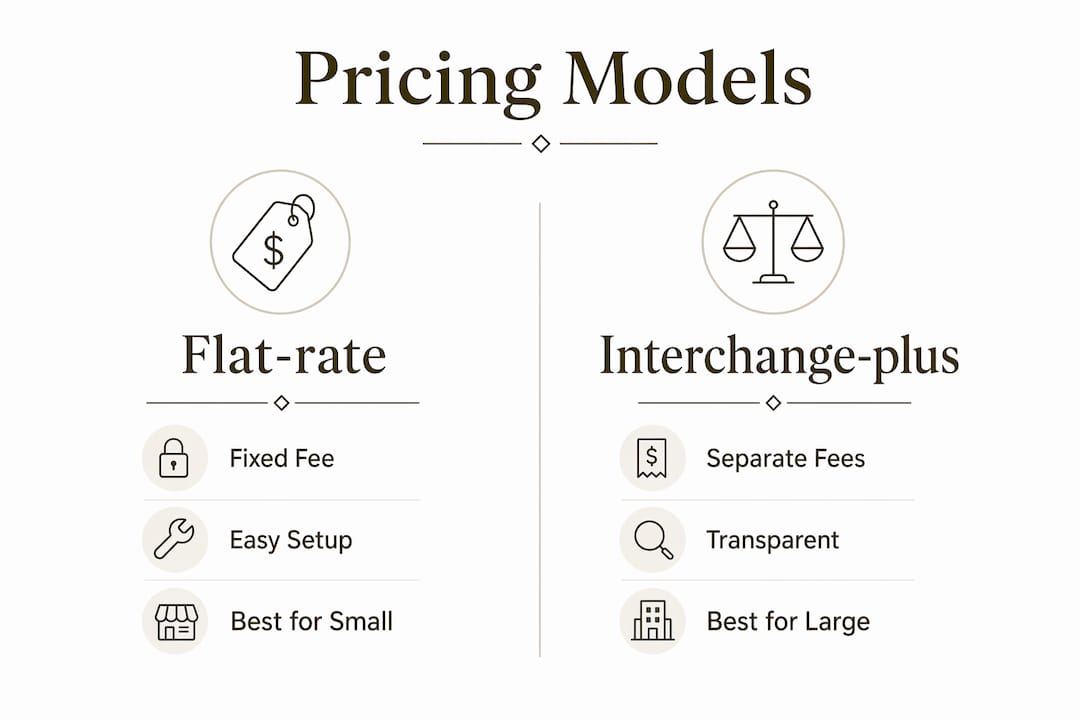
Dual pricing, where clients paying by card absorb the surcharge, is permitted in all 50 U.S. states. For B2B consulting firms that pass all engagement costs to clients, dual pricing effectively eliminates processing fees entirely.
Pro Tip: Always run a cost comparison on a client’s last 90 days of invoice volume before recommending a pricing model change. The numbers make the case better than any pitch.
Which payment methods minimize fees for B2B consultant invoicing?
ACH transfers are the most cost-effective payment method for large B2B invoices. Stripe ACH charges 0.8% with a $5 cap per transaction. A $10,000 invoice costs $5 to process via ACH versus roughly $290 via standard card processing at 2.9% + $0.30. That difference compounds fast across a client’s full invoice volume.
Consultants should structure their payment method recommendations around invoice size and client relationship:
- ACH transfers: Use for all business clients with invoices above $1,000. Include bank account details directly on the invoice to make ACH the default path.
- Card processing via Stripe: Reserve for clients who prefer card payments or need the purchase protection a card provides.
- PayPal: Use only when a client’s customer specifically requests it. PayPal’s fees are comparable to card processing and offer no cost advantage for large invoices.
- Wire transfers: Appropriate for international clients or very large single payments where ACH is not available.
ACH payments are preferred by most businesses for large invoices because they are cheaper and more predictable than card transactions. Advising clients to add ACH as a payment option on their invoices is one of the fastest ways to reduce their processing costs without changing their gateway or merchant account.
How to integrate payment gateways for regulated and subscription-based clients
Payment gateway integration for regulated industries requires more than picking a platform. Effective payment consulting means designing a full payment ecosystem that covers gateways, billing workflows, fraud tools, and reconciliation processes. Each element affects the others.
Follow this integration sequence for regulated or subscription clients:
- Confirm the client’s merchant category code (MCC). The MCC determines which processors will approve the account and at what rates. Telehealth, nutraceuticals, and subscription merchants often require specialty acquiring.
- Match the gateway to the client’s billing model. Recurring billing requires a gateway with tokenized card storage and automated retry logic. Stripe and Davincipay both support this. A gateway without native subscription tools creates manual billing risk.
- Align payment methods with regional customer habits. Ignoring regional payment preferences such as SEPA in Europe or local wallets in Asia leads to higher cart abandonment and lower authorization rates. Clients with international customers need a gateway that supports local payment methods.
- Configure fraud and chargeback controls before going live. High-risk industries face elevated chargeback rates. Set velocity rules, AVS matching, and 3D Secure before the first transaction processes.
- Test the full billing cycle end to end. Run a complete subscription cycle in a sandbox environment before launch. Catch failed retry logic, webhook errors, and refund flows before they affect real customers.
“Payment consulting requires designing an integrated, compliant payment ecosystem tailored to client vertical and growth trajectory.” — Payment Consulting Services
For clients operating across multiple countries, reviewing multi-jurisdiction payment integration requirements early prevents costly compliance gaps later.
What mistakes do consultants make when recommending payment gateways?
The most common error is defaulting to flat-rate pricing without running a cost comparison. Flat-rate processors like Stripe’s standard plan are easy to set up, but they pose hidden risks for high-ticket or infrequent invoices. Automated risk flags can freeze accounts without warning when large transactions appear outside a processor’s expected pattern.
Three other mistakes appear consistently:
- Ignoring the client’s risk profile. A nutraceutical brand or telehealth provider cannot use the same gateway as a standard ecommerce retailer. Recommending Stripe or PayPal for a high-risk client without checking their underwriting criteria leads to account terminations.
- Switching providers without optimizing first. Independent advisors recommend improving existing payment models and negotiating terms before switching providers. A provider change is disruptive and expensive. Renegotiating rates or adding ACH to an existing setup often delivers the same savings without the operational risk.
- Skipping ongoing advisory after implementation. Payment environments change. Card network rules update, chargeback thresholds shift, and new fraud patterns emerge. Clients need periodic reviews, not a one-time setup.
Pro Tip: Before recommending a provider switch, request a full statement analysis from the current processor. Most clients are leaving money on the table with their existing agreement before they ever need a new one.
For clients in regulated sectors, reviewing an international payment processing guide helps identify compliance gaps before they become account terminations.
Key Takeaways
The strongest consultant payment gateway recommendations combine pricing model analysis, ACH adoption, and industry-specific gateway selection to reduce costs and protect client accounts from disruption.
| Point | Details |
|---|---|
| Match gateway to industry risk | High-risk clients in telehealth or nutraceuticals need dedicated merchant accounts, not flat-rate processors. |
| Prioritize interchange-plus pricing | Switching from flat-rate to interchange-plus can save clients $10,000–$25,000 annually on large invoices. |
| Default to ACH for large B2B invoices | Stripe ACH at 0.8% capped at $5 costs a fraction of card processing on invoices above $1,000. |
| Optimize before switching providers | Renegotiate current terms and add payment methods before recommending a full provider change. |
| Integrate regional payment methods | Clients with global customers need SEPA, local wallets, or other regional options to protect authorization rates. |
What I have learned after years of payment consulting
The most underrated skill in payment consulting is knowing when not to recommend a new gateway. Every consultant wants to bring a fresh solution to the table. The reality is that most clients are losing money on their current setup because of pricing model misalignment, not because they have the wrong processor. I have seen firms save more by renegotiating their existing interchange-plus terms than they would have by switching to a new platform entirely.
The second thing I have learned is that high-risk clients need a specialist from day one. Recommending Stripe or PayPal to a supplement brand or a telehealth company because it is the easiest option is a disservice. Those platforms use automated underwriting, and high-risk merchants get flagged and frozen. A dedicated merchant account through a specialist like Davincipay is not a premium option for these clients. It is the only option that provides stable, long-term processing.
The trend I am watching closely in 2026 is the shift toward ACH and local payment method integration in B2B consulting. Clients who add ACH to their invoicing workflow see immediate cost reductions without any gateway change. That is the kind of fast, low-friction win that builds long-term advisory relationships.
— Peter
How Davincipay supports consultants with high-risk clients
Consultants advising clients in regulated, subscription-based, or high-risk ecommerce need a payment partner who understands the underwriting complexity behind these industries.
Davincipay provides dedicated merchant accounts with interchange-plus pricing, chargeback mitigation, and fraud prevention tools built specifically for industries like nutraceuticals, supplements, and telehealth. The team works directly with consultants to match acquiring relationships to client risk profiles, so your clients get approved and stay approved. Fast approvals, transparent pricing, and dedicated support make Davincipay a reliable partner for consultants who need more than a standard gateway referral. Apply now to get your client’s account reviewed by a specialist.
FAQ
What is a payment gateway recommendation for consultants?
A consultant payment gateway recommendation is structured advice that matches a client’s payment processing setup to their business model, invoice size, industry risk level, and compliance requirements. The goal is to reduce processing costs, improve authorization rates, and prevent account disruptions.
Which payment gateway is best for high-risk ecommerce clients?
Dedicated merchant account providers like Davincipay are the best fit for high-risk clients in telehealth, nutraceuticals, and subscription ecommerce. Standard flat-rate processors like Stripe and PayPal use automated underwriting that frequently flags or freezes high-risk accounts.
How much can clients save by switching to interchange-plus pricing?
Professional services firms can save $10,000 to $25,000 annually by switching from flat-rate to interchange-plus pricing on invoices ranging from $5,000 to $50,000. The savings come from paying the actual card network cost plus a fixed markup, rather than a bundled flat rate.
When should consultants recommend ACH over card processing?
Consultants should recommend ACH for all business clients with invoices above $1,000. Stripe ACH charges 0.8% capped at $5 per transaction, compared to roughly 2.9% plus $0.30 for standard card processing, making ACH the clear cost winner on large invoices.
Should consultants recommend switching payment providers first?
No. Independent advisors recommend optimizing existing payment models and negotiating current terms before switching providers. A provider change should be a last resort after confirming that the current setup cannot be improved through renegotiation or adding lower-cost payment methods like ACH.


.webp)