.png)
You can get a stable CBD merchant account, but only if you submit specific documentation, including certificates of analysis, compliant labels, business licenses, and owner IDs, along with a compliant website. Underwriters check these first. Setting up CBD payment processing means passing bank or acquirer underwriting and connecting a payment gateway, and expect fees and reserves higher than standard e-commerce until you build processing history.
TL;DR:
- Match every active SKU to a current, dated COA showing an accredited lab, batch ID, and delta 9 THC at or below 0.3%.
- Remove disease treatment claims: Farm Bill compliance does not override FDA rules, and therapeutic marketing can block approval even when THC meets limits.
- Budget for 4% to 7% transaction fees versus 1.5% to 2.9% in conventional ecommerce, plus a rolling reserve that may hold funds 90 to 180 days.
- Gather three to six months of bank statements, prior processor records, and government IDs for every owner with at least 25% equity before applying.
- Keep disputed transactions below roughly 1% monthly; acquirers may flag higher ratios, while clear refund terms, recognizable billing descriptors, and tracking records support disputes.
Table of Contents
- Who Handles What in a CBD Payment Setup
- What Underwriters Commonly Review for CBD Merchants
- Prepare Your CBD Merchant Account Application: Document and Site Checklist
- Common Reasons Underwriting Gets Delayed or Denied
- Gateway and Ecommerce Integration for CBD Payment Processing
- Pricing, Reserves, and What to Expect on Costs
- Maintaining a CBD Merchant Account After Approval
- How DavinciPay Supports CBD Merchants Through Underwriting and Onboarding
- Why Preparing Documentation Correctly Saves Time and Cash Flow
- How DavinciPay Can Help You Apply
- FAQ
- Sources
Who Handles What in a CBD Payment Setup
A CBD merchant account and a payment gateway solve two different problems, and knowing which party asks for what saves you from sending the wrong document to the wrong inbox.
The merchant account sits with an acquiring bank or a high-risk acquirer. This is the party that underwrites your business: it reviews your certificates of analysis, your website, your processing history, and your ownership structure before it agrees to settle your funds. The acquirer carries the risk, so it sets the terms on reserves, holds, and pricing.
The gateway is the technical layer that connects your checkout to the card networks and the acquirer. It handles encryption, tokenization, and the routing of each transaction. Some providers bundle both functions under one roof, which is common in high-risk payment processing, while others require you to pair a separate gateway with your acquiring relationship.
Day-to-day operational responsibilities split along similar lines:
- The acquirer manages settlement timing, sets reserve requirements, and makes the final call on chargeback disputes that escalate beyond your processor.
- The gateway or processor configures your checkout, manages API credentials, and handles real-time fraud screening on individual transactions.
- Your business is responsible for keeping lab reports and website claims current, since outdated documentation on either side can trigger a review freeze.
- Risk and compliance teams monitor transaction patterns continuously, and unusual spikes or chargeback ratios can prompt a reserve increase even after approval.
Understanding this split matters most when something goes wrong. A declined transaction is usually a gateway or card network issue, while a frozen account or a sudden reserve hike points back to the acquirer’s underwriting team reassessing your risk profile.
What Underwriters Commonly Review for CBD Merchants
Underwriters work through a fairly predictable checklist, and knowing the order they review things in helps you assemble a file that moves fast instead of bouncing back for clarification.
- Certificates of analysis (COAs). Underwriters want to see the testing lab’s name and accreditation, the test date, the delta-9 THC percentage, and a batch or lot ID that ties the COA to a specific production run. USDA’s lab testing guidelines call for accredited testing and retained, reportable THC results, and underwriters apply the same standard when they review your paperwork. A COA with no date, no batch number, or no visible accreditation gets flagged immediately.
- Product labeling and SKU consistency. Every SKU on your site needs a label that matches its corresponding COA, batch for batch. Mismatched SKUs, generic “hemp extract” labels with no batch reference, or a product page that lists a different potency than its COA are among the fastest ways to stall a file.
- Website and marketing compliance. Underwriters read your site the way a regulator would. The FDA has repeatedly warned sellers against disease-related claims, and the FTC has brought enforcement actions against CBD marketers for unsubstantiated health claims. Any language suggesting your product treats, cures, or prevents a disease is a hard stop for most acquirers until it’s removed.
- Licenses and registrations. This includes your EIN, articles of incorporation or formation, and, where applicable, a state hemp processor or handler license. If you operate in a state with its own hemp licensing regime, keep that document current and ready to upload.
- Processing history and KYC on beneficial owners. Underwriters want several months of bank statements and, if you’ve processed before, statements from your prior processor. Every owner with 25% or more equity typically needs to submit a government ID and basic background information.
- Fulfillment and supply-chain documentation. Invoices from your raw material supplier, a description of your manufacturing or co-packing arrangement, and proof of where your product physically ships from round out the file.
Pro Tip: Keep a single folder with one COA, one label image, and one product photo per SKU, named identically, so an underwriter can cross-check your catalog in minutes instead of days.
The FDA’s own guidance on cannabis and CBD regulation makes a point that catches many founders off guard: legality under the 2018 Farm Bill does not exempt you from the FD&C Act. A product can meet the 0.3% delta-9 THC threshold and still be treated as an unapproved drug if its marketing implies a therapeutic use. That single distinction drives more underwriting denials than THC content itself.
Prepare Your CBD Merchant Account Application: Document and Site Checklist
Before you submit anything, run through the same file an underwriter will open, item by item.
Documents to collect:
- Certificate of incorporation or LLC formation documents, plus your EIN confirmation letter.
- State business license and, where applicable, a hemp grower, handler, or processor license.
- Current COA for every active SKU, each one dated within the last testing cycle and tied to a batch number.
- Three to six months of business bank statements and, if you have prior processing history, statements from that processor.
- Government-issued ID for every beneficial owner holding 25% or more of the business.
- A signed, current W-9 and a voided business check for settlement account verification.
Name your files in a way an underwriter can scan at a glance: product name, then “COA,” then the batch number, such as “fullspectrumtincture-COA-B4471.” A folder full of files named “scan001.pdf” is one of the quieter reasons applications sit in review longer than they should.
Website edits to make first:
Go through every product page and remove language implying your product diagnoses, treats, cures, or prevents any disease, condition, or symptom. The FTC’s guidance on CBD marketing is direct about this: any health claim needs competent and reliable scientific evidence behind it before you make it, and most CBD sellers do not have that evidence on hand, so the safer route is to avoid the claim entirely.
Add a visible disclaimer on product pages and in your footer noting that your statements haven’t been evaluated by the FDA and that your products aren’t intended to diagnose, treat, cure, or prevent any disease. Link or display your COA directly on each product page, or at minimum make clear how a customer, or an underwriter, can access it. Publish a clear refund policy, a shipping policy, and visible contact information, since the absence of these basics reads as a risk signal independent of your product itself.
A quick self-audit before you apply:
Open your site in an incognito window and read every product description as if you were a regulator looking for a reason to object. Then check that every SKU on the live site has a matching, current COA in your document folder. CBD merchants typically face processing fees in the range of 4% to 7% per transaction, well above the roughly 1.5% to 2.9% that standard e-commerce merchants pay, and a clean, well-documented application is one of the few levers you control to push your pricing toward the lower end of that range.
Common Reasons Underwriting Gets Delayed or Denied
Most denials trace back to a handful of recurring issues, and each one has a straightforward fix if you catch it before you submit.
- Website claim violations. Rewrite any copy implying disease treatment into language about ingredients, sourcing, or general wellness support, and remove testimonials that mention specific health conditions.
- Incomplete COAs. Request a reissued lab report that includes the test date, batch ID, and accredited lab name if your current COA is missing any of these; a generic one-page summary from an unnamed lab will not pass review.
- Inconsistent SKUs or missing batch IDs. Build a simple spreadsheet mapping every live SKU to its COA batch number before you apply, so you catch mismatches yourself instead of an underwriter catching them for you.
- KYC or ownership gaps. List every owner with 25% or more equity and gather a government ID for each one; a missing signature or an outdated ID is one of the most common reasons files bounce back for resubmission.
- Undisclosed processing history. If a prior processor placed a hold on your account or terminated you, disclose it upfront with context rather than letting an underwriter discover it independently, since an undisclosed termination almost always does more damage than the original issue did.
Pro Tip: If a previous processor terminated your account, request the termination reason in writing. Underwriters respond better to a documented explanation than to silence on the question.
Gateway and Ecommerce Integration for CBD Payment Processing
Once underwriting approves your account, connecting it to your storefront is a mechanical process, but a few steps are worth doing in order.
- Request your gateway credentials. Your processor issues API keys and merchant IDs that link your acquiring account to your checkout platform, whether that’s a hosted page, a custom integration, or a plugin for your e-commerce platform.
- Map your routing. Confirm which acquiring bank handles your settlement and that your gateway is configured to route transactions there correctly, especially if you sell across multiple product categories with different risk profiles.
- Set up recurring billing carefully, if you use it. Subscription CBD merchants need their gateway to support tokenized recurring charges, and underwriters will specifically review your cancellation flow, your trial-to-paid conversion language, and how clearly you disclose recurring charges at checkout.
- Confirm your PCI scope. Most CBD merchants using a hosted checkout or tokenized payment fields fall into a lower PCI scope, which reduces your compliance burden, but you still need a signed Attestation of Compliance on file.
- Run pre-live tests. Process a handful of test transactions covering a standard sale, a refund, a declined card, and, if applicable, a subscription renewal, before you flip your checkout live to paying customers.
A clean integration test catches routing errors or misconfigured tax settings before they become customer-facing problems, which matters more in CBD than in most categories, since a spike in failed transactions right after launch can itself draw underwriting attention.
Pricing, Reserves, and What to Expect on Costs
CBD merchant accounts cost more than standard retail processing, and reserves are the part that catches most first-time applicants off guard.
Standard CBD merchants typically see processing fees between 4% and 7% per transaction, compared with roughly 1.5% to 2.9% for conventional e-commerce, reflecting the elevated chargeback and regulatory risk acquirers price into high-risk categories.
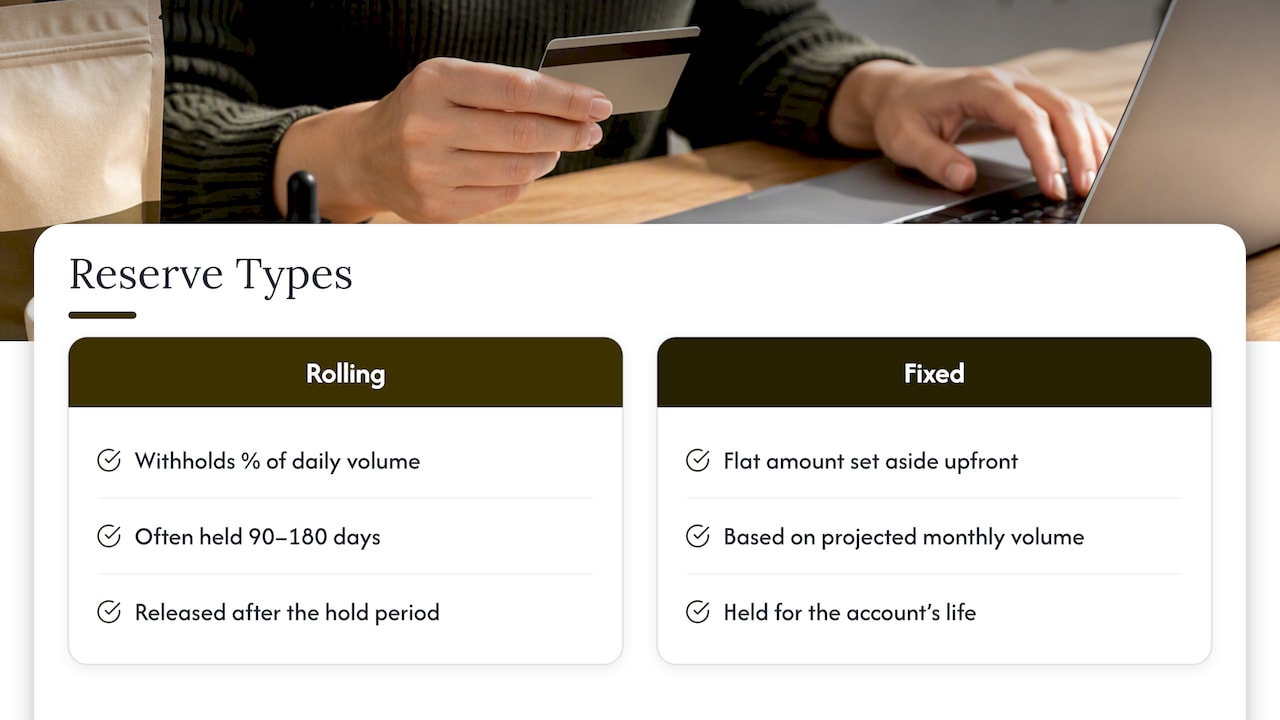
Reserves come in two common forms. A rolling reserve holds back a percentage of each day’s processing volume for a set period, often 90 to 180 days, before releasing it. A fixed reserve sets aside a flat amount upfront, calculated against your projected monthly volume, and holds it for the life of the account. Expect your acquirer to ask for one or the other, not both.
Beyond the per-transaction rate, budget for a setup fee, a monthly gateway or platform fee, and in some cases a chargeback management fee per dispute. These vary by provider and are typically disclosed during underwriting rather than published as a flat rate.
The documentation work pays off here directly. Merchants who submit complete COAs, consistent labeling, and clean processing history from day one tend to land lower reserve percentages and shorter hold periods than merchants who get approved with an incomplete file and have to rebuild trust over several months of processing.
Maintaining a CBD Merchant Account After Approval
Approval is the starting line, not the finish. Keeping your account in good standing takes the same discipline you used to get it.
Chargebacks are the single biggest threat to account stability. Publish a clear refund and cancellation policy, use a billing descriptor that customers will recognize on their statement, and keep tracking numbers on every order so you can respond to disputes with evidence instead of silence.
- Retain every COA, lab report, and order record for at least the length of time your processor’s agreement specifies, since underwriters can request historical documentation during a periodic review.
- Review your website quarterly for new claims that may have crept into product descriptions or blog content without compliance review.
- Notify your processor before launching a new product line or a reformulated SKU, rather than after, since an unannounced product change can look like an undisclosed business model shift during a routine audit.
- Watch your chargeback ratio monthly; most acquirers flag accounts that cross roughly 1% of transactions disputed, and catching a trend early is easier than explaining it after the fact.
Pro Tip: Set a recurring calendar reminder to re-check every live COA against its expiration or retest date, since an expired lab report is one of the most common triggers for a surprise account review.
How DavinciPay Supports CBD Merchants Through Underwriting and Onboarding
A specialized payment partner does the work most CBD founders don’t have time to learn from scratch: packaging your documentation correctly, presenting it to acquiring banks that already understand hemp-derived products, integrating a gateway that supports your checkout, and building chargeback mitigation into your setup from day one.
We built our underwriting support around a process for high-risk payment processing, including nutraceuticals and supplements merchants who face similar lab-testing and labeling scrutiny. If you’ve assembled your COAs, licenses, and website edits using the checklist above, you’re already most of the way through the file we’d ask for.
Why Preparing Documentation Correctly Saves Time and Cash Flow
Every CBD founder we talk to who hit a reserve freeze or a sudden termination traces it back to the same root cause: a document gap or a website claim nobody caught before it became a problem. The fix costs almost nothing in money, just attention, up front.
If you take one thing from this checklist, prioritize in this order: current COAs matched to every live SKU, a website scrubbed of disease claims, and a clean, disclosed processing history. Get those three right and the rest of underwriting moves fast.
Start your application with the full document set in hand rather than piecing it together after an underwriter asks. It’s the difference between a one-week approval and a six-week back-and-forth.
— Peter
How DavinciPay Can Help You Apply
We provide high-risk payment processing for CBD, nutraceutical, and supplement merchants, and our underwriting team reviews COAs, labeling, and compliance history as part of an application process rather than a generic one-size-fits-all review.

If you’re ready to move forward, here’s what the next step looks like:
- Gather the documents from the checklist above, including current COAs and your business formation records.
- Review your website against the claim guidance in this article and make any needed edits.
- Submit your application through DavinciPay and our underwriting team will walk you through what’s needed for your specific product line.
For CBD business owners who’ve struggled with holds or terminations elsewhere, our how-it-works page walks through the onboarding flow before you apply.
FAQ
Who will use a merchant account?
Any business that accepts card payments online or in person needs a merchant account, including CBD retailers, subscription box companies, and telehealth platforms that sell regulated products. For CBD specifically, it’s the business owner or a designated signer who submits the application and the required documentation.
What does CBD payment mean?
CBD payment processing refers to the underwriting, gateway connection, and settlement infrastructure that lets a hemp-derived CBD business accept credit and debit card payments online. Because CBD sits in a regulatory gray area under the FD&C Act, most mainstream processors classify it as high-risk and route it through specialized acquiring banks.
What is the cheapest way to accept credit card payments online for a small business?
CBD businesses instead work with high-risk acquirers, where fees commonly run 4% to 7% per transaction due to the added underwriting and chargeback risk.
Does PayPal allow CBD?
Mainstream payment platforms, including PayPal, generally restrict or prohibit CBD and other hemp-derived products under their acceptable use policies, which is why most CBD sellers work with high-risk acquirers instead. Confirm current policy directly with any platform before relying on it, since acceptable-use terms change without much notice.
What CBD product types do underwriters accept?
Underwriters generally accept full-spectrum, broad-spectrum, and isolate CBD products as long as each one carries a current COA showing delta-9 THC at or below 0.3%, consistent with Farm Bill limits. Products marketed with disease-treatment claims or that test above the THC threshold are typically declined regardless of their spectrum type.


.webp)
