A BIN country mismatch happens when the country that issued a customer’s card does not match where the customer appears to be: their IP address, billing address, shipping address or checkout currency. It is a risk signal, not a verdict. Treat it as one input in your fraud scoring and you catch fraud without turning away good customers. Treat it as an automatic decline and you lose real revenue.
This guide explains what the mismatch is, how to detect it, what causes false alarms, and how to set rules that fit a high-risk or subscription business.
TL;DR
- A BIN country mismatch means the card’s issuing country differs from the customer’s IP, billing, shipping or currency data.
- It is a common fraud indicator in card-not-present sales, but travelers, expats, students and gift buyers trigger it constantly.
- Never auto-decline on it alone. Score it, combine it with AVS, CVV, velocity and order history, and send mid-range cases to manual review.
- It is different from a billing address or ZIP mismatch: one compares the issuer’s country, the other compares the address the issuer has on file.
- Keep a record of every review decision. It becomes your evidence if the order is later disputed.
Table of Contents
- What a BIN country mismatch means
- How to identify a mismatch in your checkout
- Why a mismatch can signal fraud
- Why legitimate customers trigger it too
- Does a mismatch prove fraud?
- BIN mismatch vs. billing address and ZIP mismatch
- How to respond without declining good orders
- Mismatch rules for high-risk and subscription merchants
- Our perspective
- Get your payment setup ready for mismatches
- A checklist to use this week
- FAQ
- Sources
What a BIN country mismatch means
The BIN (bank identification number) is the first six to eight digits of a card number. It identifies the issuing bank, the card brand, the card type (credit, debit, prepaid) and the country where the card was issued. A BIN lookup returns that data in milliseconds, so your gateway or fraud tool can read it before the payment is authorized.
A mismatch appears when you compare that issuing country with something else the customer tells you or your systems observe:
- IP geolocation. The card was issued in Canada, but the order comes from an IP address in Nigeria.
- Billing country. The customer types a US billing address, but the BIN belongs to a bank in the United Kingdom.
- Shipping country. A card from one country pays for goods sent to another.
- Transaction currency. A card issued in Brazil pays in US dollars. This is sometimes called a BIN country and currency mismatch, and it affects authorization and conversion costs as much as fraud.
Each comparison tells you something different. An IP mismatch is the weakest on its own, because VPNs, mobile networks and corporate proxies distort location. A billing country mismatch is stronger, because the customer chose to type it. A shipping mismatch can be perfectly normal for gifts.
How to identify a mismatch in your checkout
Merchants can catch these mismatches by running IP tracking and BIN country checks and cross-referencing the IP address with the customer’s stated location. Visa’s card-not-present fraud guidance for merchants lists these among the standard controls.
In practice, you need four data points on every order:
- Issuing country from the BIN. Your gateway or fraud tool should return this field with the authorization request or on a separate lookup.
- IP country. Capture it at the moment of payment, not at page load, so a customer who switches networks mid-session does not skew the data.
- Billing country and address. Collect the full billing address, not just the ZIP code.
- Shipping country or delivery details. For digital goods and telehealth, this may be the account’s registered country instead.
Then run the comparison automatically. Manual BIN lookups work for a handful of orders a week. Beyond that, build the check into your gateway rules so each order carries a mismatch flag and a reason code that your team can filter.
Why a mismatch can signal fraud
Card-not-present fraud usually starts with stolen card data. The person using it is rarely in the cardholder’s country, and they rarely know the cardholder’s full details. That creates gaps in the data:
- The fraudster types a billing address that looks plausible for the card’s country, but the IP address points somewhere else.
- The fraudster uses a card from a country where address verification is not available, so the billing address cannot be checked at all.
- The order is shipped to a freight forwarder or reshipper in a third country.
U.S. government export guidance makes the same point: if the country in the buyer’s card address does not match the IP address country, the seller can flag the order for further investigation or rejection. Note the wording. Investigation comes first, and rejection is one possible outcome, not the default.
Why legitimate customers trigger it too
The mismatch is common among honest buyers. Before you tighten a rule, think about who in your customer base would trip it.
| Situation | What the data shows | Why it is usually legitimate |
|---|---|---|
| Traveler buying while abroad | US-issued card, foreign IP | The cardholder is on vacation or a business trip |
| Expat or military family | US card, overseas billing or shipping address | They keep a home bank account |
| Student studying abroad | Foreign card, US address | They opened a local account after arriving |
| Gift buyer | Card and IP in one country, shipping in another | They are sending a gift to family |
| VPN or privacy user | Card country differs from IP country | The IP shows the VPN exit, not the person |
| Mobile carrier routing | IP resolves to a distant city or country | Carrier networks route traffic through central gateways |
| Digital nomad or remote worker | Home card, changing IPs | They move often but pay from their home account |
| Currency-based buyer | Card in one country, USD checkout | They are used to paying in dollars on global sites |
If your brand sells supplements, wellness products or subscriptions online, a share of your best repeat customers fits one of these rows. Declining them on a mismatch alone means a lost sale, an annoyed customer and, with subscriptions, a lost lifetime value.
Does a mismatch prove fraud?
No. A BIN country mismatch shows that two data points disagree. It does not show who is holding the card. Plenty of fraud passes with every field matching, because criminals buy full identity details alongside the card number. And plenty of good orders show a mismatch.
The useful question is not “Is there a mismatch?” but “What else is true about this order?” A mismatch combined with a first-time buyer, a high-value cart, a free email address created yesterday, a failed CVV and three attempts on different cards is a strong signal. A mismatch on a returning customer with a long clean history, a matching CVV and a normal order size is noise.

BIN mismatch vs. billing address and ZIP mismatch
These checks are related but they test different things.
| Check | What it compares | What a failure suggests |
|---|---|---|
| BIN country mismatch | The issuing country of the card vs. IP, billing, shipping or currency | The customer may be outside the card’s home market |
| AVS (address verification) | The billing address and ZIP typed at checkout vs. the address the issuer has on file | The person may not know the cardholder’s details |
| CVV check | The security code typed at checkout vs. the one on the card | The person may not have the physical card or its data |
The BIN check uses data about the card itself. AVS depends on what the customer typed. A customer can mistype a ZIP code by accident, which is why a ZIP mismatch has a high false-positive rate. A BIN country does not change with typos.
AVS also has a coverage limit that matters for mismatches. Address verification is reliably available only for cards issued in the US, UK and Canada. For cards from other countries, you often get an “unavailable” response instead of a match or no-match. That makes the BIN country more valuable as a signal on international cards, because it may be the only geographic check you have.
Do not skip the address and verification checks either. Visa’s dispute guidance for merchants points to unreviewed address or card verification mismatches as a common factor in card-absent fraud disputes under reason code 10.4. If you saw the warning and shipped anyway with no review, you have a weak case when the chargeback arrives.
How to respond without declining good orders
Build a decision ladder, not a switch. Here is a workable structure.
Step 1: Score the mismatch
Give each mismatch type a weight. Many teams treat a billing country mismatch as heavier than an IP mismatch, and a shipping mismatch as lighter for gift-heavy categories. Choose weights from your own data, not from a generic template. Pull the last six to twelve months of orders, find the mismatch rate and see how many of those orders ended in a chargeback or fraud report.
Step 2: Combine it with other signals
A mismatch should rarely act alone. Pair it with:
- AVS and CVV results
- Order value compared with your average order
- Customer age: first order or tenth
- Email age and type
- Number of attempts and cards used in a short window
- Shipping address type, such as a forwarder or a new address
- Device fingerprint and whether it has been seen before
Visa recommends reviewing customers’ purchasing patterns and checking whether a purchase fits the customer’s past history. This is where a returning customer earns a pass.
Step 3: Route by risk tier
| Risk tier | Example profile | Action |
|---|---|---|
| Low | Returning customer, IP mismatch only, CVV and AVS pass | Approve |
| Medium | New customer, billing country mismatch, average order value | Manual review or step-up verification |
| High | New customer, mismatch plus failed CVV, high value, forwarder address | Decline or hold |
Step 4: Add friction where it helps
For medium-risk orders, ask for more before you decide. Options include 3-D Secure authentication, a confirmation email, a phone call for high-value orders, or a request to update the payment method with a card that matches the billing country. Good customers usually respond within a day. Fraudsters usually do not.
Step 5: Record the decision
Store the signals you saw, who reviewed the order, what you did and why. When a dispute comes in, that record is your evidence. Visa advises that in card-absent environments, merchants who are unsure what evidence they need should consult their acquirer before responding to a fraud dispute. Ask your acquirer early, not after the deadline is close.
Mismatch rules for high-risk and subscription merchants
High-risk categories carry extra pressure. Supplements, telehealth, CBD, subscriptions and digital services draw close attention from acquiring banks, and chargebacks can lead to reserves or account reviews. That makes a blunt mismatch rule tempting. Resist it, for three reasons.
- Subscriptions amplify both errors. A fraudulent first order creates repeat chargebacks. A wrongly declined good customer removes months of recurring revenue.
- Telehealth and regulated sales add checks. If you verify age, identity or a prescriber relationship, you already hold stronger evidence than a BIN country. Use the mismatch to decide how much extra verification to run, not to replace it.
- International expansion raises the base rate. Once you sell outside the US, mismatches are normal. Your rules need country-specific thresholds, so a Canadian card with a Canadian IP and US shipping is not scored like a card from a country you have never sold to.
A few practical settings:
- Allow-list customers with a successful payment history and no disputes.
- Set a higher bar for first orders from countries where you have seen fraud, and a lower one for markets you actively serve.
- Review mismatches in a queue with a service-level target, so good customers are not left waiting days.
- Review your rule results monthly: approval rate, review rate, and fraud and chargeback rate by mismatch type.
Our perspective
We see the same pattern with merchants who come to us after a processing problem. Many built a strict rule after a bad month of fraud, and the rule did its job but also cut approvals on customers they wanted. Others had no rule at all and let mismatched, high-value first orders through unreviewed.
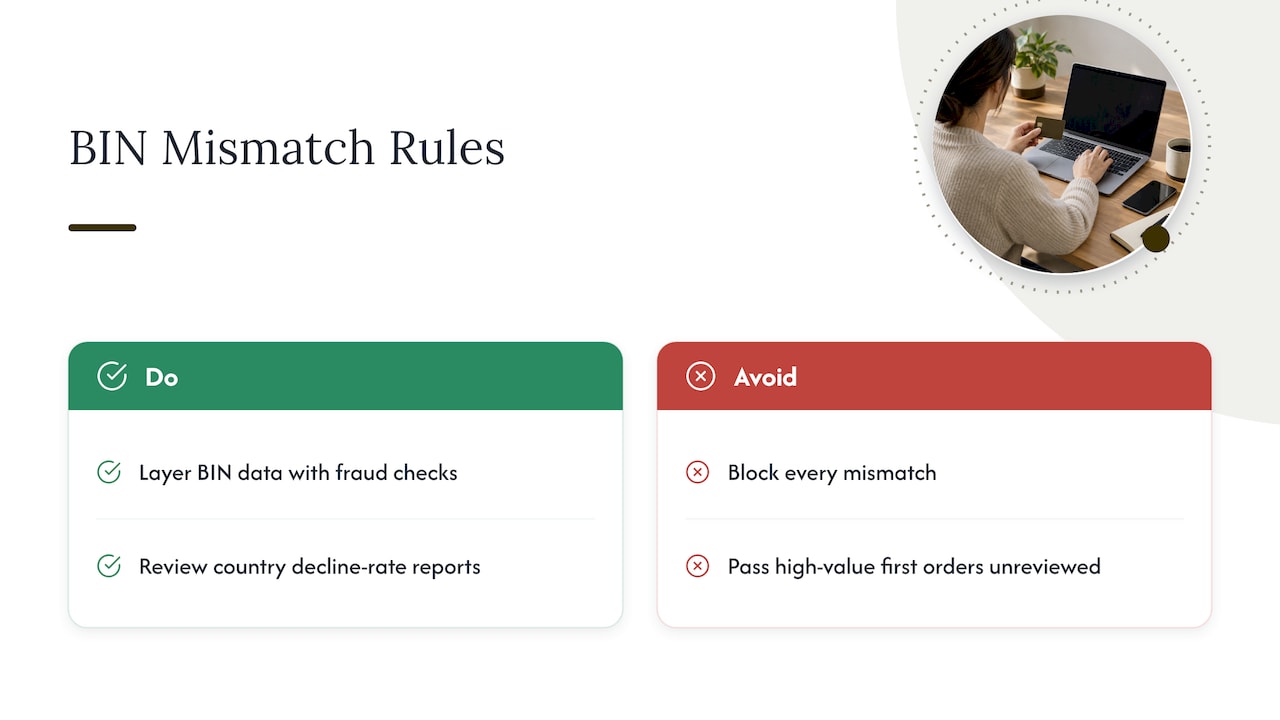
Both extremes cost money. Our view is simple. A BIN country mismatch is a flag that earns its place in a layered setup: BIN data, AVS, CVV, velocity checks, device data and 3-D Secure where it fits. In high-risk and regulated verticals, layering matters more because your acquirer watches your chargeback ratio closely and your customers expect a smooth checkout.
We built our onboarding and monitoring around that idea. We pair acquiring relationships with fraud prevention tools, chargeback mitigation and real-time reporting, so you can see which rules block fraud and which block revenue. If your decline rate by country looks odd, that report is the first place to look.
— Peter
Get your payment setup ready for mismatches
If you sell supplements, telehealth services, subscriptions or other regulated goods, your payment stack needs to handle mismatches without hurting approvals. Our high-risk payment processing combines acquiring, gateway integration, fraud prevention and chargeback mitigation, with age verification and compliance controls for regulated merchants. If you are ready to move, you can apply now and our team will review your business model and processing history.
A checklist to use this week
- Confirm your gateway returns the issuing country and passes it to your fraud rules.
- Pull 90 days of orders and tag each with its mismatch type.
- Compare chargeback and fraud rates for mismatched and matched orders.
- Replace any automatic decline on a single mismatch with scoring.
- Set a review queue with a response-time target.
- Turn on step-up authentication for medium-risk orders.
- Write down your evidence-capture process for disputes.
FAQ
What is a BIN country mismatch?
It is a difference between the country that issued a payment card and the country shown by the customer’s IP address, billing address, shipping address or checkout currency. The issuing country comes from the first digits of the card number. Merchants use the difference as a fraud risk signal.
Is a BIN country mismatch always fraud?
No. Travelers, expats, students, gift buyers and VPN users all trigger it. It raises the odds of fraud when it appears with other warning signs such as a failed CVV, a new account or a high-value first order. Judge the whole order, not one field.
Should I automatically decline orders with a BIN country mismatch?
Usually not. Score the mismatch, combine it with other signals and send medium-risk orders to review or step-up verification. Automatic declines work only in narrow cases, such as a country you do not serve or a pattern you have already tied to fraud.
How is a BIN mismatch different from a ZIP code mismatch?
A BIN mismatch compares the card’s issuing country with other location data. A ZIP mismatch compares what the customer typed with the address the issuer holds. ZIP errors are often typos, and AVS may be unavailable for cards issued outside the US, UK and Canada.
What evidence helps if a mismatched order becomes a chargeback?
Keep the signals you saw, your review notes, any step-up authentication result, delivery proof and the customer’s order history. Ask your acquirer which evidence they need for the specific dispute type before you respond.